Fish Finder Transducers Explained: CHIRP, Frequencies, and Mounting

This post may contain affiliate links. Read our policy.
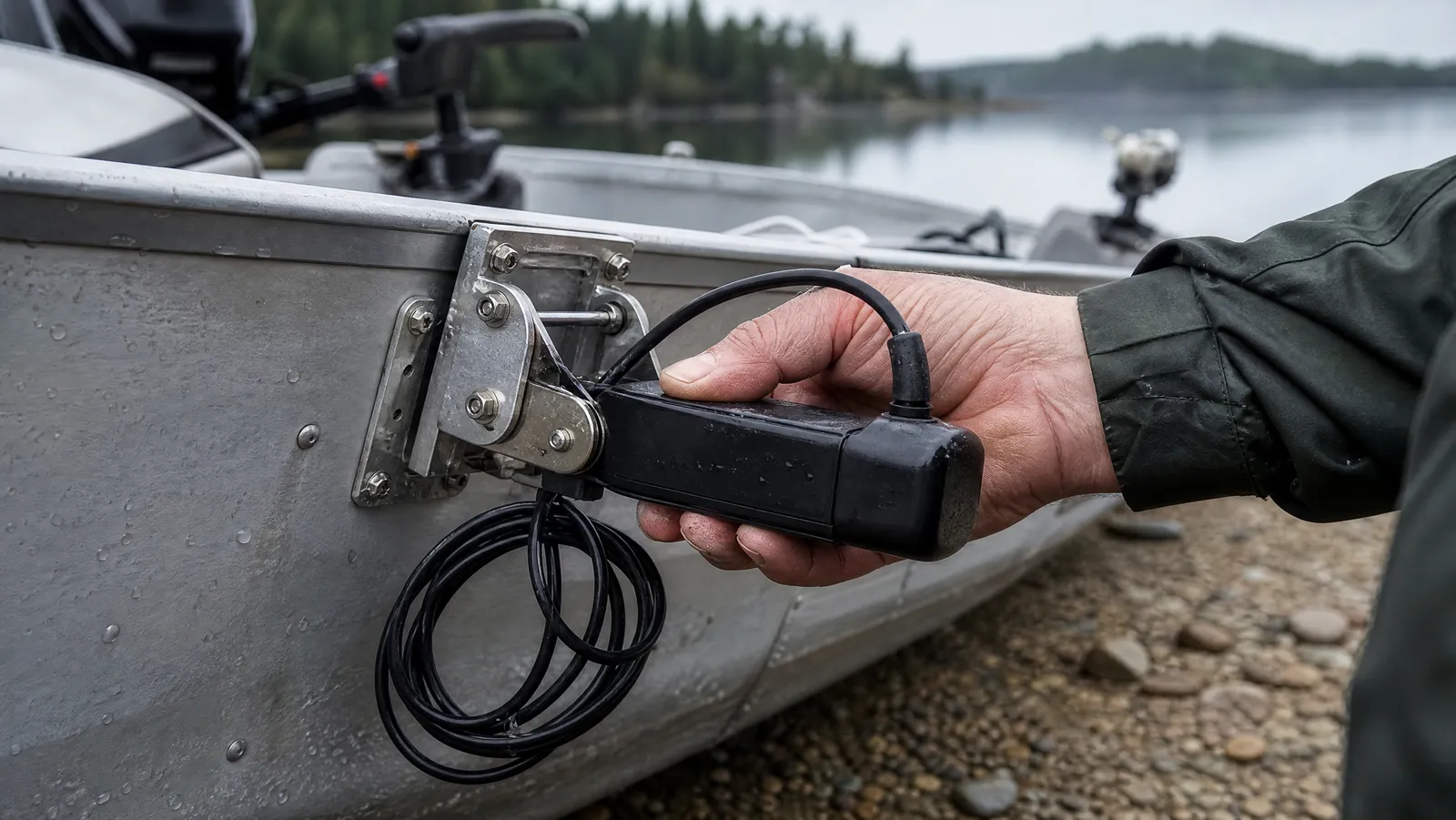

Garmin Dual Beam Transom/Trolling Motor Transducer
The standard 4-pin dual-beam replacement transducer for Garmin Striker and echoMAP units, mountable on a transom or a trolling motor.
- Covers both ends of the traditional sonar tradeoff in one housing, a 45-degree beam at 77 kHz and a 15-degree beam at 200 kHz
- Mounts on either a transom or a trolling motor, so one part covers two positions
- Handles transom angles anywhere from 0 to 70 degrees
- Traditional 2-D sonar only, with no down or side imaging
- Needs adapter cable 010-11614-00 to talk to 6-pin Garmin sounders
Fish Finder Transducers Explained: CHIRP, Frequencies, and Mounting
A fish finder transducer is the sensor that actually sends and receives the sonar pulse. The screen only draws what the transducer collects, which means the transducer — not the display — sets the ceiling on what you can see. A sharp head unit fed by the wrong sensor is an expensive depth gauge.
Angler Reviews is reader-supported. We may earn a commission on purchases made through links on this page, at no extra cost to you.
Garmin's transducer selection guide puts it plainly: "For optimum performance, it is very important to match the transducer to your device's sonar." Four things decide whether that match is any good — frequency, CHIRP, cone angle, and mounting. If you are still choosing a unit rather than a sensor, start at Angler Reviews' fish finder hub and come back here before you drill a single hole.
What a Transducer Actually Does
Inside the housing is a ceramic element that changes shape when you put voltage across it. The head unit sends a pulse, the element flexes, and that flex pushes a pressure wave into the water. Then it listens. When the wave bounces off bottom, a brush pile, or a fish's swim bladder, the returning pressure squeezes the ceramic and generates a tiny voltage the head unit can time and measure.
Everything on your screen is built from two numbers: how long the echo took, and how strong it was. Time becomes depth. Strength becomes color and thickness. The head unit cannot draw detail the transducer never resolved.
Most transom sensors also carry a temperature probe — the Lowrance SplitShot Skimmer and both Humminbird transducers here list one — which is where your surface temp reading comes from.
Transducer Frequencies: 200 kHz, 83 kHz, and the Low End
Frequency is the biggest lever on the sensor, and it controls a tradeoff you cannot escape: higher frequency buys detail, lower frequency buys depth and coverage.
Traditional freshwater sonar has settled on a small set of numbers. According to Garmin's transducer selection guide, dual-beam traditional sonar "transmits two frequencies, generally either 77/200 kHz or 50/200 kHz" combos. Humminbird's DualBeam PLUS pairing runs 200 kHz and 83 kHz. Either way — one high frequency for detail, one lower frequency for reach.
How the bands behave in practice:
- 200 kHz. The narrow, detailed beam. It separates targets that sit close together and draws crisp arches — the right default for most freshwater fishing inside 100 feet.
- 77 to 83 kHz. The wide beam. Less resolution, much more water inside the cone, and it holds bottom better as you go deeper. Your searching frequency.
- 50 kHz and below. Deep-water penetration for offshore work. Wide beam, coarse picture, but the energy travels.
The Garmin Dual Beam Transom/Trolling Motor Transducer in this guide is a clean illustration: 77 to 200 kHz, with a beam width of 45 to 15 degrees. One housing, two very different views of the same water.
CHIRP Transducer Explained: A Sweep Instead of a Single Note
CHIRP is not a frequency. It is a way of transmitting.
Garmin's guide spells out the acronym — Compressed High-Intensity Radiated Pulse — and describes the difference bluntly. Standard sonar "sends one single frequency at a time," so "there is limited information to work with, restricting the clarity and resolution." CHIRP instead "sends a continuous sweep of frequencies within a range from low to high" and then "interprets each frequency individually upon its return." Garmin's own example: an 80 to 160 kHz sweep hits every frequency in between.
Because the return carries far more information, the unit resolves targets that a single-frequency ping smears into one blob. Simrad describes the payoff as "substantially less noise and greater target separation," enough to pick out "individual baitfish within a school, or multiple closely-spaced game fish."
You can see the sweep on a spec sheet. The Humminbird XNT-9-HW-T runs Dual Spectrum CHIRP across 150 to 220 kHz, and Humminbird's specs break that into a narrow mode around 180 to 240 kHz and a wide mode around 140 to 200 kHz — coverage or detail, without changing hardware.
The catch is that CHIRP lives in the transducer, not the display. Garmin is explicit: "The transducer selection is key to CHIRP performance. CHIRP transducers have elements that are tuned to specific frequency ranges." Pair a CHIRP head unit with an old single-frequency ducer and you get serviceable traditional sonar and none of the CHIRP benefit you paid for.
Cone Angle: Why Depth Multiplies Your Coverage
Cone angle is the width of the beam leaving the transducer face, and it decides how much bottom you are actually looking at. Coverage scales with depth, which means in shallow water every beam is narrow.
The arithmetic is easy enough to do at the ramp. As Louisiana Sportsman lays it out, a 45-degree cone covers a circle equal to the depth, so at 21 feet you see a 21-foot circle. A 20-degree cone covers about a third of the depth, or roughly 7 feet at that same 21 feet. An 8-degree cone covers about a seventh, or 3 feet.
Run that against the Garmin dual-beam numbers above and the tradeoff gets concrete. At 20 feet down, the 45-degree low-frequency beam scans a circle about 20 feet across while the 15-degree beam scans closer to 5 feet. One finds fish. The other tells you what they are. And because area grows with the square of the width, the gap is bigger than it sounds. Humminbird's own DualBeam PLUS documentation states that the wide 60-degree 83 kHz beam expands "your coverage to an area equal to your depth," so "in 20 feet of water, the wider beam covers an area 20 feet wide" — roughly three times the diameter of the 20-degree 200 kHz beam, which works out to about nine times the bottom area.
Two consequences. In 6 feet of water, nobody sees much — even a 45-degree cone covers about a 6-foot circle, so shallow-flat anglers get more from a wide beam than a sharp one. And a mark at the edge of a wide cone is not under your boat, which is exactly why the narrow beam exists.
One caution when comparing brands: they do not measure the same way. Garmin publishes beam width at -3 dB, while Humminbird publishes those DualBeam PLUS figures at -10 dB, a more generous cutoff. The two spec sheets are further apart than the beams are.
Fish Finder Transducer Mount Types: Transom, Thru-Hull, and In-Hull
There are three main ways to get the sensor in contact with the water, plus the trolling motor, and each suits a different hull.
Transom mount. The bracket screws to the back of the boat and the transducer hangs just below the hull. Garmin lists the advantages as good for trailered boats, easy to install and remove "especially if a kick-up bracket is used," usable with any hull material, and good performance below 30 knots, which Garmin notes is about 34 mph. The limits are just as clear: Garmin says a transom mount "will not work on vessels with an inboard engine," is "not recommended for sailboats because of excessive heeling," and "will not work on stepped hull." For trailered aluminum and fiberglass boats, it is the right answer.
Thru-hull. A hole is drilled through the hull and the transducer sits in the water with nothing between it and the bottom. Garmin notes thru-hulls "work with any engine type: inboard, outboard, or I/O" and that "there are thru-hull transducers for every hull material." Two Garmin warnings: no plastic housings in a wooden boat, because wood swells as it absorbs water and may crack the housing, and no bronze housings in aluminum or stainless boats, because the interaction in salt water corrodes the hull, the housing, or both. External thru-hulls also need a fairing block to aim the beam vertically and are meant for larger untrailered vessels.
In-hull, also called shoot-through. The transducer is bonded inside the hull and fires through the laminate. No hole, no drag, trailerable without damaging the sensor, no marine growth. But the cons are the whole story: Garmin says in-hull is "not recommended for metal, wood, and cored fiberglass hulls" and that you "lose signal by transmitting through hull." Solid fiberglass only. Aluminum boat, or a foam or balsa core, and this option is off the table.
Trolling motor. The sensor clamps to the shaft or motor body. Garmin's argument is position: sonar "from the bow, right below where you are fishing, instead of further astern." The tradeoffs are that the image follows wherever the motor points, and that it hangs low enough to hit submerged objects.
The Two Installation Mistakes That Cause Most Complaints
Nearly every "my sonar quits above idle" story traces back to one of two things, and Humminbird's transom transducer installation guide addresses both directly.
Mistake one: wrong height. Humminbird specifies a minimum clearance between the bottom of the mounting bracket and the bottom of the transom of 1/4 inch (6 mm) for fiberglass boats and 1/8 inch (3 mm) for aluminum, and notes that riveted flat-bottom aluminum boats may need a slightly smaller gap to avoid excessive turbulence at speed. Once mounted, the seam on the leading edge should be "level and just slightly below the hull." Humminbird also notes a natural downward slant of 4 to 5 degrees, while Down Imaging transducers need no slant and should sit "parallel to the water and submerged."
The symptom of getting this wrong is specific: fine at idle, skipping or losing bottom as you speed up. The fix is to adjust height in small increments, and Humminbird warns that "it is often necessary to make several incremental transducer adjustments before optimum high speed performance is achieved."
Mistake two: wrong location. Humminbird states that "it is very important to locate the transducer in an area that is relatively free of turbulent water," and that turbulence lives "immediately aft of ribs, strakes, or rivets on the bottom of the boat, and in the immediate area of the propeller(s)." Its practical rules:
- On outboard or I/O boats, keep the transducer at least 15 inches (38.1 cm) to the side of the propeller.
- Clockwise props throw more turbulence to port, counterclockwise to starboard, so Humminbird says mount starboard for a clockwise prop and port for a counterclockwise one.
- On stepped hulls, do not mount behind a step, or the transducer pops out of the water at speed.
- Nothing — hull, motor, or another transducer — can sit in the line of sight of a Side Imaging transducer's side beams.
- Keep it clear of trailer bunks and rollers so loading does not knock it out of alignment.
Humminbird also notes that after time out of the water, small air bubbles can cling to the transducer face and interfere with operation, either dissipating on their own or wiping off with your fingers. If your first ten minutes look wrong, that may be all it is.
A crooked or aerated transducer does not fail cleanly — it produces noise, phantom returns, and broken bottom. That is harder to diagnose than a dead sensor, because it looks like sonar you cannot interpret rather than sonar that is broken. Our guide on how to read a fish finder tells you which one you are dealing with.
Matching a Transducer to Your Head Unit
Three checks, in order.
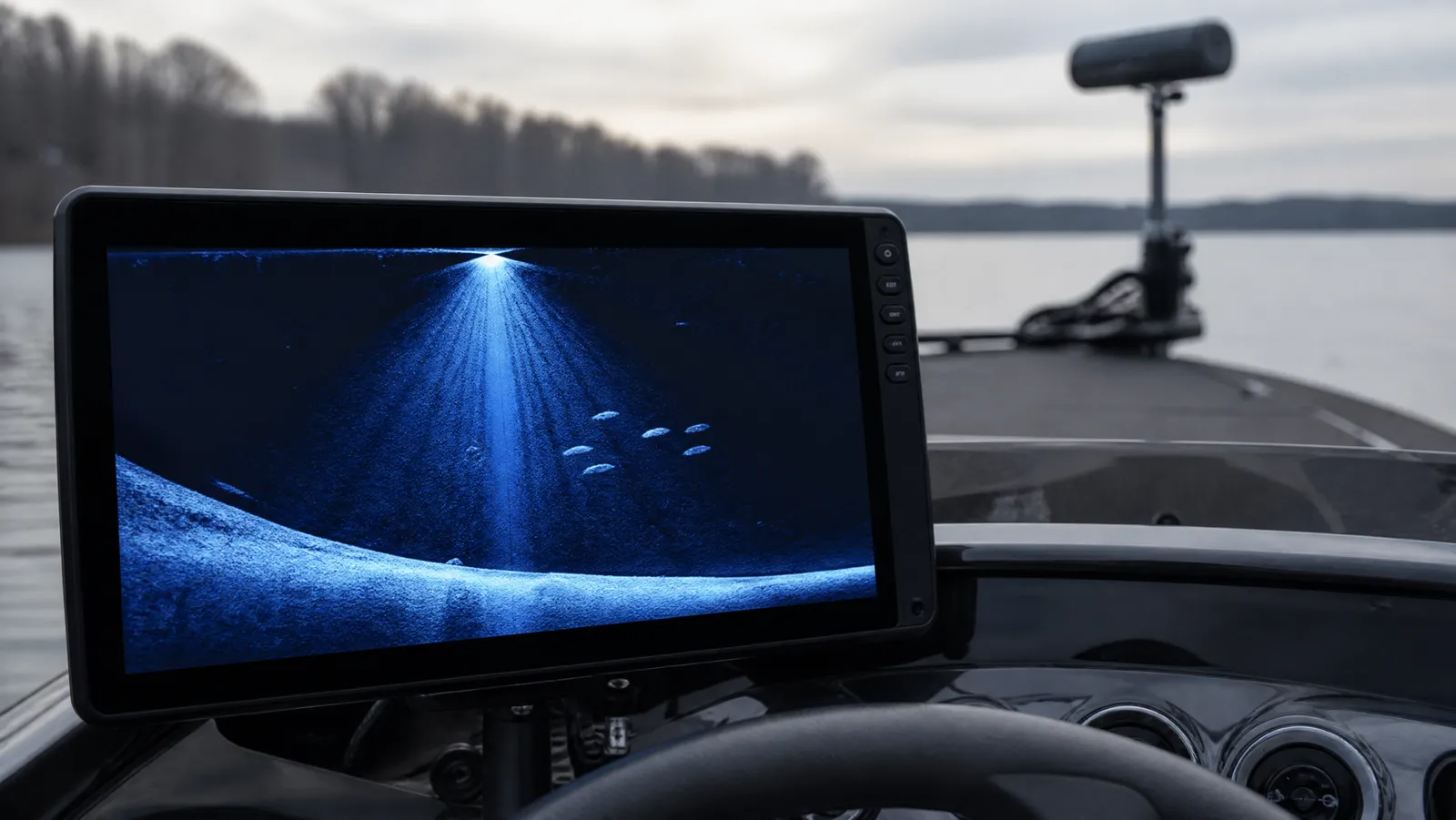
Check the views. Imaging is generated in the water, not in the display. A head unit with side and down imaging menus paired with a plain 2-D sensor gives you menus you cannot use. If you are not sure which imaging view you want, our breakdown of side imaging vs down imaging sorts that out first.
Check the connector. Pin counts are not universal even within a brand. Garmin's selection guide lists 4-pin and 8-pin transducers side by side, and the Garmin Dual Beam Transom/Trolling Motor Transducer requires adapter cable 010-11614-00 to work with 6-pin Garmin sounders.
Check for CHIRP on both ends. A CHIRP head unit with a single-frequency transducer gives you traditional performance. Not a defect, but not what the box promised.
Four examples of what that looks like at the checkout page:
- The Garmin Dual Beam Transom/Trolling Motor Transducer, about $90 as of August 2026, is the plain replacement for Garmin echo, echoMAP CHIRP 42dv-55dv, and Striker units — 77 to 200 kHz, a 45-to-15-degree beam, and a transom angle range of 0 to 70 degrees.
- The Lowrance SplitShot Skimmer, about $86 as of August 2026 and down from a $93 list price, fits HOOK² 5, 7, 9, and 12-inch models. One skimmer produces both DownScan and CHIRP 2-D, and it mounts on the transom, inside the hull, on a trolling motor, or through a scupper hole.
- The Humminbird XNT-9-HW-T, about $92 as of August 2026 and down from $129.99, is Dual Spectrum CHIRP 2-D only — rated to 1,200 feet, 20-foot cable, temperature sensor, GPS-equipped HELIX G2, G3, and G4 models. It will not add imaging.
- The Humminbird XNT-9-HW-MSI-150-T, about $189 as of August 2026 and down from $239.99, is the one that does: MEGA Side Imaging, MEGA Down Imaging, and Dual Spectrum CHIRP 2-D, with MEGA coverage out to 250 feet side-to-side and 75 feet deep, on HELIX 7 G3, G3N, and G4N units that support MEGA Side Imaging.
Those two Humminbirds mount the same way on the same boat and differ by about $97 as of August 2026 — a gap that is entirely the sensor. The bundled transducer is where budget fish finders quietly cut cost. The display and the housing look similar at every price; the sensor in the box is where the money went or did not. Our roundup of the best fish finder for the money breaks down which bundles include a transducer worth keeping.
Mounting Sonar on a Kayak Without Drilling the Deck
Paddle craft break most of the rules above. There is no real transom, drilling below the waterline in a plastic hull is a bad idea, and Garmin notes that even kayak in-hull mounts involve a "slight loss of signal by transmitting through hull."
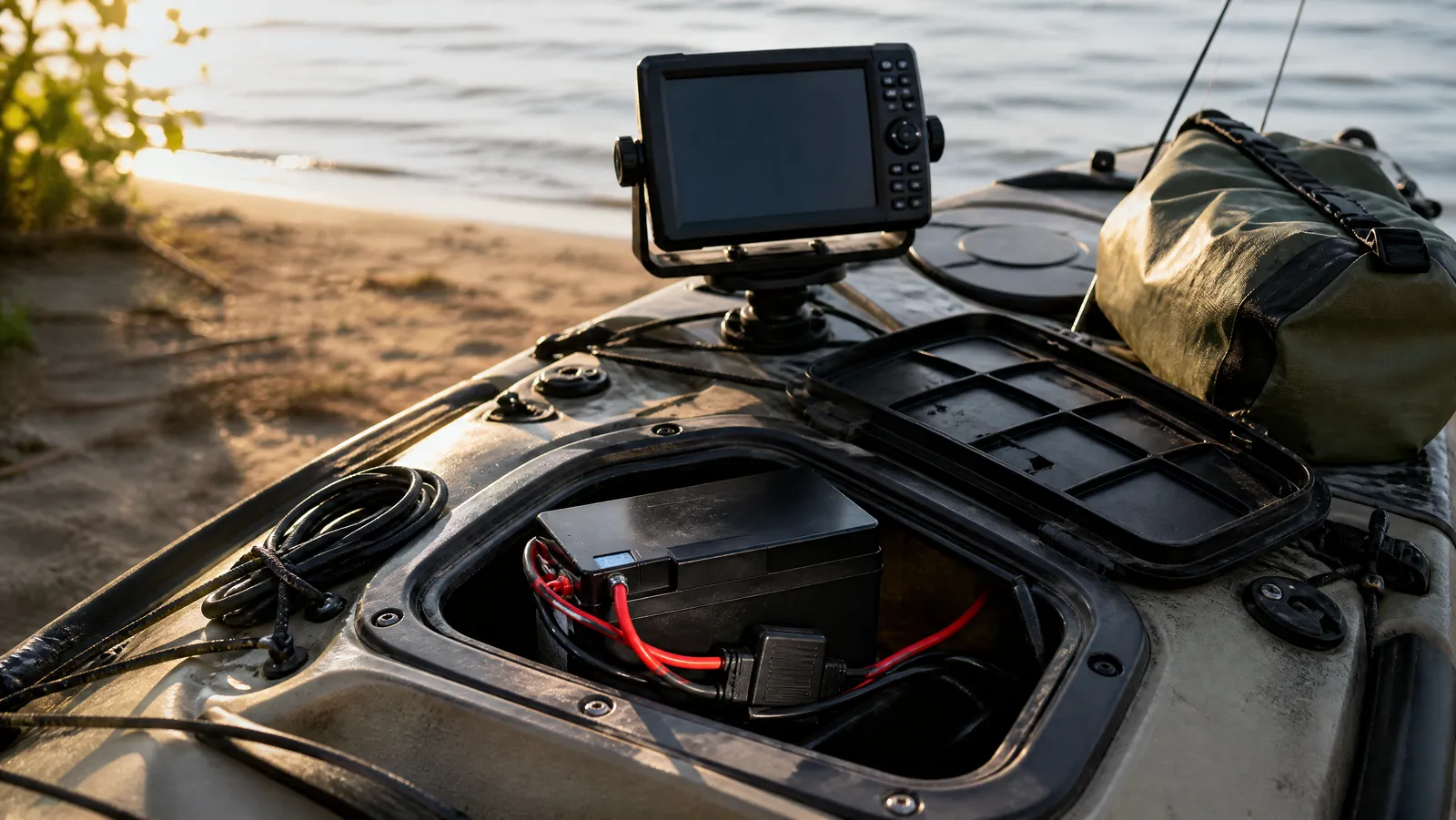
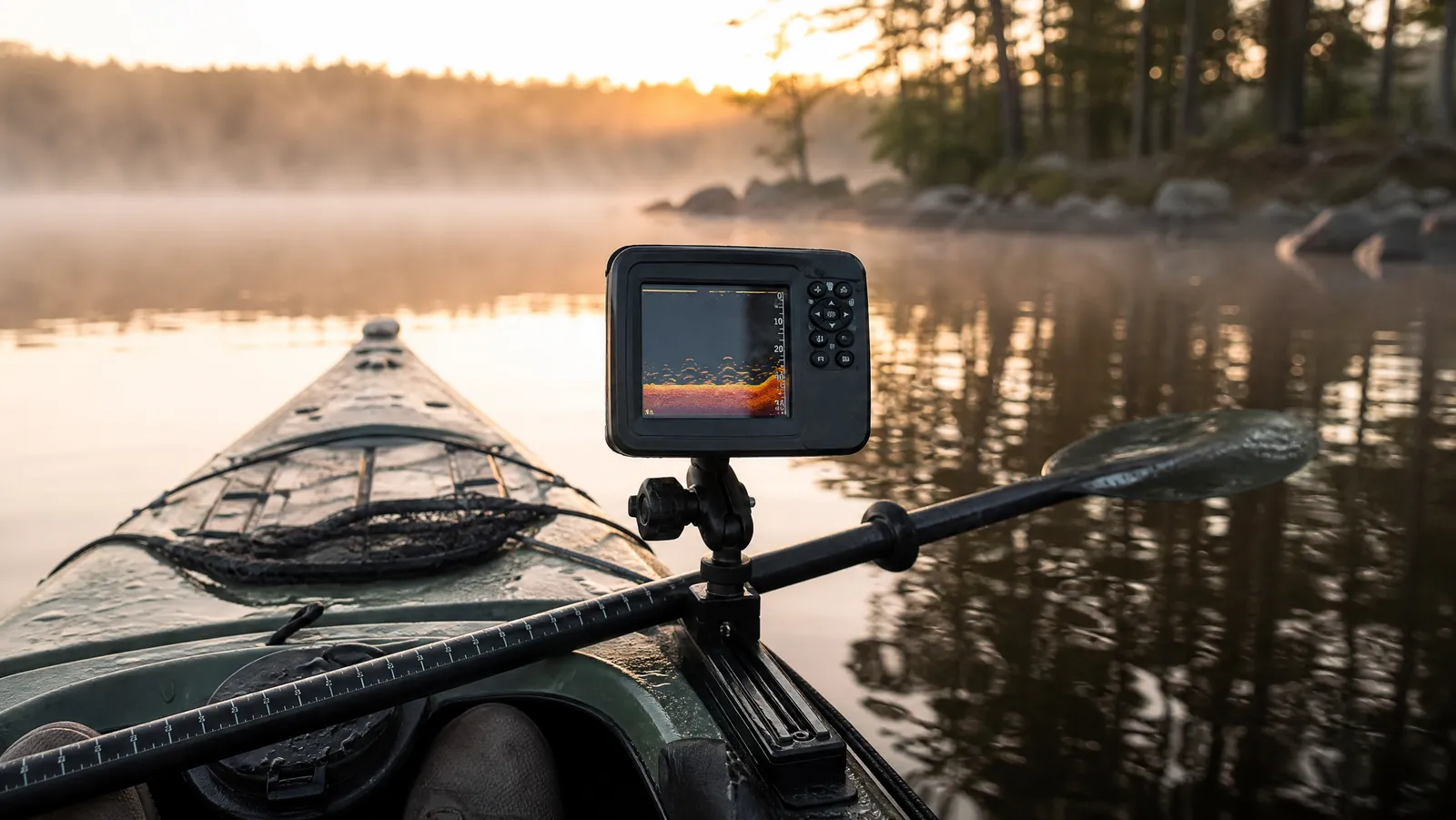
The practical answer is to hang the sensor beside the hull off the accessory track. The WINDFRD Track Mount with Transducer Arm is about $56 as of August 2026 and does exactly that: one track base carries the display and a transducer arm that extends from 11.42 to 17.91 inches, with a 1.5-inch double-socket ball and a 360-degree ratcheting slip disc so you can set the face level. It slides onto an existing track with a universal track ball and T-bolt, or drills down if your kayak has no track. Glass-reinforced nylon body, aluminum hardware, 316L stainless screws, and an adapter plate that fits Garmin Striker and ECHOMAP Plus, Lowrance Elite and HOOK, and Humminbird PiranhaMax units.
The Lowrance SplitShot Skimmer is the other kayak answer, since scupper-hole mounting is one of its four listed options. Either way the goal is the same: fully submerged, face level, cable clear of your paddle stroke.
When Replacing the Transducer Beats Replacing the Unit
Anglers replace whole fish finders far more often than they need to. Run this test first.
Replace the transducer if the screen still lights up and holds GPS, the head unit already supports the views you want, the cable or housing is damaged, or you bought a CHIRP-capable unit and never upgraded the sensor feeding it. A transom transducer at about $92 as of August 2026 that unlocks a menu you already own is one of the better values in marine electronics.
Replace the whole unit if the head unit cannot render the view you want at any price, the screen is too small or dim to read in sun, you want mapping it does not have, or the imaging transducer for your model costs a large fraction of a new combo. At $189 as of August 2026, the MEGA imaging transducer is worth it on a HELIX 7 you like and hard to justify on a unit you were already tired of.
Check compatibility before either. Both Humminbird transducers here are locked to specific HELIX generations, and the Garmin dual-beam needs an adapter cable for 6-pin sounders. Compatibility, not price, is what turns a transducer purchase into a return.
The Short Version
The transducer is the sonar. Everything else is a screen.
Get four things right and the rest follows. Pick the frequency band that matches your water — high for detail, low for depth and coverage. Make sure CHIRP is in the sensor, not just on the box. Remember that your cone covers only a fraction of the depth, so shallow water always looks narrow. And mount it level, slightly below the hull, well away from the prop and anything that makes bubbles.
Do that and a transducer at about $90 as of August 2026 can make an old unit look new. Get it wrong and no display on the market will save you. When you are ready to shop the display side, our guide on how to choose a fish finder picks up where this one leaves off.
The Picks, Tested
Garmin Dual Beam Transom/Trolling Motor Transducer
The standard 4-pin dual-beam replacement transducer for Garmin Striker and echoMAP units, mountable on a transom or a trolling motor.
- Covers both ends of the traditional sonar tradeoff in one housing, a 45-degree beam at 77 kHz and a 15-degree beam at 200 kHz
- Mounts on either a transom or a trolling motor, so one part covers two positions
- Handles transom angles anywhere from 0 to 70 degrees
- Traditional 2-D sonar only, with no down or side imaging
- Needs adapter cable 010-11614-00 to talk to 6-pin Garmin sounders
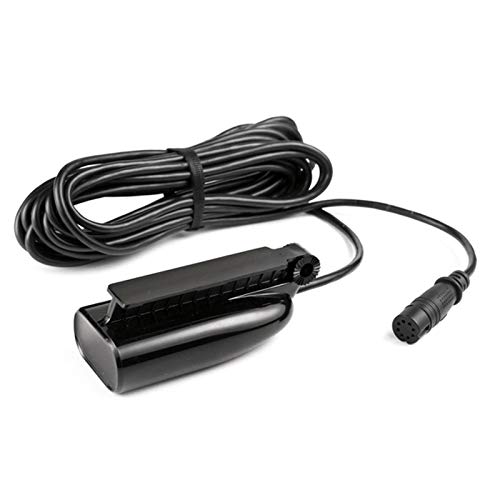
Lowrance SplitShot Skimmer
A single skimmer that produces both DownScan and CHIRP 2D views, with four mounting options including through a kayak scupper hole.
- One sensor and one cable produce both DownScan and CHIRP 2-D views
- Four mounting paths, including a kayak scupper hole, cover almost every hull a HOOK² ends up on
- Built-in temperature sensor comes along for free
- Built around the HOOK² line rather than sold as a universal replacement

Humminbird XNT-9-HW-T
Humminbird’s high-wide Dual Spectrum CHIRP transom transducer for HELIX units, covering the 2D sonar job only.
- Sweeps 150 to 220 kHz instead of firing one fixed frequency, which is what separates CHIRP from traditional sonar
- Rated to 1,200 feet, deeper than most freshwater anglers will ever fish
- 20-foot cable reaches a console dash on most tiller and small glass boats
- Will not add Side or Down Imaging to a HELIX, no matter what the head unit menu offers
- Restricted to GPS-equipped HELIX G2, G3, and G4 models

Humminbird XNT-9-HW-MSI-150-T
The MEGA Side and Down Imaging transom transducer for HELIX 7 units — what you buy when your head unit supports imaging and your transducer does not.
- Turns on three views from one transom sensor — MEGA Side Imaging, MEGA Down Imaging, and Dual Spectrum CHIRP 2-D
- 250 feet of side-to-side imaging coverage per pass
- Keeps the same 1,200-foot 2-D depth rating as the imaging-free transducer
- Roughly double the price of the 2-D-only XNT-9-HW-T at $189.06 as of August 2026
- Only fits HELIX 7 G3, G3N, and G4N units that already support MEGA Side Imaging

WINDFRD Track Mount with Transducer Arm
A track-mounted arm that holds the display and drops the transducer beside the hull, which is how you mount sonar on a kayak without drilling the deck.
- Puts the display and the transducer on one track base, so a sit-on-top gets sonar with no new holes in the deck
- Ratcheting slip disc lets you level the transducer face, which is the whole ballgame for a clean picture
- Adapter plate covers Garmin Striker and ECHOMAP Plus, Lowrance Elite and HOOK, and Humminbird PiranhaMax
- Needs an existing accessory track unless you are willing to drill the base down
- Arm hangs the transducer beside the hull, where it is exposed on shallow rocky launches
Compare The Field
| Compare | Best Garmin Replacement Garmin Dual Beam Transom/Trolling Motor Transducer | Best for Lowrance HOOK² Lowrance SplitShot Skimmer | Best Humminbird 2D CHIRP Humminbird XNT-9-HW-T |
|---|---|---|---|
| Overall | — | — | — |
| Price | $89.99 Check price → | $85.99 Check price → | $92.44 Check price → |
About The Author
Rob Thomas
Rob Thomas is a fisherman who loves catching tales from his fellow fishermen. He always enjoys a good story, especially when it comes from the sea.