Best Fish Finder for the Money: Real Sonar Without the Tournament Budget

This post may contain affiliate links. Read our policy.
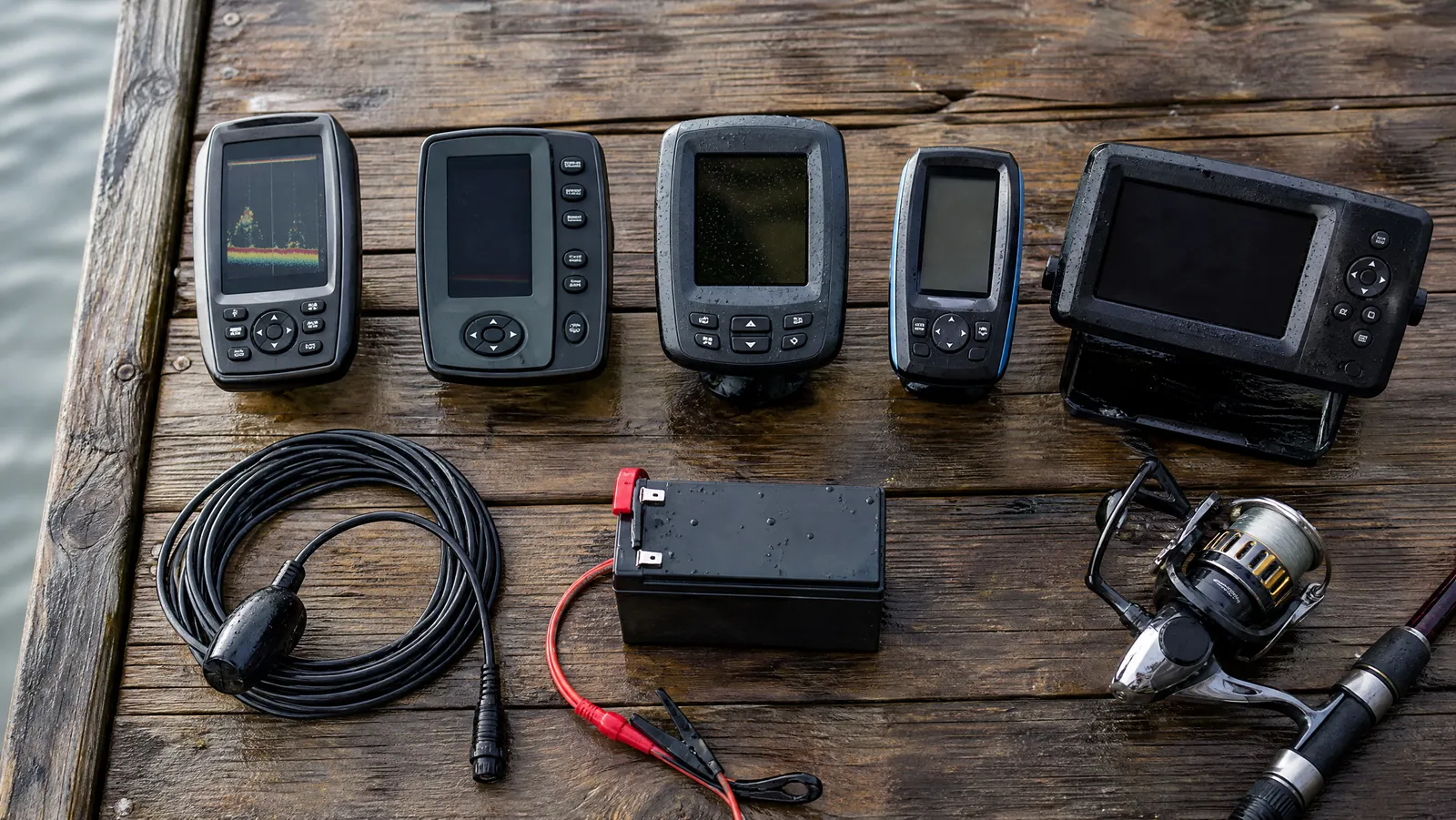

Garmin Striker 4
CHIRP sonar and GPS waypointing together at this price is the core reason the Striker 4 has stayed a default recommendation, and the built-in flasher makes it do double duty on the ice.
- Dual-beam CHIRP sonar and GPS waypointing at the lowest price in the Striker line
- Built-in flasher mode works for ice fishing and vertical jigging
- Waypoint map marks brush piles, stumps and docks; IPX7 water rating
- 3.5-inch screen is small for split-screen sonar views
- No preloaded lake maps, only Quickdraw Contours you record yourself
- Keyed buttons rather than a touchscreen
Best Fish Finder for the Money: Real Sonar Without the Tournament Budget
The best fish finder for the money is the Garmin Striker 4 at about $131 as of August 2026. It runs dual-beam CHIRP sonar, marks waypoints with built-in GPS, and reads to 1,600 feet in fresh water. Those three capabilities are what actually change how you fish, and they cost roughly a tenth of a live-sonar rig.
Angler Reviews is reader-supported. We may earn a commission on purchases made through links on this page, at no extra cost to you.
Below are six units between $73 and $420 that we would put on a boat, a kayak, or a bank rod today, plus what each one does that the others do not. If you want the wider framework first — frequencies, screen sizing, mapping, mounting — our complete fish finder buyer's guide covers it. This article is narrower. It answers the question most anglers actually have at the ramp, which is the point where more money stops buying more fish.
Why 2026 Made the Cheap Fish Finder Interesting Again
Something unusual happened at the top of the sport this season, and it argues for spending less rather than more.
Bassmaster reported that B.A.S.S. announced a live sonar rule change for the 2026 Elite Series: forward-facing sonar is permitted in only up to five of the nine regular-season events, with the qualifying events determined randomly, and prohibited entirely in the rest, including during official practice. The restrictions introduced for 2025 also carry over, limiting anglers to one live sonar transducer and a maximum of 55 total screen inches.
Major League Fishing went the same direction. Per MLF's own announcement of its 2026 forward-facing sonar rules, Bass Pro Tour anglers may use forward-facing or 360-degree sonar for only one continuous three-hour segment per competition day, declared in advance, enforced with electronic lock boxes that track how long they are unlocked and with onboard cameras. MLF extended restrictions across all of its circuits, from the Phoenix Bass Fishing League up to the Bass Pro Tour.
Here is why that matters to you. The best anglers in the country are being pushed back toward traditional 2D sonar and map reading for a substantial share of their competition hours — and traditional 2D sonar is exactly what a $131 unit does. Meanwhile, marine retailers list the Garmin LiveScope Plus LVS34 transducer on its own at $1,199.99, before you add a compatible head unit. The skill a restricted tournament field is busy re-learning is the same skill a budget CHIRP unit teaches.
How We Picked the Best Fish Finder Under 500 Dollars
We weighted four things, in this order.
- CHIRP, not a single frequency. Per Garmin, standard sonar sends one frequency at a time, while CHIRP — Compressed High-Intensity Radiated Pulse — sweeps a continuous range of frequencies in a single transmission. Garmin says that continuous sweep delivers "far greater target separation and more defined arches than you would with standard 77/200 kHz sonar." It is the biggest single jump in image quality available under $200.
- GPS and waypoints. Sonar tells you what is under the boat right now. A waypoint tells you how to come back to the brush pile in November. A unit without waypoint marking is a depth gauge with ambitions.
- Screen area you can actually read. Split-screen views are where budget units break down. A 3.5-inch display cut in half is two very small windows.
- A transducer in the box. Every pick here ships with one, which is not universal at this price and matters because a mismatched transducer undoes everything else.
One note on method: we do not run a sonar lab. These picks come from manufacturer specifications, published tournament rules, current pricing, and what anglers consistently report about each unit's real limits. Where we say something is a trade-off, we say why.
Garmin Striker 4: The Best Fish Finder for the Money
The Garmin Striker 4 is our pick at about $131 as of August 2026, down from a $159.99 list price, because it is the cheapest unit here that does all four jobs above.
Garmin rates it to 1,600 feet in fresh water and 750 feet in salt water, running traditional CHIRP sonar through a dual-beam 77/200 kHz transducer, with high-sensitivity GPS for waypoints. The display measures 1.9 x 2.9 inches, or 3.5 inches diagonal, and the unit is rated IPX7 for water resistance. Current draw is 0.23 amps at 12 volts, which is low enough that a small sealed lead-acid battery in a dry box will outlast a full day on the water.
The feature most people overlook is the built-in flasher mode, which shows returns in the classic circular format. That makes the Striker 4 a legitimate two-season purchase: a vertical jigging display in summer, an ice unit in winter, without buying a second box.
What you give up is real. The 3.5-inch screen is genuinely small once you split it between the sonar view and the waypoint map. There are no preloaded lake maps — you get Quickdraw Contours, which means you record your own bathymetry as you drive. And the interface is keyed buttons, not a touchscreen, which some anglers prefer with wet hands and some find slow.
Who we point here: anyone buying their first real fish finder, anyone rigging a jon boat or a rental, and anyone who wants one unit for open water and hard water. It is also the unit most often recommended for a small craft, though the best fish finder for kayak setups is a separate question we cover on its own, because mounting and power draw drive that decision more than sonar features do.
Garmin Striker Vivid 4cv: Best Screen Under 200 Dollars
The Garmin Striker Vivid 4cv costs $199.99 as of August 2026, roughly $69 more than the Striker 4, and the honest description of that $69 is legibility, not capability.
You get a 4-inch color display with Garmin's vivid scanning sonar color palettes, a GT20 transducer running both CHIRP traditional and CHIRP ClearVu, high-sensitivity GPS for waypoints, routes and boat speed, and built-in Quickdraw Contours mapping. The head unit weighs 11.2 ounces and ships with a tilt/swivel bailmount bracket.
The palettes are the point. The same returns that require a squint on a monochrome screen separate at a glance in color, which matters most when you are idling and trying to decide whether a mark is bait, a fish, or the top of a stump. There is still no side imaging at this tier, and half an inch of extra screen does not solve the split-screen problem.
Who we point here: the angler who knows they will run split-screen sonar most of the day and wants the returns to be readable without stopping the boat.
Garmin Striker Cast: Best Without a Boat
The Garmin Striker Cast is $129.99 as of August 2026, down from $149.99, and it solves a different problem than everything else on this list: it gives sonar to people who do not own a hull.
It is a castable sonar ball. You tie it to a spare rod, cast it, and reel it back while it streams to the free Striker Cast app on an Apple or Android device from up to 200 feet away. Garmin lists traditional 2-D and ice fishing flasher modes, 10-plus hours on the internal USB-rechargeable battery, and automatic power-on when it floats in water and power-off when you take it out. It can also download Quickdraw Community maps with contours as fine as 1 foot.
The compromises are structural. There is no screen, so a dead phone is a dead fish finder, and this version has no built-in GPS, although a separate GPS model exists. Casting and retrieving the sensor to scan a bank is also slower than idling over it with a hull-mounted transducer.
Who we point here: bank anglers, dock anglers, pond hoppers, and anyone who fishes water they cannot launch on. For a shore fisherman, this is the difference between guessing where the drop-off is and knowing.
Humminbird Helix 5 G3: Best Step-Up Unit
The Humminbird Helix 5 G3 is $306.00 as of August 2026 — more than twice a Striker 4 — and it is the first unit here that arrives already knowing what the water looks like, rather than making you record it yourself.
It runs Dual Spectrum CHIRP through a Low-Q transducer. Per Humminbird, Dual Spectrum gives you two ways to search: Wide Mode for maximum coverage and Narrow Mode for maximum detail. In practice that is a search setting and an inspection setting, which is a workflow the single-mode budget units cannot offer.
The mapping is the other half. It ships with Humminbird Basemap covering more than 10,000 lakes plus continental U.S. coastlines, and accepts LakeMaster, CoastMaster and Navionics charts. AutoChart Live then records your own depth contours, bottom hardness, and vegetation with eight hours of built-in recording time. Bottom hardness is the feature worth the money — being able to see where soft mud turns to gravel is how you find the transitions that hold fish on lakes with no visible structure.
Control is a softkey keypad rather than a touchscreen, and side imaging requires stepping up to a different Helix model.
Who we point here: the angler who has outgrown "is there a fish there" and wants to start building a picture of a lake they will fish for years.
DANOPLUS Portable Fish Finder: The Cheapest Fish Finder That Still Works
The DANOPLUS Portable Fish Finder is $72.99 as of August 2026, and it earns its spot by being the honest floor. Below this, you are buying a novelty.
It is a rechargeable castable sensor with its own 2.4-inch color LCD, so no phone is required, and it supports 21 operating languages. It detects to 147 feet (45 m) through a 90-degree sonar cone and displays a fish-size icon along with depth, water temperature, bottom contour and the water surface. The sensor and its lamp switch on automatically on contact with water, and a fish alarm sounds and displays when fish pass through the coverage area.
Be clear about what that is. The screen shows icons, not raw sonar returns. A 90-degree cone covers a lot of water, which is precisely why the unit can tell you a fish is somewhere in the cone but not where. There is no GPS and no waypoint marking, so nothing you learn gets saved.
What it does well is the unglamorous work: depth, temperature, and the shape of the bottom. If you are fishing an unfamiliar pond from the bank and want to know whether you are casting into 4 feet or 14, that is a real answer for under $75.
Who we point here: kids' boats, vacation rentals, ice-out scouting, and anyone who wants depth and temperature without a project.
Garmin Striker Vivid 7cv: Best Big Screen Under 500 Dollars
The Garmin Striker Vivid 7cv is $419.99 as of August 2026, the most expensive unit here, and the sonar package is the same as the 4cv: a GT20-TM transducer running Garmin CHIRP traditional and CHIRP ClearVu, high-sensitivity GPS, and built-in Quickdraw Contours.
What you are buying is a 7-inch screen. That sounds like a soft upgrade until you run split-screen CHIRP and ClearVu side by side, at which point each window is larger than the entire display on a Striker 4. In our view that changes how much information you can take in while the boat is moving, which is the only time it matters.
The 7cv also adds Wi-Fi and the ActiveCaptain app for transferring waypoints, receiving notifications, and pulling Quickdraw Community maps. There is still no side imaging, and a 7-inch head unit needs real console or bracket space, so measure before you order.
Who we point here: anglers who already know they read sonar in split-screen and are tired of squinting. Everyone else should put the difference into a better transducer mount or a second battery.
What You Give Up Under 150 Dollars
Every unit on this list is a set of deliberate omissions. The four that matter:
- No side imaging. None of the units on this list have it — the Striker Vivid "cv" models run ClearVu down imaging only, and Garmin reserves SideVu for the "sv" models such as the Vivid 7sv and 9sv. On the Helix line it likewise requires a different model. If you fish shallow flats or want to scan docks without idling over them, that is a real gap.
- No preloaded maps on the Striker line. Quickdraw Contours records your own, which is excellent over a season and useless on your first morning at a new lake.
- Small screens. Under $200 you are choosing between a full-screen view you can read and a split-screen view you cannot.
- Interpretation is on you. This is the big one. A budget CHIRP unit and a $2,000 unit both show arches, bottom hardness, and bait — the expensive one just draws them more clearly.
That last point deserves emphasis, because it is where most budget-fish-finder disappointment actually comes from. A cheap unit is only as good as your ability to read it, and the gap between an angler who understands what a hard bottom return looks like and one who does not is far wider than the gap between two price tiers. Our guide to how to read a fish finder walks through arches, bait balls, thermoclines and bottom composition, and it is worth an hour before you spend a dollar.
The Transducer Is Half the Purchase
Every pick here includes a transducer, which is why the mounting job is the part people get wrong. Sonar quality is a function of the water flowing past the sensor, not the price of the screen.
The common failure is cavitation — air bubbles from hull turbulence washing across the transducer face. Installation and troubleshooting guides consistently point to it as the reason depth readings drop out at speed, and the standard fix is positioning the face slightly below the cavitation plate and out of the prop wash. On a trolling motor, the sweet spot is generally just above the lower unit, in clean water but protected from bottom strikes.
The other decision is placement philosophy. A transom mount keeps you reading bottom the entire time you are moving, which suits trolling and searching. A trolling-motor mount puts the cone directly under where you are fishing, which suits vertical jigging and picking apart cover. Neither is wrong, and plenty of boats end up with both. We will cover fish finder transducers as their own topic, because frequency, cone angle, and hull material change the answer more than the head unit does.
Two minutes of care here is worth more than $200 of screen.
Which Budget Fish Finder Should You Buy?
If you want one answer: the Garmin Striker 4 at about $131 as of August 2026. Dual-beam CHIRP, GPS waypoints, a 1,600-foot freshwater rating, and a flasher mode for the ice, at a price where a mistake does not hurt. It is the best fish finder for the money because nothing else under $150 gives you all four.
From there, the branches are simple:
- No boat? Garmin Striker Cast, $129.99.
- Tightest budget, just need depth and temperature? DANOPLUS Portable Fish Finder, $72.99.
- Want the returns easier to read? Garmin Striker Vivid 4cv, $199.99.
- Ready to start mapping your lake? Humminbird Helix 5 G3, $306.00.
- Run split-screen all day? Garmin Striker Vivid 7cv, $419.99.
Both major tournament trails moved this season to limit how much of the work forward-facing sonar is allowed to do — MLF says it acted on positive feedback from fans and anglers about the restrictions it trialed in 2025. That is a useful signal for the rest of us. Buy the unit that shows you depth, structure, and bottom composition clearly, then spend your next hundred hours learning to read it. For the full breakdown of features, brands, and tiers above this price range, start with our guide to the best fish finders.
The Picks, Tested
Garmin Striker 4
A 3.5-inch keyed-interface CHIRP fishfinder with a dual-beam 77/200 kHz transducer and high-sensitivity GPS for marking waypoints.
- Dual-beam CHIRP sonar and GPS waypointing at the lowest price in the Striker line
- Built-in flasher mode works for ice fishing and vertical jigging
- Waypoint map marks brush piles, stumps and docks; IPX7 water rating
- 3.5-inch screen is small for split-screen sonar views
- No preloaded lake maps, only Quickdraw Contours you record yourself
- Keyed buttons rather than a touchscreen

Garmin Striker Vivid 4cv
A 4-inch color fishfinder with vivid scanning sonar color palettes, shipped with a GT20 transducer that runs Garmin CHIRP traditional sonar and CHIRP ClearVu scanning sonar. It includes high-sensitivity GPS for waypoints, routes and boat speed, built-in Quickdraw Contours mapping, and a tilt/swivel bailmount bracket.
- Vivid color palettes make fish and structure easier to separate at a glance
- GT20 transducer covers both traditional CHIRP and ClearVu
- Built-in Quickdraw Contours mapping and GPS waypoints
- 4-inch screen still limits split-screen detail
- No side imaging at this tier
- Transducer is the included GT20 rather than a higher-end option

Garmin Striker Cast
A castable sonar ball that pairs with the free Striker Cast app on Apple or Android devices and streams sonar wirelessly from up to 200 feet away. It offers traditional 2-D and ice fishing flasher sonar modes, works in both shallow and deep water, and runs 10+ hours on an internal USB-rechargeable battery.
- Streams sonar up to 200 feet away — works from bank, dock or kayak
- 10+ hours on the internal USB-rechargeable battery
- Auto power-on in water; 2-D and ice flasher modes included
- Requires a smartphone or tablet — there is no standalone screen
- This version has no built-in GPS (a separate GPS model exists)
- Casting the sensor repeatedly is slower than a hull-mounted transducer

Humminbird Helix 5 G3
A 5-inch chartplotter/fishfinder running Dual Spectrum CHIRP sonar with a Wide Mode for maximum coverage and a Narrow Mode for detailed scanning, using a Low-Q transducer for 2D target separation. It ships with Humminbird Basemap covering more than 10,000 lakes plus continental U.
- Dual Spectrum CHIRP offers both Wide and Narrow search modes
- Basemap covers 10,000+ lakes; accepts LakeMaster, CoastMaster and Navionics
- AutoChart Live maps contours and bottom hardness with 8 hours of recording
- Costs roughly twice a Striker 4
- Softkey keypad control rather than a touchscreen
- Side imaging requires stepping up to a different Helix model

DANOPLUS Portable Fish Finder
A rechargeable castable fish finder with a 2.4-inch color LCD screen supporting 21 operating languages.
- Cheapest unit here that still shows depth, temperature and bottom contour
- 147-foot detection with a 90-degree cone; 21 languages
- Self-contained screen — no phone required
- 2.4-inch screen shows icons rather than true sonar returns
- No GPS and no waypoint marking
- Fish-icon interpretation is far less informative than raw arches

Garmin Striker Vivid 7cv
A 7-inch color fishfinder with vivid scanning sonar color palettes and a GT20-TM transducer running Garmin CHIRP traditional sonar and CHIRP ClearVu scanning sonar. It adds high-sensitivity GPS for waypoints, routes and boat speed, built-in Quickdraw Contours mapping, and Wi-Fi connectivity to the ActiveCaptain app for transferring waypoints, receiving notifications and accessing the Quickdraw Community.
- 7-inch screen makes split-screen CHIRP and ClearVu genuinely readable
- Wi-Fi and ActiveCaptain app for waypoint transfer and Quickdraw Community
- Same GT20 transducer sonar package as the smaller Vivid units
- The most expensive unit here by a wide margin
- Still no side imaging
- 7-inch head unit needs real console or bracket space
Compare The Field
| Compare | Our Pick Garmin Striker 4 | Best Screen Under $200 Garmin Striker Vivid 4cv | Best Without a Boat Garmin Striker Cast |
|---|---|---|---|
| Overall | — | — | — |
| Price | $130.99 Check price → | $199.99 Check price → | $129.99 Check price → |
About The Author
Rob Thomas
Rob Thomas is a fisherman who loves catching tales from his fellow fishermen. He always enjoys a good story, especially when it comes from the sea.