How to Set Spinning Reel Drag (and Why Most Anglers Set It Too Tight)

This post may contain affiliate links. Read our policy.
How to Set Spinning Reel Drag (and Why Most Anglers Set It Too Tight)
Set the drag to start slipping at roughly a quarter to a third of your line's rated breaking strength. On 10 lb line that is about 2.5 to 3.3 lb of pull. FishTalk Magazine puts the window at one quarter to one third of rated strength; Fish and Game Magazine sets the mark at one third. Both are lighter than many anglers run.
Rather not do fractions on a wet dock? Our drag setting calculator takes your pound test and hands you the target figure.
That number is a starting point, not a law. Below is how to set spinning reel drag with a scale, how to do it by feel, and how the answer shifts between braid, mono and fluorocarbon. None of it needs an expensive reel, though a smoother stack makes a setting easier to hold — our spinning reel buying guide covers what that money buys.
The one-third rule, and what it assumes
The fraction exists to leave you a margin. One third of 15 lb test is about 5 lb of pull, and that is the figure you dial in on the scale. The margin is there because nicks, frays, general line wear and knots all cut the line's real strength below the number on the box, so the drag has to give way before the weakest link does — Field and Stream's knot testing, further down, puts numbers on how much a connection gives away.
That is the whole logic. Your drag is not set against the line's rating. It is set against whatever your line has actually become.
Three things sit inside that assumption:
- Pound test is a label, not a measurement. If you are unsure what your spool really holds, start with our fishing line weight chart — the one-third rule is a fraction of that figure.
- The rod is part of the drag system. A moderate action bleeds off surges that a stiff, fast rod sends straight to the knot.
- Pressure climbs as the spool empties. This is Fish and Game Magazine's main argument for scale-setting to a third: as line runs off, the spool diameter shrinks, so it takes more force to turn and the effective drag climbs through a long run.
Why most anglers set the drag too tight
A spinning reel's drag is a stack of washers squeezed together under spring tension. Before the stack can slip, it has to break free from a standstill, and breaking free takes more force than staying in motion. Reel people call that start-up inertia, or breakaway drag. Sport Fishing Magazine, writing on how makers chase higher maximum drag figures, frames the engineering problem as raising the ceiling without sacrificing smoothness or increasing breakaway drag.
So the first instant of a run loads your line harder than your steady-state setting suggests. Set the drag at 8 lb, and if the stack needs an extra shove to move, the hookset and the first surge see more than 8 lb. Everything after that sees 8 lb.
Makers treat this as a real problem. Daiwa states that its ATD drag system uses a grease with low viscosity at rest that becomes more viscous immediately after start-up, which Daiwa says reduces initial drag start-up inertia for a smoother drag from the hookup. That is a manufacturer claim rather than an independent measurement, but it tells you the industry sees start-up as the weak moment.
A tight drag also feels confident on the dock — it barely gives, and you feel ready for something big. On the water that same setting pulls hooks from soft mouths and snaps leaders on the strike. A drag's job is not to stop a fish. It is to keep the line short of its breaking point while the rod and the fish wear each other out.
How to set spinning reel drag with a scale
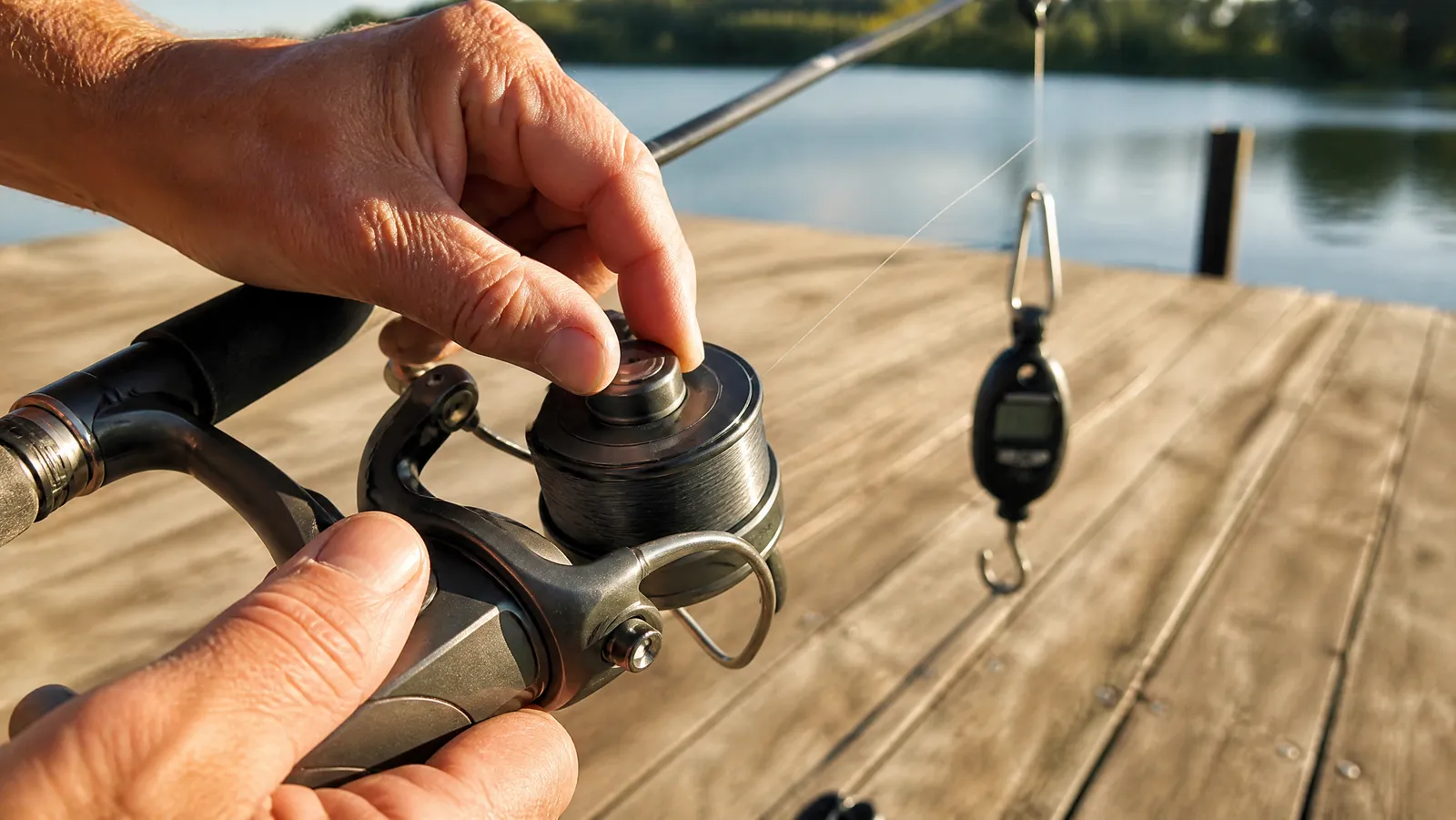
A small digital fish scale or a hanging spring scale is the only honest method.
- Rig the rod exactly as you will fish it, line through every guide, with the knot you actually tie.
- Attach the line to the scale — loop it over the hook, or tie it to a short length of heavy cord.
- Anchor the scale, or have someone hold it. FishTalk Magazine's method is to back off 10 or 12 feet and faux-fight a fish.
- Lift the rod to a real fighting angle. Around 45 degrees, rod loaded, hands where they would be on a fish.
- Pull smoothly until the spool starts to give, and read the force at that moment — not while line is already running.
- Adjust a little, re-measure, repeat until you are inside the window.
Step 4 is the one that matters. Measuring straight off the reel with the rod pointed at the scale reads a different number than measuring through a loaded rod, because a bent rod changes the angle the line leaves the tip and adds resistance of its own. Measure the easy way and you walk off believing the drag is set when it is not. FishTalk is explicit: hold the rod in a fish-fighting position and pull from a distance, with a scale rather than with your hand.
Setting it by feel when you have no scale
Most of us do not carry a scale to the bank. The by-feel version is the same motion without the number: rig up, load the rod to a fighting angle, and pull line off the spool with your free hand gripping the line a foot above the reel.
What you want is firm but giving — steady pressure that makes the spool surrender line in a continuous slip, with no point at which it feels locked.
- The line should move before your hand hurts. If you have to wrap line around your fingers or set your heels, it is too tight.
- It should not peel under light load. If a hard hookset would bury the hook in nothing but slipping line, it is too loose.
- It should slip, not stutter. A stack that grabs and releases in steps is too dry, too tight, or due for service.
Listen to the drag
Most spinning reels click or buzz as the drag slips. Treat that noise as instrumentation.
In a fight it tells you whether the fish is taking line, how fast, and whether the drag is slipping smoothly or in bursts. A continuous buzz means the stack is working. Ragged on-off chatter usually means the setting is sitting right at the edge of breaking free each time, which is the condition that spikes tension on the line.
Front drag vs rear drag
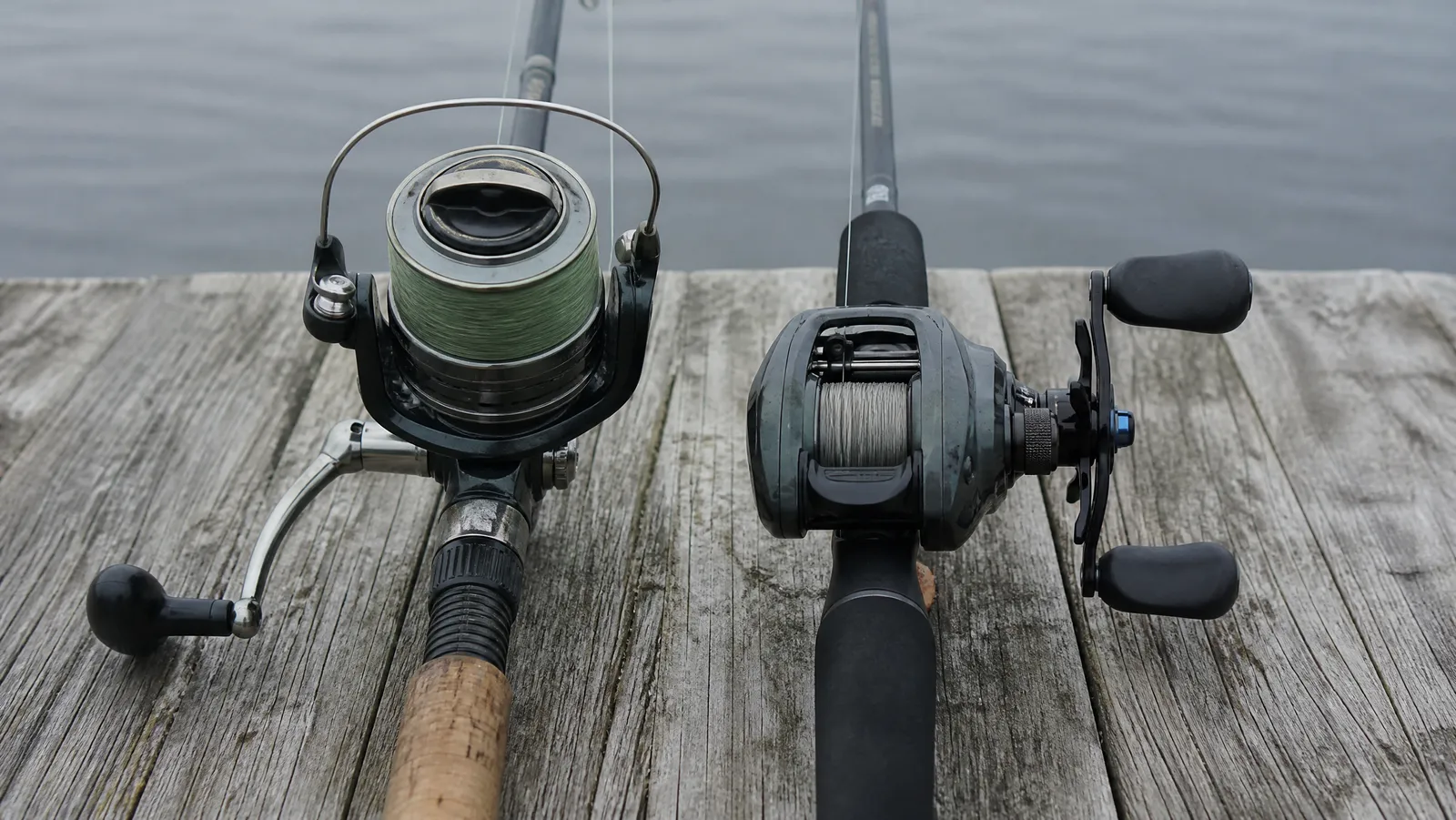
The adjustment logic is identical either way, and the quarter-to-a-third fraction does not change. What differs is where the washers live and how big they are.
Front drag
The knob sits on top of the spool and the washer stack sits inside the spool, pressing directly on it. Because the spool is the widest part of the reel, that stack can run large-diameter washers.
Surface area is why that matters. Sport Fishing Magazine states that increased drag-washer surface area is the easiest way to achieve higher maximum drag, through either more surfaces or bigger ones, which is why the larger reels in a family carry the larger drag numbers. Bigger washers also spread the same load over more material and shed heat better, which tends to mean more consistent pressure over a long run.
Rear drag
The knob sits at the back of the body and drives the drag through the shaft. The stack is usually smaller, because it fits inside the body rather than inside the spool.
Rear drags survive for two honest reasons: they are cheap to build, which is why they turn up on budget reels, and the knob is easy to reach with the hand already on the rod, which suits ultralight fishing and constant small adjustments on 4 lb line. For light-line work, where you may never ask for 3 lb of pressure, the smaller stack is rarely the limiting factor.
At the bottom of the market the drag is usually where the savings came from — our guide to the best spinning reel under 100 is candid about what those stacks deliver.
Adjusting drag mid-fight
Two rules: small changes, and bias toward backing off rather than tightening.
Tightening on a running fish is how leaders break. You are adding pressure to a system already at its working load, on a spool that is getting smaller, with a fish that might turn and surge in the next second. There is no margin left to spend.
Backing off is the move that saves fish. Three moments where we do it almost automatically: when a fish is close and the shock-absorbing length of line is nearly gone, when it makes a sudden short-range run the rod cannot soak up, and when it thrashes on the surface where a tight line pulls hooks.
Drag by line type
Line is the other half of the shock-absorption system, so the same reel wants a different setting depending on what is on the spool. The full picture is in our best fishing line guide.
Braid
Braid has very little stretch, so the drag and the rod absorb shock the line will not. Fish and Game Magazine's stretch testing found monofilament stretched roughly three times as much as braid.
Two adjustments follow: run the drag at the lighter end of the window, and add a mono or fluorocarbon leader so the last few feet can give. Our fishing line leader guide covers lengths and connections.
Monofilament
Mono stretches and forgives. Fish and Game's testing had monofilament reaching about 16 percent elongation before snapping over a 50 foot length, though it notes the drag normally gives way long before stretch approaches the figures people quote. That buffer lets you sit at the upper end of the window without punishing the knot.
Fluorocarbon
Fluoro sits between the two: less stretch than mono, more than braid, and more abrasion-resistant, which is why it earns its place as a leader. It is less forgiving of sudden shock than mono, so if you fish straight fluoro as a main line, treat your setting as closer to a braid setting than a mono one.
Knot strength is the real ceiling
No drag setting protects a bad connection. Field and Stream's knot-strength testing is the clearest illustration we have seen: it rated the Berkley braid knot tying braid to a lure at 62 percent of line strength, while a Palomar joining braid to a mono leader held 96 percent and a Trilene knot on mono to a lure also held 96 percent.
Sit with 62 percent. On 30 lb braid, that is an 18 lb connection. A third of 30 lb is 10 lb, still under 18 — but the margin you thought you had is mostly gone, and start-up inertia eats into what is left. Tie well first, then set the drag against the real strength of the weakest link. Our guide to the best fishing line knots ranks them by tested strength.
Where reel size meets drag capacity
Maximum drag is a specification, not a setting. A reel rated at 20 lb maximum drag is not a reel you fish at 20 lb; it is a reel whose stack is barely working at 5 or 6, and that headroom is the real benefit of the bigger sizes. Sport Fishing Magazine makes the point from the other side, noting that most anglers never need to go above 25 to 30 lb of drag at all.
How size and capacity line up is covered in spinning reel sizes explained. For bass on finesse gear, where smoothness matters far more than maximum, our best spinning reel for bass picks are built around exactly that.
Maintenance that keeps the setting honest
A setting is only as repeatable as the stack underneath it.
- Back the drag off for storage. BoatUS Magazine's rod-and-reel care guidance is to back the drag off almost completely after use, which it says prevents the plates compressing over time and becoming less effective. Washers left squeezed for months can take a set, and a stack that has taken a set does not slip evenly.
- Tighten it down before you rinse. The same guidance recommends snugging the drag fully before rinsing so water cannot push between the plates, then rinsing gently with a mist or slow hose rather than a nozzle.
- Follow the maker on grease. Penn's reel grease is listed for main gears, pinion gears, spool shafts and compatible drag systems, with the instruction to follow your own reel maker's lubrication guidance before greasing a drag. Florida Sportsman's reel-service guidance is blunter: carbon fiber washers need no grease, while Teflon and felt washers do benefit from a light coating. Check your manual rather than greasing on principle.
- Rinse salt every time. Salt crystallises between washers and turns smooth slip into stutter.
The mistakes that undo a good setting
- Cranking the drag down to stop a fish. A drag is a pressure regulator, not a brake.
- Trusting the numbers on the knob. Those marks are reference points for your own adjustments, not calibrated units of force. Nothing guarantees 4 on your reel is 4 lb.
- Forgetting last trip. You backed it off for storage, or tightened it to free a snag, and never reset it. Check the drag before the first cast the way you check your knot.
- Confusing the rear knob with the drag. On some reels the knob at the back is a secondary control rather than the drag, and on a front-drag reel the drag is the knob on the spool.
- Reeling against a slipping drag. If the spool turns backwards while you crank forwards, the line is not coming in, it is being twisted. Pump the rod and reel on the drop instead. Twist has its own consequences, which we cover in how to spool a spinning reel.
The short version
Set the drag to a quarter to a third of your line's rated breaking strength. Measure it with a scale, through a loaded rod, at a real fighting angle, and read the force at which the spool first starts to give. Go lighter with braid, a touch heavier with mono, and remember that start-up inertia means the first instant of a run always sees more than your setting. Then mostly leave it alone — small changes during a fight, and back off far more often than you tighten.
If your drag grabs and stutters no matter what you do, that is a reel problem rather than a technique problem, and our best spinning reels guide is where to start.
About The Author
Rob Thomas
Rob Thomas is a fisherman who loves catching tales from his fellow fishermen. He always enjoys a good story, especially when it comes from the sea.