Best Spinning Reels Under $100: Where the Money Actually Goes

This post may contain affiliate links. Read our policy.

Piscifun NautiX, 3000 Size
The NautiX spends its budget on metal where metal matters.
- Aluminum body resists the frame flex that pulls a gear mesh out of line
- Machined gears and a brass pinion instead of cast zinc alloy
- 26 lb of claimed drag is far past anything freshwater will ask of it
- A metal body weighs more than graphite in the same size
- IPX5 is jet resistance, not immersion, so it still wants a rinse
Best Spinning Reels Under $100: Where the Money Actually Goes
The best spinning reel under $100 for most freshwater anglers is the Piscifun NautiX in the 3000 size, about $85.99 as of September 2026, because it spends the budget on a full aluminum body and machined aluminum gears rather than on a bearing count. If that is more reel than a second rod deserves, the KastKing Spartacus II 3000 at about $39.09 as of September 2026 does the same fishing.
Angler Reviews is reader-supported. We may earn a commission on purchases made through links on this page, at no extra cost to you.
Under $100 you are not picking between good reels and bad reels. You are picking which corner gets cut, because every reel here cuts one. Field & Stream said it flatly in its own sub-$100 testing: "every reel in this roundup sacrifices some durability or weight to hit the sub-$100 ceiling." The question is which compromise you can live with. For the whole category without a price ceiling, start with our guide to the best spinning reels, then come back here for the budget end.
What $100 buys in 2026
A spinning reel is five cost centres: body and rotor, gear train, drag stack, bearings, and whatever sealing keeps water away from the other four. At this price a factory funds about three of them properly.
Where the money usually gets saved, roughly in order:
- Sealing. Real gasketing costs tooling and assembly minutes, so most reels in this class have none worth the name.
- Gear material. Zinc alloy main gears are cheap to cast. Brass and machined aluminum are not.
- Drag washers. Outdoor Life's tester notes that "felt is the most common material used for drag in spinning reels of this class," and that a carbon drag "can add to the price of the reel considerably."
- Body stiffness. Graphite, which Field & Stream's reviewer calls "a.k.a. plastic," is cheaper and lighter than aluminum, but the same review warns it "can flex slightly under heavy strain."
Where money almost never gets saved is bearing count, because it is the one number on the box a shopper can compare across brands.
The drag stack is where we would spend first
A front drag is a short stack of washers, some keyed to the spool and some to the shaft, squeezed together by the knob on top. When a fish pulls hard enough the stack slips against itself, converting line pull into heat. That last word is the whole argument.
Felt glazes and fades as it heats. Carbon fiber does not, or nowhere near as fast. Field & Stream sorts the materials exactly that way, putting "ceramic discs, or carbon fiber plates" in the camp that "offer a lifetime of service and resist the heat created from the friction," with oiled felt pads on the other side. Cadence Fishing gets there from the maintenance angle: a carbon fiber drag "is infinitely adjustable, very easy to maintain, will not slip and rarely gets flat spots."
Every reel below is specified by its maker with carbon fiber drag washers. That is the one thing we would not compromise on, and in 2026 you no longer have to.
Maximum drag figures, though, are close to meaningless in fresh water. Salt Water Sportsman's rule of thumb is to set drag at 20 percent of breaking strength for mono up to 20-pound test and 15 percent for braid up to 20-pound test, which puts 10 lb braid nearer 1.5 lb than 10; our drag setting calculator does that arithmetic for whatever you have spooled. A claimed 22 lb maximum does not mean you will ever use 22 lb, it means the stack is loafing at your working setting.
Bearing count is the number to ignore
Ten bearings on a $40 reel are not ten bearings on a $400 reel. Sport Fishing magazine's piece on reel bearings is blunt: "reels with lots of bearings aren't necessarily better," and a "$30 reel that has 15 low-quality bearings might not work as well as a $500 reel with only six bearings." Penn brand manager Ben Joyce, quoted in the same article, puts a timeline on the disappointment: "You pick up a 15-bearing reel, it'll feel pretty good. But after you catch a few fish, it'll feel like a coffee grinder."
Placement beats quantity. Joyce names the four positions that matter in a spinning reel: "Two support the main gear and two support the pinion gear, basically one on each end of the gears." His summary: "if you have precise tolerances, you don't need a lot of bearings; you just need high-quality bearings in the right places."
Material is the other half. Sport Fishing notes that cheap reels tend to use chrome-steel balls, harder than stainless but "much more susceptible to corrosion." That is why "double shielded stainless steel" in a spec list is worth more than the digit in front of it. Even KastKing's own buying guide calls five bearings "pretty much the starting point for a good spinning reel" and warns that padding the count with bushings is "substituting quantity for quality."
Sealing: what IPX5 and IPX6 actually promise
Two picks here carry an IPX number, and it is worth knowing what was measured. Those ratings come from IEC 60529, the international ingress-protection standard. According to a test-lab guide to it, IPX5 means the enclosure survived a 6.3 mm nozzle throwing 12.5 litres a minute from 2.5 to 3 metres away, and IPX6 raises the same test to a 12.5 mm nozzle at 100 litres a minute, both for at least three minutes.
Neither covers immersion. The same guide is explicit that submersion resistance "requires an IPX7 or IPX8 rating." So an IPX6 reel shrugs off rain, spray and a dock wash-down. Drop it off the jetty and you own a wet reel.
For a bass-lake angler the spec barely registers. In salt it is the spec worth paying for, and it still does not excuse skipping the rinse below.
Body and gears: aluminium, graphite and the flex question
Cadence Fishing sums the trade-off up in one line: "Aluminum frames are stronger and more durable than graphite, but graphite is lighter and more resistant to corrosion." Both halves matter under $100.
Here is why body stiffness is more than a bragging point. The main gear and the pinion have to stay meshed at a fixed angle. When a graphite body deflects under a hard pull, that angle changes, the teeth load on their edges instead of their faces, and the reel both feels rough under load and wears faster. Field & Stream's note that graphite "can flex slightly under heavy strain" is the polite version.
Gear material follows the same logic. Outdoor Life's tester flags that "brass gears and composite bodies aren't necessarily bad, but they are things to look out for if you plan on using the reel for larger gamefish or in harsher conditions," and rates "machined aluminum and stainless steel" as marks of a better build. Under $100 the ladder runs cast zinc alloy at the bottom, brass in the middle, machined aluminum at the top. That ladder is most of why our overall pick costs three times our cheapest pick.
What size reel to buy under $100
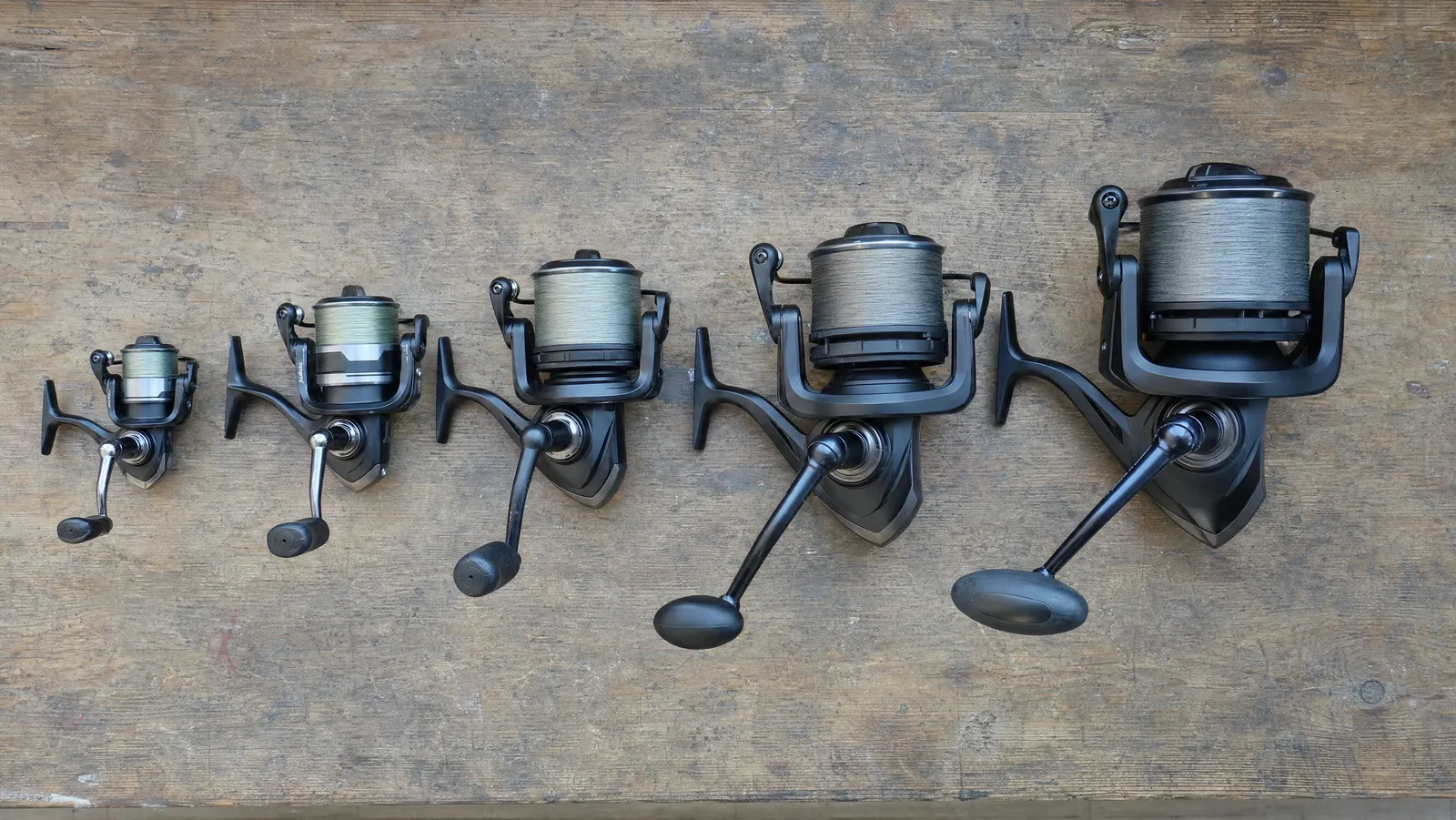
For most of what happens in fresh water, a 2500 or a 3000 is the answer. It holds enough 10 lb braid to fish all day, balances the sort of 7-foot medium rod we cover in fishing rods explained, and is the size most makers build the most of. Step down to a 1000 for trout and panfish, up to a 4000 for bigger baits or salt. The size-by-size breakdown, including what each one actually holds, is in spinning reel sizes explained.
Two notes once you have a size. Match line to the spool rather than to the fish story: our fishing line weight chart sets pound test against diameter, which is what decides whether 200 yards fits.
Then fill it properly. Our line capacity calculator will tell you how much of a given line a given spool takes before you start cutting. Tackle Village's target is a gap of about an eighth of an inch between the packed line and the spool lip, and it warns that underfilling means "you lose energy in the cast." Every coil has to climb a taller lip to leave the spool, and on a light lure you feel that first.
Best spinning reel under $100 overall: Piscifun NautiX 3000
The Piscifun NautiX is our overall pick at about $85.99 as of September 2026 because it buys metal in the two places metal pays off. Piscifun lists a full aluminum main body with a carbon rotor, and CNC-machined aluminum main gears running against an HRB 90 brass pinion.
Read that against the ladder above: machined aluminum gears and a brass pinion inside a stiff aluminum shell is the gear train of a considerably more expensive reel, where $86 often buys a zinc gear in a flexing graphite body. Piscifun rates the triple-disc carbon drag at 26 lb in the 3000 and 4000, with 8+1 double shielded stainless bearings and a stainless main shaft.
Piscifun also claims an IPX5 rating with an aluminum dust cover and four rubber rings. By the standard above, treat that as rain and spray protection, not a licence to dunk it.
The metal costs you weight: an aluminum 3000 sits heavier in the hand than graphite, which you notice on a long day of casting and not at all when a fish turns downstream.
Best gearing under $100: KastKing Royale Legend Pro 3000
At about $81.89 as of September 2026, down from a $90.99 list price, the Royale Legend Pro makes a different bet. KastKing specifies a Digi-cut aluminum main gear it states is 30 percent stronger and 60 percent lighter than zinc alloy, paired with a 6.2:1 ratio.
That ratio is the reason to choose it. A 6.2:1 reel takes up more line per handle turn than a 5.2:1, which is what you want fishing spinnerbaits, jerkbaits or anything you have to stay ahead of. The flip side is leverage: fast gears make winching a fish out of pads harder work.
KastKing rates the triple carbon fiber drag up to 25 lb and lists 10+1 MaxiDur double shielded stainless bearings. By the argument above we would not pay extra for four bearings over the NautiX, but we would pay for the sealed CNC anodised aluminum spool and the O-ring sealed front drag, because keeping grit off a washer stack is the difference between a smooth drag next season and a sticky one. The body is carbon fiber rather than aluminum, so it is lighter and less rigid than our overall pick.
Best saltwater spinning reel under $100: KastKing Kapstan SE 4000
Salt reorders the priority list, and the KastKing Kapstan SE at about $98.99 as of September 2026, down from $109.99, respects that. KastKing claims an IPX6 rating built on up to 15 EverSeal rubber rings, the most aggressive sealing claim in this bracket.
The rest of the spec is consistent with the claim rather than decorative: a CNC aluminum frame with a carbon fiber rotor, an UltraDura 90 pinion against a CNC hardened manganese brass main gear, a triple-disc carbon fiber drag KastKing rates at 30 lb in the 2500 through 4000 sizes, 6.2:1 gearing and a one-piece bail. That last item matters, because a common bail failure is the joint where the wire meets the arm.
The cost is the price: at $98.99 it eats essentially the whole budget, and its IPX6 rating still stops short of immersion.
Best value spinning reel: KastKing Spartacus II 3000
About $39.09 as of September 2026 buys a reel with no business having a carbon drag. KastKing specifies a 22 lb triple-disc carbon fiber drag, a brass pinion gear, 7+1 shielded stainless bearings, a ceramic line roller and its K.I.S.S. water-resistant treatment of spool, rotor and body, inside a reinforced graphite body and rotor.
Set against Outdoor Life's observation that felt is the class norm at this price, that drag is the whole argument for the Spartacus II. The ceramic line roller is the second reason: braided line can saw a groove into a cheap steel roller, and a grooved roller frays line.
The 5.2:1 ratio is slow, which is correct for Ned rigs, Texas rigs and anything you drag, since a slower gear returns more feel and more leverage per turn. What you give up is body stiffness. Lean on a graphite 3000 with 30 lb braid and a snagged jig and you are flexing the housing that holds the gears in alignment.
Best ultralight reel under $100: KastKing Zephyr 1000
Ultralight is a balance problem before it is a power problem. KastKing puts the Zephyr 1000 at about 7 ounces, light enough to sit under a 6-foot light rod without dragging the outfit butt-down in your hand. It is about $39.09 as of September 2026.
KastKing specifies a graphite body, body cover and rotor, described as corrosion-free, with an oversized stainless steel main shaft and a brass pinion gear. The CNC machined aluminum spool is braid-ready, and KastKing says no mono backing is needed, which saves a knot on a small spool.
The limitation is the one every 1000 shares: capacity. Spool 4 to 6 lb mono or 10 lb braid, fish it for trout, crappie and perch, and treat the small spool, not the drag, as the thing that limits how far up in line class you can go.
The cheapest reel worth buying: KastKing Brutus 2000
There is a floor below which a reel stops being cheap and becomes disposable. The KastKing Brutus at about $22.94 as of September 2026 sits just above it.
KastKing lists a graphite frame and rotor, a CNC-machined aluminum spool, a brass pinion gear, a steel main shaft, 4+1 bearings and a carbon fiber drag rated 12 lb in the 2000 size. A machined aluminum spool and a carbon drag for $23 is genuinely surprising.
The main gear, though, is zinc alloy, the softest material on the ladder, and there is no sealing claim of any kind. Buy it as a spare, a loaner or the reel that lives in the truck, and expect the gear train to age first. By the bearing logic above, the 4+1 count is not the problem. The zinc is.
What changes if you spend $150 to $250
Three things, mostly.
Sealing gets real. Field & Stream's advice is to "look for reels that have a sealed drag system, as it prevents debris from getting between the discs and causing premature wear and sticky performance." Above $150 that stops being a marketing claim and becomes a gasket you can see.
Gears get forged rather than cut. Field & Stream credits the cold-forged Hagane gears on Shimano's Sedona FJ, which itself sneaks under $100, with making that reel "extremely durable." Forging compresses the metal's grain instead of cutting across it, and it is standard higher up the range.
Bodies get better metal. Cadence Fishing's list of body materials ends with magnesium, which "is both light and resists corrosion" and answers the weight penalty our overall pick pays for aluminum, though magnesium bodies tend to appear further up the range than this bracket.
Worth double? If you fish 50-plus days a year, or you fish salt, yes: you are buying service life. If you fish a dozen weekends on a lake, a carbon drag and a machined gear train will outlast your interest in the reel.
How to make a cheap reel last
A budget reel has less margin for neglect, so the boring habits pay off faster.
- Rinse it, gently. Reel technician Alan Hawk's care guide says to "hold the reel horizontally under a running tap or a bottle of freshwater and rinse it thoroughly," and for sealed designs to "let a gentle stream of freshwater enter each opening." A pressure nozzle drives salt inward, the opposite of the goal.
- Back the drag off when you put it away. Cadence Fishing's guidance is to "always unwind it a few turns after using the spinning reel," and it warns that leaving the drag set tight "compresses the felt out of shape." Carbon tolerates it better than felt, but there is no upside to storing a compressed stack.
- Service on hours, not vibes. Hawk's interval is maintenance every "about 60 or 70 hours of actively fishing a reel, which would generally be 6 to 8 fishing days," with a fuller service roughly once a year, adjusted for use.
- Treat line as a consumable. Hawk notes braid "absorbs and traps saltwater," and recommends stripping the line and cleaning underneath it before long storage. Fresh line also fixes most of what gets blamed on the reel. Pick what to spool in best fishing line for spinning reels, then put it on without twist using how to spool a spinning reel.
What we would buy with a $100 bill
One reel, fresh water: the Piscifun NautiX 3000 at about $85.99 as of September 2026, and spend the change on line. Its aluminum body and machined gears are exactly the corners the rest of this category cuts.
If you crank moving baits, take the KastKing Royale Legend Pro 3000 at about $81.89 as of September 2026 for the 6.2:1 ratio and the aluminum main gear. If any part of your season happens in salt, the Kapstan SE 4000 at about $98.99 as of September 2026 and its IPX6 claim is the only pick here built for it.
If the goal is the most fishing per dollar, with all prices as of September 2026: the Spartacus II 3000 at about $39.09 gets you a carbon drag and a ceramic line roller for the price of two spools of braid, the Zephyr 1000 at about $39.09 covers trout and panfish at about 7 ounces, and the Brutus 2000 at about $22.94 is the cheapest reel here we would still tie a knot on.
Pick the compromise that matches your water, set the drag properly, and rinse the thing. For the rest of the category, including what happens above $100, work through Angler Reviews' complete spinning reel buying guide.
The Picks, Tested
Piscifun NautiX, 3000 Size
The NautiX spends its budget on metal where metal matters. Piscifun specifies a full aluminum main body with a carbon rotor, CNC-machined aluminum main gears and an HRB 90 brass pinion, and rates the triple-disc carbon drag at 26 lb in the 3000 size.
- Aluminum body resists the frame flex that pulls a gear mesh out of line
- Machined gears and a brass pinion instead of cast zinc alloy
- 26 lb of claimed drag is far past anything freshwater will ask of it
- A metal body weighs more than graphite in the same size
- IPX5 is jet resistance, not immersion, so it still wants a rinse

KastKing Royale Legend Pro, 3000 Size
This is the pick if your day is mostly cranking moving baits. KastKing specifies a 6.
- An aluminum main gear at a price where zinc alloy is the norm
- 6.2:1 picks up line fast enough for spinnerbaits and jerkbaits
- O-ring sealed front drag keeps grit off the washer stack
- Carbon fiber body is lighter but less rigid than the NautiX aluminum
- A fast ratio trades low-end cranking torque for line speed

KastKing Kapstan SE, 4000 Size
The Kapstan SE is the only pick here with a serious sealing story. KastKing claims an IPX6 rating built on up to 15 EverSeal rubber rings, a CNC aluminum frame, a CNC hardened manganese brass main gear and a triple-disc carbon fiber drag rated 30 lb in the 4000.
- The strongest sealing claim of any reel in this price bracket
- One-piece bail removes the usual weak joint in a bail wire
- Hardened brass main gear rather than zinc alloy
- At $98.99 it uses almost the entire budget
- IPX6 covers high-pressure jets, not immersion, so it can still be drowned
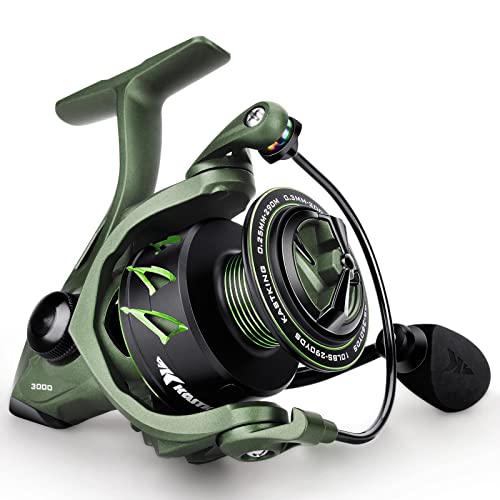
KastKing Spartacus II, 3000 Size
At about $39.09 as of September 2026 this is the reel we hand somebody building a second rod.
- A carbon fiber drag at a price where felt is the class standard
- Ceramic line roller stands up to braid better than plain steel
- Under $40 leaves money in the budget for decent line
- Graphite body flexes more than aluminum under a heavy load
- 5.2:1 feels slow if you fish fast-moving baits all day

KastKing Zephyr, 1000 Size
A trout and panfish reel, and priced like one. KastKing puts the 1000 size at about 7 ounces, with a graphite body, body cover and rotor, an oversized stainless steel main shaft and a brass pinion gear.
- About 7 ounces balances a light 6-foot rod instead of hanging under it
- Braid-ready spool skips the mono backing step
- Carbon drag on a reel this cheap is unusual
- A 1000 spool holds too little line for anything past trout and panfish
- Graphite will not absorb the abuse a metal-bodied reel shrugs off

KastKing Brutus, 2000 Size
The Brutus is the floor of the category. For about $22.
- A carbon fiber drag and a machined aluminum spool for about $23
- Cheap enough to be a spare, a loaner or a travel-rod reel
- Zinc alloy is the softest main gear material in this list
- 4+1 bearings and no sealing claim at all
Compare The Field
| Compare | Best Overall Under $100 Piscifun NautiX, 3000 Size | Best Gearing Under $100 KastKing Royale Legend Pro, 3000 Size | Best Saltwater Reel Under $100 KastKing Kapstan SE, 4000 Size |
|---|---|---|---|
| Overall | — | — | — |
| Price | $85.99 Check price → | $81.89 Check price → | $98.99 Check price → |
About The Author
Rob Thomas
Rob Thomas is a fisherman who loves catching tales from his fellow fishermen. He always enjoys a good story, especially when it comes from the sea.