Best Fishing Line for a Baitcaster: Fewer Backlashes, More Casts

This post may contain affiliate links. Read our policy.
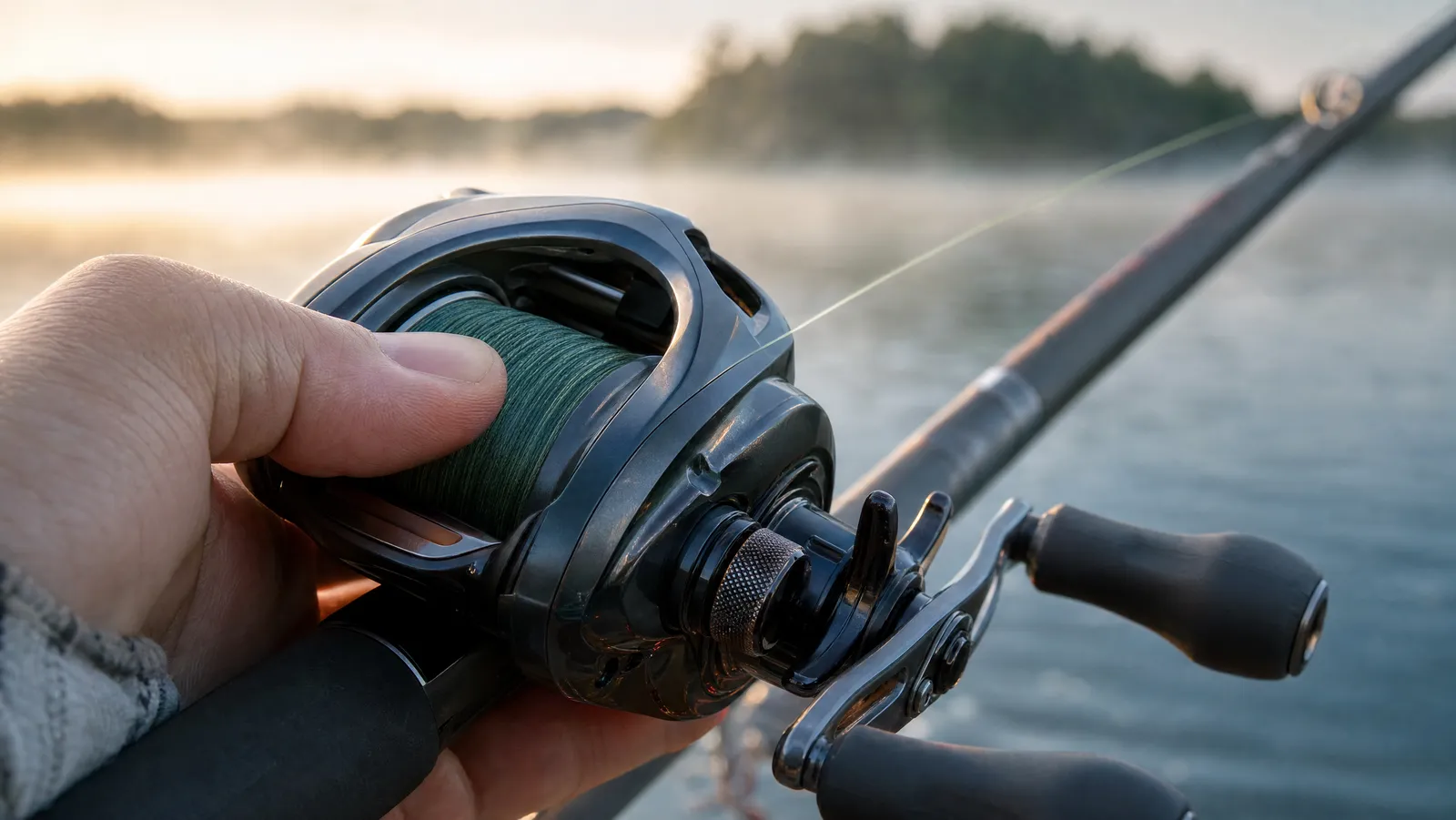

SpiderWire Stealth Superline Braid, 30 lb, 300 yd, Moss Green
SpiderWire states this line measures 0.
- SpiderWire publishes both a diameter and a mono equivalent, which most braid brands do not
- Fluoropolymer-treated Dyneema is the quiet, slick end of the braid market
- The Stealth range runs 6 lb to 250 lb, so you can stay in the family when you go heavier
- Even at 30 lb it is thinner than 14 lb mono, so a bare spool needs backing or tape
- A braid overrun at this diameter is the hardest kind of backlash to pick out
Best Fishing Line for a Baitcaster: Fewer Backlashes, More Casts
The best fishing line for a baitcaster is heavier and stiffer than what you would put on a spinning reel — 12 to 17 pound monofilament while you are learning, 30 to 50 pound braid once you are not. A baitcaster spool is a rotating mass problem, not a line strength problem, and heavy line is the cheapest brake you can buy.
Angler Reviews is reader-supported. We may earn a commission on purchases made through links on this page, at no extra cost to you.
That reads backwards to anyone coming off spinning gear, where the whole game is going lighter and thinner. On a casting reel, thin line is the thing that hurts you. If you are still choosing between mono, fluorocarbon and braid in general terms, start with our guide to the best fishing line and come back here for the baitcaster-specific half of the problem.
Why a Baitcaster Wants Different Line Than a Spinning Reel
A spinning reel's spool does not move during the cast. Line peels off a fixed cylinder in coils, and the only failure mode is loose coils jumping off together. Nothing has to be stopped, because nothing was spinning.
A baitcaster is the opposite machine. The lure drags line off a spool that is free to rotate, and that spool builds up real angular momentum in the first half second of the cast. Then the lure slows down — wind, water, a tree — and the spool does not. Beyond Braid's write-up on baitcasting backlash states it in one sentence: "Backlash occurs when your spool continues spinning after your lure hits the water or slows down mid-cast," with lure deceleration, loose spool tension and insufficient brakes as the listed causes.
Something has to absorb that leftover rotation. You have three brakes: your thumb, the reel's braking system, and the line itself. Most beginners only think about the first two.
Line weight matters in three specific ways:
- Resistance. Thicker line drags harder through the guides and pushes more air. That drag is continuous and automatic, unlike your thumb.
- Coil size. Heavier, stiffer line leaves the spool in larger, lazier loops. Big loops are far less likely to slip under the wraps beneath them.
- Forgiveness when it goes wrong. A loose loop in 14-pound mono lifts out with your fingers. A loose loop in thin braid welds itself into the pack under the next hookset.
Kevin VanDam's baitcasting primer for Bassmaster does not hedge on the fix: "For learning purposes, use 17-pound monofilament because it handles so much easier," because "Larger diameter lines come off the spool easier and are less likely to overrun."
If you are fighting backlashes, go up in line weight before you go down in casting weight. It is the single change that costs the least and works the fastest.
Your Reel's Line Rating Is a Capacity Spec, Not a Recommendation
Every baitcaster prints a capacity figure on the box — so many yards of so many pound test. Anglers read it as advice. It is not. It is a volume measurement, and it is usually quoted with a thin line, which is what produces the biggest yardage number.
Nothing about that number says the reel casts well with that line. It says the line fits. A reel listed at 120 yards of 12-pound mono will also hold 90 yards of 17-pound mono, and the second setup is the one a beginner should be running.
Work out what your specific reel actually holds in the line you want with our line capacity calculator before you buy a 300-yard spool you can only half use. Treat the printed rating as the floor of the range, not the middle of it.
Monofilament: The Line That Teaches You to Cast
Mono is the correct answer for a first baitcaster, and it is not a compromise answer.
Everything that makes monofilament unfashionable elsewhere is an asset on a casting spool. The stretch absorbs the shock of a lure hitting the water, which is the exact moment a spool overruns. The memory keeps coils wide and lazy. The thickness slows the spool on its own. And because it is cheap, the bird's nest you will eventually cut out of it costs you a dollar of line rather than the price of a coffee.
The Berkley Trilene XT in 14-pound is our pick here for one reason you can check on a spec sheet: Berkley states a diameter of 0.016 inches at 14-pound test. Compare that to the 30-pound SpiderWire braid further down this page, which SpiderWire states at 0.012 inches. The mono you are told is "heavy" is a third thicker than a braid rated at more than double its strength. That gap is the entire reason casting reels and mono get along.
Berkley positions XT as its extra-tough, abrasion-resistant monofilament and says it holds up against rough or sharp objects and heavy cover, which describes most of the water a baitcaster gets pointed at. It runs about $9 as of September 2026 for 300 yards, down from a $9.99 list price, and the XT range covers 4 to 30 pound if you want to go heavier still.
Buy mono for your first two months on a baitcaster even if you already know you want braid. You will cut some of it off, and it will not matter.
Fluorocarbon: Best Underwater, Least Forgiving on the Spool
Fluorocarbon is the technique line. It sinks, which holds a jig or a crankbait on the line angle you intended rather than a bowed one, and its refractive index is closer to water's than nylon's, which is why it is sold as the harder line for a fish to see. Those are real advantages and they are why most serious bass anglers have fluoro on at least one casting rod.
The catch is that fluorocarbon is stiffer and denser than mono, and both properties work against you when a cast goes wrong. A fluoro backlash packs tighter than a mono backlash and resists being picked apart.
Worse, it does not forgive being pulled on. Sunline's own write-up on backlashes and fluorocarbon describes the sequence exactly: an overrun creates "loops, kinks, and tangles in your line," then "You pull on the line when it is stuck, and a kink is created in the line in that spot." Sunline reports that the micro-cracks left by a kink caused the line to "break at a 5% lower strength on average after repeated testing," and the company notes that this "can often be seen when fluorocarbon line unexpectedly breaks in the spool on a cast."
That is the fluoro-specific failure nobody warns you about. You clear the backlash, keep fishing, and the line parts on a cast an hour later at a spot you damaged and forgot about. Sunline's advice is to "remove the tangles as carefully as possible to avoid any kinks in the line," and ours is blunter: after a bad fluoro backlash, cut back past the damage.
Seaguar's Red Label is the fluorocarbon we would put on a casting reel, because Seaguar states outright that it is designed for bait casting reels rather than selling it purely on invisibility. It is 100% fluorocarbon from Seaguar's own resins, positioned as a freshwater main line with knot and tensile strength, and Seaguar says it holds up against pike and other toothy species. The 15-pound, 200-yard spool is about $16 as of September 2026, down from a $19.25 list price.
If you would rather keep fluorocarbon at the business end only and run something more forgiving on the spool, our tippet and leader selector will get you to a sensible leader test for the species you are chasing. Put fluoro on the reel when your backlash rate is already low — not to fix one.
Braid on a Baitcaster: Distance, Sensitivity, and the Worst Backlash You Will Ever Pick
Braid gives you the most casting distance, the most sensitivity and the most direct hookset of the three. It also produces the single worst tangle in fishing, because a thin, slick, stretchless line under load digs straight down into the wraps below it.
There is a hard floor on diameter here. Salt Strong's guidance on braid for casting reels is specific: "Thin diameter line is great for spinning reels, but if you're using baitcasting reels, you don't want to use anything under 20 lb. braid." The reasoning is mechanical — "If the line is really thin, it'll dig into the spool if you have a big fish on or get snagged, which can cause knots and tangles" — and the secondary failure is worse: "if you get a bird's nest, the thinner line is much more likely to snap."
Tournament practice runs heavier than that floor. In Bassmaster's line Q and A, Bobby Lane Jr. describes splitting his spools by reel type: "I use the 10-pound Spiderwire on spinning tackle and the heavier sizes on casting gear," and reserves 50- and 65-pound braid for "single-hook lures like worms and jigs," which he calls "the ideal line for flipping heavy cover."
We would start at 30. The SpiderWire Stealth in 30-pound is the braid we would spool, about $31 as of September 2026 for 300 yards, because SpiderWire publishes both numbers that matter: 0.012 inches of diameter and a 10-pound mono equivalent. It is Dyneema fiber with fluoropolymer-treated microfibers that SpiderWire says glide through reel and guides for quiet operation, in a round braid construction.
For the same 30-pound test at a lower price, the Berkley Trilene Big Game Braid runs about $20 as of September 2026 for 330 yards — the most line in this group. Berkley claims it is three times stronger than mono of the same diameter, states zero stretch for sensitivity, and describes it as tough and abrasion resistant for slicing through vegetation. The listing carries no diameter figure, which is the trade you make at the price.
The contrast with spinning gear is total. On a fixed spool, 10-pound braid is a sensible main line and thin diameter is the point, which is why our guide to the best fishing line for spinning reels reaches almost the opposite conclusion from this page. Same braid, same water, different machine.
Earn braid on a baitcaster. Spool it when a windy-day cast no longer scares you.
Backing: Braid Slips on a Bare Baitcaster Spool
This is the practical step most pages skip, and it turns a new braid setup into a mystery failure.
Nylon bites into a spool arbor. Braid does not. Lew's spooling guide puts it flatly: "Braided line will slip on a spool regardless of the knot used. A monofilament backing eliminates this problem." When it happens, you hook a fish, the handle turns, and the entire mass of line rotates around the arbor while nothing comes in.
Two accepted fixes:
- Mono backing. Lew's recommends that "An 8- to 10-pound monofilament backing makes for a smooth, even base layer on the spool," joined to the braid with a line-to-line knot. It also saves money, since you are not paying braid prices for line that never leaves the reel.
- Tape on a bare arbor. A few wraps of electrical tape over the arbor give braid something to grip. Faster, free, and fine on a reel you strip and refill often. Some spools now ship braid-ready with a rubberised or knurled arbor, in which case you can skip both.
Spool under firm, constant tension either way. Lew's is emphatic that "A towel is absolutely necessary when spooling braided line, which requires such heavy pressure it would burn or cut your bare fingers." Loose braid buries itself on the first hard cast. The mechanics carry over from our walkthrough of how to spool a reel without wind knots — the backing question and the tension question are identical on both reel types.
Fill Level, Brakes and Tension: The Settings Your Line Weight Interacts With
Line choice and reel setup are not separate decisions. Change one and you have changed the other.
Fill level. Lew's spooling guide gives the number: "The reel is full when the line is about 1/8-inch from the top of the spool," stopping "when the line is even with the bevel on the outer edge of the spool." Beyond Braid gives the same 1/8 inch figure. Overfill and line spills off the rim in sheets before the cast is even underway. Underfill and you lose distance and retrieve speed.
Spool tension knob. VanDam's instruction is a feel test: "Loosen or tighten the tension knob to where the lure falls slowly and smoothly as you jiggle the rod tip." KastKing describes the same target as "a nice, even drop that is controlled and smooth. Not in free fall, but where you can see and feel that there is contact." Beyond Braid adds a stopwatch version — the spool should stop spinning within one second of the lure hitting the ground.
Brakes. Beyond Braid's recommendation for magnetic brakes is to "Start at 75% and work down as your skills improve." Heavier line lets you run less brake, because the line is already doing part of the braking; lighter line needs more of it. Either way you are adding up resistance from several sources, and line is one of them.
Drag. KastKing's rule of thumb is to set the drag at roughly a quarter to a third of the line's rated poundage, which is a different number on 14-pound mono than on 30-pound braid. Run yours through our drag setting calculator rather than thumbing the star and guessing, especially on braid, where the drag is the only shock absorber left in the system.
Heavier line on a shallower fill beats light line on a full spool. A spool filled to the 1/8-inch mark with 17-pound mono holds fewer yards than the same spool full of 12-pound, and it will cast better all day. You are not fishing the last 40 yards anyway.
The Picks, by Job
Four spools cover almost everything a freshwater baitcaster gets asked to do.
- Learning to cast, or any rod with treble hooks. Berkley Trilene XT in 14-pound. Berkley's stated 0.016 inches is your cheapest insurance against an overrun, and the stretch protects treble-hooked fish at the boat.
- Jigs, Texas rigs and bottom contact in clear water. Seaguar Red Label in 15-pound, the fluorocarbon Seaguar itself points at casting reels. Cut back past any kink.
- Grass, pads and anywhere you need to pull. SpiderWire Stealth in 30-pound, over mono backing. SpiderWire's no-stretch construction at a stated 0.012 inches of diameter is what moves a fish out of cover.
- Finding out whether you like braid at all. Berkley Trilene Big Game Braid in 30-pound, 330 yards, the longest spool here.
If your baitcaster is a bass rod — and statistically it is — the technique-by-technique matching of line to presentation lives in our line guide for bass fishing. This page is about the reel. That one is about the fish.
What We Would Actually Spool
If this is your first baitcaster, buy 14- or 17-pound monofilament and nothing else. Not because braid is worse, but because every dollar you spend on premium line in month one gets cut off with nail clippers in month two. Berkley Trilene XT at about $9 as of September 2026 makes that loss irrelevant. Fill to 1/8 inch below the lip, set the tension knob so the lure falls slow and controlled, start the brakes at 75 percent, and back them off as your thumb learns the job.
If you already cast clean in wind, run 30-pound braid with a mono backing. SpiderWire Stealth at about $31 as of September 2026 gives you a published diameter and a published mono equivalent, which is more than most braid brands offer. Add a fluorocarbon leader when the water is clear, and keep a spool of Seaguar Red Label for the rods that live on the bottom.
The one sentence to carry away: on a baitcaster, line thickness is a braking system. Everything else on this page is a consequence of that.
When you are ready to compare mono, fluorocarbon and braid head to head rather than reel by reel, our main guide to line types lays out the full field.
The Picks, Tested
SpiderWire Stealth Superline Braid, 30 lb, 300 yd, Moss Green
SpiderWire states this line measures 0.012 inches at 30-pound test, with a mono equivalent of 10 pounds.
- SpiderWire publishes both a diameter and a mono equivalent, which most braid brands do not
- Fluoropolymer-treated Dyneema is the quiet, slick end of the braid market
- The Stealth range runs 6 lb to 250 lb, so you can stay in the family when you go heavier
- Even at 30 lb it is thinner than 14 lb mono, so a bare spool needs backing or tape
- A braid overrun at this diameter is the hardest kind of backlash to pick out
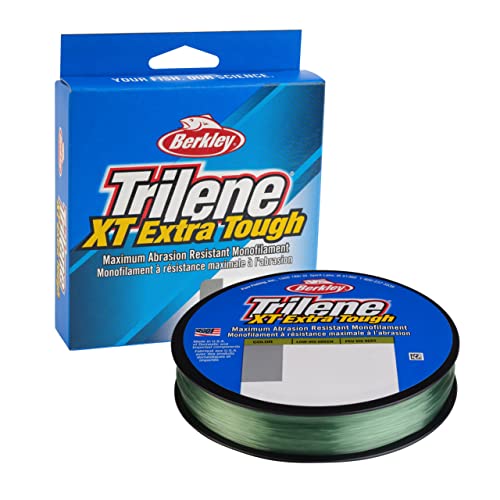
Berkley Trilene XT, 14 lb, 300 yd, Low-Vis Green
Berkley states 0.016 inches at 14-pound test, which makes this thicker than 30-pound braid and is exactly why it is the line to learn a baitcaster on.
- Berkley's stated 0.016 in is thick enough to resist a spool overrun
- Berkley positions XT for rough objects and heavy cover, which is baitcaster water
- Cheapest spool here, so cutting a bird's nest out of it costs almost nothing
- Nylon stretch dulls a hookset at the far end of a long cast
- Low-Vis Green is a compromise in genuinely clear water

Seaguar Red Label 100% Fluorocarbon, 15 lb, 200 yd
Seaguar states Red Label is designed for bait casting reels, which is unusually specific for a fluorocarbon — most are sold on invisibility alone. It is the main line for jigs and bottom-contact work once your thumb has stopped costing you casts.
- Seaguar names bait casting reels as the intended application
- 100% fluorocarbon from Seaguar's own resins rather than a coated hybrid
- Sinks, which keeps jigs and crankbaits on their intended line angle
- Stiffer than mono, and Sunline reports that backlash kinks cost fluorocarbon measurable strength
- 200 yards is the shortest spool here, so there is less line to sacrifice to a bad cast

Berkley Trilene Big Game Braid, 30 lb, 330 yd, Lo-Vis Green
Berkley claims three times the strength of mono at the same diameter and zero stretch, on the longest spool in this group. At 30-pound test it clears the diameter floor a baitcaster needs, and it is the cheap way to find out whether you actually like braid on a casting reel.
- 330 yards is the most line of anything in this group
- Berkley claims 3x the strength of mono at the same diameter, with zero stretch
- Berkley builds it for vegetation, which is where most baitcasters get pointed
- The listing carries no diameter figure, so you cannot compare it to the SpiderWire directly
- Zero stretch is unforgiving on treble-hooked baits
Compare The Field
| Compare | Best Braid for a Baitcaster SpiderWire Stealth Superline Braid, 30 lb, 300 yd, Moss Green | Best Mono for Learning a Baitcaster Berkley Trilene XT, 14 lb, 300 yd, Low-Vis Green | Best Fluorocarbon Main Line Seaguar Red Label 100% Fluorocarbon, 15 lb, 200 yd |
|---|---|---|---|
| Overall | — | — | — |
| Price | $30.51 Check price → | $9.14 Check price → | $15.98 Check price → |
About The Author
Rob Thomas
Rob Thomas is a fisherman who loves catching tales from his fellow fishermen. He always enjoys a good story, especially when it comes from the sea.