Best Fishing Line for Bass: Matching Line to the Technique

This post may contain affiliate links. Read our policy.
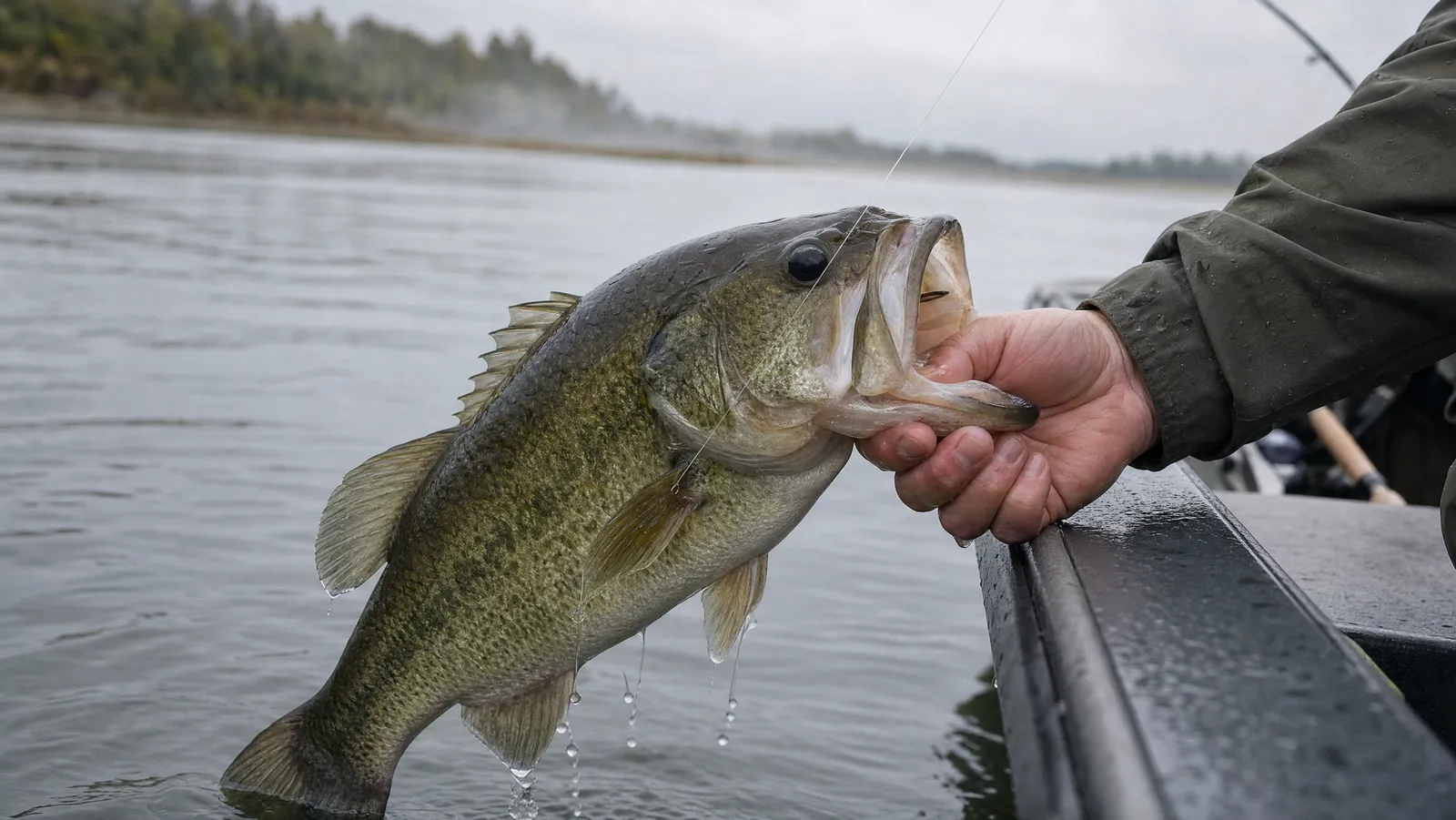

PowerPro Super8Slick V2, 30 lb, 150 yd Moss Green
Eight yarns of spectra fiber treated with what PowerPro calls Enhanced Body Technology, in the one colour that works everywhere on a bass lake.
- Eight carriers run quieter and cast farther than a four-carrier braid
- Moss green is the least conspicuous braid colour in stained water
- 30 lb is the most versatile single braid test for bass
- 150 yards is a short spool for the money
- Too light for punching matted vegetation
Best Fishing Line for Bass: Matching Line to the Technique
Serious bass anglers do not have a best fishing line for bass. They have three, and the technique on the end of the rod picks which one gets spooled. Ask a tournament angler what line he fishes and he will ask you what you are throwing, because braid, fluorocarbon and monofilament are not three grades of the same product. They are three different materials with three different densities and three wildly different amounts of stretch.
Angler Reviews is reader-supported. We may earn a commission on purchases made through links on this page, at no extra cost to you.
So this guide is organised by technique instead of by product. Frogs and punching, jigs and Texas rigs, crankbaits and trebles, finesse spinning, topwater. Each section ends with what we would actually put on that reel. If you want the material-by-material comparison first, our best fishing line hub covers braid against fluoro against mono in the abstract. This page is what happens when the abstraction meets a grass mat.
Two Numbers Decide Half of These Choices
Before any technique, two properties. Learn them and most of the decisions below make themselves.
Density. Sunline publishes the specific gravities plainly: braid sits at 0.97, nylon monofilament at 1.11 to 1.14, and fluorocarbon at 1.78, against water at 1.0. Sunline's conclusion is the one that matters: "Anything with a specific gravity less than one will float, so the braided line will be the most buoyant, nylon the second most, and fluorocarbon being the densest and the least buoyant of the three-line types." One Outdoors' line comparison lists the same figures for braid and fluorocarbon, and puts nylon at a specific gravity of about 1.14.
Braid floats. Fluorocarbon sinks, and it sinks hard. Nylon is nearly neutral. That single fact explains why frogs go on braid and jigs go on fluoro, and it is not a preference you can argue with.
Stretch. One Outdoors puts monofilament at 25 to 35 percent stretch, fluorocarbon at 10 to 15 percent, and braid at 1 to 3 percent. Read that as a shock-absorber rating. High stretch forgives a bad hookset and keeps hooks pinned. Low stretch transmits a bite from forty yards and drives a hook through a jaw.
Every section below is really a question about those two numbers. Do you want this bait to sink or float, and do you want the line to forgive you or to report to you?
Frogs and Punching: Heavy Braid, and No Arguing
A hollow-body frog and a one-ounce punching weight are the same problem: the fish is wrapped in vegetation before you know it is on, and your job is to move it up and out before it finds a stalk to hold. There is no stretch budget for that. There is no diameter budget either, because thick line does not slice through grass.
Wired2Fish's Jason Sealock is direct about the numbers in his guide to choosing bass line: 65-pound braid for frogs fished over matted grass, 20-pound fluorocarbon or 65-pound braid for pitching to heavy cover, and 30 to 65-pound braid for swim jigs. The ceiling exists because grass fishing is a cutting job, not just a pulling one.
The braid arithmetic is what makes this possible. PowerPro lists its 50-pound Spectra braid at a stated 0.014 inch diameter and an approximate mono equivalent of 12 pounds. Set that next to Berkley's own spec for Trilene XL in 12-pound test, a stated 0.013 inch. So you can carry roughly four times the breaking strain on essentially the same thickness of line. That is the whole trick, and our braided line deep-dive walks through the fiber and carrier-count side of it.
The pick. The PowerPro Spectra braid in 50-pound, about $20 as of September 2026 for 150 yards, is the cheapest honest way into a dedicated frog and flipping rod. It is 150 yards, so put mono backing under it. The colour is vermilion red, which we will come back to, because the reason it is red is more interesting than the marketing suggests.
If you are punching genuinely matted vegetation rather than fishing frogs over scattered grass, buy heavier than anything on this page. Sealock writes that most anglers want 65 to 80-pound braid for fishing heavy cover with frogs or punching through matted vegetation with big weights. Fifty is the walking-frog and scattered-grass number, not the mat number.
Jigs and Texas Rigs: Fluorocarbon, 15 to 20 Pound
Single hooks, bottom contact, and a bite that often feels like nothing at all. This is fluorocarbon's home water, for two separate reasons that people tend to blur together.
The first is sensitivity, and it comes from the stretch figure rather than from the material being magic. Ten to 15 percent beats mono's 25 to 35, so a jig ticking gravel arrives at your hand instead of dying in the line.
The second is density, and it is the underrated one. Sunline notes that fluorocarbon suits "techniques that require your bait to sink or that you want to keep down in the water column," and adds that "the sinking nature of fluorocarbon reduces line bow on long casts. It can also aid in better hooksets and increase sensitivity." A floating line above a bottom bait puts a bend in the system. Every degree of that bend is hookset power you do not get back.
Sealock's numbers for this water: 15 to 20-pound fluorocarbon for football jigs, and 12 to 20-pound for big plastic worms. His prose puts the same 15 to 20-pound band on any jig or spinnerbait he fishes on fluorocarbon.
The pick. Seaguar InvizX in 15-pound, about $25 as of September 2026 for 200 yards, sits exactly in the middle of that band. Seaguar makes its own fluorocarbon resins and describes InvizX as soft, castable and virtually invisible to fish, with low memory, virtually no stretch and fast sinking. Treat the invisibility line as the manufacturer's claim rather than a measurement. Treat the fast sinking as physics you can verify with a bucket.
Fluorocarbon earns its price on bottom baits and almost nowhere else. Which brings us to the section most anglers get wrong.
Crankbaits and Treble Hooks: Buy the Cheap Mono
Here is the counterintuitive one, and it runs against everything the tackle industry has spent twenty years telling you.
A treble hook is three small, thin-wire points with short penetration. It does not bury to the bend the way a 4/0 flipping hook does. It catches skin, it tears a slightly larger hole every time the fish shakes, and the only thing standing between that hole and a thrown bait is something elastic in your setup. On a jig rod, you want the line to report. On a crankbait rod, you want the line to cushion.
Walker Smith made the case cleanly at Wired2Fish: "Monofilament fishing line has a lot more stretch than modern fluorocarbon, so it can help compensate for the lack of 'give' in your cranking setup." He describes mono's stretch as providing the "very important split-second delay that's needed for suitable hook penetration."
The important nuance is that this is a system question, not a line question. Smith's own condition for fishing fluorocarbon on crankbaits is having the right rod: "It does have very little stretch, but remember, my cranking rods have enough 'give' in the tip to offset it." If you own a genuine soft-tipped cranking rod, the rod is your shock absorber and fluorocarbon becomes defensible. If you are throwing a squarebill on the medium-heavy rod you also flip with, the line has to do that job, and nylon is the only thing here that can.
Smith's pound-test breakdown is the most usable we found: 12-pound mono for flat-sided plugs and smaller squarebills, 15-pound for larger squarebills, and 10-pound for most deep-diving crankbaits. Sealock lands in the same neighbourhood at 10 to 12-pound mono for deep divers.
Diameter matters more here than anywhere else on this page, because a crankbait's dive curve is a function of how much line is dragging through the water. Berkley states 0.013 inch for 12-pound Trilene XL and 0.015 inch for 12-pound Trilene XT. Same rated test, noticeably different thickness, and a deep diver will feel it.
The picks. Berkley Trilene XL in 12-pound is about $6 as of September 2026 for 300 yards, which makes it the cheapest line on this page by a distance. Berkley states it resists twists and kinks for smooth casting, and the thinner 0.013 inch profile is what you want on anything meant to reach depth. When the crankbait is going into wood, rock or riprap, step across to Trilene XT in 12-pound, about $10 as of September 2026, which Berkley designed for rough conditions and markets on ultra abrasion resistance. You pay for that in the thicker 0.015 inch diameter.
Copolymer sits between the two ideas: less stretch than straight nylon, more than fluorocarbon. A legitimate middle answer, but it does not change the rule. For treble hooks on a stiff rod, stretch is the feature.
If you spend $6 on one spool this season, spend it here. The mono crankbait rod is the single most common upgrade we see anglers refuse to make.
Finesse and Spinning: 8-Pound Fluoro, or Braid With a Leader
Smallmouth, pressured largemouth, drop shots, shaky heads, Ned rigs and anything else you would throw on a spinning rod. Two workable systems.
Straight fluorocarbon main line is the simple one. It sinks, it is thin, and there is no connection knot to fail. The cost is memory: fluorocarbon coils off a spinning spool in a way nylon does not.
Braid with a fluorocarbon leader is the other. Sealock's spec is 10 to 20-pound braid on the spinning reel with an 8 to 12-pound fluorocarbon leader for drop shots and shaky heads. You get braid's thin diameter and casting distance plus a sinking, low-visibility tip, and a knot you have to tie properly every time.
The pick. Seaguar Red Label in 8-pound, about $14 as of September 2026 for 200 yards, works for either. Seaguar positions Red Label as a freshwater main line built from its own resins, and offers it from 4 to 20-pound test. Worth knowing before you buy: Seaguar markets Red Label for baitcasting reels. It is stiffer than InvizX, which Seaguar builds around extremely low memory so that it stays soft, supple and castable. If you run it as a spinning main line and hate the coil, that is the reason.
Fill level decides more spinning-reel outcomes than line choice does. Underfilled spools cast short, overfilled spools throw loops. Run your reel through our line capacity calculator, and our guide to the best fishing line for spinning reels covers the wind-knot and backing side in full.
Topwater: It Depends on the Hook, Not the Bait
Topwater is where anglers reach for one answer and there are two, and the hook tells you which.
Hollow-body frogs and single-hook topwater go on braid. Braid floats at 0.97 specific gravity, so the line lies on the surface instead of sinking and pulling the nose of the bait down. The hookset has to travel through grass. Everything from the frog section applies.
Treble-hook topwater plugs go on mono. Walking baits, poppers and prop baits carry the same thin treble points as a crankbait, and they take them at the boat, at the end of the fight, on a slack-line surge. Sealock's topwater note is 15-pound monofilament or 30-pound braid, and he adds that he ties a monofilament leader whenever he throws a topwater lure on braid, because it keeps the line from sinking and fouling the bait. Nylon's near-neutral 1.11 to 1.14 specific gravity is close enough to floating that it does not drag a walking bait off its cadence, and it brings the 25 to 35 percent stretch that a treble needs.
The pick for the braid half. The PowerPro Super8Slick V2 in 30-pound moss green, about $25 as of September 2026 for 150 yards, is the most versatile braid here. PowerPro builds it from 8 yarns of spectra fiber, treats it with what the company calls Enhanced Body Technology, and describes the result as an incredibly round, smooth and sensitive line with added abrasion toughness. Thirty pound is the number we would run if one braid had to cover frogs over scattered grass, topwater, and a swim jig, though it is not enough line for a true punching rod.
Braid gives you no shock absorption, so the drag becomes the only elastic component left in the system. Set it deliberately rather than by thumb feel with our drag setting calculator.
The Colour Question, and the Red Line Claim
Three colour families show up on bass reels, and only one of them involves a factual dispute.
Moss green and low-vis green are the defaults for a reason. They are dull, they break up against vegetation and stained water, and no one has to believe a theory to use them.
Hi-vis yellow and orange are line-watching colours. If you fish a shaky head or a jerkbait where the bite shows up as a line jump before you feel it, being able to see your line is worth more than the fish not seeing it.
Red is the contested one, and our 50-pound pick is red, so it deserves a straight answer. Retail copy states the case openly. Tackle Warehouse's own product description for PowerPro's Vermilion Red concedes the popular version is wrong before making a narrower claim: "Since shades of red are the first color to fade, it is thought that by using red colored line, the angler's line 'disappear' underwater. Truth be told, Red does not disappear but in fact turns to a shade of Gray." The same description puts a number on it: "The color red will completely fade out at a depth of 14 feet. Therefore, when targeting fish in depths of 20 feet or greater, Red Line is ideal."
The underlying physics is real. NOAA Ocean Exploration explains that red light is filtered out with depth and that a red animal deep in the water column "appears blackish because there is no red light to reflect at that depth" — its example depth is 100 meters, in open ocean water.
The gap between those two things is where the claim gets shaky. NOAA is describing open ocean water at a depth no bass angler ever fishes. A bass angler is usually fishing the top ten feet of a stained lake, where red light is still very much present. And whatever colour the line turns, braid is opaque: a red braid at 14 feet becomes a grey braid, not an absent one. We found no controlled testing of bass strike rates by line colour.
Buy the red 50-pound because it is a good, cheap, thin heavy-cover braid and because you can see it against a grass mat, not because you expect it to vanish. In the shallow, weedy water where you fish a frog, no line colour is invisible, which is exactly why the flipping crowd never worried about it.
Knots Are Where These Recommendations Actually Fail
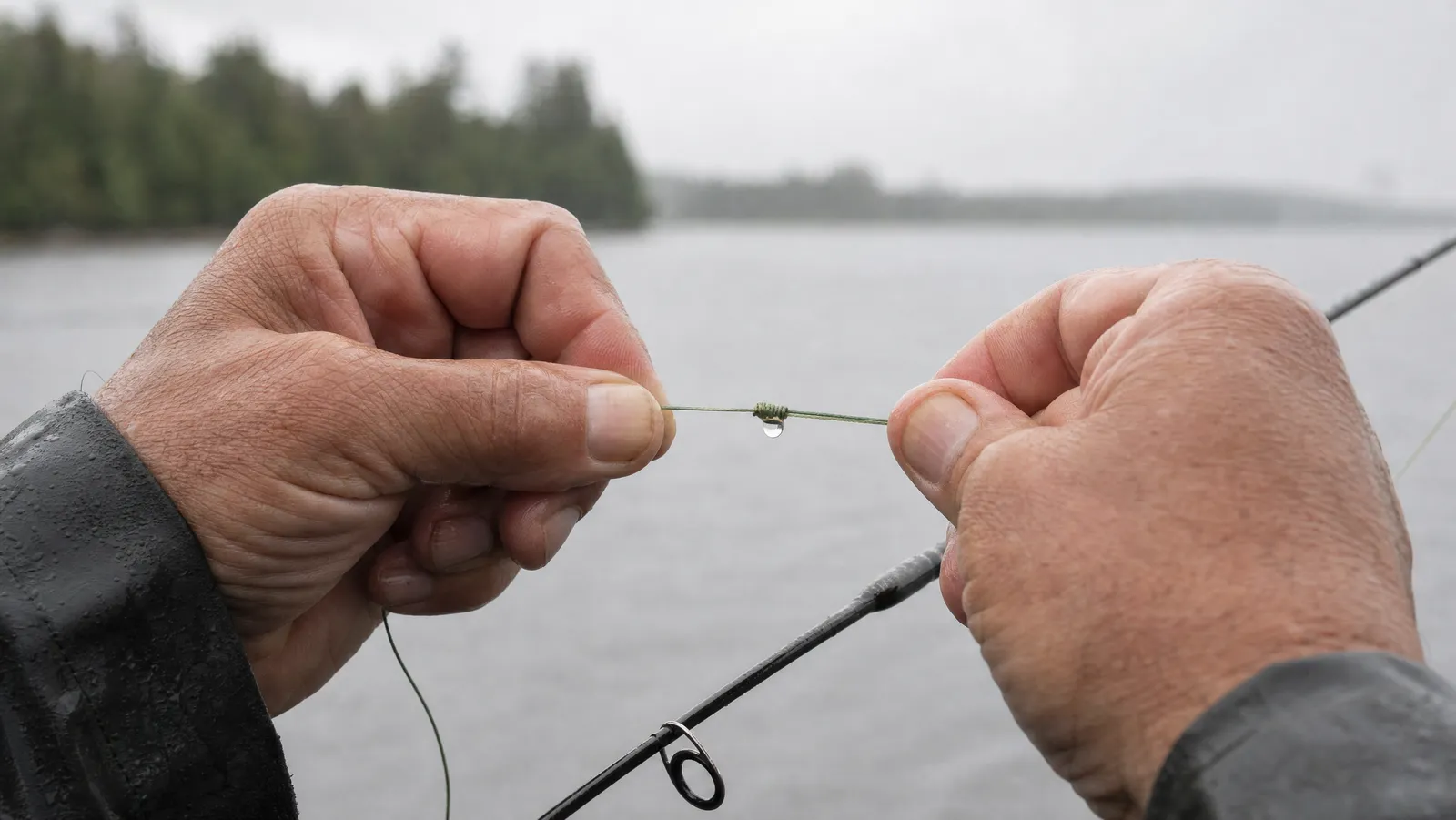
None of the above survives a bad connection. Braid is slick enough that clinch-family knots slip in it, fluorocarbon can cut itself if you cinch it dry, and a braid-to-fluoro setup asks you to tie a line-to-line join correctly every time you re-rig. Our guide to the knots that hold these systems together covers which knot belongs on which material.
If You Only Buy One
Thirty-pound braid with a fluorocarbon leader. It is the most honest single answer, and it is not a dodge.
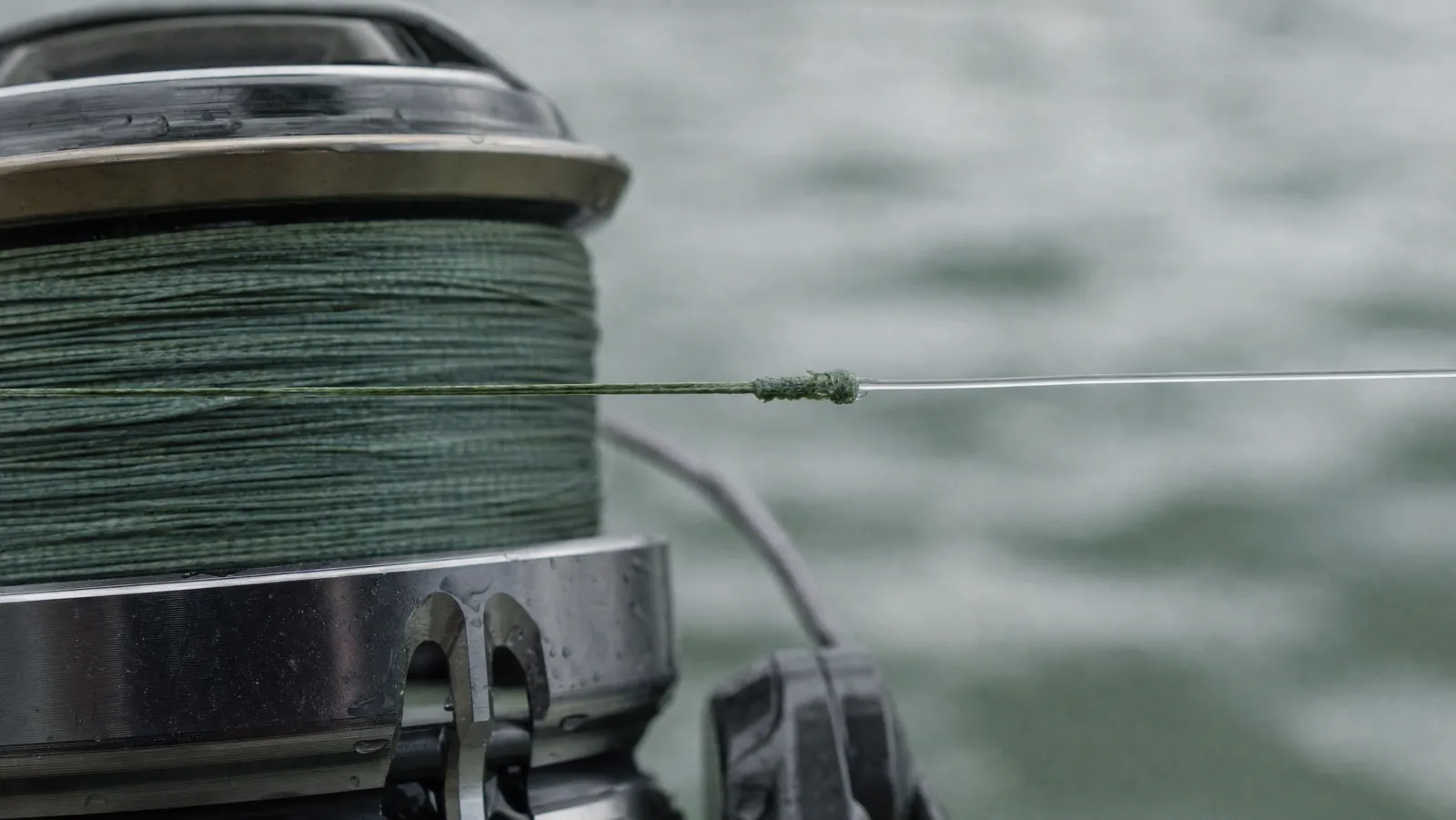
Braid handles the two things the other materials cannot do at all: it pulls fish out of cover, and its diameter lets a spinning reel cast light baits properly. The leader buys back the two things braid lacks — sinking behaviour and lower visibility — for a few feet of line and one knot. The PowerPro Super8Slick V2 in 30-pound plus a spool of Seaguar fluorocarbon covers frogs, topwater, swim jigs, Texas rigs and most finesse work on one system.
The one thing it will not do well is crankbaits. Braid is 1 to 3 percent stretch and a treble hook wants 25 to 35. If your second spool is not a $6 spool of 12-pound mono for the cranking rod, you are leaving fish in the water to save six dollars.
Your third spool, not your second, is the expensive fluorocarbon.
The Short Version
Braid floats at 0.97 and does not stretch. Fluorocarbon sinks hard at 1.78 and stretches a little. Nylon sits nearly neutral at 1.11 to 1.14 and stretches a lot. Those three lines on the spec sheet predict every recommendation on this page.
Frogs over scattered grass: 50 to 65-pound braid. Punching mats: 65 to 80-pound, no substitutions. Jigs and Texas rigs: 15 to 20-pound fluorocarbon, because it sinks and it reports. Crankbaits and treble-hook topwater: 10 to 15-pound mono, because the stretch is the point. Finesse: 8-pound fluorocarbon, either straight or as a leader under light braid.
Spool by technique, not by brand loyalty, and respool the mono more often than you think you need to. When you want the material-level comparison behind these picks, our full fishing line comparison lays out braid, fluorocarbon and mono side by side.
The Picks, Tested
PowerPro Super8Slick V2, 30 lb, 150 yd Moss Green
Eight yarns of spectra fiber treated with what PowerPro calls Enhanced Body Technology, in the one colour that works everywhere on a bass lake. Thirty pound test is the sweet spot for a do-everything braid: heavy enough to pull a fish out of scattered grass, thin enough that a casting reel will still throw a walking bait a country mile.
- Eight carriers run quieter and cast farther than a four-carrier braid
- Moss green is the least conspicuous braid colour in stained water
- 30 lb is the most versatile single braid test for bass
- 150 yards is a short spool for the money
- Too light for punching matted vegetation

PowerPro Spectra Braid, 50 lb, 150 yd Vermilion Red
Fifty pound test on a stated 0.014 inch diameter, which PowerPro puts at roughly the diameter of 12 pound mono.
- 50 lb on a 0.014 in diameter is the strength-per-thickness that heavy cover needs
- Cheapest way into a dedicated frog setup
- Red is easy for you to track against a grass mat
- The case for red being less visible to fish is a marketing argument, not a tested one
- 150 yards means backing on most baitcasters
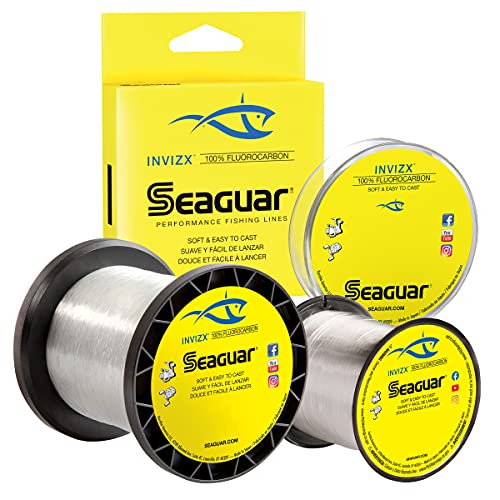
Seaguar InvizX 100% Fluorocarbon, 15 lb, 200 yd
Seaguar makes its own fluorocarbon resins, and InvizX is the one it positions as the soft, castable main line rather than a stiff leader coil. Fifteen pound test is the middle of the jig and Texas rig band, and fluorocarbon's density is doing real work there: it sinks, so the line follows the bait down instead of arcing above it.
- Seaguar rates it for spinning as well as casting reels, which most fluoro main lines are not
- Soft enough to spool as a main line rather than a leader
- Sinks, which is the whole point for jigs and bottom contact baits
- Costs four times what a comparable mono spool does
- Virtually no stretch is the wrong property for treble hooks

Seaguar Red Label 100% Fluorocarbon, 8 lb, 200 yd
Red Label is Seaguar's value tier, and 8 pound test is where a finesse angler actually spends the money. Whether you run it as a spinning main line or cut leaders off it for a braid-to-fluoro setup, 200 yards is a lot of drop shots and shaky heads for the price of a couple of crankbaits.
- Cheapest genuine 100 percent fluorocarbon here
- Doubles as leader material for a braid-to-fluoro finesse setup
- Offered from 4 to 20 lb, so one brand covers the whole range
- Seaguar markets it for baitcasters, and it is stiffer on a spinning spool than InvizX
- 8 lb is not enough line for anything near heavy cover
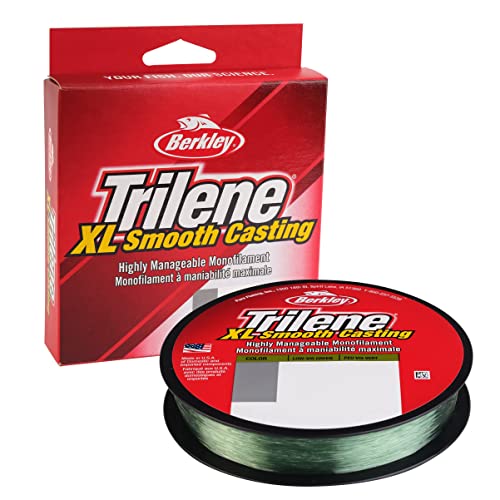
Berkley Trilene XL, 12 lb, 300 yd Low-Vis Green
The cheapest line on this page and the right answer for treble hooks. Berkley states XL resists twists and kinks for smooth casting, and at a stated 0.
- 300 yards for the price of a sandwich, so you can respool often
- Nylon stretch keeps treble hooks pinned on headshakes
- Available 2 lb to 30 lb, so one line covers every rod in the garage
- Smooth-casting build gives up abrasion resistance to XT
- Mono degrades in sunlight and needs replacing far more often than fluoro
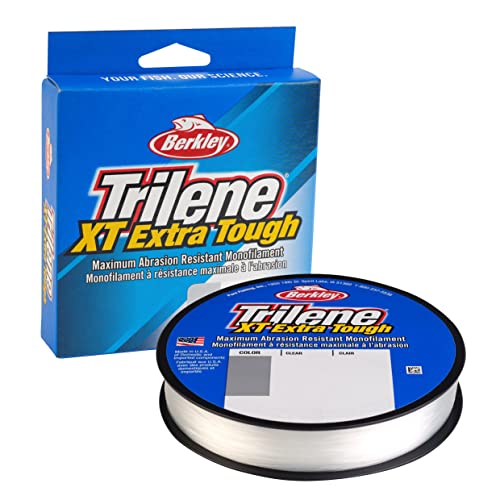
Berkley Trilene XT, 12 lb, 300 yd Clear
XT is the same family as XL with the priorities reversed: Berkley designed it for rough conditions and claims ultra abrasion resistance for heavy cover. It runs thicker at a stated 0.
- Berkley claims ultra abrasion resistance, which is what wood and rock ask for
- Still cheap enough to respool without thinking about it
- Rated by Berkley for saltwater as well as freshwater
- Thicker at 0.015 in, so deep crankbaits will not reach their rated depth
- Stiffer than XL, which shows up as coil memory on light reels
Compare The Field
| Compare | Best All-Round Bass Braid PowerPro Super8Slick V2, 30 lb, 150 yd Moss Green | Best for Frogs and Heavy Cover PowerPro Spectra Braid, 50 lb, 150 yd Vermilion Red | Best Fluorocarbon Main Line Seaguar InvizX 100% Fluorocarbon, 15 lb, 200 yd |
|---|---|---|---|
| Overall | — | — | — |
| Price | $24.5 Check price → | $19.99 Check price → | $24.99 Check price → |
About The Author
Rob Thomas
Rob Thomas is a fisherman who loves catching tales from his fellow fishermen. He always enjoys a good story, especially when it comes from the sea.