Best Topwater Bass Lures: Frogs, Poppers, and Walking Baits

This post may contain affiliate links. Read our policy.
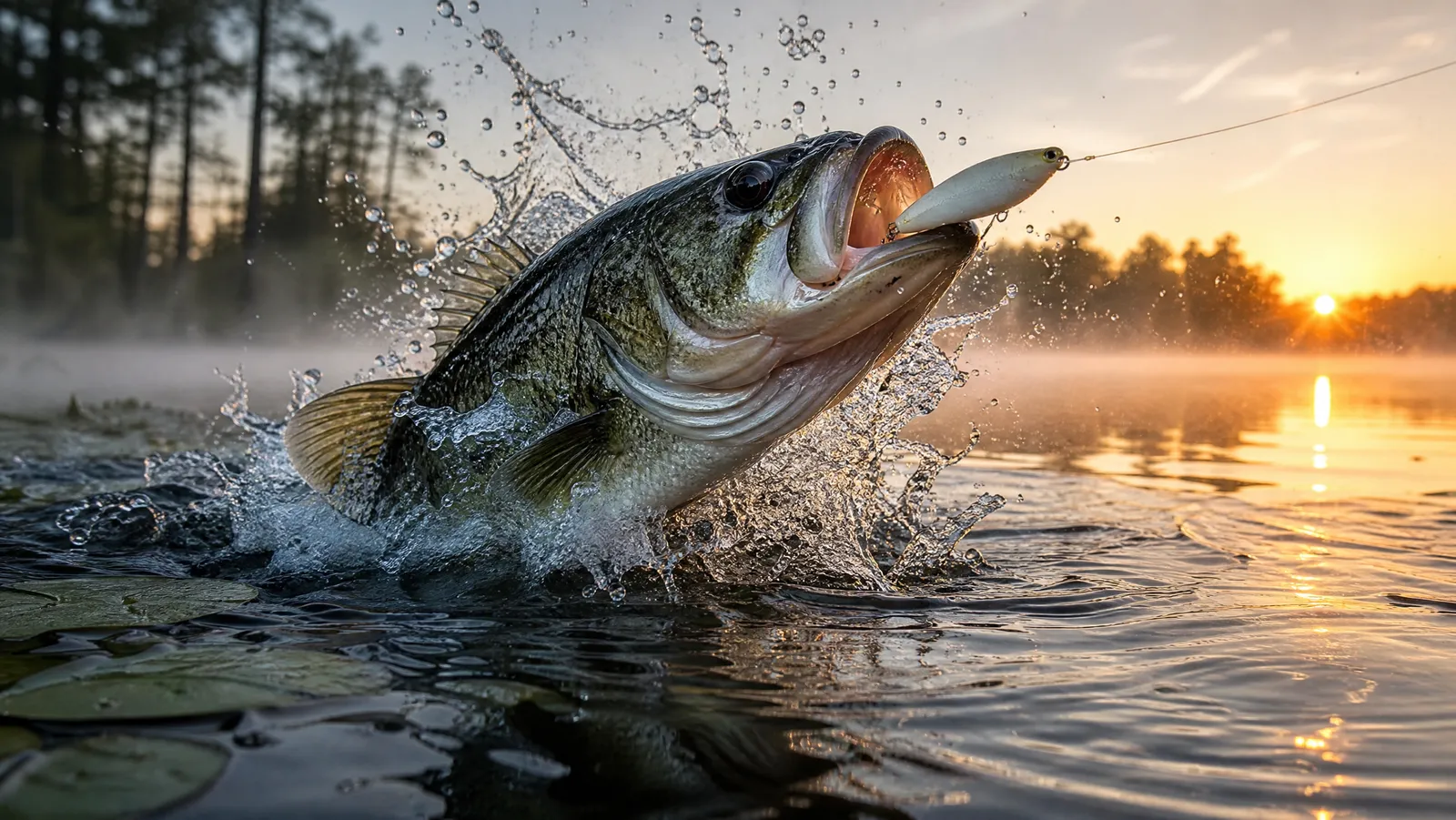

Heddon Super Spook (3-pack)
One pack covers three proven colors — bone, baby bass and foxy shad — with super sharp treble hooks ready to fish out of the package.
- One pack covers three proven colors — bone, baby bass and foxy shad — with super sharp treble hooks ready to fish out of the package.
The best topwater bass lures we can hand most anglers are a walking bait, a popper, and a hollow frog — and if we could pick only one, it would be the Heddon Super Spook, the walk-the-dog bait that still sets the standard at $18.49 for a three-pack as of July 2026.
Angler Reviews is reader-supported: as an Amazon Associate we may earn a commission from qualifying purchases, at no extra cost to you.
But "best" depends on the water in front of you. A Super Spook that shines over open points will come back draped in salad if you throw it into a grass mat, and the frog that dominates that mat wastes the Spook's long, lazy glide on open water. That is why our five picks below cover the five topwater styles that matter for bass: walking baits, poppers, ploppers, hollow-body frogs, and prop frogs. This article is a deep dive on one lure family — for the full picture of how topwater fits alongside jigs, crankbaits, and soft plastics, start with our complete guide to bass lures.
Below, we cover when and why each style earns a spot on your deck, the retrieve cadence that triggers strikes, and the gear notes that keep hooked fish hooked.
What Makes a Topwater Bass Lure Worth Buying
Every lure in this roundup had to clear four bars:
- A distinct surface action. Walking, popping, plopping, and frog-crawling each call fish in a different way. We picked one proven bait per action rather than five look-alikes.
- Fishability out of the package. Sharp hooks, honest buoyancy, and an action that works without tuning. The Super Spook ships with what Heddon calls super sharp treble hooks; the TRUSCEND plopper comes factory-equipped with corrosion-resistant BKK hooks.
- Sensible cost per bait. Topwaters get thrown at wood, rock, and matted grass. Multi-packs — three Spooks, three Pop-Rs, five frogs — mean losing one does not end your morning.
- A real track record or a real innovation. Two of these baits have decades of history; the other three earn their spots with design details you can see working on the water.
One theme you will notice: commotion is a dial, not a switch. Calm, clear water usually calls for the subtle end (popper, walking bait); wind, stain, and heavy cover call for the loud end (plopper, prop frog). Keep that dial in mind as you read.
Walking Baits for Bass: The Heddon Super Spook
If topwater fishing has a founding document, it is the Zara Spook. According to Bass Pro Shops' 1Source, the bait began life in 1922 as the wooden Zaragossa; per Wikipedia, it picked up the "Spook" name when the plastic version arrived in 1939. 1Source goes further, writing that no other plug has the Zara Spook's action for walking the dog — the side-to-side motion skilled anglers give the lure that drives gamefish wild. The Heddon Super Spook is the modern, beefed-up descendant, and it remains our overall pick among topwater bass lures.
The three-pack covers bone, baby bass, and foxy shad — a bright-sky natural, a bluegill-adjacent pattern, and a shad imitation — which between them handle most water clarity you will meet. Per Heddon, the bait targets largemouth, stripers, and speckled trout, so it moonlights on your next coastal trip too. As of July 2026 the three-pack runs $18.49, down from a $19.99 list.
How to walk the dog: cast past your target, point the rod tip low, and give slack-line twitches in a steady rhythm — twitch, small slack, twitch. The bait glides left, then right, in that wounded-baitfish zigzag no bass has evolved to ignore. In our experience the two mistakes that kill the action are keeping the line tight (which drags the bait toward you instead of letting it glide) and setting the hook on the blowup instead of the weight of the fish.
Where it wins: open water with a defined target — points, seawalls, flats, schooling fish, the edge (not the middle) of grass. Treble hooks are the trade-off: this is not the bait for slop.
Topwater Poppers: The Rebel Pop-R Still Earns Its Keep
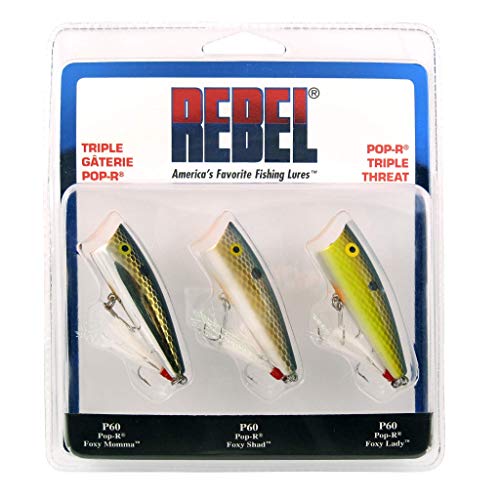
Where the Spook covers water, a popper picks it apart. The Rebel Pop-R is the reference point here — per Rebel, it has been the standard by which topwater poppers and chuggers have been judged for more than three decades. The Triple Threat pack gives you three of the 2 1/2-inch, 1/4-ounce originals with #6 hooks, in the Foxy Momma, Foxy Shad, and Foxy Lady patterns, for $13.49 as of July 2026.
The popper's cupped face spits water and makes a hollow bloop that reads as a struggling baitfish. The classic cadence is twitch, twitch, pause — and the pause is where most strikes happen, so do not rush it. Around docks, laydowns, and bed areas, gentle pops with long pauses let the bait sit in the strike zone while the rings settle; that patience is the whole technique.
But the Pop-R has a second gear that most anglers never use. According to Outdoor Life, Rick Clunn won a pile of money in the early 1980s by reeling a Pop-R across the surface at speed — no pauses, just a constant spitting retrieve that turns the popper into something closer to a fleeing shad. When bass are chasing bait on wind-blown banks, that fast retrieve out-fishes the polite version.
Where it wins: calm mornings, target fishing around cover, and any time fish are keyed on small forage. It is also the easiest topwater style to teach a kid — cast it out, let it sit, pop it home.
Plopper-Style Baits: Steady Noise That Covers Water
The plopper is the newest style in this lineup and the simplest to fish: cast it out and reel it in. A soft, rotating tail throws spray and produces a churning gurgle bass can track from a distance. According to Wired2Fish, plopper-style baits perform best on a steady retrieve, precisely because that constant sound lets bass home in on them from a distance, through heavy cover or dirty water.
Our pick is the TRUSCEND Popobait at $21.99 as of July 2026. Two design details stand out. First, TRUSCEND says the rotating tail starts working immediately, even at slow retrieve speeds — a slow-speed startup matters because the deadliest plopper retrieve is often barely faster than idle. Second, the aerodynamic body and double-blade design are built for longer casts, and casting distance is half the game with a search bait: more water covered per cast, and the bait working farther from the boat where fish have not been spooked. It ships with corrosion-resistant BKK hooks and, per TRUSCEND, keeps a balanced side spray and straight swim rather than rolling out at speed.
Cadence notes: start slow and steady. If fish swirl behind it without eating, vary the speed — a brief surge or a half-second stall often converts followers. Wind on the water that would drown out a popper is exactly when the plopper shines.
Where it wins: covering long banks, riprap, grass edges, and stained water. It is the bait we hand someone who wants topwater results without learning a retrieve.
Topwater Frog Lures: Hollow-Body Frogs for Heavy Cover
When the surface is matted grass, lily pads, or slop too thick for anything with trebles, the hollow-body frog is the only lure that fishes where the biggest bass live. The design is elegant: a soft, air-filled body rides hook-points-up and glides over cover, then collapses when a fish eats, exposing the double hook. This is the same principle behind the broader family of weedless bass lures, applied to the surface.
You can spend $12–15 on a single name-brand frog, and there are good reasons to. But because frog fishing means throwing at the nastiest cover on the lake, there is a strong case for the Jeoronuly hollow-body frog set: five frogs — three 13-gram large and two 8-gram mediums — for $9.99 as of July 2026. The weedless design glides through thick cover, the soft hollow body collapses on the bite, and the stainless steel double hook shrugs off wet summers. Two sizes in the box is genuinely useful: the 8-gram mediums get bit when fish are swiping at and missing the full-size frog.
Technique is everything with frogs:
- Work it in short glides and pauses across the mat, and slow down at holes, points, and edges in the vegetation — the high-percentage ambush spots.
- Do not set on the blowup. Wired2Fish's hook-setting advice for hollow frogs is to fight that jumpy urge and wait until the fish takes the frog down — if you can still see the frog, do not swing. The thicker the cover, the longer the pause.
- Gear up. A heavy rod and braided line are standard frog-fishing equipment, because you are winching fish out of vegetation, not playing them in open water. Braid in the 50–65 lb class is the common choice; this is one technique where light line costs you fish.
Where it wins: matted grass, pads, timber slop — anywhere else on this list is unfishable.
Prop Frogs: Extra Commotion When Plain Frogs Get Ignored
The prop frog splits the difference between a frog and a buzzbait. The KRLAO prop frog kit puts two 360-degree rotating propeller feet on a 3.5-inch, 13-gram hollow PVC body, so instead of gliding silently, it churns and sputters on a straight retrieve. Per KRLAO, a built-in lead sinker gives it a no-sink design that keeps the body riding correctly, and a weedless double barbed hook plus 3D-eye frog finish round it out. Five frogs run $16.99 as of July 2026, down from $17.99.
Reach for the prop frog when a standard hollow frog is being ignored: wind rippling the mat, stained water, scattered (rather than carpeted) vegetation, or fish that need noise to find the bait. Fish it on a slow, steady retrieve so the props keep spitting, and pause it at mat edges and holes exactly as you would a walking frog. Because it is weedless, it also doubles as a louder option over sparse grass where a plopper's trebles would foul.
Where it wins: sparse-to-medium vegetation, wind on the slop, and low-light aggression. Keep both frog styles rigged; the fish tell you which one they want.
When to Throw Topwater: Conditions, Temperature, and Timing
Owning the right lures only pays off if you throw them at the right times. Three factors do most of the work — light, temperature, and season.
Light. Bass are ambush predators that love attacking upward at a silhouette, which is why low light is topwater's home field. According to Bass Fishing Blueprint, the best window of the day is the first two hours after sunrise, when dissolved oxygen is high and bass slide shallow to ambush prey in low light; BassForecast's topwater guide calls first light to 9 a.m. the prime window, with the last hour before dark next and overcast days stretching the bite into midday. BassOnline agrees that early morning, nighttime, and overcast days are when topwater fishing is at its best.
Temperature. BassForecast puts the topwater sweet spot at 65–85°F, and that squares with what we see on the water. Below 60, bass turn sluggish and surface strikes get rare; from the mid-60s through the 70s, everything on this list works; and once summer water climbs toward 90, the daytime bite compresses into dawn, dusk, and dark — or into shaded slop, which is where the frogs keep producing when open-water topwater dies at noon. If you are building a warm-season box, the same thinking applies to bass lures for summer generally: follow the shade, the oxygen, and the low light.
Season. Late spring through early fall is prime time, but do not rack the topwaters at Labor Day. Shad school up shallow during the autumn feed, and walking baits and ploppers over those schools can be the best surface fishing of the year — we cover that transition in detail in our guide to bass lures for fall.
One more variable: wind. A light ripple helps every bait here by softening the fish's view of the fake. Heavy chop drowns out poppers first, walking baits second — that is your cue to switch to the plopper or prop frog and let noise do the finding.
The Bottom Line
Topwater is the rare category where a full system costs less than one premium swimbait. As of July 2026, all five picks — the Heddon Super Spook three-pack ($18.49), Rebel Pop-R Triple Threat ($13.49), TRUSCEND Popobait ($21.99), Jeoronuly frog set ($9.99), and KRLAO prop frogs ($16.99) — total about $80 and cover every surface situation a bass lake can throw at you.
If you are starting with one, make it the Super Spook and learn to walk the dog; a century of fish catches says the technique is worth the practice. Add the Pop-R for calm-water target fishing, the plopper for covering water, and the two frogs the day your lake's grass mats up. And if a fish flushes on your bait and misses, do not repeat the cast immediately — follow up with something subsurface; our list of five deadly largemouth lures has the right candidates.
Topwater is one wing of a larger arsenal. For our full rankings across every category — and how these five fit into a complete tackle system — see our guide to the best bass lures.
The Picks, Tested
Heddon Super Spook (3-pack)
A walk-the-dog style walking bait and long-time tackle-box staple, sold as a 3-pack in bone, baby bass and foxy shad colors. It comes rigged with super sharp treble hooks and targets largemouth bass, stripers and speckled trout.
- One pack covers three proven colors — bone, baby bass and foxy shad — with super sharp treble hooks ready to fish out of the package.
Rebel Pop-R Triple Threat (3-pack)
A 2 1/2-inch, 1/4-ounce tournament-proven popper with.
- A tournament-proven popper design at a compact 2 1/2 inches and 1/4 ounce, with three popular color patterns in one pack.

TRUSCEND Popobait Plopper
A plopper-style topwater whose rotating tail starts working immediately, even at slow retrieve speeds, producing balanced side spray, a gurgling sound and a straight swim. The aerodynamic body and double-blade design cast long, and it comes factory-equipped with corrosion-resistant BKK hooks.
- The rotating tail engages instantly at slow speeds, and the double-blade, aerodynamic body adds real casting distance.

Jeoronuly Hollow-Body Frog Set (5-pack)
A five-frog hollow-body set — three 13 g large frogs and two 8 g mediums — with a weedless design that glides through thick cover. The soft hollow body collapses on the bite to expose the stainless steel double hook.
- Five weedless hollow-body frogs for under ten dollars, with soft bodies that collapse on the bite to expose the stainless double hook.

KRLAO Prop Frog Kit (5-pack)
A 3.5-inch, 13 g prop frog with two 360-degree rotating propeller feet that churn the surface as it swims.
- Twin 360-degree propeller feet churn the surface while the weedless double barbed hook and no-sink hollow body keep it fishing through cover.
Compare The Field
| Compare | Our Pick Heddon Super Spook (3-pack) | Classic Popper Rebel Pop-R Triple Threat (3-pack) | Plopper Pick TRUSCEND Popobait Plopper |
|---|---|---|---|
| Overall | — | — | — |
| Price | $18.49 Check price → | $13.49 Check price → | $21.99 Check price → |
About The Author
Rob Thomas
Rob Thomas is a fisherman who loves catching tales from his fellow fishermen. He always enjoys a good story, especially when it comes from the sea.