Best Saltwater Spinning Reels: Sealed, Serviceable, and Worth the Money

This post may contain affiliate links. Read our policy.

Piscifun NautiX, 3000
The only reel on this page under $100 that publishes both a water-resistance rating and sealed bearings.
- The 26 lb drag rating is pinned to the 3000 and 4000 sizes rather than quoted across the whole series, which is rarer at this price than it should be
- A full aluminium main body with a carbon rotor and a stainless main shaft, per Piscifun, for under $100
- The only pick here with both a published IPX5 claim and sealed bearings under $100
- A brass pinion gear and a CNC-machined aluminium main gear, per Piscifun, rather than moulded parts
- IPX5 is a water-jet rating rather than an immersion rating, and it is Piscifun's claim rather than an independent test result
- The listing describes the bearings as sealed in the title and as double-shielded in the feature list, which are not the same standard
- Parts, schematics and service for Piscifun are harder to come by than for PENN, Shimano or Daiwa if something goes wrong in year three
Best Saltwater Spinning Reels: Sealed, Serviceable, and Worth the Money
Buy the Piscifun NautiX 3000 at about $85.99 as of October 2026 for the most sealing per dollar, or the PENN Battle III 4000 at about $138.88 as of October 2026 for the reel most inshore anglers should actually own. Salt does not break reels by brute force. It breaks them by getting inside, and those two picks attack that problem from opposite ends.
Angler Reviews is reader-supported: as an Amazon Associate we may earn a commission from qualifying purchases made through links on this page, at no extra cost to you.
So the question here is not which reel is strongest. It is which reel keeps salt out, and which reel you can take apart when salt gets in anyway. A sealed reel you cannot service is a worse buy than a serviceable reel you rinse properly, because sealing fails quietly and a schematic does not. If you are shopping the whole rack rather than just the salt end of it, start with how to choose a spinning reel.
The short version
- Best value: Piscifun NautiX 3000, about $85.99 as of October 2026. The only pick under $100 publishing both an IPX5 claim and sealed bearings, with a 26 lb drag rating pinned to the 3000 and 4000 sizes rather than a whole series.
- Light inshore: Shimano Sahara FJ SH2500FJ, about $104.90 as of October 2026. A 2500 for flats, specks and redfish, bought for the service network. Shimano publishes no sealing rating, so treat it as rinse-and-dry.
- All-round inshore: PENN Battle III 4000, about $138.88 as of October 2026. Published 4000-size capacities, an all-aluminium body, and the lowest maximum drag here.
- Surf and jetty: PENN Spinfisher VI 4500, about $184 as of October 2026. An IPX5 sealed spool and 390 yd of 15 lb braid.
- Big water: Daiwa BG8000, about $189 as of October 2026 against a $199.99 list price. The listing showed only 1 unit left as of October 2026, so check availability first.
What salt actually destroys inside a reel
Two mechanisms do the damage, and neither is the orange rust you can see.
The first is galvanic corrosion, which needs two dissimilar metals in contact and a liquid to carry ions between them. A Shimano patent on fishing components, US7530514B2, puts it in a reel designer's terms: when a conducting liquid such as saltwater seeps between a magnesium alloy part and a stainless steel part, the difference in how readily the two metals ionize sets up small local cells and the magnesium part corrodes. The patent notes a part is especially vulnerable where its coating has a pinhole, and proposes insulating films on the stainless component as the fix. So the danger spots are the screws, shafts and bearing races, not the painted panels.
The second mechanism is mechanical, and it happens on the drive home. A Pure Fishing Japan reel patent, US10143189B2, states that seawater enters the gaps between the rolling elements and the raceway surfaces of a bearing, and that when it crystallizes out it can hinder the rotation of rotary members and cause abnormal noise and fixation - what the patent calls salt engagement. Water that gets in and then evaporates leaves hard crystals in the one place you cannot wipe.
A reel rarely dies during a trip. It dies between trips, quietly, while it dries.
"Sealed" is a spectrum, not a state
Two picks here carry an IPX5 rating, which is commonly read as meaning waterproof. It is not.
IPX5 comes from the IEC 60529 ingress-protection standard. In an IP-ratings reference published by Oriental Motor, which classifies ratings to EN 60529 and notes it as equivalent to IEC 60529, the second-digit 5 test is a sprayed water jet of 30 kPa at 12.5 litres per minute for 3 minutes from all directions at a distance of 3 m. That is a low-pressure hose test. Immersion is a different digit entirely: the same reference defines 7 as immersion to a depth of 1 m for 30 minutes.
So an IPX5 reel is rated to shrug off rain, spray and a wave over the gunwale. It is not rated to be dropped over the side or blasted at the dock. And on both listings the rating is a manufacturer claim - no independent lab result appears on either page.
The five picks line up like this, least to most protected:
- No published rating at all: the Shimano Sahara FJ and the Daiwa BG8000. Neither listing claims water resistance, so neither gets credit for any.
- Claimed IPX5 plus shielded bearings, a dust cover and rubber rings: the Piscifun NautiX. Its own title says sealed bearings while its feature list says double-shielded, and those are not the same standard.
- Claimed IPX5 on the spool plus an all-metal body: the PENN Spinfisher VI, where PENN pairs the sealing claim with a body and spool design it says is there to combat corrosion.
The other half of the equation is whether anyone can fix the thing. PENN, Shimano and Daiwa keep long-running parts and schematic networks; the budget brands mostly do not, and that is a real cost no spec sheet shows. We go through it brand by brand in spinning reel brands compared.
Size and capacity: why 3000 to 5000 is the working range
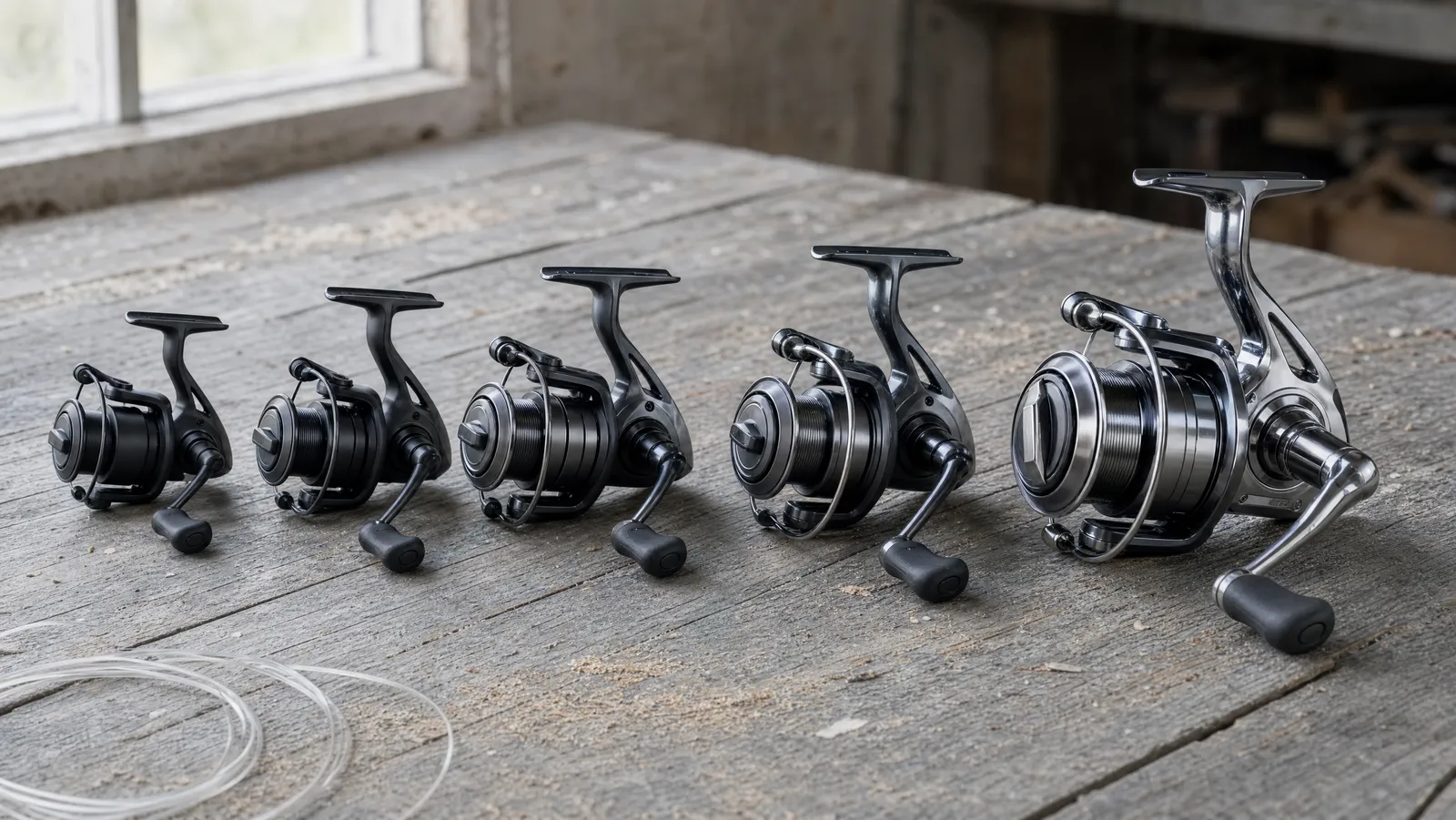
For inshore saltwater, 3000 to 5000 covers nearly everything. A 2500 is a flats and marsh reel - fine for speckled trout, redfish and snook on light line, short on capacity for much else. A 4000 is the all-round choice, and a 4500 is where you go when you need the line.
Capacity is the reason, not strength. PENN lists 360 yd of 15 lb braid for the Battle III 4000, and 390 yd of 15 lb braid or 425 yd of 8 lb mono for the Spinfisher VI 4500. Daiwa lists 590 yd of 65 lb J-Braid for the BG8000. Each step buys another hundred yards of insurance, and surf fishing spends it fastest: you give away distance before the fish even arrives, then a bull red running parallel to the beach takes the rest.
Gearing scales with it. PENN publishes 37 inches of recovery per crank at 6.2:1 for the Battle III 4000 and 40 inches at the same ratio for the Spinfisher VI 4500 - same gearing, bigger spool, more line per turn, which is what keeps a long cast from becoming a slack-line hookset.
If the numbering feels arbitrary, spinning reel sizes explained is the companion piece, and our line capacity calculator tells you what a spool swallows before you buy the wrong amount of line. These capacities are mostly quoted in braid, and braided fishing line covers why thin diameter is worth more in salt than in a farm pond.
Drag: the maximum number is the least useful one
This page is the clearest illustration of why maximum drag is a marketing number.
PENN publishes a maximum of 15 lb for the Battle III 4000. Piscifun publishes up to 26 lb for the NautiX 3000 and 4000. On paper the $85.99 reel beats the $138.88 reel by 73 percent. In the water that gap is close to meaningless, because nobody fishes near maximum drag.
Published guidance sits far below it. Saltwater Sportsman's drag primer from George Poveromo recommends about 20 percent of breaking strength for monofilament up to 20 lb test and 25 percent for 30 to 50 lb mono, with lower figures for braid because it does not stretch: about 15 percent for braid up to 20 lb test and 20 percent for 30 to 65 lb.
Run that on inshore tackle. On 20 lb braid, the braid figure is 15 percent, so 3 lb of drag; on 30 lb braid, 20 percent gives 6 lb. PENN's 15 lb maximum is already more than double what the heaviest inshore braid asks for, and Piscifun's 26 lb is headroom you will never touch on a 4000.
What matters instead is start-up smoothness. A drag has to break static friction before it slips, so a dry, salty or gritty washer stack spikes above its set value at exactly the wrong moment. That is a sealing and maintenance problem rather than a torque problem - this whole page in one sentence. How to set your spinning reel drag has the method with a scale.
Piscifun NautiX 3000 - best value saltwater reel
The most sealing per dollar here, and what we would buy with a hard $100 ceiling. Piscifun states an IPX5 rating, an aluminium alloy dust cover and 4 rubber rings to limit water intrusion, around a full aluminium body with a carbon rotor, a stainless main shaft, 8+1 bearings at 6.0:1 and a brass pinion. The triple-disc carbon drag is rated up to 26 lb on the 3000 and 4000, with 33 lb quoted for the 5000 and 6000.
Two caveats. Piscifun's 26 lb figure is pinned to the size you are buying rather than quoted across a series, which is more honest than this price bracket usually manages. The second is less flattering: the title calls the bearings sealed and the feature list calls them double-shielded, and a shield is not a seal. Add a thinner parts network and this is a reel to buy with open eyes. The Piscifun NautiX 3000 is about $85.99 as of October 2026.
Shimano Sahara FJ SH2500FJ - best for light inshore
For flats, marsh edges, speckled trout and redfish on light line, a 2500 is the right size and this is a good one. Shimano lists HAGANE Gear, SilentDrive, the Propulsion Line Management System and a G-Free Body, and the real argument for it is that you will still be able to buy parts and find a dealer in ten years.
The honest part matters more. Shimano publishes no sealing rating on this listing, no drag figure and no bearing count, and we will not quote numbers that do not exist. Treat the Shimano Sahara FJ as a well-made general-purpose reel that suits light salt water on the condition that it gets rinsed and dried every trip. About $104.90 as of October 2026: roughly $19 more than the Piscifun, with fewer published figures and a much better service network.
PENN Battle III 4000 - best all-round inshore reel
If you buy one saltwater spinning reel, buy this one. PENN publishes figures that belong to the 4000 rather than to a series: 6.2:1 recovering 37 inches per crank, an HT-100 front drag with carbon fiber washers rated to a maximum of 15 lb, and braid capacity of 360 yd of 15 lb or 260 yd of 20 lb. Body and sideplates are all aluminium, with a forged and machined aluminium spool carrying Line Capacity Rings so you can see what is left mid-run.
PENN's listing cites a 2020 ICAST Online Best of Category win for Saltwater Reel, and trade coverage of that year's awards confirms the Battle III took the saltwater reel category. Read that as the industry liking the value, not as a durability test.
The drawbacks are real. PENN publishes no sealing rating, so your rinse routine is the only gasket. The 15 lb maximum drag will cost PENN sales to spec-sheet shoppers even though 20 lb braid asks for about 3 lb. And an all-metal 4000 carries more mass than a graphite reel of the same size, which you feel at hour six. The PENN Battle III 4000 is about $138.88 as of October 2026.
PENN Spinfisher VI 4500 - best for surf and jetty
Surf and jetty is the hardest duty here: constant spray, sand, long casts, and fish that run before you can turn them. PENN states an IPX5 sealed aluminium spool with an all-metal body and spool design to combat corrosion, an HT-100 drag rated to a maximum of 20 lb, 40 inches of recovery per crank at 6.2:1, and 390 yd of 15 lb braid.
Keep two things in proportion. PENN specifies only 5 stainless bearings plus 1 instant anti-reverse, the lowest published count here, on the second most expensive reel. And IPX5 means water jets, not immersion, so a wave hitting the reel is within its brief while a drop into the wash is not.
Distance is the other half of surf performance, and it is mostly technique: spool fill, rod load and timing, which how to cast a spinning reel breaks down. Note too that per PENN the automatic bail trip covers sizes 2500 through 5500 only, so sizing up to a 6500 later means flipping the bail by hand. The PENN Spinfisher VI 4500 is about $184 as of October 2026.
Daiwa BG8000 - best for big water
The big-water pick: offshore casting, heavy structure, and fish that take 300 yards without asking. Daiwa lists a black anodised machined aluminium Hard Bodyz housing and side cover, an over-sized Digigear drive gear, an Air Rotor and a solid screw-in handle, with J-Braid capacity of 590 yd of 65 lb or 440 yd of 80 lb.
Two flags, stated plainly. The listing showed only 1 unit left as of October 2026, so check availability before planning anything around it. And no maximum-drag figure appears on the Amazon listing, so we will not quote one, the same way we will not quote a sealing rating Daiwa has not published here.
What you are buying is housing material and capacity, which is the right thing to buy in an 8000 - and far too much reel for inshore water. The Daiwa BG8000 is about $189 as of October 2026, against a $199.99 list price.
The rinse routine that decides whether any of this lasts
Everything above is a hedge. This is what decides whether your reel sees a tenth season, and the counterintuitive part is that pressure is the enemy.
BoatUS, in its fishing rod and reel care guidance, says to tighten the drag all the way down first so rinse water cannot push between the plates, then rinse gently at low pressure - a mist or a slowly running hose with no nozzle - and warns that using a stream or blasting the reel with a nozzle can drive salt into the reel, particularly into the drag, quickly ruining it. Boating Magazine makes the same point: high pressure from a hose can drive salt and dirt into the reel's workings. BoatUS also advises backing the drag off once the reel is dry so the washers are not left compressed.
The routine we would run after a salt trip:
- Tighten the drag down before any water touches the reel.
- Rinse at low pressure, aimed at the outside rather than into the spool and rotor gap.
- Wipe it down and let it dry standing up, out of direct sun.
- Back the drag off once it is dry.
- Strip and service it once a season, more often if you fish the surf: salt that got in has to come out physically.
Step five is where serviceability repays the money you did not spend on sealing. How to clean a spinning reel walks through a full teardown, including which screws to leave alone.
What we would skip
- Any reel marketed as waterproof without a published rating. A specific claim you can check beats an adjective.
- Buying on maximum drag. In our view the 15 lb Battle III out-fishes a 26 lb budget reel on the metrics that actually matter.
- Bearing count as a shortcut. PENN specifies 5 plus 1 on a $184 reel; Piscifun specifies 8+1 on an $85.99 one. Count says nothing about grade, fit or sealing.
- A sealed reel from a brand with no parts network. Sealing eventually fails. Schematics do not.
What we would buy
Every price here is as of October 2026. Buy the PENN Battle III 4000 at about $138.88 if you fish salt regularly and want one reel for it: published 4000-size numbers, an all-aluminium body, parts you can get, and a 15 lb maximum drag that is still more than double what the heaviest inshore braid will ask for. With a $100 ceiling, buy the Piscifun NautiX 3000 at about $85.99 and know exactly what its IPX5 claim does not cover. For surf or a jetty, step up to the PENN Spinfisher VI 4500 at about $184. On the flats, the Shimano Sahara FJ at about $104.90 buys the best service network here, as long as you rinse it like it is not sealed. Go to the Daiwa BG8000 at about $189 only if the water is genuinely big, and check that one-unit stock first.
Then stop reading spec sheets and start rinsing: salt gets in no matter what the box says, so the reel that lasts is the one you rinse at low pressure and strip once a season. For the wider picture on frames, gearing and sizes beyond salt water, our guide to the best spinning reels is where to carry on.
The Picks, Tested
Piscifun NautiX, 3000
The only reel on this page under $100 that publishes both a water-resistance rating and sealed bearings. Piscifun states an IPX5 rating, an aluminium alloy dust cover and 4 rubber rings to limit water intrusion, around a full aluminium body with a carbon rotor and a stainless steel main shaft.
- The 26 lb drag rating is pinned to the 3000 and 4000 sizes rather than quoted across the whole series, which is rarer at this price than it should be
- A full aluminium main body with a carbon rotor and a stainless main shaft, per Piscifun, for under $100
- The only pick here with both a published IPX5 claim and sealed bearings under $100
- A brass pinion gear and a CNC-machined aluminium main gear, per Piscifun, rather than moulded parts
- IPX5 is a water-jet rating rather than an immersion rating, and it is Piscifun's claim rather than an independent test result
- The listing describes the bearings as sealed in the title and as double-shielded in the feature list, which are not the same standard
- Parts, schematics and service for Piscifun are harder to come by than for PENN, Shimano or Daiwa if something goes wrong in year three
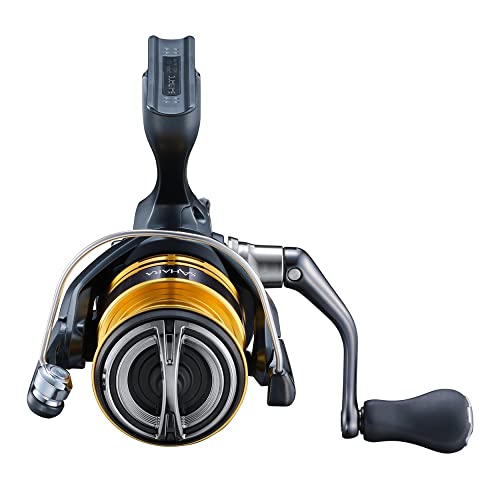
Shimano Sahara FJ, SH2500FJ
A 2500 for flats, marsh, speckled trout, redfish and light jetty work, bought for Shimano's parts and service network rather than for its spec sheet. Shimano lists HAGANE Gear, SilentDrive, the Propulsion Line Management System and a G-Free Body.
- Shimano dealer support, schematics and spare parts are the easiest to find of any brand on this page, which matters most on the reel you keep for a decade
- A 2500 is the right size for flats and marsh fishing, where an all-metal 4000 is dead weight on a light rod
- Named gear and line-management features rather than an eye-catching drag number aimed at spec-sheet shoppers
- Shimano publishes no sealing or water-resistance rating on this listing, so do not treat it as a sealed saltwater reel
- No drag rating and no bearing count appear on the listing either, so there are fewer published figures here than on a reel costing $19 less
- A 2500 runs out of capacity fast in the surf, and this is not the reel for a jetty in a running tide

PENN Battle III, 4000
The default inshore reel, and the one we would hand almost anyone who fishes salt water a dozen or more days a year. PENN publishes 4000-size numbers that belong to this reel: a 6.
- Every figure PENN publishes here is pinned to the 4000 size, including mono and braid capacities you can check before you spool
- All-aluminium body and sideplates with a forged, machined aluminium spool, per PENN, rather than a graphite frame
- Line Capacity Rings on the spool, per PENN, so you can see what is left during a long run
- PENN parts and schematics are widely available, which is the half of saltwater durability nobody advertises
- PENN publishes no sealing or water-resistance rating for the Battle III, so your rinse routine is doing that job
- The published 15 lb maximum drag reads as weak next to budget reels claiming 22 to 26 lb, and plenty of shoppers will buy on that number alone
- An all-metal 4000 carries more mass than a graphite-bodied reel of the same size, which you notice over a day of casting

PENN Spinfisher VI, 4500
The pick when the reel spends the day in spray and the cast has to be long. PENN states an IPX5 sealed aluminium spool with an all-metal body and spool design to combat corrosion, an HT-100 front drag with carbon fiber washers rated to a maximum of 20 lb, a 6.
- A published IPX5 claim on the spool alongside an all-metal body, per PENN, which is the right pairing for surf and jetty spray
- 390 yd of 15 lb braid or 425 yd of 8 lb mono in the 4500, per PENN, so a long first run does not reach your knot
- 40 inches of recovery per crank, per PENN, which is what a long cast needs to pick up slack
- A 20 lb maximum drag, per PENN, with capacity and gearing matched to the same fishing
- 5 stainless bearings plus 1 anti-reverse is the lowest published count on this page at the second-highest price
- IPX5 is a low-pressure water-jet rating rather than an immersion rating, and it is PENN's claim rather than an independent test result
- A 4500 all-metal reel is more than inshore fishing needs, and per PENN the sizes above 5500 lose the automatic bail trip if you size up later

Daiwa BG8000
An 8000-size BG for offshore casting, heavy structure and fish that leave. Daiwa lists a black anodised machined aluminium Hard Bodyz housing and side cover, an over-sized Digigear drive gear, an Air Rotor and a solid screw-in handle, with J-Braid capacity of 590 yd of 65 lb and mono capacity of 440 yd of 25 lb.
- A machined aluminium housing and side cover, per Daiwa, rather than a composite frame carrying an offshore load
- 590 yd of 65 lb J-Braid in the 8000, per Daiwa, which is a genuine big-water spool
- A solid screw-in handle rather than a folding one, per Daiwa
- At about $189 as of October 2026 it is the cheapest route here into real offshore capacity
- The listing showed only 1 unit left as of October 2026, so check availability before you plan a trip around it
- No maximum-drag figure appears on the listing, and we are not going to invent one
- No sealing or water-resistance rating appears on the listing either, so this is a rinse-and-service reel, not a sealed one
- An 8000 is far too much reel for inshore work and tiring to cast all day
Compare The Field
| Compare | Best Value Saltwater Reel Piscifun NautiX, 3000 | Best for Light Inshore Shimano Sahara FJ, SH2500FJ | Best All-Round Inshore Reel PENN Battle III, 4000 |
|---|---|---|---|
| Overall | — | — | — |
| Price | $85.99 Check price → | $104.9 Check price → | $138.88 Check price → |
About The Author
Rob Thomas
Rob Thomas is a fisherman who loves catching tales from his fellow fishermen. He always enjoys a good story, especially when it comes from the sea.