How a Spinning Reel Works: Every Part, and What It Does

This post may contain affiliate links. Read our policy.
How a Spinning Reel Works: Every Part, and What It Does
A spinning reel works by holding the spool still and moving everything else around it. Turn the handle and a gear train swings a rotor in a circle around that fixed spool, with a small roller on one rotor arm feeding line on. On the cast the rotor stops, the bail opens, and line peels off the front lip of the spool in loops.
The part most anglers get wrong is the first clause. The spool on a spinning reel does not rotate to pay out or take in line. The drag holds it against rotation, and its only movement under power is a slow slide in and out along the main shaft. Almost everything odd about these reels follows from that one fact: why they throw a 1/16 oz jighead so easily, why they put twist in line, why gear ratio is not retrieve speed, and why braid can leap off the spool and knot itself in the guides.
Below is the drivetrain in the order the energy travels, with the common failure named at each stage. If you are shopping rather than diagnosing, our guide to the best spinning reels covers that decision; this page is the mechanism underneath it.
Spinning reel parts, front to back
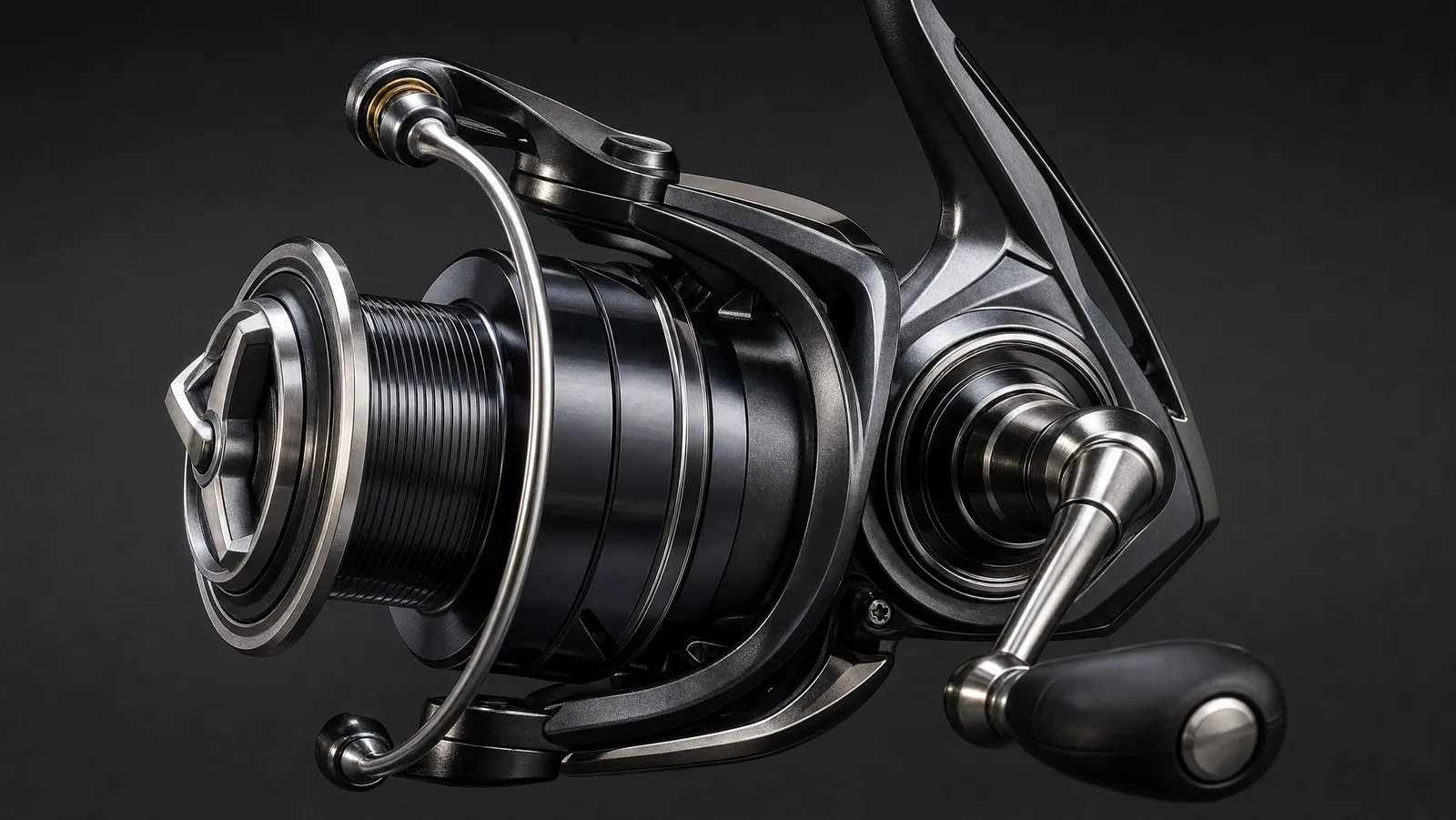
Nobody can draw a diagram in a paragraph, so here is every part you can touch, in order from the nose of the reel to the handle.
- Drag knob. The dial at the very front on most reels, clamping the drag stack inside the spool.
- Spool. The cylinder the line sits on. Its front lip is the edge line jumps over on the cast; its skirt keeps line out of the rotor.
- Bail. The wire arc hinged on two rotor arms, which flips open and shut.
- Line roller. The small grooved wheel at the tip of one bail arm, where line turns the corner on the retrieve.
- Rotor. The assembly carrying the bail arms and the roller, orbiting the spool.
- Main shaft. The steel rod running from the body through the rotor. The spool rides on it.
- Body. Houses the main gear, pinion, oscillation parts and anti-reverse clutch.
- Handle and knob. On the side, reversible on most reels.
- Stem and reel foot. The post and flat blade that clamp into the rod's reel seat.
- Rear of the body. A rear drag knob on some reels, an anti-reverse switch on others.
That order matters for maintenance too: the front group comes apart in your lap with no tools, the body group does not. Our cleaning guide splits the job on exactly that line.
What happens on the cast
Open the bail, trap the line against the blank under your index finger, load the rod, unload it, let go. The lure drags line off the front lip of a spool that never moves. The spool adds no rotating mass, so the only brake on the lure is friction as the coils scrape over the lip and through the guides.
Outdoor Life's baitcaster-versus-spinning comparison puts it plainly: because a spinning reel's spool stays in a fixed position and line flows out once the bail opens, spinning reels do not need as much inertia to get line moving. The same piece names the cost — spinning gear gives up some distance, because friction as line leaves the stationary spool slows the lure.
A baitcaster has the opposite problem. Its spool must be spun up from rest by the lure itself, so there is a floor on how light a lure it can throw. That floor, not casting skill, is why finesse fishing lives on spinning gear. Bait-finesse baitcasters with shallow, light spools have pushed it down, so treat this as a difference of degree — the full argument sits in our spinning reel vs baitcaster comparison.
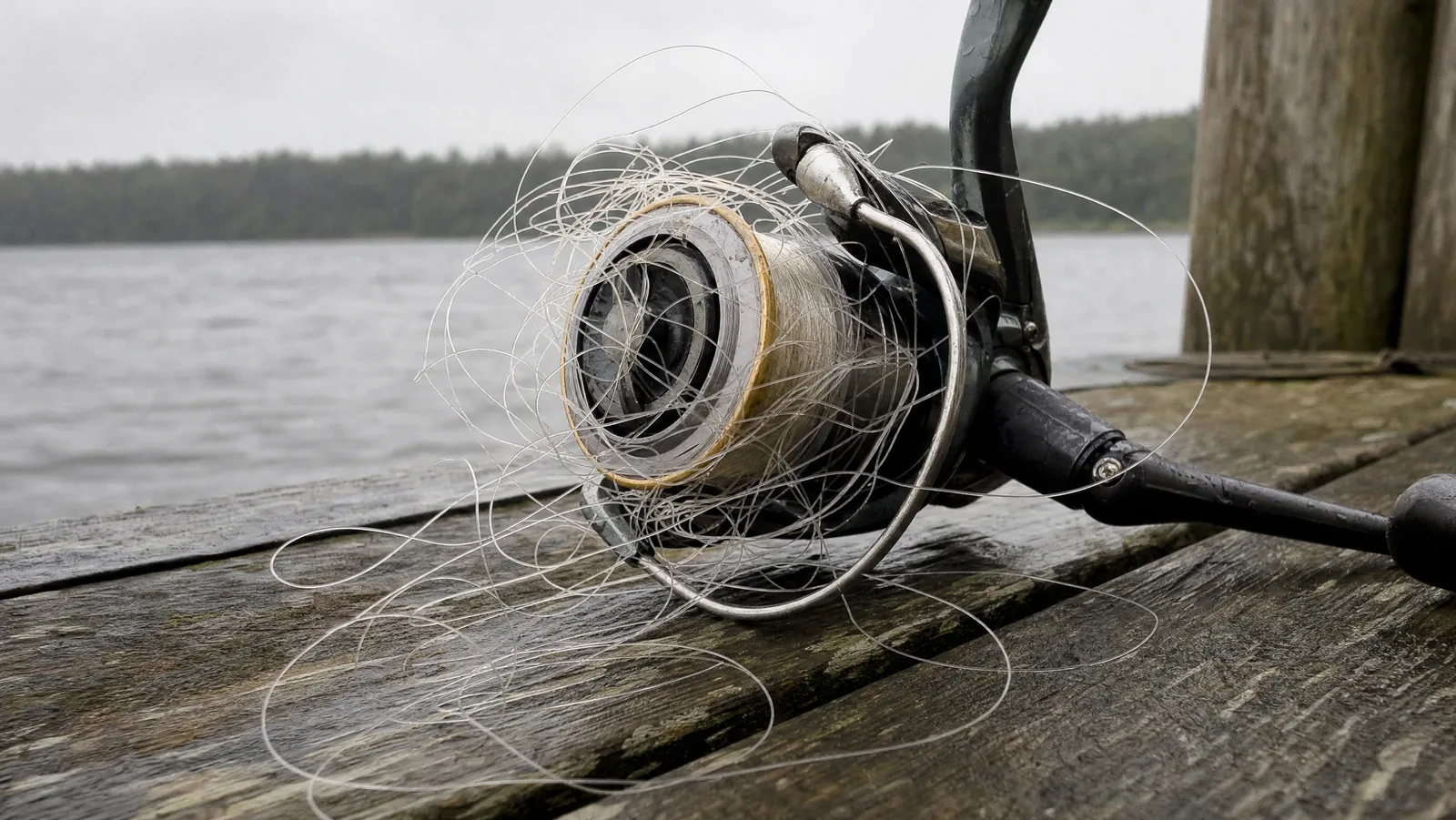
Line choice bites harder here for the same reason: line must bend into a coil to leave the spool lip, so stiff line holds that shape and springs off in loops. Limp line behaves, which drives most of our picks for fishing line for spinning reels.
The handle, main gear and pinion
Turn the handle and you turn a main gear, usually called the drive gear, which meshes with a much smaller pinion. In the designs described across US spinning-reel patents, the pinion is tubular with the main shaft running through it, and the rotor is fixed to the front of the pinion so the two turn as one piece.
Gear ratio is nothing more exotic than the tooth count of the main gear divided by the tooth count of the pinion, which is why ratios land on awkward numbers like 5.2:1. Because the rotor is bolted to the pinion, that ratio counts rotor revolutions per handle turn, not spool revolutions. It tells you how many laps the rotor does, not how big a lap is, which is why we treat inches per turn as the only honest figure in our piece on spinning reel gear ratio.
Gear material is where the marketing budget goes. Shimano claims its HAGANE gear is cold forged by compressing a solid metal block with roughly 200 tons of force, reaching micron-level accuracy without cutting the tooth surface. That is the company's claim, not an independent test. Gears do announce their own failure: grinding under load, or a handle notchy at the same point in every revolution, means wear or grit in the mesh.
The rotor and the line roller
The rotor is the arm assembly orbiting the stationary spool, and the line roller at the tip of one arm is what the line actually rides over. The roller is supposed to rotate. When it spins freely, line slides across a moving surface and any twist it carries can relieve itself before it is wound on.
When it seizes, the line drags across one static point instead. Line-roller patents describe grooved roller designs meant to stop line rolling sideways along the roller's axis, specifically to prevent twist. TackleTour's review of the Daiwa Revros makes the field version of the argument, observing that because that reel has no bearing under the roller guide, line has a greater tendency to twist than on reels equipped with one.
So the failure runs like this: a seized roller gets a groove worn into it by braid, the groove grips the line, and every retrieve feeds twist onto the spool. You find out when the line throws loops the moment it goes slack. How the line went on is the other half of that story, covered in our spooling guide.
The bail, and why beginners fight it
The bail is three things: a wire arm, a spring, and a trip mechanism. Pushing it open loads the spring and holds the arm over. Cranking the handle swings the rotor until a trip feature catches and flips it shut — TackleTour describes that mechanism on one Daiwa reel as a mechanical trip ridge inside the rotor that pushes the bail closed.
Closing the bail by hand is gentler on that ridge and the spring behind it, and the same reviewer notes the habit: fish these reels long enough and you close it by hand anyway. The bail is also the part beginners lose fish to — a tired spring or worn trip lets it snap shut mid-cast, shock-loading line already near its limit.
Oscillation, and why line lay goes bad
While the rotor orbits, the spool creeps slowly forward and back along the main shaft. That motion comes from a separate drive inside the body — a worm shaft, or a spiral gear and cam shaft turned by an intermediate gear, moving a slider that carries the spool shaft, as described in US patent 6,682,007 for an improved spool oscillating mechanism. Without it, every rotor revolution would drop line in the same place and build one fat band.
Oscillation speed sets the crosswrap: slower spool travel per rotor revolution means finer criss-crossing, which generally sits flatter and comes off cleaner. Shimano sells a refinement on the idea, explaining that a conventional oscillation gear at constant speed gives uneven spool speed, while an oval gear varies the cam's speed to keep it consistent.
The useful part for an angler: a bad line lay is usually a machine problem, not a user problem. Line piling at the front, stacking at the back, or climbing the lip and dumping a coil is normally oscillation geometry or a missing spool shim, not bad spooling. Spool shape and depth are also where reel size shows up, the subject of spinning reel sizes explained.
The drag stack
Unscrew a front drag knob and the stack falls into your hand: alternating friction washers and keyed metal plates inside the spool. The knob squeezes them together. The spool is keyed to one set and the shaft to the other, so when a fish pulls harder than the clamping force allows, the spool rotates against the stack and gives line. That is the only time it rotates on purpose.
Start-up inertia comes first. The stack has to break free before it can slip, and the industry describes the symptom as it feels: a momentary stickiness when a fish first strikes. The opening instant of a run therefore loads the line hardest, which is why a drag set near the line's limit still breaks off on the strike.
Heat is the second. Quoted in Fishtrack's reel science explainer, Okuma's director of product development argues carbon fibre is the best drag washer material because it sheds heat effectively; the same piece notes that as heat builds the preset drag value rises. The same source credits oiled felt with low start-up inertia but warns that felt compresses, so reels using it should be stored with the drag backed off.
Back the drag off in storage either way; for turning this into a number on the water, see how to set spinning reel drag.
Anti-reverse, and the backplay that gives it away
Anti-reverse is a one-way clutch. Spinning-reel patents place a roller-type version between the reel body and the rotor, in one design seated in the inner periphery of the rotor skirt. It lets the rotor turn in the retrieve direction and locks the other, so the handle will not spin backwards when a fish pulls.
Some reels add an anti-reverse switch at the back of the body. Flipping it off disengages the clutch and lets the handle turn backwards, which is how anglers back-reel against a fish instead of leaning on the drag. A preference, not a feature grade.
A failing instant anti-reverse shows up as a few degrees of back-play in the handle before it locks, where there used to be none: a worn or contaminated clutch, and it gets sloppier from there.
Bearings: reading the spec sheet honestly
Bearing count is printed largest on the box and tells you least. Reel makers split on it: KastKing's buying guide argues more bearings mean a smoother reel, with the caveat that they must be well placed and of good quality, while Bass Pro's spinning reel buyer's guide states that a reel with four quality bearings will outperform one with ten poor ones.
Both can be true, because the count is a proxy and placement is the variable. Bearings under the pinion, on the main gear and under the line roller carry load; one dropped into a low-stress spot raises the number and nothing else. Read a bearing count as a rough price signal, not a smoothness rating.
Body, rotor and spool materials
Materials trade stiffness, weight, corrosion resistance and cost against each other. Nothing wins everywhere.
- Graphite and carbon composites. Light, immune to salt corrosion, cheap to mould, least stiff. Under heavy drag a graphite body can flex, and makers selling stiffer bodies argue that flex lets the gears wander out of mesh — part of why graphite is most common on lighter freshwater reels.
- Aluminium. Stiff, holds gear alignment under load, heavier, and liable to corrode if the anodising is breached and it is left wet in salt.
- Magnesium. Lighter than aluminium at similar stiffness, top of the price ladder, and needs more care.
Makers mix them: Shimano describes its HAGANE body as built from ultra-rigid materials such as aluminium and magnesium to cut weight without losing strength. The common pattern on a shelf is an aluminium body with a composite rotor — stiffness where the gears are, saved weight where the reel swings.
What fails first
Nine times in ten, a reel that feels wrong has one of these.
- Line twisting and looping. A seized or grooved line roller, or line that went on twisted.
- Loose coils jumping off the spool. Line lay: oscillation geometry, shims, or line too stiff for the spool.
- Grinding or clicking under load. Gear mesh — wear, grit, or washed-out grease.
- Bail closing on the cast. A weak bail spring or worn trip.
- Jerky drag, or drag that climbs during a run. A compressed or dry stack, or heat in the washers.
- Handle back-play. The one-way anti-reverse clutch.
- Gritty rotation. A dead bearing, usually the one under the line roller, which lives in the water.
Each symptom and its fix gets the full treatment in our spinning reel problems troubleshooting guide.
Knowing the parts changes how you buy
A spinning reel is a fixed spool, a rotor that orbits it, a gear train driving the rotor, an oscillation mechanism that spreads line across the spool, a stack of washers that lets a fish take line, and a one-way clutch that stops the handle turning backwards. Name those six with the reel in your hand and the spec sheet stops being a wall of numbers: gear ratio becomes a rotor-speed figure that needs spool diameter to mean anything, bearing count becomes a price signal, body material a question about how hard you intend to pull.
Go and find all ten parts on the reel you own. Then back the drag off for storage and spin the line roller with a fingertip — the two highest-value minutes an owner can spend. When you are ready to turn mechanism into a purchase, how to pick a spinning reel walks the whole decision in order.
About The Author
Rob Thomas
Rob Thomas is a fisherman who loves catching tales from his fellow fishermen. He always enjoys a good story, especially when it comes from the sea.