Spinning Reel Gear Ratio: Inches Per Turn, Not Marketing Numbers

This post may contain affiliate links. Read our policy.
Spinning Reel Gear Ratio: Inches Per Turn, Not Marketing Numbers
A spinning reel gear ratio counts how many times the rotor circles the spool for one full turn of the handle. It does not tell you how fast the reel picks up line. Inches per turn does, because retrieve speed is the ratio multiplied by the circumference of the line sitting on the spool. Compare the inches, not the ratio.
The proof sits on one manufacturer's own spec sheet. Penn's published specs for the Battle III list the 2000 size at a 6.2:1 ratio recovering 30 inches of line per crank, and the 8000HS — the model Penn calls high-speed — at a slower 5.3:1 recovering 44 inches per crank. Same brand, same series, same drag design. The lower-geared reel moves nearly half again as much line per handle turn, because its spool is fatter.
So "5.2:1 or 6.2:1" is only a real question when the two reels are the same size. Everywhere else the ratio is a number floating free of the thing you actually care about. If you are working out the rest of the buying decision at the same time, start with how to pick a spinning reel and come back here for the gearing.
What the ratio literally measures
On a baitcaster the handle spins the spool, so people describe gear ratio as spool revolutions. On a spinning reel the spool barely rotates at all — it oscillates in and out while the rotor and line roller swing around it, laying line on. Daiwa's Australian site puts the definition plainly: a reel with a ratio of 6.2:1 achieves 6.2 revolutions of the rotor for every one full turn of the handle.
That number comes from metal, not marketing. The ratio is the tooth count of the main gear divided by the tooth count of the pinion it drives, which is why ratios land on awkward figures like 5.2:1 and 6.2:1 instead of round ones.
So the ratio is a true statement about the gear train and a useless statement about line pickup on its own. It tells you how many laps the rotor does. It says nothing about how big a lap is.
Why the ratio is not retrieve speed
One rotor revolution picks up one circumference of line. The circumference depends on how far out from the spindle the line is sitting, so the full expression is simple: inches per turn equals the gear ratio multiplied by pi times the diameter of the line on the spool. The long-running gear ratio threads on BassResource arrive at exactly that arithmetic, and Tackle Village makes the same point in words: the same gear ratio on different-sized spools can give drastically different retrieval speeds.
Work it on two reels. Say a 4000-size reel has line sitting at roughly 1.8 inches across. Pi times 1.8 is about 5.65 inches of line per rotor revolution. At 5.2:1 that is a little over 29 inches with every handle turn.
Now a 1000-size reel with line sitting at about 1.2 inches across. Pi times 1.2 is about 3.77 inches per revolution. Give it the faster 6.2:1 gearing and you get roughly 23 inches per turn.
The 5.2:1 reel wins by about six inches a crank. The slow reel is the fast reel, because spool diameter is the other half of the equation and it moves in bigger steps than the ratio does. This is why reel size and gearing cannot be shopped separately, and why we treat spinning reel sizes as the first decision rather than the second.
Comparing 5.2:1 and 6.2:1 without fooling yourself
Hold the size constant and the ratio becomes a clean comparison. Divide 6.2 by 5.2 and you get 1.19, so the faster reel recovers about 19 percent more line per turn — meaningful, not dramatic. Roughly a fifth more line, and a fifth more effort at the handle.
Penn's Battle III ladder shows the other axis working alone. Penn lists the 2000, 2500, 3000 and 4000 sizes all at 6.2:1, with line retrieve rising from 30 to 33 to 35 to 37 inches per crank. Identical gearing, 23 percent more line at the top of the range, purely from spool diameter.
Stack both effects and the ranking scrambles completely. That is the whole reason two boxes in a tackle aisle cannot be compared by their ratios.
If you want to see how much line a given spool will actually hold at a given diameter, our line capacity calculator does that part of the maths for you.
Inches per turn falls as the spool empties
Here is the part the spec sheets do not mention. The published figure is measured with a full spool. The moment you make a long cast, the line left on the spool sits at a smaller diameter, every rotor revolution picks up a shorter circumference, and your effective retrieve rate drops.
It is the same equation running backwards. Take 0.2 inches off the diameter of the line pack and you lose about 0.63 inches of circumference, multiplied again by the ratio.
That gap explains two things anglers notice and rarely connect. A reel that felt quick on the dock feels sluggish thirty yards into a fish's run, right when you want line back. And a half-empty spool makes even a 6.2:1 reel feel like power gearing.
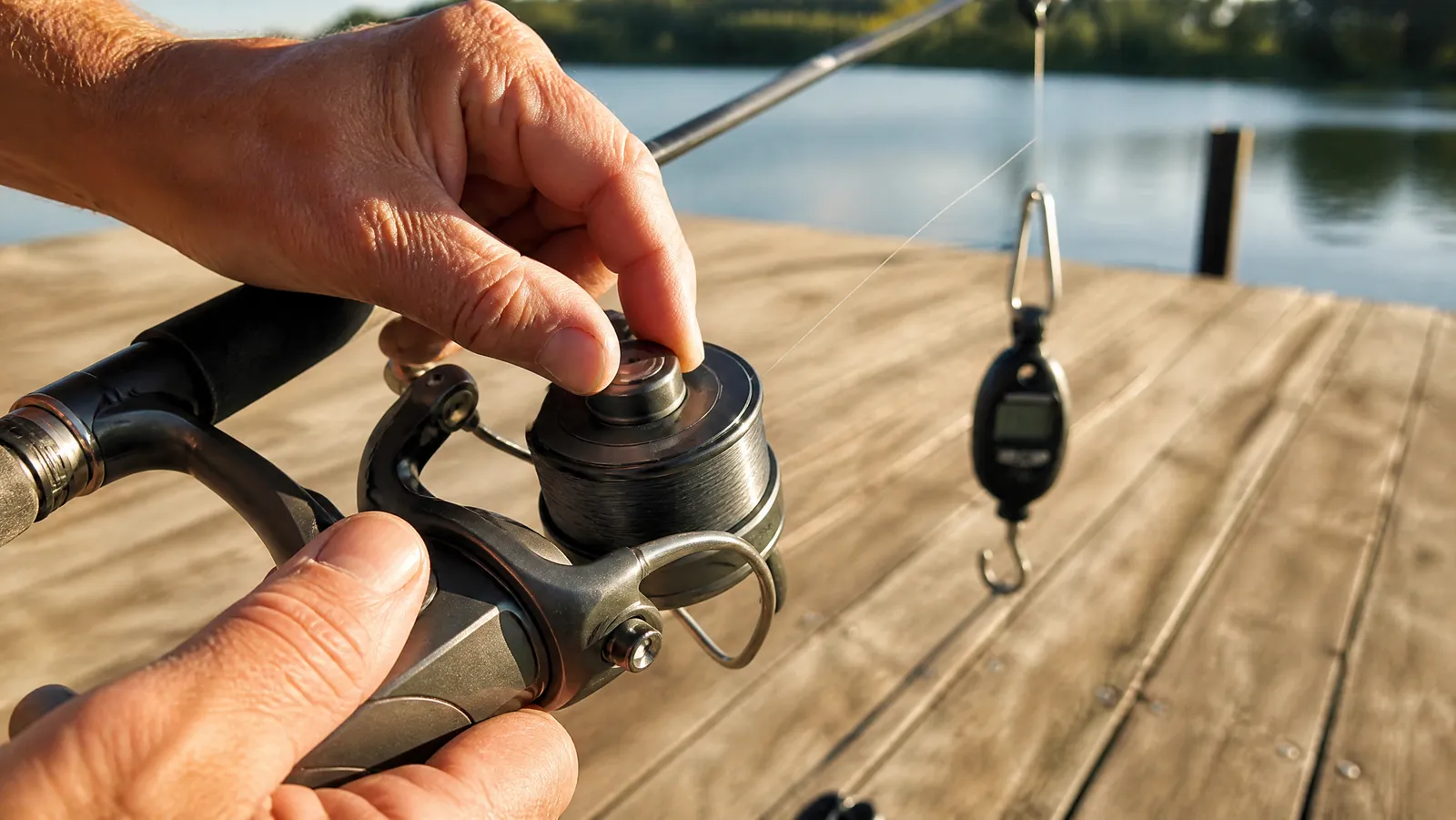
The practical response is unglamorous: keep the spool filled to within a couple of millimetres of the lip. Our guide to spooling a spinning reel covers how to get there without memory coils. Line choice matters too, because a thinner line puts more yards inside the same diameter — the diameter figures in our fishing line weight chart are the honest way to compare spools of the same labelled strength.
Where to find inches per turn, and the letter codes that hide it
Most makers publish retrieve per crank for every model, usually as inches or centimetres per turn, sitting in the spec table beside weight and drag. It is the single most useful number on that table and the one nobody quotes in reviews.
What makes it worth hunting for is that several brands label gearing with letters rather than ratios, and the letters are not interchangeable. Shimano's own gear ratios explainer describes PG as power gearing for jigging and deep bait work, HG as high gearing for lure anglers who want quicker pickup, and XG as extra-high gearing for fast surface presentations and fast-moving fish. A rough guide to Shimano reels published by ukbass.com puts the typical figures behind those letters at about 4.8:1, 5.8:1 and 6.2:1.
Daiwa uses a different alphabet for the same idea. Daiwa's Australian site lists P as power at around 4.8:1, H as high at around 5.7:1, and XH as extra-high at around 6.2:1. Penn appends HS for high-speed, and that label is worth a second look: Penn lists the Battle III 8000HS at 5.3:1, slower gearing than the 2000 through 4000 sizes that Penn all lists at 6.2:1, and it still recovers more line per crank, 44 inches, than any other reel in the family, including the 10000 at 43 inches. High-speed, slower gearing. Both true at once.
So an H on a Daiwa and an HG on a Shimano are roughly comparable in ratio, and neither tells you what either reel will do with a spool of braid on it. Published inches per turn is the only number that travels between brands. Write it down for each reel on your shortlist.
The torque trade-off: a fast reel is a heavier handle
Gearing is leverage. The handle is a lever arm turning a main gear, and the gear train trades distance for force exactly the way a bicycle's gears do. A high ratio makes the rotor travel further for each turn of the handle, which means the load on the line is resisting you through a longer sweep — more line per turn, more effort per turn.
A lower ratio does the reverse. Tackle Village describes low ratios as delivering a high amount of torque and suiting large lures, while higher ratios trade pulling power for retrieval speed. You feel it in your forearm long before you can describe it: a deep crankbait on a 6.2:1 reel pulls like a bucket, and the same bait on a 5.2:1 reel just comes in.
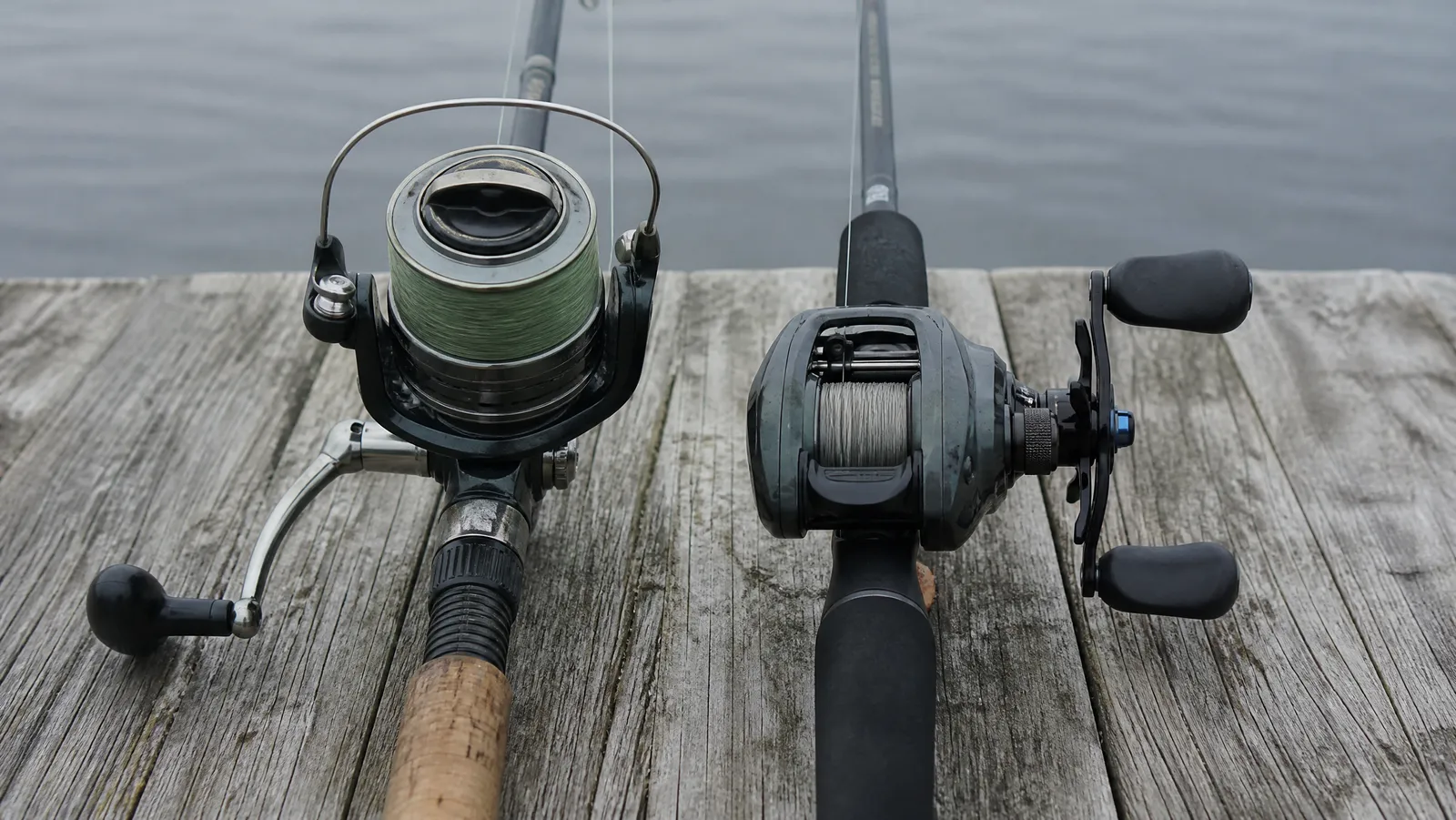
Handle length changes the sum again. A longer handle arm is more leverage at the same ratio, which is part of why two reels with identical gearing can feel nothing alike. It is also part of why the cranking comparison between reel types is not straightforward — the handle-to-spool geometry differs, as we get into in spinning reel vs baitcaster.
Which retrieve speed suits which lure
These bands are convention and common practice among anglers, not a published standard, and they shift with reel size for all the reasons above. Think of them as starting points for a spinning reel in the 2500 to 4000 range.
Slow or power gear, roughly 4.8:1 to 5.2:1
Deep-diving crankbaits, big swimbaits, bladed jigs, anything that pushes water hard. FishUSA's guide to selecting a gear ratio recommends roughly 5.0:1 to 5.9:1 for large, deep-diving crankbaits, on the grounds that those baits demand torque and a slower reel lets you retrieve them without exhausting your arm over a long session.
There is a fishing reason as well as a comfort reason. A slower retrieve keeps a diving bait in the strike zone longer. If deep cranking is your main game, our crankbait picks are the clearest case for choosing the slower reel on the shelf.
Middle, around 5.5:1 to 6.0:1
Jigs, soft plastics, spinnerbaits, general freshwater work. This is the honest do-everything band: fast enough to take up slack on a hookset, slow enough that a bait with some drag on it does not become a workout. If you are buying one reel and you do not yet know what you will fish most, buy here and stop worrying about it.
Fast, 6.2:1 and up
Fast gearing earns its keep whenever the job is taking up line rather than pulling against it. Walking baits and poppers, where you move the lure with the rod and then recover slack — our topwater lures coverage is the clearest example. Jerkbaits, drop shot and Texas rigs, where the rod does the work and the reel collects. Burning a lure back to the boat for another cast. And the moment a fish turns and runs at you, which no amount of torque solves.
Why one fast reel is a reasonable simplification
If you own one spinning reel, buy the faster one. You can always reel slowly with a fast reel; you cannot reel fast with a slow one. Retrieve speed is set by your hand, and a 6.2:1 reel turned at half pace is a slow reel with extra range on top.
The honest counter-argument is fatigue and feel. Slowing a fast reel down to crankbait pace means turning a heavier handle at a deliberately low cadence, which is harder to hold steady than letting a lower ratio do it for you, and some anglers genuinely lose touch with a deep bait that way. If most of your casts involve heavy-pulling lures, the lower ratio is not nostalgia, it is ergonomics.
For most bass anglers the fast single reel is the right compromise, which is roughly where we land in our bass spinning reel coverage.
The gear ratio mistakes that cost money
- Comparing ratios across reel sizes. A 6.2:1 in a 1000 body is slower than a 5.2:1 in a 4000 body. Compare inches per turn or compare nothing.
- Reading a high ratio as a better reel. Ratio is a gear tooth count. It says nothing about gear material, drag, sealing or how the reel will feel in year three.
- Ignoring handle length. Leverage at the handle changes effort as much as a step in ratio does, and nobody puts it on the box.
- Forgetting the spool empties. Judge a reel's speed at the point in the retrieve where you need it, which is usually a long way from a full spool.
- Buying for gearing when size and drag were the real decision. Gearing is a preference. Spool capacity and a smooth drag are requirements. Get those right and almost any ratio in the range will catch fish.
The short version
Gear ratio is a gear-train fact, not a retrieve speed. Multiply it by the circumference of the line on your spool and you get inches per turn, which is the number worth comparing — and the number that quietly shrinks as the spool empties. Find it in the spec table, write it down for each reel you are considering, and ignore the letters on the box.
Then pick the band that matches what you actually cast. Slow for baits that pull, fast for baits that need slack taken up, middle if you want one reel for everything. When you are ready to put gearing back together with size, drag and build, Angler Reviews' spinning reel guide walks the whole decision in order.
About The Author
Rob Thomas
Rob Thomas is a fisherman who loves catching tales from his fellow fishermen. He always enjoys a good story, especially when it comes from the sea.