Fishing Line Weight and Diameter: Reading Pound Test Properly

This post may contain affiliate links. Read our policy.
Fishing Line Weight and Diameter: Reading Pound Test Properly
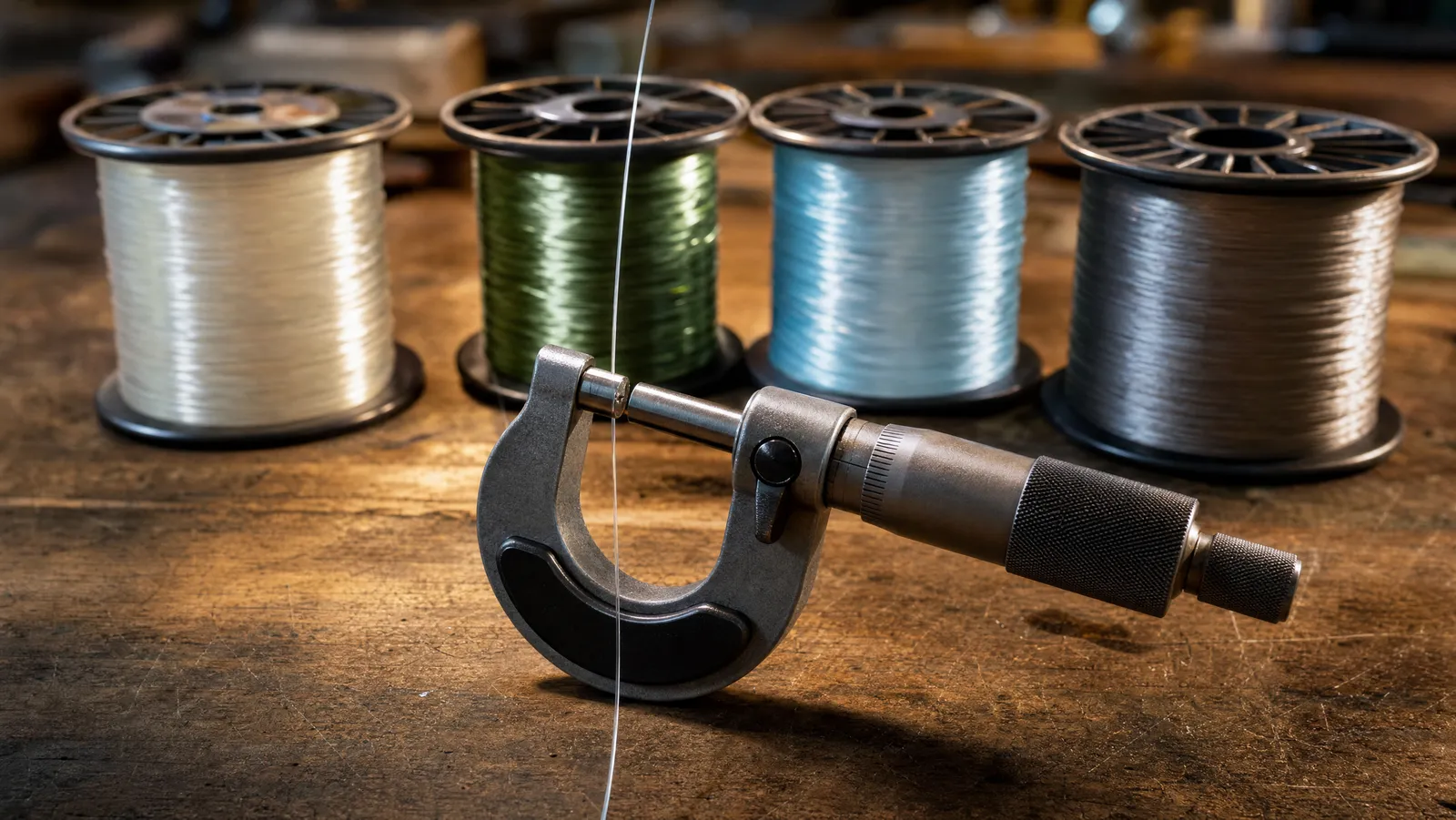
Pound test is a labelled breaking strength, not a measurement of the line itself. Diameter is the number that actually decides how the line casts, sinks, hides and fills your spool — and across mono, fluorocarbon and braid the two numbers are only loosely related. Read the diameter column first. It is the honest one.
Every fishing line weight chart you have ever squinted at on the back of a spool is really two charts stacked on top of each other. One is a promise about strength that most manufacturers appear to under-state in practice. The other is a physical measurement in thousandths of an inch that determines almost everything you will notice on the water.
Most anglers buy on the first number and then wonder why their 14-pound mono casts like rope. This is the reference piece for the rest of our line coverage, so if you are still deciding what material to spool in the first place, we have the three line families compared side by side. Come back here when you need to pick a number.
What Pound Test Actually Promises
The definition is simpler than the marketing around it. As knots.fish puts it in its pound test guide, pound test is the manufacturer's rated breaking strength, and a 12-pound test line should break under approximately 12 pounds of direct pull.
The word doing the work there is "approximately." knots.fish goes on to note that most fishing lines test above their labeled strength when new, while nicked, UV-degraded or old line tests below rated strength. So the label is a moving target in both directions — generous out of the box, pessimistic by August.
How generous? Sport Fishing magazine ran destructive testing in 2014 on 101 lines all rated at 30 pounds and reported that all but a few exceeded 30 pounds, though some broke at less than 27 pounds. The extreme case in that test broke at 66.8 pounds. That is a line sold as 30-pound test holding more than double its label.
Sit with the spread rather than the headline. Across a hundred-odd spools that all say the same thing on the front, the real number ranged from under 27 pounds to nearly 67. Two lines on a shop shelf with identical labels can be completely different pieces of equipment.
Treat the printed test as a floor with an unpublished ceiling. It tells you roughly what the line will survive, and nothing at all about how it will fish. And because the knot is usually the weakest point in the system, set your drag against a realistic working strength rather than the label — our drag setting calculator will give you a number to start from.
Where the Label Runs Backwards: IGFA Class Line
There is one category of line where the printed number means the opposite, and knowing it is the fastest way to understand everything else.
The International Game Fish Association keeps line class world records, and its International Angling Rules define a class record by the breaking strength of the first 5 metres — 16.5 feet — of line directly preceding the double line, leader or hook. Those classes are metric. The IGFA rules state that line designated by the manufacturer as 8-pound class line may test up to 8.81 pounds, which is 4 kilograms, to qualify for a 4-kilogram line class world record.
Up to. Not around, not at least. If the line over-tests its class, the IGFA rules say the application will be considered in the next highest class, which in practice means the record you were chasing evaporates into a bracket where somebody stronger already sits. Sport Fishing makes the same point about the bracket everyone calls 30-pound: it is really the 15-kilogram class, and 15 kilograms — just over 33 pounds — is the maximum strength permitted.
So class line is engineered to break at or below its rating, and everyday line is engineered to break above it. Same two words on the spool, opposite intent. The IGFA even offers a line and tippet testing service to members at a stated fee of 30 US dollars per sample, which tells you how seriously record anglers take the difference.
If you are not chasing a record, class line is the wrong purchase — you are paying for a guaranteed weakness. But the existence of two opposite conventions under one label is the single clearest proof that pound test is a marketing category, not a measurement.
Why Line Diameter Is the Number That Actually Fishes
Diameter is measured, not rated. The unit is the same across every brand — a thousandth of an inch is a thousandth of an inch, even if the figure itself still comes from the maker — and it drives the five things you notice on the water: how far the line casts, how visible it is, how fast it sinks, how much fits on the spool, and how much it bows in current and wind.
Here is the comparison that makes the case. Per the specification chart Tackle Warehouse publishes for Berkley Trilene XL, 6-pound XL measures .009 inches or .23 millimetres, and 14-pound XL measures .014 inches or .36 millimetres. Berkley's tougher Trilene XT is thicker at every test on the equivalent chart, with 14-pound XT at .016 inches or .40 millimetres.
Now put a braid next to it. SpiderWire's published spec for 30-pound Stealth, as carried on retailer spec sheets, lists the line at 0.012 inches with a stated superline mono equivalent of 10 pounds. That is more than double the breaking strength of the 14-pound XT above, at three-quarters of the diameter.
Tackle Village's diameter chart puts a number on that gap generally, describing braided line as running between 35 and 45 percent lower in diameter than either mono or fluoro line — 45 percent slimmer at 6-pound test, 38 percent slimmer at 20-pound. That relationship is why braid breaks the pound-test mental model completely, and why we treat it as a different measuring system rather than a stronger version of mono.
If two spools carry the same pound test and different diameters, the thinner one is the better line for almost every job except abrasion. Buy the diameter.
The Fishing Line Weight Chart, Band by Band
Here is the chart the search box is actually asking for, written as bands rather than a grid. Monofilament and fluorocarbon figures below are from the line strength charts published by Sportsman's Warehouse, with brand-specific numbers attributed where we use them. Braid equivalents come from the comparable-mono column of the same Sportsman's Warehouse braid chart.
- 2 to 4 pounds — the ultralight end. Sportsman's Warehouse lists 4-pound mono at 0.008 inches or 0.20 millimetres and 4-pound fluorocarbon at 0.007 inches or 0.17 millimetres. knots.fish recommends 4 to 6 pound mono or fluoro for panfish. This is crappie, bluegill, stocked trout and spooky clear water, and it is the band where line diameter does more for your bite count than lure choice does.
- 6 to 8 pounds — the all-purpose light band. Sportsman's Warehouse gives 6-pound mono as 0.009 inches or 0.22 millimetres and 8-pound as 0.010 inches or 0.25 millimetres. Berkley's Trilene XL chart agrees almost exactly at .009 and .010 inches. For braid at this diameter, Sportsman's Warehouse lists 15-pound braid at 0.007 inches with a comparable mono rating of 4 pounds. This is the working band for trout on spinning gear, light jigs and finesse plastics.
- 10 to 12 pounds — general freshwater. Sportsman's Warehouse puts 10-pound mono at 0.011 inches or 0.27 millimetres and 12-pound at 0.013 inches or 0.33 millimetres. The braid that lands nearest is 20-pound, which Sportsman's Warehouse lists at 0.009 inches with a comparable mono rating of 6 pounds. knots.fish suggests 10 to 15 pound mono or fluoro for bass generally and 10 to 14 pound mono specifically for crankbaits, where a little stretch is a feature.
- 14 to 17 pounds — jigs, Texas rigs and casting reels. Sportsman's Warehouse lists 14-pound mono at 0.014 inches or 0.35 millimetres and 17-pound at 0.015 inches or 0.38 millimetres, while Berkley's abrasion-first Trilene XT runs heavier at .016 and .017 inches for the same two ratings. The braid parallel is 30-pound, listed by Sportsman's Warehouse at 0.011 inches against a comparable mono rating of 8 pounds. Most of the heavier work on a baitcaster starts here, and the extra diameter is part of why casting reels handle it better than spinning reels do.
- 20 to 30 pounds — cover, big fish and pulling. Sportsman's Warehouse gives 20-pound mono as 0.016 inches or 0.40 millimetres and 30-pound as 0.020 inches or 0.50 millimetres. Berkley's Trilene XT is thicker again at .018 and .022 inches. In braid, Sportsman's Warehouse lists 40-pound at 0.012 inches with a comparable mono rating of 10 pounds. knots.fish recommends 20 to 30 pound fluorocarbon for pike and muskie and 40 to 65 pound braid for flipping heavy cover.
Read down the braid column and the pattern is unmistakable. A 40-pound braid occupies roughly the space of 10-pound mono. Pick your diameter band from the water, then choose whichever material gives you the most strength inside it.
Why the Same Pound Test Measures Differently Brand to Brand
The most useful comparison here is not between materials. It is between two nylon lines from the same company.
Berkley Trilene XL at 14-pound test measures .014 inches or .36 millimetres on Tackle Warehouse's chart. Berkley Trilene XT at 14-pound test measures .016 inches or .40 millimetres. Same manufacturer, same rating, two thousandths of an inch apart, because XT is built for abrasion resistance and XL is built to cast smoothly. At 30-pound test the same two-thousandths gap holds, .020 inches for XL against .022 inches for XT on the same charts.
Material adds a second layer, and it is less dramatic than folklore suggests. Tackle Village's diameter chart lists monofilament and fluorocarbon as identical at 6, 10, 20 and 30 pounds, and notes that once you get to 50 and 60 pound tests, fluorocarbon is a little thicker than mono of the same breaking strength. Seaguar's published spec for 20-pound Blue Label leader is .016 inches or .405 millimetres — the same figure Sportsman's Warehouse gives for 20-pound mono. Sportsman's Warehouse does show fluorocarbon running slightly thinner in the middle of its chart, at 0.012 inches for 12-pound against 0.013 for mono.
So the honest summary is that fluorocarbon and mono occupy roughly the same diameter at the same rating, and the brand-to-brand spread is bigger than the material-to-material spread.
What fluorocarbon genuinely changes is density, not thickness. AFTCO explains that fluorocarbon has a specific gravity of about 1.78 against nylon's 1.14, with water at 1.0, so fluorocarbon sinks markedly faster than nylon. That is a sink-rate and presentation difference, and it is real. It is just not a diameter difference.
Stop comparing materials in the abstract and start comparing spools. The number printed on the back of the specific product you are holding is the only one that applies to it.
How Diameter Decides What Fits on the Spool
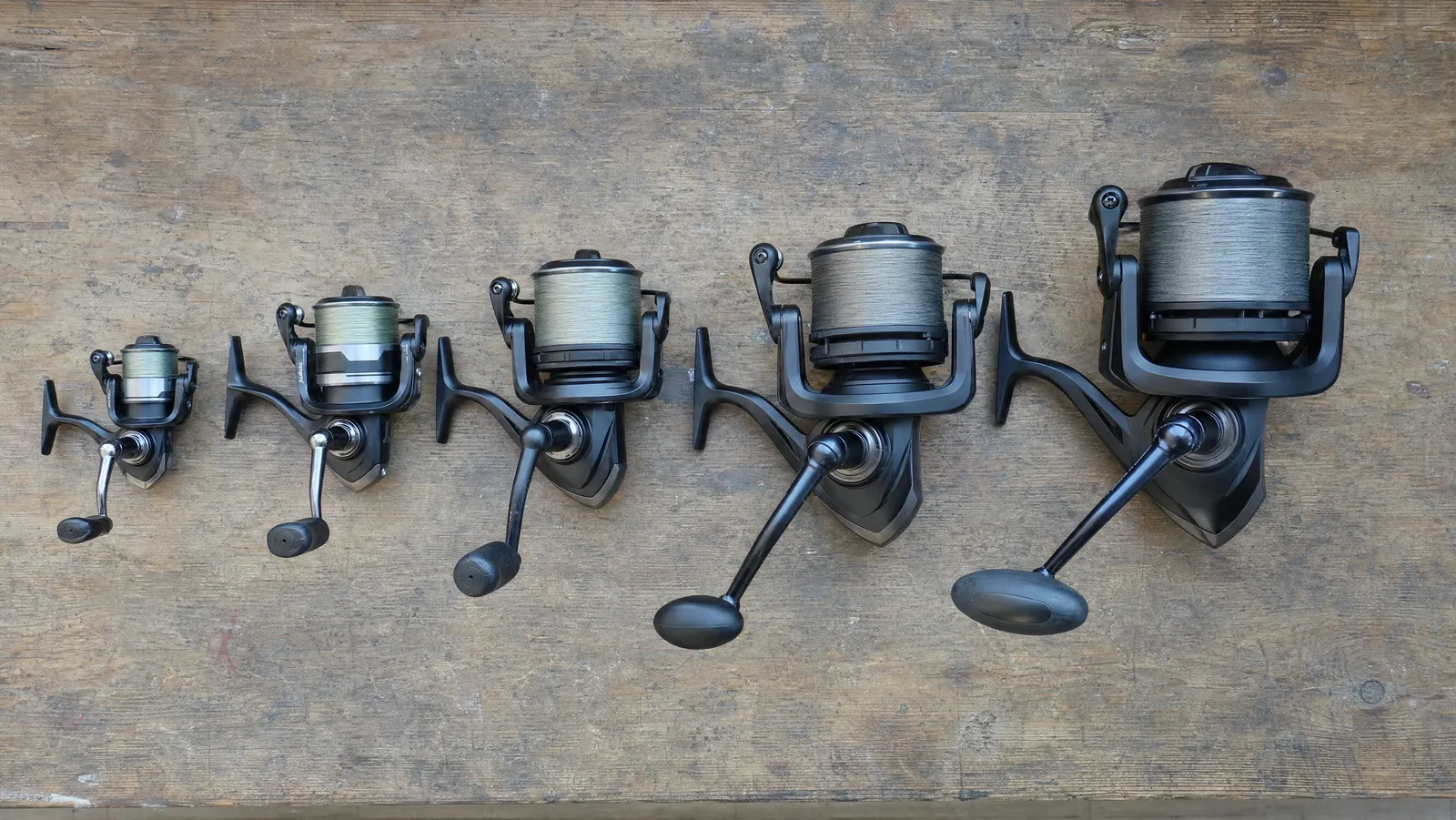
This is where diameter stops being trivia and starts costing you casts. Reel capacity is printed as a pairing of line and yardage — Top Gear Tackle gives the typical format as 8 pounds over 180 yards, or 0.20 millimetres over 420 metres in metric. That rating is a volume statement dressed up as a strength statement. The spool holds a fixed amount of space, and diameter is what decides how much line goes into it.
Change the diameter and you change the yardage, which is why a reel rated for 180 yards of mono swallows considerably more braid of a higher pound test. It is also why so many spools end up wrong.
- Overfilled spools tangle. Top Gear Tackle is blunt that overfilling causes wind knots and poor drag, and the loops come off the lip on the cast rather than at a convenient moment.
- Underfilled spools cast short. The same source notes that underfilling costs distance; the usual explanation is that the line is peeling off a smaller effective coil and dragging harder over the lip.
- The target is about one-eighth of an inch below the spool lip, per Top Gear Tackle. That is the whole specification, and it does not change with line type.
Work out what your reel actually holds in the diameter you have chosen with our line capacity calculator, then follow the process in our guide to filling a spinning reel properly. Guessing the fill level is the most common reason a good line fishes badly.
Choosing a Pound Test: Start From the Cover, Not the Rod
Rod ratings are a constraint, not a recommendation. What should set your pound test is what the line has to survive between the hook and the reel.
Ask three questions in this order. What will the line be dragged across — sand, gravel, timber, matted grass, zebra mussels? How clear is the water, and therefore how much diameter can you afford to show? And only then, how big is the fish?
That ordering explains most of the published guidance. knots.fish lands on 4 to 6 pounds for panfish and 40 to 65 pound braid for flipping heavy cover, and the gap between those two numbers has far more to do with what surrounds the fish than with the fish itself. A 3-pound bass in open water and a 3-pound bass buried in hydrilla are the same animal and completely different line problems.
Two rules we would hand a new angler:
- Go up in test when the cover gets abrasive, not when the fish gets big. Drag and rod do the lifting. Line does the surviving.
- Go down in diameter, not down in test, when the bite gets tough. Switching from mono to a thinner braid with a fluorocarbon leader buys you the presentation without giving up strength.
The Short Version
Pound test is a label. Diameter is a measurement. When they disagree, believe the measurement.
Everyday line is built to break above its rating — Sport Fishing found that all but a few of 101 lines rated at 30 pounds exceeded it, with one reaching 66.8 pounds. IGFA class line is built to do the opposite, with 8-pound class line permitted to test up to 8.81 pounds and no higher. Berkley's own Trilene XL and XT differ by two thousandths of an inch at 14-pound test. And SpiderWire lists 30-pound Stealth at 0.012 inches with a 10-pound mono equivalent, which is thinner than 14-pound mono at more than double the rating.
Pick the diameter band your water and cover allow. Choose the material that gives you the most breaking strength inside that band. Fill the spool to an eighth of an inch below the lip, set the drag deliberately, and stop reading the front of the packaging.
When you are ready to choose between nylon, fluorocarbon and woven polyethylene for a specific rod, the Angler Reviews fishing line hub lays out the full comparison.
About The Author
Rob Thomas
Rob Thomas is a fisherman who loves catching tales from his fellow fishermen. He always enjoys a good story, especially when it comes from the sea.