How to Store and Transport Fishing Rods

This post may contain affiliate links. Read our policy.
How to Store and Transport Fishing Rods
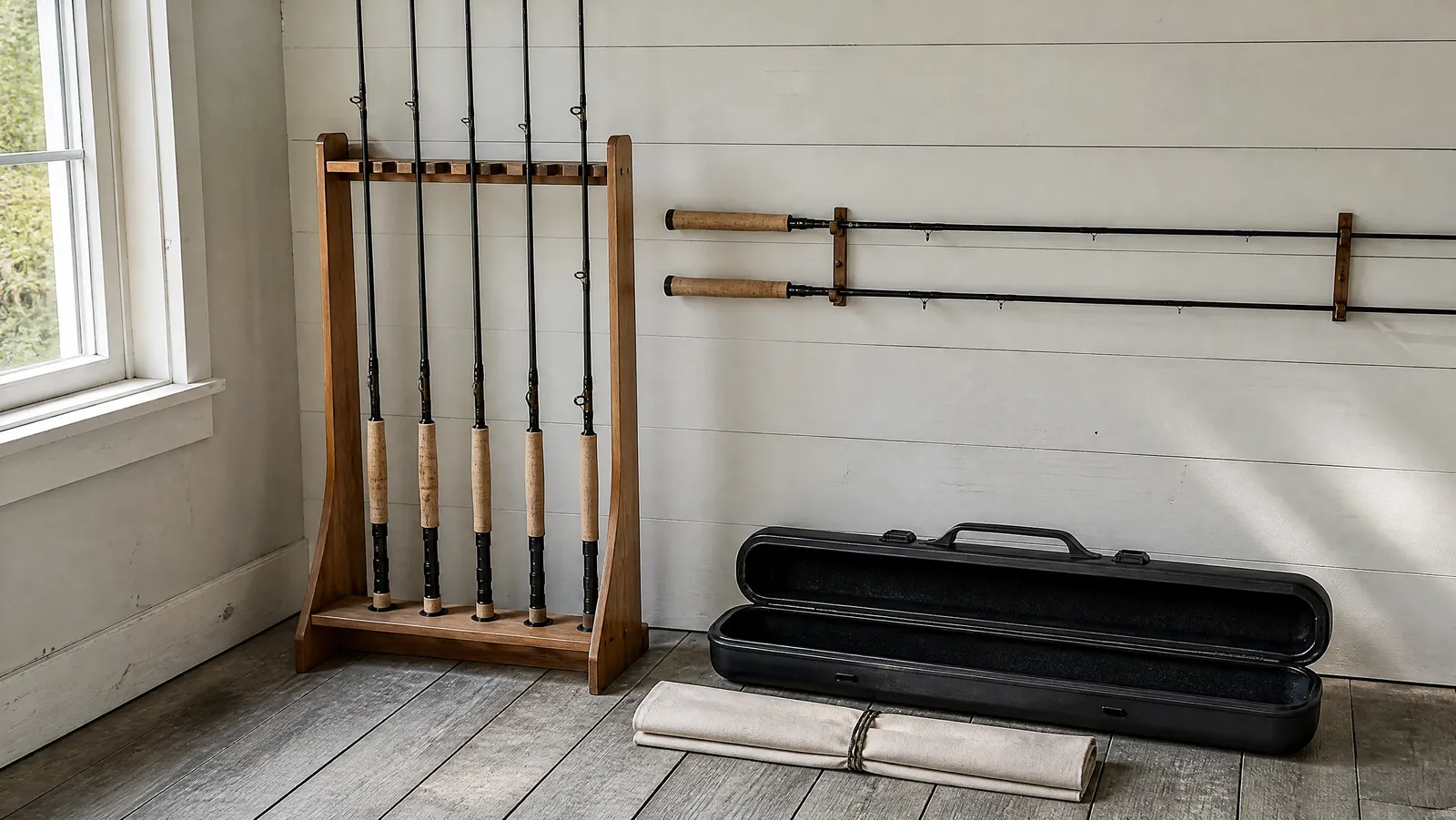
Store rods indoors, unloaded, and supported along the blank - vertically with the butt carrying the weight, or horizontally on at least two contact points. Keep them out of direct sun, out of the attic and out of the car. Unhook the lure from the guide, back the drag off, separate the sections, and move them in a tube, tip-first, with nothing stacked on top.
Every item on that list exists because of a specific way a rod dies. Most storage articles are a catalog of rack ideas; this one starts with the damage, because once you know what kills a blank in a garage, the rack you need becomes obvious - and so does why a $22 ceiling track belongs above $600 of rods. If you are still on the buying side, choosing a fishing rod handles that half.
The five ways stored rods die
Set. A blank left bent for weeks can stop coming back straight. Orvis, in its own rod-care guide, tells owners to check that stored rods "aren't bent in any way as this can permanently change the shape of your rod." That sentence is the reason behind half the rules below. Thin-walled, light blanks show it first, which is why ultralight rods need more thought in storage than a heavy trolling stick. Set is not cosmetic: a rod that has taken a bend has a changed taper, and taper is most of what you feel as action and power.
Finish and resin breakdown. The clear epoxy over the blank and the thread wraps is the part sunlight attacks. A 2022 study in Polymer Testing by Wu and colleagues, on yellowing in epoxy and vinyl ester resins, reports that the yellowing results from a radical oxidation reaction during aging which forms chromophores such as carbonyl groups and conjugated structures, and that antioxidants and UV absorbers were not effective against it. Epic Fly Rods puts it bluntly: "The intense sunlight and heat will deteriorate your fly rod," and "your dash is about the worst place to sit your fly rod." Delamination - fiber layers losing their bond to the resin - is what that looks like once it is structural, and the two materials may not get there on the same schedule. See graphite versus fiberglass.
Guide and reel-seat corrosion. Orvis notes that "over time, salt, dirt, vegetation, and other debris can build up on your guides and damage your lines." Epic Fly Rods is categorical: "Never put your rod back wet or damp in the rod bag or tube." A rod sealed damp in a tube is a humidity chamber around metal guide frames and a threaded reel seat.
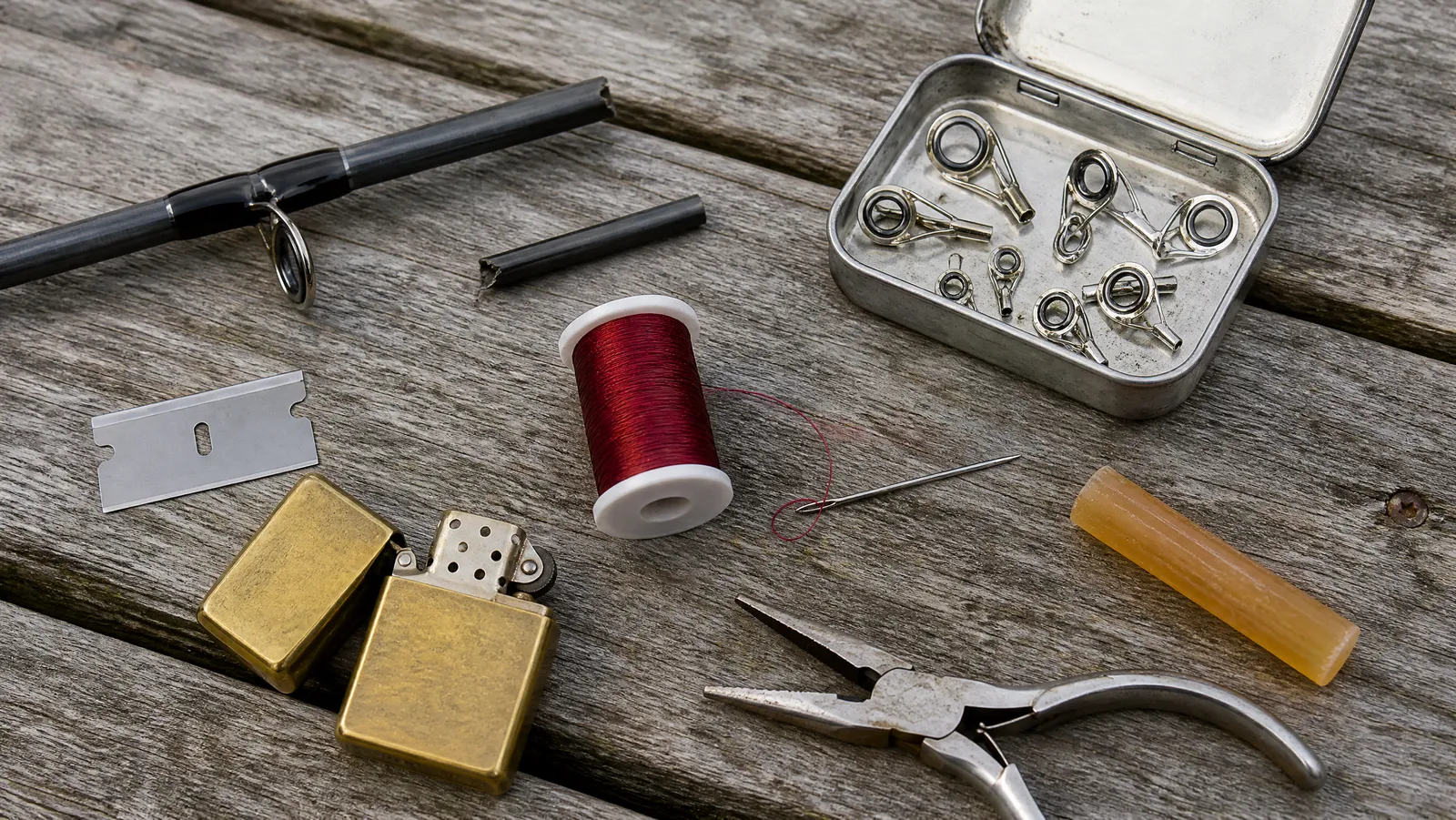
Tip breakage. This is the one that actually happens. Epic Fly Rods states that "almost all rod repairs are victims of car doors and windows." Thomas and Thomas, independently, says "the greatest cause for damage to any fly rod is that inflicted by car doors and windows." Two makers naming the same culprit is as strong as this evidence gets. If you are past that point, how to fix a broken fishing rod covers what is repairable.
Crushed sections and seized ferrules. A hollow tube is weak across its diameter, so anything heavy laid on a rod in a garage or a truck bed loads it the wrong way. Mud Hole Custom Tackle's ferrule guidance is one line worth memorizing: "Never force sections together or apart."
Vertical, horizontal, or hanging?
All three work. What matters is where the support points are and whether the blank carries load between them.
- Vertical racks are easiest to get right: the butt carries the weight and the blank only leans. The failure mode is an off-center upper clip, so the rod leans in an arc. Over months, that lean is how set happens.
- Horizontal racks need at least two support points, ideally three for a one-piece rod over about seven feet. One point turns the rod into a cantilever bending under its own weight, with a reel hanging off the butt.
- Hanging by the butt is a recognized method. Epic Fly Rods says "the best way to stow a rod over long periods is to hang it in its bag," positioned "with the tip top and cork handle up," so the tip hangs free.
The genuinely bad option is hanging a rod by its tip, or standing it tip-down in a corner, which puts the whole weight of rod and reel on its thinnest-walled section.
Makers disagree on the rest: Thomas and Thomas states that "horizontal storage is optimal to keep the tips and the ends in good shape," while Epic prefers hanging. Neither is arguing about support. Pick whichever fits your wall.
Heat, UV and humidity
The worst storage spots in a house are the two most convenient ones: the attic and the car.
Thomas and Thomas warns that "attics can reach hot temperatures and basements are prone to being cold and damp," and that "car interiors can reach extreme temperatures depending on your location." The car numbers are well documented, because child-safety researchers measure them. The National Weather Service states that in a parked car "a dark dashboard or seat can easily reach temperatures in the range of 180 to over 200" degrees Fahrenheit. A study by Arizona State University and University of California San Diego researchers, reported by ABC7, parked vehicles in 100-degree conditions for about an hour and found average cabin air at 116 degrees in sunlight with dashboard surfaces at 157 degrees. That dash is exactly where rods get laid. We have no published figure for the temperature at which a rod's finish softens and will not invent one. We would still never leave a rod on one.
UV is the slower problem, and it works on the finish and the thread wraps rather than the fibers. Per the Wu study the mechanism is an oxidation reaction. It tends to act on the exposed surface, so the sunlit side of a rod in a window takes more of it than the shaded side. Yellowing on light wraps is the first sign. Thomas and Thomas also advises keeping rods away from "extreme temperature swings or humidity," which rules out an uninsulated garage if a conditioned room is available.
Take the load off
A stored rod should carry no tension at all.
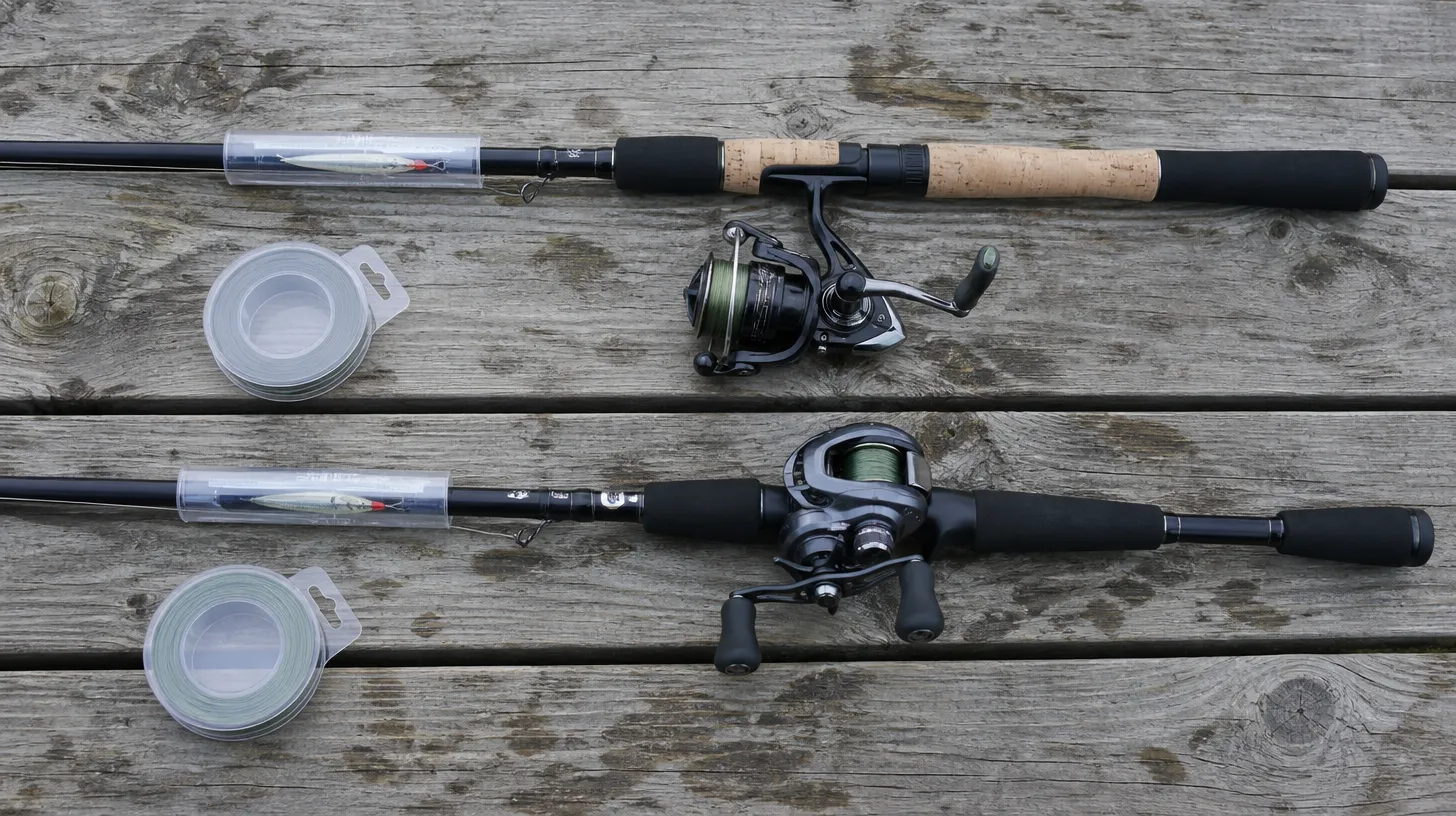
The common mistake is parking a lure in a guide or a hook keeper and reeling down until the line is tight. That is a bent rod held bent by monofilament for however many weeks it sits there, and it is the fastest way to put set in a tip. Unhook the lure, or leave enough slack that the blank is straight. Same for rod holders: a rod clamped into a boat holder with a bend in it is bent for as long as it sits there.
Back the drag off too - a stack left clamped down all winter sits under compression and the washers take it. The adjustment is in how to set spinning reel drag. Monofilament on a stored spool also keeps taking set in coils and has a shelf life: see does fishing line go bad.
Two-piece rods, ferrules and why you should not store them assembled
Store the sections apart. The reasoning is specific to how ferrules fail.
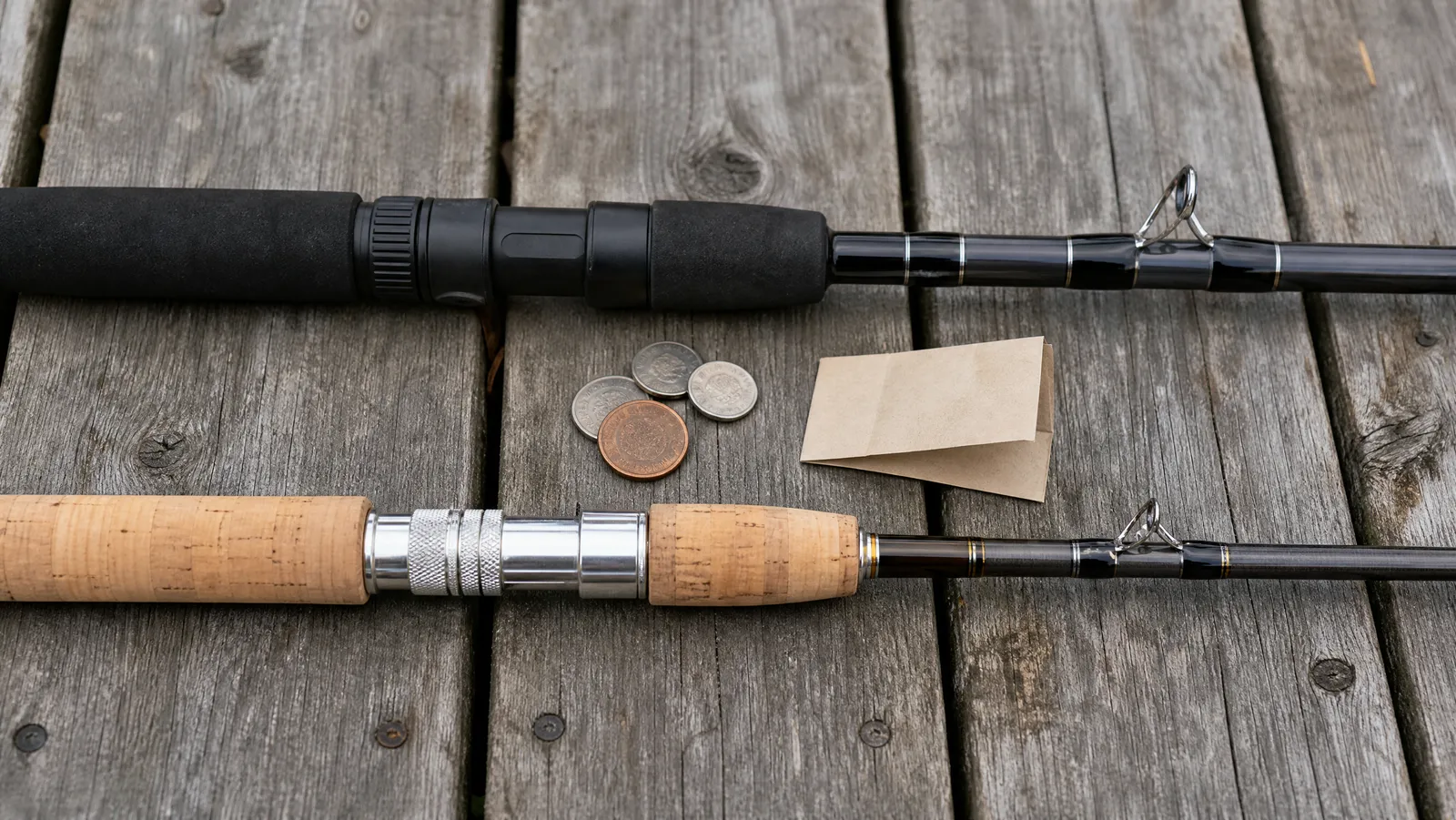
Mud Hole describes the two joint types clearly. A spigot ferrule uses "a smaller internal plug that is permanently attached to one rod section," and - the part that surprises people - "there should be a gap of 1/8 to 1/2 inch by design." Mud Hole is explicit that "the gap is intentional" and that you should "not sand the ferrule or force the sections together." In a tip-over-butt or sleeve joint, "the thinner upper section slides over the thicker lower section."
Both types seize if left together. Epic Fly Rods says to "take the rod apart when you are done fishing to avoid stuck ferrules," warning that "leaving a rod together for days on end, particularly after tropical use, will lead to stuck ferrules." The counter-risk is real: sections stored apart collect grit in the female socket, and grit is abrasive. The fix is a habit - "before assembling, wipe both the male and female sections," per Mud Hole, and push them straight together, because, in Epic's words, "twisting scores out the ferrules and over time will contribute to a loose fit."
Lubricant is where the makers genuinely split. Thomas and Thomas recommends it on metal ferrules - "a simple Vaseline petroleum jelly applied with a Q tip to metal ferrules is all it takes" - while warning to "avoid using ferrule lubricants on your blanks" because "certain lubricants can interact with the varnish of your rod poorly, causing damage." Epic goes the other way on graphite: "our ferrules are designed to operate best when clean and dry," and "waxes attract and trap dust and grit that will scratch your beautiful blank." Both can be right, one describing metal ferrules and the other graphite on graphite. Absent instructions with your rod, clean and dry is the lower-risk default.
Rod racks: ceiling, wall, floor and garage
Price the category rather than chasing a model. As of November 2026, Sportsman's Warehouse lists the Dubro Hang-M-High ceiling rack at $21.99, holding "8 fishing rods with reels connected" on two track sections fixed with two number 8 screws, not included. Bass Pro Shops' listings show $29.99 for a wall-mount horizontal rack rated to six rod-and-reel combos, and $69.99 for a ten-rod Reel Salty rack. Call it $20 to $70 for wall and ceiling racks, with floor-standing and cabinet units above that.
Two things matter more than the brand:
- Spacing that matches your rods. The Dubro listing says to "mount the track sections at the best distance apart from each other to cradle your fishing rods," closer for short rods and wider for long ones. A track set for 6-foot 6-inch rods will cantilever a 7-foot 6-inch one.
- What the fastener goes into. A ceiling rack hangs the whole collection off two screws. Drywall anchors are not joists.
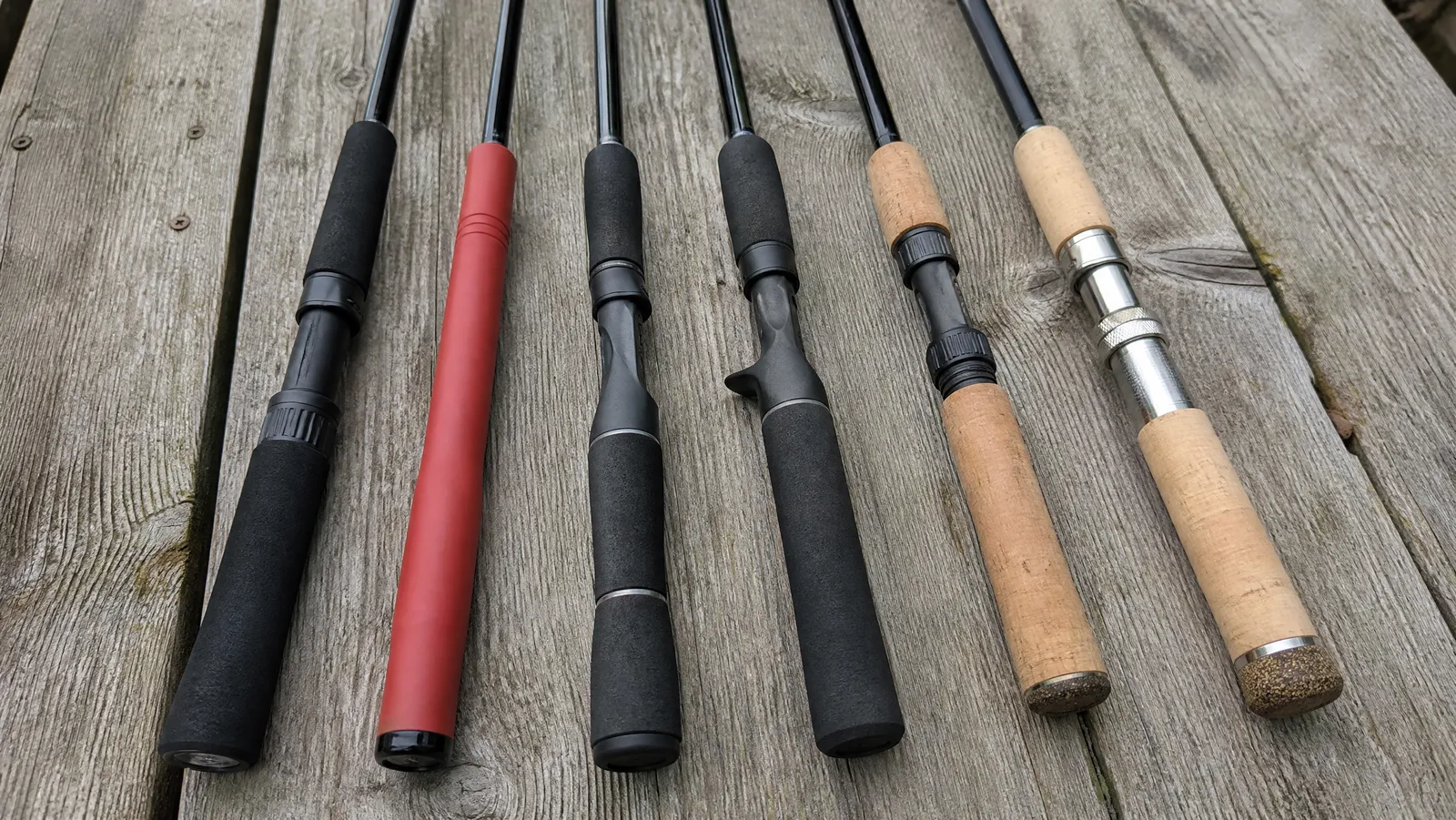
One detail most racks get wrong: spinning and casting rods carry their guides on opposite sides, so a mixed rack can press a guide frame into the next rod's blank in ways a matched one does not. If you are unsure which you own, casting rod vs spinning rod sorts it out. Leave a slot of air between anything that can touch.
Transporting rods in a car
This is where rods actually break. Both makers quoted above name car doors and windows as the leading cause of rod damage, and the mechanism is always the same: a tip ends up outside the opening, somebody closes the door or the hatch, and the thinnest part of the rod takes a shear load.
- Load tip-first through the cabin, and know where every tip is before any door moves. One person closing a hatch while another loads is the standard accident.
- Nothing on top. A cooler across a rod in a truck bed is a crushing load on a hollow tube.
- Break it down when you are not the driver. Thomas and Thomas's advice for anyone "renting a vehicle or riding with others" is to "disassemble and use a rod tube."
Length is the whole problem here. A 7-foot 11-inch one-piece tends not to go diagonally through a sedan, and that logistics cost belongs in the buying decision - we say so in our fishing rod length guide. Insist on a one-piece with a small car and you are buying a rod carrier too.
Tubes, hard cases and flying with rods
A tube is the baseline. Thomas and Thomas says "a rod tube is most optimal and highly recommended; utilize one if you can." Capped PVC is a legitimate homemade version; what a purpose-built hard case adds is padding and section dividers that stop two blanks grinding together, rather than crush strength. Pack cloth socks on the sections either way.
Air travel is governed by two separate rulebooks. The TSA's own What Can I Bring listing marks a fishing pole "Yes" for both carry-on and checked bags, states that "fishing rods are permitted in carry-on and checked bags," and adds that "passengers should check with the airline to confirm that the fishing rod fits within size limitations for carry-on items." It also notes that "the final decision rests with the TSA officer on whether an item is allowed through the checkpoint."
The airline is the binding constraint. Delta's published sporting-equipment page states that "fishing poles up to 115 linear inches (length + width + height) (292 cm) are allowed as checked baggage" and must be "contained safely," that items exceeding 115 linear inches "will not be accepted," and that poles meeting the carry-on standard of 22 by 14 by 9 inches are allowed in the cabin. Equipment over 50 pounds incurs an excess weight fee. Those are Delta's numbers, policies differ by carrier, and they change - read your own airline's page before you pack. The figures we found quoted secondhand for other US carriers did not agree with each other, which is why we are not reproducing them. One consequence: 115 linear inches is generous for a four-piece rod in a 30-inch case, and even a one-piece 7-footer in a tube clears it on Delta's own arithmetic - roughly 84 inches of rod plus a few inches of tube diameter each way is about 90 linear inches. What a long one-piece will not clear is the 22 by 14 by 9 inch carry-on standard, so it has to be checked.
Boats, kayaks and rod holders
Boat storage stacks every problem at once: salt, constant vibration and direct sun for whole days. Rod holders and rocket launchers are built for the fishing day, not the off-season. Rinse and dry before a rod goes back into a rack. Reel seats need attention too: that is where a reel foot and a metal thread sit together in salt, contact points covered in how to match a rod and reel.
A five-minute end-of-season routine
Once, in the fall, per rod:
- Rinse and wash. Orvis says to rinse the rod "with a hose or in the shower," wash with "warm freshwater and a mild washing liquid," work around the guide frames with "a Q-tip or a small soft brush," and clean the handle with "a cloth and some rubbing alcohol."
- Dry completely. Epic Fly Rods: "completely air dry your fly rod and place it in the cloth bag and tube before storing."
- Inspect the guide rings. A cracked or grooved insert cuts line all next season. Run a nylon stocking through each ring; anything that snags needs replacing.
- Look for cracks and flat spots. Flex the blank slowly in both planes, looking for a hinge or a pale patch. Anything the inspection turns up goes to how to fix a broken fishing rod first.
- Separate the sections and clean the ferrule. Straight pull, no twisting.
- Back the drag off and clean the reel. That half of the job is in how to clean a spinning reel.
- Leave the tube caps off. Thomas and Thomas advises leaving "the end caps off entirely to allow the rods to 'breathe,'" and Orvis says the same for long storage, because a sealed tube traps whatever moisture is already inside.
- Put it somewhere conditioned. Not the attic. Not the car. Not a sunlit window.
Five minutes and about $25 of rack covers it. The gear that protects rods is cheap and the failures are almost entirely avoidable, which is a better position than most gear maintenance leaves you in. When it is time to add to the rack rather than protect it, our fishing rod guide has the current picks.
About The Author
Rob Thomas
Rob Thomas is a fisherman who loves catching tales from his fellow fishermen. He always enjoys a good story, especially when it comes from the sea.