How to Match a Rod and Reel

This post may contain affiliate links. Read our policy.
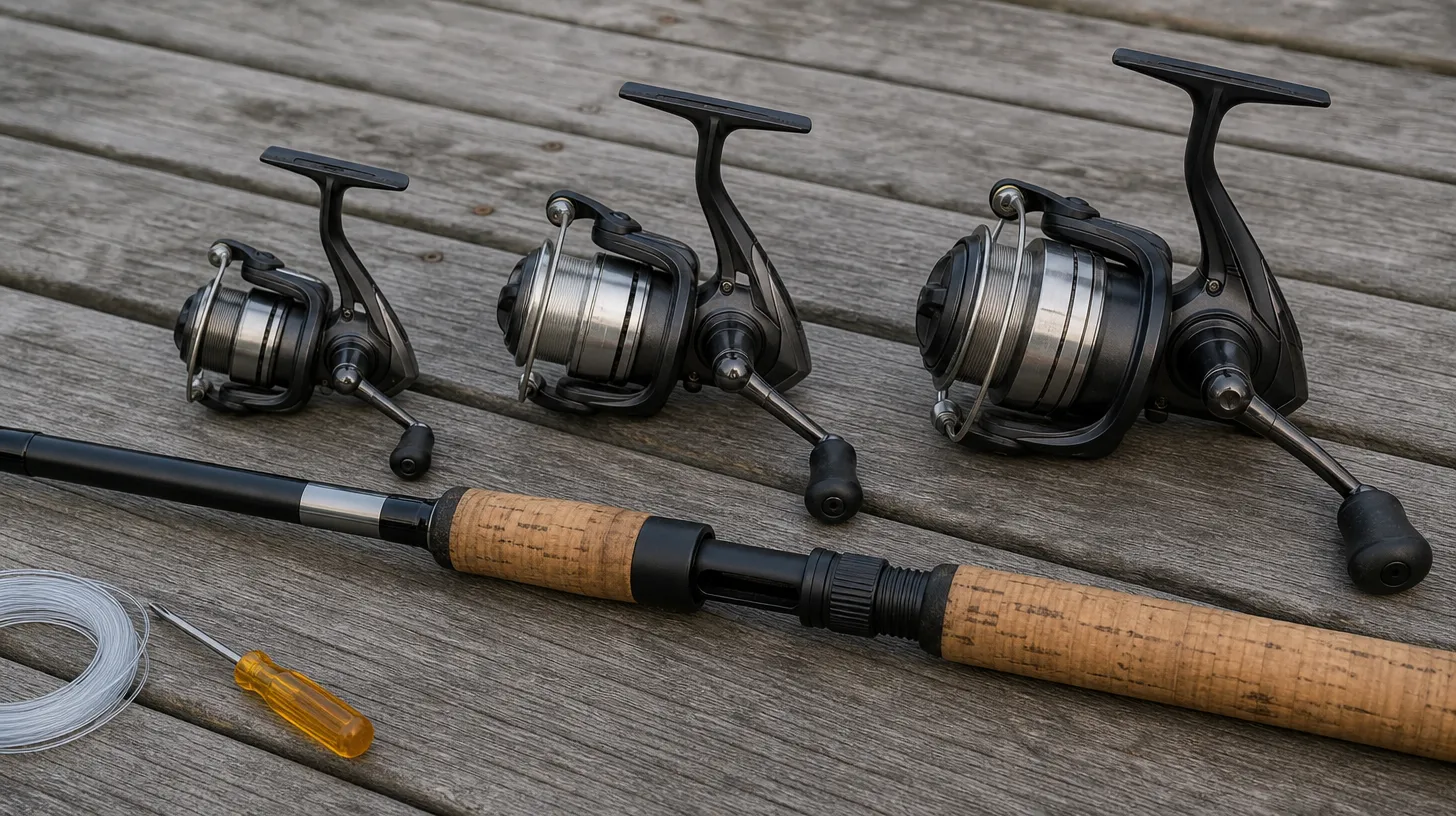
How to Match a Rod and Reel
Match the reel to the line rating printed on the rod, not to the number on the reel box. A rod stamped 6 to 12 lb wants a reel whose spool was built around 6 to 12 lb line, which on the common four-digit ladder usually means a 2500 or a 3000. Then check the lure rating. Then check balance. Three checks, one minute.
That is how to match a rod and reel in one breath, and it works because the rod names a line class and the reel either serves it or does not. Texas Parks and Wildlife's Learn to Fish guide puts the idea plainly, in the fly-reel entry of its Fishing Reels section: "Reels come in different sizes and should match the rod size." The guide says that about fly tackle rather than as a general rule, but its tackle section supplies what you match any rod and reel through. "Match your fishing line to your rod and reel capability and the species of fish you want to catch."
Order matters too. Writing for Take Me Fishing, Ken Schultz — a longtime Field and Stream staff writer and former fishing editor of ESPNoutdoors.com — gives the sequence as "select a rod first, then match the reel to it." If you have not chosen the rod, settle that end of it in our fishing rod buying guide first.
The Two Numbers Printed Above the Handle
Look at the blank just above the grip. Most rods carry two ratings there; many anglers read neither.
The line rating is the first. Lamiglas, which builds rods, defines it this way: "Line rating is meant to suggest the normal breaking strength of line that can be paired with a properly adjusted reel." Lamiglas is explicit that the rating does not tell you the weight of fish you can land, because that depends on current, the fish's own strength and other factors. It is a line-class suggestion, not a lifting limit.
It is equally direct about going over it. "You should not run 50lb mainline and a 30lb leader with an 8-12lb rod," Lamiglas writes, because with a leader far above the rating "you run the risk of stressing the rod to a break point." Our fishing line weight chart translates pound test into something shoppable.
The lure rating is the second, and it governs casting rather than fighting. Lamiglas calls it the ideal weight range for loading the rod on the cast. Go under it and the rod "will not load properly and result in a shorter cast." Go over it and "the rod will load too much and have a sluggish cast," with the blunter warning that on a real overload "the rod is not meant to take that and could break due to over-stress."
A Rod's Line Rating Is Not a Reel's Line Rating
This trap catches experienced anglers as often as beginners. Both numbers are printed in pounds and mean different things. The rod's rating, per Lamiglas, describes the blank's safe working range. A reel's line numbers are a capacity spec — how many yards of a given pound test fit on the spool. A listing that reads 12 lb is not claiming the reel is for 12 lb rods.
Schultz draws the line with an example that is easy to picture: "Nor would you use a big reel capable of holding 200 yards of 12-pound line with a light rod meant for 4- to 8-pound line." Nor, he adds, does filling that big reel with 6-pound line solve it, because "you'd still have a reel that is too large for comfortable use with that particular rod."
Two gates, then. Our line capacity calculator settles the capacity one; the balance check below settles the fit.
Matching Reel Size to Rod, Starting From the Line Rating
Daiwa publishes its own guidance on choosing a spinning reel, the cleanest manufacturer statement we found on what the numbers mean. "Reel sizes are usually given as numbers like 1000, 2500, 3000, 4000 and so on," it writes, and "the higher the number, the larger and stronger the reel, with more line capacity and drag power."
Daiwa then maps its ladder onto fishing rather than onto rods: 1000 to 2500 for light freshwater work including trout and perch, 2500 to 3000 as "a versatile all-round size" for coastal fishing, 3000 to 4000 as a pike choice "mainly because of the increased line capacity and stronger construction," 4000 to 8000 for saltwater and 8000 up for bluewater.
Two honest observations. It is Daiwa's ladder, for Daiwa reels. And it is organized by species and venue rather than by rod rating — a quiet admission that the size number was never a rod-matching instruction. So read across: find the line class your rod is rated for, then the size whose published capacity holds a useful amount of it. Our deeper look at spinning reel sizes takes the numbering apart.
One phrase in Lamiglas's definition does quiet work: "a properly adjusted reel." The rating assumes drag set against the line, not cranked to maximum — a line decision, not a rod one. Our walkthrough on setting spinning reel drag covers that step.
What Size Reel for a 7 Foot Rod?
We found no manufacturer that publishes a reel size per rod length, and anyone who gives you one number is guessing. Daiwa's guidance points without landing: "As a general rule, longer rods benefit from a slightly larger or heavier reel, while shorter rods work better with a smaller or lighter reel." Its actual instruction is to "choose a reel size that matches the rod length, the rod's casting weight and the species you plan to fish for" — three inputs, only one of them length.
Seven feet is a common freshwater length across a wide span of powers, so length alone tells you almost nothing: two 7-foot rods on one rack can be two line classes apart. The reasoning we would use instead:
- Rated roughly 4 to 10 lb, a 7-foot rod reads light or medium-light, which puts it in the 1000 to 2500 band Daiwa describes for light freshwater work.
- Rated roughly 6 to 15 lb, it is the common medium-power spinning rod, and Daiwa's 2500 to 3000 all-round range is the obvious place to look.
- Rated 10 to 20 lb or heavier, it wants the capacity and construction Daiwa associates with 3000 to 4000.
Those are inferences from the rating plus a manufacturer's guidance, not a standard. The rating does the work.
Spinning or Casting: The Decision That Comes First
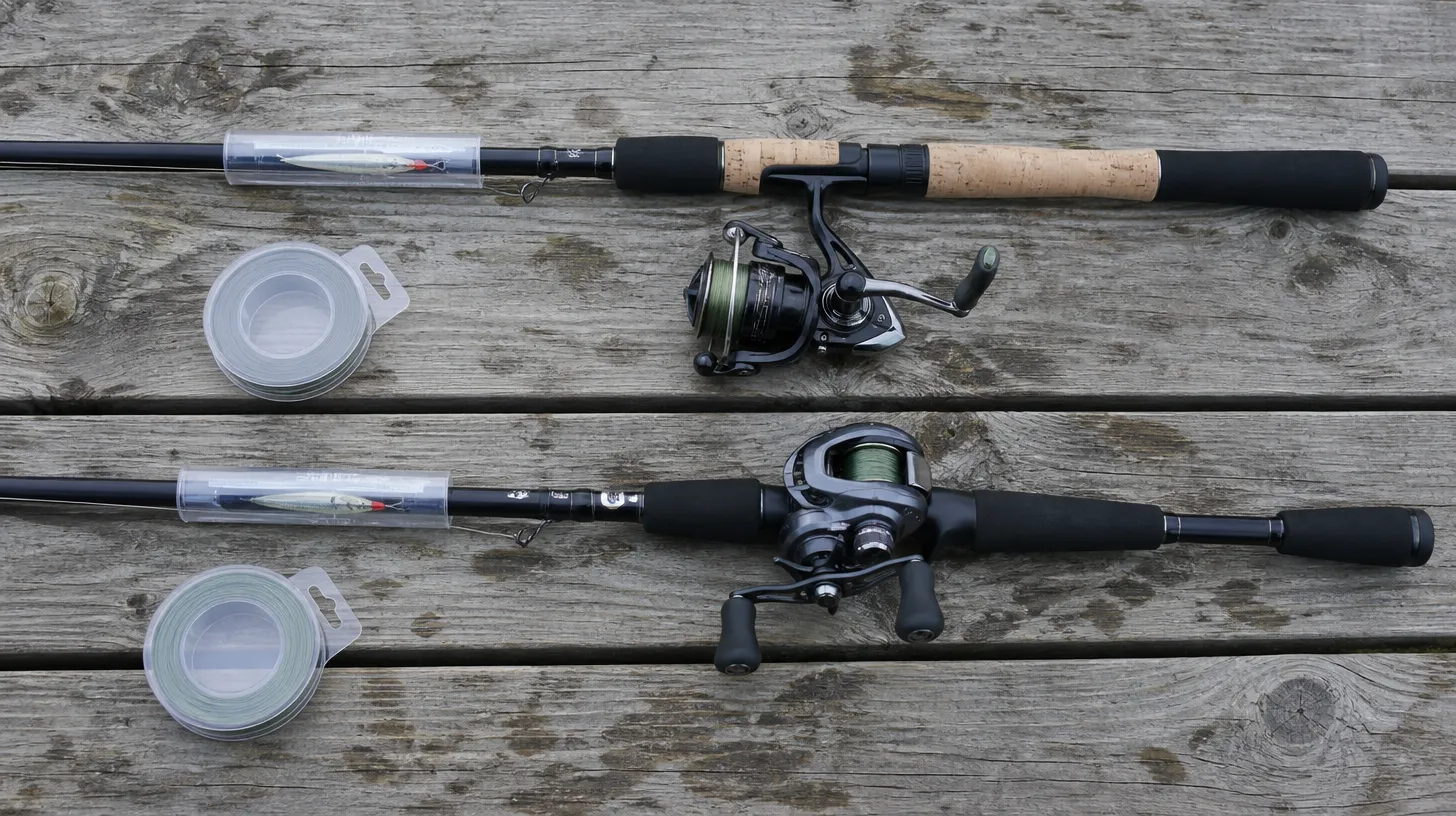
The rod has already decided which family of reel it takes. Texas Parks and Wildlife describes spinning rods as having "straight handles with large line guides and reels mounted on the bottom," and casting rods as carrying "spincast or baitcast reels and line guides mounted on top." Our breakdown of casting rod vs spinning rod is the prerequisite read.
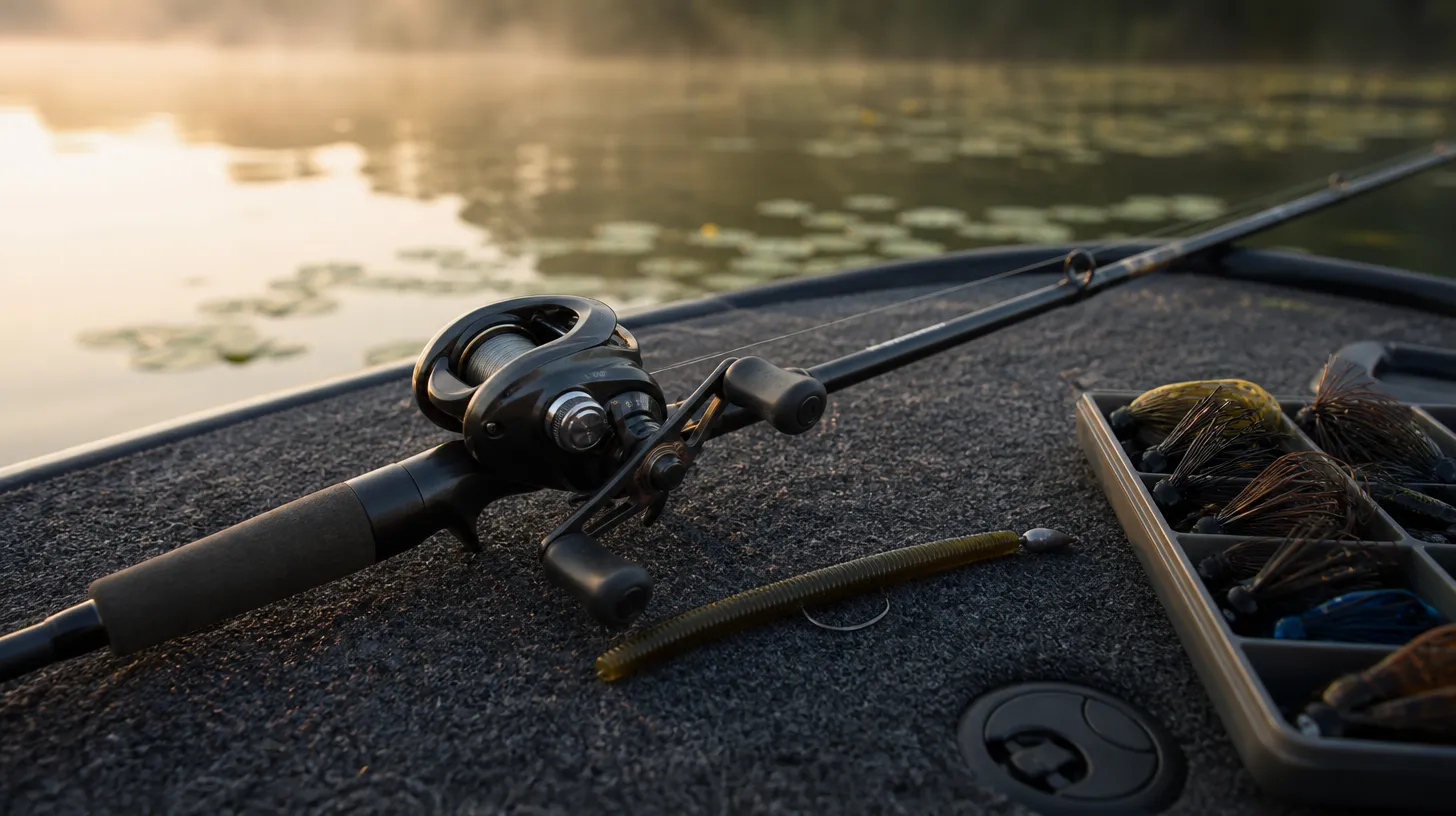
The matching rules shift when you cross over. Low-profile casting reels are generally specified by line capacity and gear ratio rather than by the four-digit ladder Daiwa describes for spinning reels, which leaves the rod's line rating as the one number both halves share. A low-profile reel also assumes a trigger-style seat and a blank finished to be loaded with the guides on top, so the rod must have been built for it — a fit question with no workaround.
Material changes how a correctly matched pair feels in the hand, a separate axis from whether the numbers agree: our comparison of graphite and fiberglass rod blanks covers what each does to the weight you hold.
Why Reel Sizes Do Not Compare Across Brands
Many anglers read a two-digit 30 as the rough equivalent of a four-digit 3000, and that convention is about as precise as cross-brand comparison gets.
Daiwa's page shows why. It defines a ladder, then layers its own suffix code on top: no letter means a standard gear ratio, H is high speed, XH extra high speed, and P power, "indicating a slower gear ratio with more torque." Nothing on the page claims those letters carry over to anyone else's box.
Salt Strong, which writes about inshore tackle, flags the same thing in the chapter list of its spinning-reel-size video — "Reel sizes aren't always the real sizes" — and reduces the problem to one instruction: "Don't go by the number, go by the specs."
So match the line rating, not the number on the box. Pull up the reel's published capacity in the line type you actually fish — braid and mono yardages for one reel are not interchangeable — and compare it against the rod's rating. The size number narrows the shelf; the capacity line decides.
The Rod and Reel Balance Check, in Under a Minute
Balance is the third check and the one nobody performs in the shop, though it takes less time than reading the price tag.
Schultz frames the stakes as outcomes rather than feel. A properly matched rod "should be neither too heavy in the tip section nor too heavy in the handle," and if the reel is too heavy or too light for it, "casting distance and accuracy will be impaired, as will strike detection" — "especially true with spinning gear," he notes.
His method, the only clearly described test we found from a nameable source: mount the reel, tie on no lure, and hold the rod with the reel stem between your little finger and ring finger, or between ring finger and middle finger, whichever is comfortable. In the first grip the balance point should fall where your middle finger touches the handle; in the second, where your index finger does. Then the test: "If the rod is properly balanced, you'll be able to hold the rod with one finger at the balance point and the rod will stay level, not tipping in either direction." This holds, he adds, "for the general range of spinning tackle, excepting heavy outfits."
A tip-heavy pair announces itself. Schultz defines it as a rod where "the tip falls down when you hold it at the balance point," and his fix is weight at the other end: one to four quarters in a snug butt cap, or a rod-balancing kit.
He is clear on the limit too: what "works, or feels comfortable, for one person may not work for another due to differences in hand size, hand strength, the way each holds a fishing outfit, and other reasons." So treat the finger test as a real check with a clear pass condition, not a specification. We will not quote balance points or gram figures for named models, because we found no source that publishes them.
Gear Ratio and Line Retrieve Match the Technique, Not the Rod
Gear ratio gets pulled into rod-matching conversations where it does not belong. It describes reel speed, and speed answers to the lure, not the blank.
Daiwa defines it mechanically — "gear ratio describes how many times the rotor spins around the spool for each turn of the handle" — then tells you to look past it: "What really matters in practice is how much line the reel retrieves per turn of the handle." The reason is geometry, which Daiwa states outright: "A larger spool retrieves more line per turn, even with the same gear ratio." So retrieve per crank, not ratio, is the number worth comparing.
Daiwa's advice for anyone unsure is refreshingly unambitious: "If you're not sure which gear ratio to choose, we recommend starting with a standard gear ratio, not a high-speed model." We would hand a beginner exactly that, and our page on spinning reel gear ratio covers which techniques genuinely want the fast end. What gear ratio never does is match or mismatch a rod: two speed versions of one reel fit it equally well.
What to Do When the Rod Publishes No Ratings
Plenty of rods do not tell you. In our own rod coverage we have repeatedly flagged budget listings that publish no line rating and no lure rating at all, including rods we otherwise rate well on value. When the number is missing, match by inference, in this order.
- Read the power label, and distrust it a little. Lamiglas says of these ratings that "they are not always a perfect science and vary from rod company to rod company," and that a medium-heavy "may vary greatly between a saltwater jigging rod and a salmon/steelhead combo rod." The word narrows the field without settling it.
- Work backward from the lures. Lamiglas's point about loading the rod applies whether or not a range is printed, and a rod that will not load with your usual lure is the wrong rod.
- Then work backward from the species. Texas Parks and Wildlife's instruction earns its keep here: match the line to the rod and reel capability and to the fish you are after. Know you fish 8 lb line for a species, and you know roughly what class of reel to buy.
- Do not read a missing rating as permission to go heavy. Lamiglas's over-stress warning does not stop applying because the number was omitted.
Common Mismatches and the Symptom Each One Produces
- Reel too large for the rod. The handle feels heavy and the balance point slides behind your hand. Per Schultz, the cost is impaired casting distance and accuracy plus worse strike detection — and lighter line does not rescue an oversized spool.
- Reel too small for a long or powerful rod. The classic tip-heavy outfit. Schultz's test catches it in seconds: the tip falls when you hold the rod at the balance point. Weight in the butt cap is his fix.
- Line heavier than the rod's rating. Lamiglas gives the risk of stressing the rod toward a break point. Texas Parks and Wildlife adds a cost unrelated to breakage: heavier line than needed "may reduce the number of hits or strikes you get because heavier line is more visible to fish."
- Lures outside the lure rating. Under it, per Lamiglas, the rod "will not load properly" and you lose distance. Over it, a sluggish cast and, on a genuine overload, a rod that "could break due to over-stress."
The Setups That Work
Three reads and one test. Read the line rating and buy a reel whose published capacity suits that class. Read the lure rating and check it covers what you throw. Mount the reel and do the one-finger balance check before you leave the shop. Pass all three and the number stamped on the reel foot never had to enter into it.
Two points bear repeating: reel size numbers are a within-brand ladder, so match the rating, not the number — and a rod's line rating and a reel's line capacity are different specs sharing a unit.
If you are still choosing the blank, our fishing rod guide handles that half with the ratings front and center. And skipping the matching exercise is legitimate: Schultz notes that some manufacturers sell rod-and-reel combinations already matched for suitability with each other, and that these are "generally well balanced and priced at a discount to purchasing the components separately." Our picks for rod and reel combos start from that premise.
About The Author
Rob Thomas
Rob Thomas is a fisherman who loves catching tales from his fellow fishermen. He always enjoys a good story, especially when it comes from the sea.