Graphite vs Fiberglass Fishing Rods

This post may contain affiliate links. Read our policy.
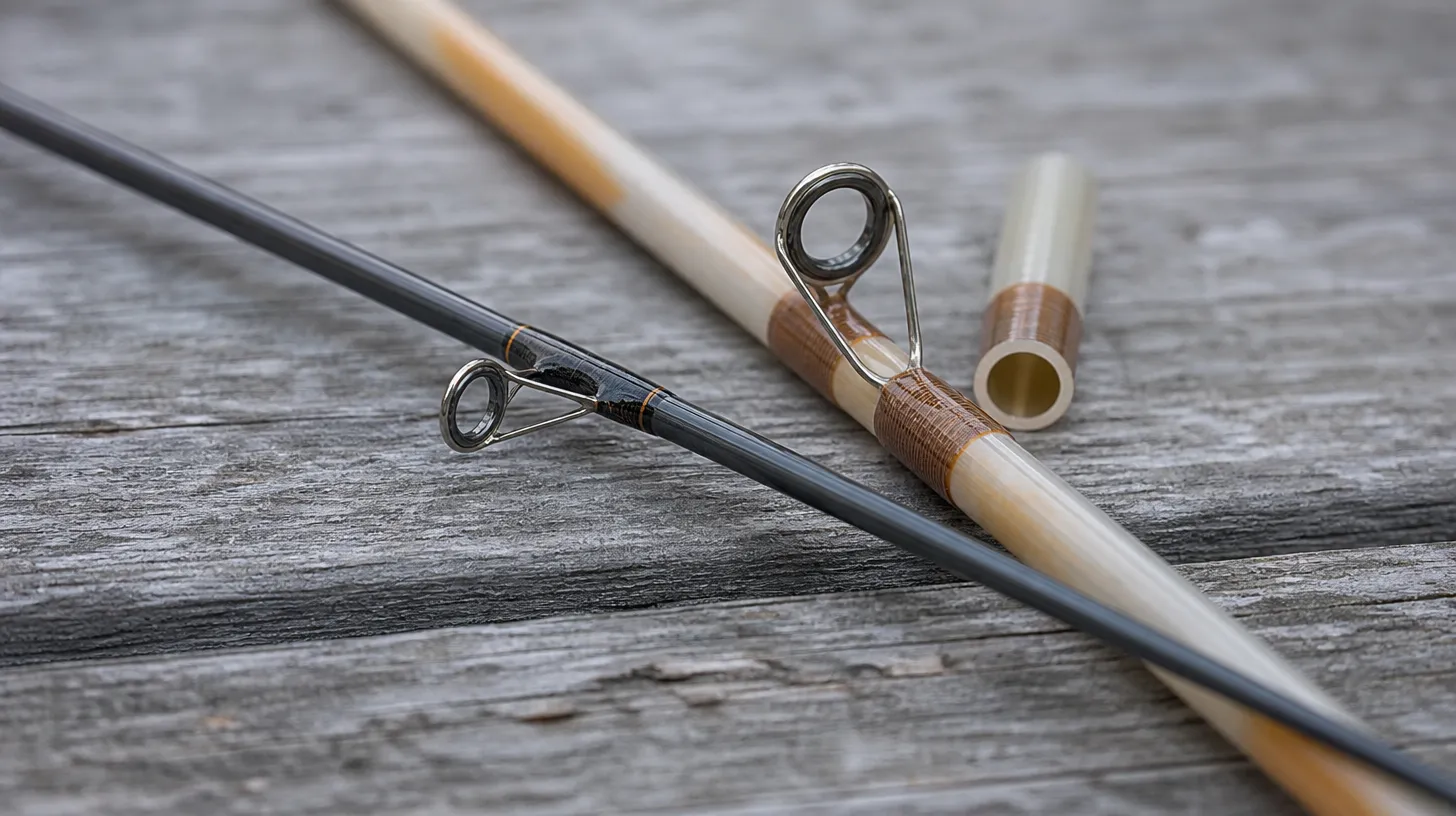
Graphite vs Fiberglass Fishing Rods
Neither material is better. They fail in opposite directions. Graphite is stiffer, lighter and more sensitive per ounce, so it suits single-hook presentations where you need to feel bottom and drive a hook home. Fiberglass bends deeper and recovers slower, so it suits crankbaits, trolling, and any lure hanging on treble hooks.
That is the short graphite vs fiberglass fishing rod answer. Most of what follows is about the one thing that makes the choice hard: the modulus labels printed on graphite rods — IM6, IM7, 24-ton, 36-ton, "high modulus" — are marketing designations, not a measurement you can compare between brands. If you are shopping today rather than learning the vocabulary, our guide to how to choose a fishing rod covers the rest of that decision and this page handles the material.
One thing to clear up first: material is not the same thing as action. A graphite blank can be built slow and a glass blank can be built faster than you would expect, because where and how much a rod bends is set largely by taper and layup rather than by the fiber alone — In-Fisherman lists taper, blank thickness and material together as what sets action. Our page on rod action and power separates those two ratings, and this one is only about what the tube is made of.
What a rod blank is, and what modulus measures
Rod blank materials come down to two fibers, graphite and glass, plus the resin that holds them in place. A rod blank itself is a hollow tapered tube of that fiber. G.Loomis describes resin in its 2014 catalog as the glue that bonds the fibers, and as the hard surface of the blank that you touch and feel, encasing the graphite fibers inside. Everything else — guides, reel seat, cork — is hardware bolted to that tube.
The fiber inside is rated two separate ways, and this is where buyers get lost. G.Loomis defines them cleanly in that same catalog:
- Modulus is the rating used to describe the stiffness-to-weight ratio of a fiber. G.Loomis adds that the higher the modulus, the stiffer the fiber, and that this translates to increased sensitivity for the angler.
- Tensile strength is the maximum load to failure of the fiber. The higher the tensile strength, the stronger it is.
Modulus is stiffness. It is not strength. Those are different properties of the same material, and the difference is the whole reason high-modulus rods have a reputation for snapping. G.Loomis's own account of the history is blunt: in early high-modulus graphites, as the modulus increased the tensile strength decreased, making them brittle and not useable in fishing rod applications. The company credits IM6 as the first material that raised both numbers at once.
Al Campbell, in a rod-building primer for Fly Anglers OnLine that dates back to the early 2000s, gives the same definition from the rod-builder's side — modulus describes the stiffness-to-weight ratio of the graphite used to create the blank — and names the trade-off plainly: increased modulus also results in a rod blank that is somewhat brittle and more likely to break from impact fracture. He suggests mid-range modulus blanks for beginners for exactly that reason.
So "high modulus" on a rod sticker is a claim about stiffness per unit weight. It is not a quality grade, and it is not a durability grade. It is closer to the opposite.
Why the modulus number on the label does not compare across brands
Here is the part worth the page. IM6 and IM7 are not industry standards. They are one supplier's product names. Hexcel lists IM6, IM7, IM8, IM9 and IM10 among the carbon fibers in its HexTow line, alongside aerospace grades like AS4 and HM63. The names began as a fiber catalog, not a fishing-rod scale.
The names then escaped the catalog. Rod builders in BassResource's long-running forum threads make two points repeatedly: plenty of manufacturers use fiber from suppliers other than Hexcel and still label the result IM6 or IM7, and there is no industry standard governing how much graphite a blank must contain to carry the rating at all. The same posters note that a glass-and-graphite composite blank can be sold as IM6. One maker's IM7 can be another maker's IM6, or another maker's IM8.
The published conversion tables disagree too. Campbell's figures at Fly Anglers OnLine put standard graphite near 33 million modulus, IM6 at 38 million and IM7 at 42 million. Nick Heid, writing for Surf Fishing In So Cal, offers what he calls a probable conversion and lands somewhere else: IM6 at 36 million modulus or 24 ton, IM7 at 40 million or 30 ton, IM8 at 44 million or 36 ton. Heid is direct about why the numbers wander, saying there is no true universal standard for IM, and that the ratings describe the carbon fiber used to make a blank rather than the finished rod.
When two careful write-ups cannot agree on what IM6 is worth, the sticker is not carrying information.
Practical upshot: use modulus claims to compare rods inside one manufacturer's lineup, where the maker is at least being consistent with itself. Ignore them across brands. And ignore them entirely as a proxy for strength, because the fiber rating says nothing about resin, wall thickness, taper, or how many layers of fiber the blank has. If you want the rest of the vocabulary on a rod label, we cover how rods are built and rated separately.
Graphite: what you get, what you give up
First, a naming note, because the two words send shoppers in circles: a carbon fiber fishing rod and a graphite rod describe the same thing in rod listings. Field & Stream's Pete M. Anderson describes graphite blanks as sheets of a crystalline form of carbon that are rolled and baked, which is why listings use the two words interchangeably.
What you get is feel and weight. Anderson calls those graphite blanks lightweight, extremely sensitive and powerful. FishUSA's materials guide puts it in fishing terms: higher-modulus graphite transmits tiny vibrations such as gravel, shell and leaf taps, plus the slack-line ticks you get from jigs and dropshots. FishUSA also notes graphite's quick snap-back, which it calls fast recovery, and that the lower weight reduces fatigue over a long day.
What you give up is margin for error. FishUSA calls graphite comparatively brittle under impact and specifically sensitive to high-sticking and point impacts. Campbell's impact-fracture warning says the same thing from the blank side. Neither source claims graphite is weak in a fight — it is the sideways, sudden, careless loads that kill it: a tip hooked in a door frame, a rod pinned under a hatch, a high-stick to free a snag.
You also give up money. Campbell writes that the highest-modulus graphite material costs as much as ten times more than standard graphite, and that the cost gets passed to the buyer. That cost gap is a plausible part of why the cheap end of the rack is rarely pure high-modulus graphite, though we found no published breakdown of blank costs.
Who should take graphite: anglers fishing single hooks and bottom contact. FishUSA points graphite at jigs, Texas rigs, dropshots and vertical jigging — a single thick-wire hook has to be driven, and the rod's job there is transmission rather than cushioning.
Fiberglass: what you get, what you give up
Fiberglass is the forgiving one, and it is not a beginner's consolation prize. Anderson calls fiberglass flexible and says it creates the smoothest parabolic bend, and that it is the pick of crankbait purists. FishUSA describes glass as bending deeper and recovering slower, producing what it calls a parabolic cushion, and rates it the most impact-tolerant of the three blank types.
That slow recovery is a feature, not a shortcoming. A treble-hooked lure is held in a fish's mouth by several thin wire points, and a blank that keeps loading rather than snapping straight is what stops a thrashing fish from levering those points free. FishUSA's recommendation follows directly: glass for treble-hook lures and trolling — crankbaits, jerkbaits, spinnerbaits, and plugs for steelhead, salmon and stripers.
The costs are plain. Anderson notes that fiberglass rods often weigh the most but cost the least. FishUSA rates glass the least sensitive of the three materials, which matters the moment you want to feel a jig tick a rock. A glass rod will not tell you what the bottom is made of.
Not all glass is the same, either. FishUSA separates E-glass, which it describes as heavier, from S-glass, which it calls stronger per weight and a touch lighter. S-glass is the premium version and it shows up on named rods — Anderson identifies the St. Croix Legend Glass as using an SCI Linear S-glass blank. If a listing just says "fiberglass," assume the cheaper cloth.
Composite blanks, and why a budget "graphite" rod may be a blend
A rod described as graphite is not always pure graphite: composite blanks put graphite and fiberglass in the same tube, and a listing can say "graphite" without telling you which you are holding. We cannot tell you what share of the market is blended: we found no published figure for it, so treat it as unknown rather than as "most."
The clearest documented example is the Ugly Stik GX2. Sportsman's Warehouse's listing for the Ugly Stik GX2 casting rod states that the GX2 uses the Ugly Tech Construction, which comprises a graphite and fiberglass combination. That is a rod many anglers think of as "the tough fiberglass one," and the retailer's own description says it is a blend.
The blend exists because it works. FishUSA says a composite blank blends graphite's sensitivity with glass's shock absorption, and recommends it for power-moving baits where you want feel and forgiveness — chatterbaits, spinnerbaits, mid-depth cranks, inshore plugs. Anderson describes a blend the same way: fiberglass provides the action, graphite adds sensitivity and subtracts weight, and the result can be a good compromise for specific situations.
Two honest caveats. First, a composite is not a free win: FishUSA says composite blanks are not as telegraphic as graphite on subtle bottom ticks. Second, the weight saving is modest. Anderson lists the Lew's David Fritts Perfect Crankbait Speed Stick, a blend-blank rod carrying the name of the crankbait specialist who won the 1993 Bassmaster Classic, at 6.6 ounces, and notes that this is heavier than most 7-foot cranking rods. FishUSA makes the same point about the Shimano Zodias composite: lighter than pure glass, with enough cushion for moving baits. Lighter than glass is not light.
Which material to pick, by technique
Technique, not species, decides this. Based on the sources above:
- Jigs, Texas rigs, dropshot, vertical jigging — graphite. You are driving one heavy-wire hook and reading the bottom through the blank. This is FishUSA's single-hook and bottom-contact category.
- Crankbaits, jerkbaits, trolled plugs — fiberglass, or a composite if the weight bothers you. Treble hooks need the cushion, and Anderson's and FishUSA's advice agree here.
- Spinnerbaits, chatterbaits, mid-depth cranks, inshore plugs — composite. FishUSA's own framing for the blend is power-moving baits where you want both feel and forgiveness.
- Live bait and bottom rigs for kids and newcomers — composite, for the plain reason that it tolerates the abuse FishUSA says graphite does not.
- Finesse and light line — graphite, with the brittleness caveat live. Our picks for the best ultralight fishing rods are where this trade-off gets sharpest.
Whichever material you land on, the line rating stamped above the handle still governs what you can spool. Our fishing line weight chart is the cross-reference, and the material does not change those numbers.
Length, very light blanks, and where brittleness bites
Material and length interact. A longer blank gives you more leverage over the tip, which is the loading condition Campbell's impact-fracture warning and FishUSA's high-sticking warning both describe. That is the argument against pairing the longest rod in the rack with the most aggressive modulus claim — our rod length guide covers what length buys you on casting distance and hooksetting.
Very light blanks push in the same direction. Make a tube thinner and lighter and there is less material left to absorb a knock. Some light rods answer this with a solid rather than hollow tip: the UK light-rock-fishing guide Light Rock Fishing explains that a solid section is spliced into the tubular blank at the tip, and that because there is a join between the solid and hollow sections, vibrations traveling down the rod can be softened. On the trade-off itself, Tom Kirkman of RodMaker Magazine is direct: a solid rod is generally more durable than a tubular one, but a tubular rod offers greater stiffness for the same amount of material.
Durability, repairs, and what actually breaks a rod
A fish is rarely what breaks a rod. The failure modes our sources actually name are point loads and bad angles, which is why FishUSA singles out high-sticking and point impacts as graphite's weakness and notes that many warranties still exclude abuse. Read that second half carefully before you buy on the strength of a warranty.
Check warranty length per model, and check who is making the claim. The Sportsman's Warehouse listing for the Ugly Stik GX2 casting rod quotes a 7-year warranty, but that is a retailer's listing field rather than a manufacturer spec sheet, so confirm it with whoever you buy from.
Glass earns its keep here. FishUSA rates fiberglass the most impact-tolerant of the three materials with composite close behind, which is why we would put a blend in the hands of anyone who loans rods out, leaves them in a truck bed, or is teaching a beginner.
What we would buy
If we could only own one rod, we would buy a composite in a medium power, and we would be honest that we were buying it for tolerance rather than feel. If we already owned one good graphite rod, the second rod we would add is glass or composite for crankbaits, because that is the gap graphite genuinely cannot cover.
What we would not do is pay extra for a modulus number. Compare modulus claims within a brand, never across brands, and treat "high modulus" as a statement about stiffness and price rather than quality. Pick the failure mode you would rather live with: graphite gives up toughness to buy feel, glass gives up feel to buy toughness, and composite splits the difference without fully winning either.
If you want the whole rod decision laid out in order rather than just the material question, our complete fishing rod guide walks through power, action, length and price together. Once the rod is chosen, what to spool it with is the next call, and if you still need the other half of the setup, our spinning reel picks cover that side.
About The Author
Rob Thomas
Rob Thomas is a fisherman who loves catching tales from his fellow fishermen. He always enjoys a good story, especially when it comes from the sea.