Fishing Rod Action and Power Explained

This post may contain affiliate links. Read our policy.
Fishing Rod Action and Power Explained
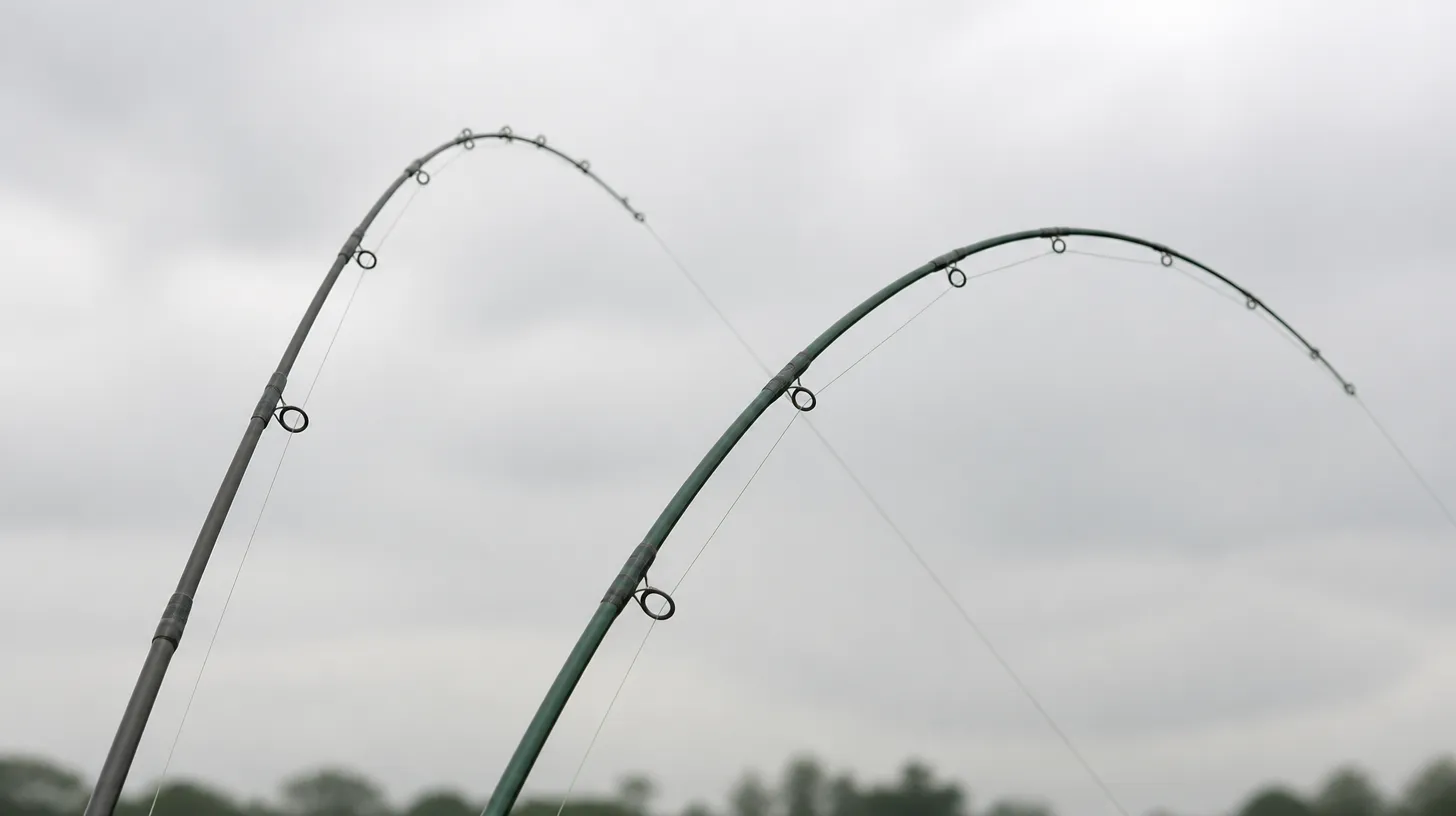
Power is how much force it takes to bend a rod. Action is where along the blank that bend happens. Power is printed as ultralight through extra heavy; action as slow through extra fast. The two are independent, so a rod can be heavy power with a slow action, and the pair of words together tells you what the rod can lift and how it will behave when a fish pulls back.
Both ratings are stamped just above the handle on nearly every rod sold, usually on the same line as a lure-weight range and a line-weight range. Most buyers read one of the two and assume it covers the other. It does not, and the confusion costs fish at both ends: too much power snaps light line on the hookset, and the wrong action pulls hooks out of a mouth three feet from the net.
That is fishing rod action and power explained in two sentences, and the rest of this page is what to do with it. If you are picking a rod today rather than learning the vocabulary, our guide on how to choose a fishing rod covers that decision.
What rod power measures
Mud Hole Custom Tackle, which sells blanks to rod builders, defines power as how much force is required to make the blank bend under a load. Writing for Game & Fish, Josh Ward puts the same idea in fishing terms — power is essentially a designation of the rod's lifting power — and notes a direct correlation between a rod's power and its overall weight.
Power is the rating tied to numbers you can check. Temple Fork Outfitters publishes lure ranges for each step of its own ladder, which gives the scale:
- Ultralight — subtle presentations, ultra-light line, lures from 1/32 oz up, per TFO's chart.
- Light — TFO describes these as ideal with lures around 1/16 oz.
- Medium light — 1/8 to 1/2 oz in TFO's listing.
- Medium — 1/4 to 3/4 oz, the range that covers the most techniques.
- Medium heavy — TFO says only that where medium power stops, medium heavy starts.
- Heavy — a stiffer blank, rated 3/8 to 1 oz.
- Extra heavy — 1/2 to 2 oz, which TFO calls the stiffest rod in its lineup.
Read that list closely and the first problem with power ratings shows up. TFO's heavy rods start at 3/8 oz, lighter than the top of its own medium range, and its ultralights are rated up to 3/8 oz while its lights are quoted at 1/16 oz. The ranges overlap so heavily that the ladder is not a clean staircase even inside one brand's catalog.
The lure range is the useful half. The line range is the half people ignore, and Ward is blunt about the consequence: rod makers list suggested bait and line sizes on the blank, and a heavy rod can snap line that is too light during the hookset. Match both. Our fishing line weight chart is the cross-reference for the line side, and at the bottom of the ladder, where 2 to 6 lb line is normal, the reel has to cooperate too — see our picks for the best ultralight spinning reel.
What rod action measures: where the bend starts
Action has nothing to do with strength. Mud Hole defines it as how and where a rod blank flexes under load, and TFO reduces it to four words: action is where a rod bends.
Described by behavior rather than adjectives, the ladder runs like this:
- Extra fast. Only the very tip flexes under load, in Mud Hole's description. Pick the rod up and the top few inches move while the rest feels like a broom handle. Hooksets are near-instant and nothing is forgiven.
- Fast. Bends primarily in the upper third of its length, per Mud Hole; TFO says the top third or less. This is the default on most modern bass rods.
- Moderate fast. The bend reaches a little deeper than the top third. Mud Hole frames the design goal of this action as hook retention during the fight rather than hookset speed.
- Moderate, also sold as medium. TFO puts the bend through roughly the top half of the blank. The rod loads visibly on the cast and keeps pulling after the hookset is over.
- Slow. Mud Hole says the blank flexes much deeper, often through the top three-fourths; TFO describes the bend starting in the lower third and running into the handle. It is a parabola, not a lever.
One confusion will trip you in a shop: medium is used as both a power rating and an action rating. Some brands print moderate instead of medium for action for exactly this reason. If a rod is labeled only medium, you do not yet know which of the two you have been told.
The part most guides skip: the two ratings interact
Power and action are set independently, which is why two rods sharing one rating can feel like different tools. A medium power, fast action rod bends in its top third and stops: it casts a 3/8 oz lure, telegraphs a bite through the tip, and sets a hook with a short, sharp move. A medium heavy, moderate action rod carries more lifting power but bends halfway down the blank, so it throws heavier baits, pulls harder once loaded, and sets a hook slowly.
Neither is better. They suit different jobs, and the labels alone will not separate them — Mud Hole's own guidance is that you cannot rely solely on the label, because a fast action, medium power blank from one manufacturer may behave quite differently from one labeled the same by another.
How action changes your hookset
This is the section worth the price of the article, and it is mostly about hooks rather than rods.
A treble hook spreads the force you apply across six or more points, which dilutes pressure and leads to less effective hooksets. That is Pete M. Anderson's explanation in Field & Stream's crankbait rod guide, and he connects it straight to lost fish: diluted pressure makes it easier for a jumping, lunging bass to throw a crankbait. Mud Hole adds the other half of the physics — treble hooks use thinner wire than single hooks and therefore need less pressure to penetrate in the first place.
So the softer rod is not there to help you set the hook. It is there to stop you from undoing a hook that is already set. Anderson describes a slow-action crankbait rod as functioning like a shock absorber that keeps the line tight, and notes that the early graphite rods were a genuine problem for treble-hooked lures because their inflexibility made them hard to fish. Mud Hole makes the same case for moderate-fast blanks, which it says keep treble hooks pinned while absorbing the shock of a hard strike.
Single hooks invert the argument. A jig hook or a worm hook is heavy wire with one point that has to be driven through a jaw, and Mud Hole's description of what a fast action blank must do is exactly that: drive the hook home with authority. There is no slack in the system to absorb, so the rod's job is transmission, not cushioning.
The honest caveat comes from anglers rather than manufacturers: hook size may matter more than hook count. Experienced posters in long-running BassResource threads argue the real variable is how big the hook is, how sharp it is, and how the fish gets hooked — and that a rod with power in the butt section will drive hooks home whatever its action is called. Treat the treble-versus-single rule as a strong default, not a law.
Practically, that means:
- Treble-hook baits — crankbaits, jerkbaits, topwaters — want moderate or moderate-fast. Our best crankbaits for bass picks are the obvious case.
- Single-hook presentations — jigs, Texas rigs, soft plastics — want fast or extra fast. See our soft plastic bass lures guide for what that rod will be throwing.
- Both in one rod is a compromise, not a solution. Moderate fast is the usual middle ground, and it is slightly wrong for each job rather than right for either.
Mapping power and action to real fishing
Power follows the bait weight and the cover; action follows the hook.
Finesse and panfish work sits at ultralight to light power with a moderate-to-fast action, because 2 to 6 lb line cannot survive a stiff hookset. General bass fishing lives at medium to medium heavy. Field & Stream's guidance for mid-sized crankbaits is medium or medium-heavy power on 8 to 15 lb line, and for deep divers Anderson says a medium-heavy or heavy rating and strong lines are required.
Heavy and extra heavy power is cover-extraction gear — frogs over mats, punching, flipping into wood — where the problem is not the fish but dragging it out of something.
Size the reel to the line rating printed on the blank, not to the rod's length.
Ratings are not standardized between brands
Before you shop across brands, learn this: one company's medium heavy is another company's heavy, and nobody is lying.
Mud Hole states it directly — there are no universal industry standards for these ratings, and there is not one power range that every maker uses. Ward's Game & Fish piece explains why: there is no standardized testing to rate rods, so makers judge a blank against other blanks they build, which makes the label largely a matter of opinion. He adds that the vocabulary itself varies brand to brand, with some makers calling a whippy, light-action rod fast while others reserve fast for a rod that bends nearer the tip.
Published gear writing shows the same slippage. Field & Stream's own crankbait guide recommends a medium-heavy or heavy action for deep divers, when medium heavy is a power rating — not a gotcha, just evidence of how loose the terms are in practice.
The practical rule we would follow: compare ratings only within one brand's lineup, and compare lure and line ranges across brands. Those numbers are at least units.
Modulus, IM6, IM7 and other numbers that do not settle it
If a blank advertises a modulus figure or an IM rating, that describes the carbon fiber's stiffness, not the rod's power or action. Rod-building discussions are consistent that these labels are not standardized either — one brand's IM7 may be another brand's IM9 — and the modulus figures published for IM6, IM7 and IM8 conflict noticeably between sources, a good sign the numbers are marketing rather than measurement.
Builders there also point out that resin, scrim, mandrel shape and wall thickness do as much to set a blank's behavior as the fiber rating, and that higher-modulus material generally trades toughness for stiffness. None of it tells you where the rod bends.
What to buy if this is your first rod
Skip the specialist actions. A medium power rod with a moderate-to-fast action, around 6 to 7 feet, will cast most of the lures you will own, set both hook types acceptably, and forgive a late hookset. Our best fishing rods for beginners picks are built around that spec, and around rods cheap enough to replace after a car door finds one.
The common first-rod mistake is buying an ultralight because it was the cheapest rod on the rack, then discovering it cannot cast anything heavier than a small jighead. The second is buying extra fast because it sounded better. Fast is not a quality rating.
How to read a rod you are holding
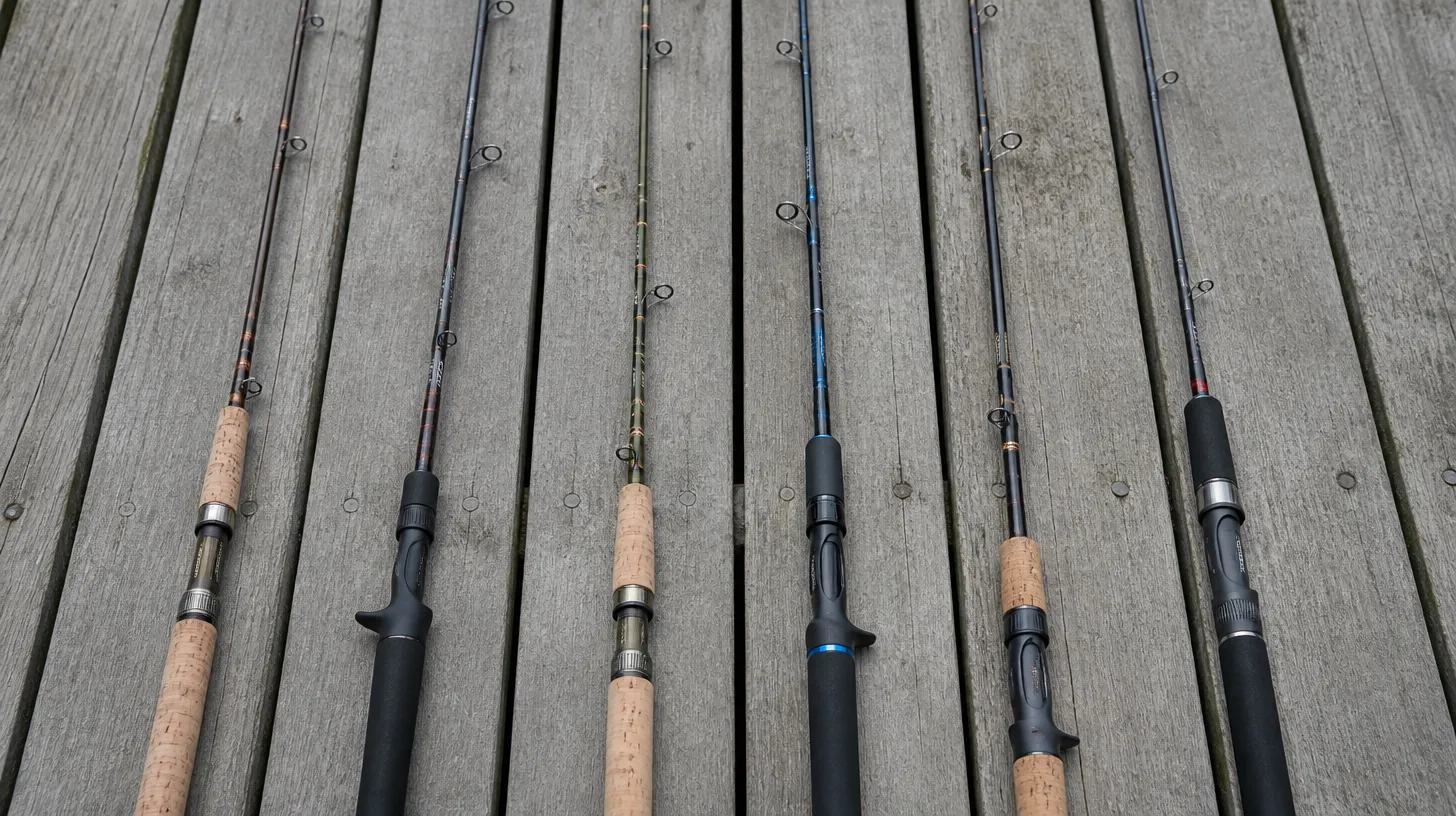
The ratings print on the blank just above the handle, usually as a short line reading something like 6 ft 10 in, MH, Fast, 10-20 lb, 1/4-1 oz. Read the lure and line numbers first; they are the only part of the label with units. Then confirm the two words against the blank itself.
Ward's shop advice is still the best test available to a buyer. Walk the racks and flex rods against each other, do not buy an unfamiliar rod without evaluating it yourself, and clamp a reel on before deciding, because the reel changes the balance and the sensitivity you feel. His last point is the honest one: a rod's feel is subjective, so the final judgment happens on your own water.
If a rod carries no printed rating — common on old rods, imports and some combos — reason from what you can see. Flex it under a steady pull and watch where the bend starts to place the action, compare its stiffness against a rated rod on the same rack to place the power, then size the line to the lightest sensible guess, because an unrated blank that breaks line is a cheaper mistake than one that breaks itself. Our older primer on fishing rods explained covers the rest of the anatomy.
The short version
Power is force; action is location. Power should match your lure weight and your line, both of which are printed on the blank. Action should match your hook: fast for single hooks you have to drive, moderate for trebles you only have to keep pinned. And because no standards body rates either one, the words are comparable within a brand and not much beyond it.
Get those two choices right and most of the rest of the rod — guides, grip material, fiber modulus, paint — is preference. When you are ready to turn that into a purchase, our complete fishing rod guide works through length, price and the specific models we would buy.
About The Author
Rob Thomas
Rob Thomas is a fisherman who loves catching tales from his fellow fishermen. He always enjoys a good story, especially when it comes from the sea.