Best Fishing Line: Braid, Fluorocarbon, and Mono Compared

This post may contain affiliate links. Read our policy.
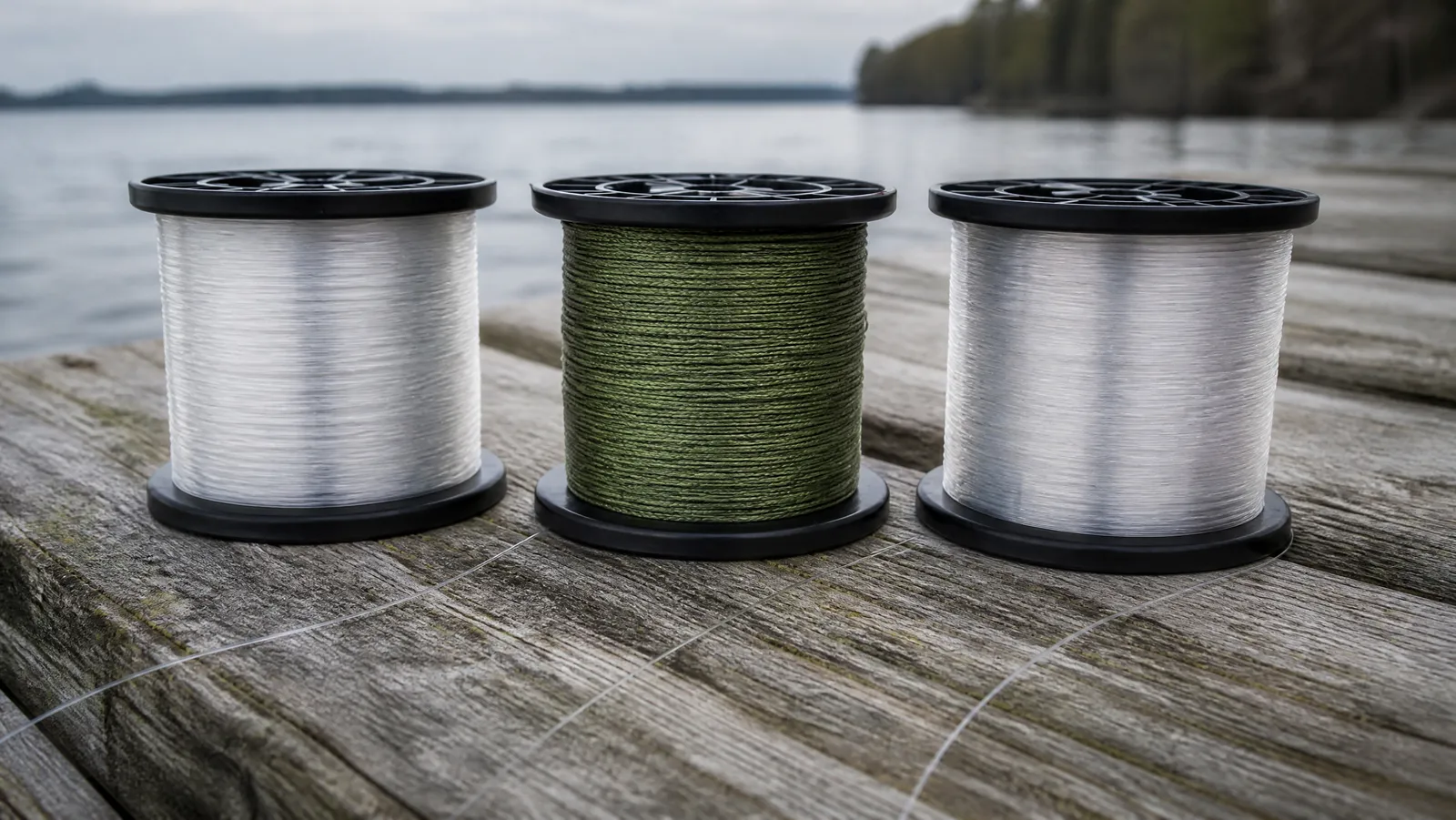
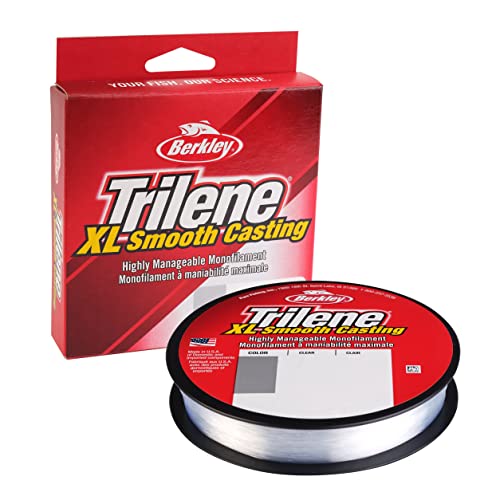
Berkley Trilene XL Monofilament, 8 lb
Berkley's Trilene XL is the default limp monofilament: 8-pound test at 0.
- Cheapest way to get a full, fishable spool onto almost any reel
- Berkley builds it specifically to resist the twist that ruins mono on spinning gear
- Stretch makes it forgiving on treble-hook baits
- 0.010 in for 8 lb is thick next to braid of the same rating
- Mono absorbs water and weakens over a season
Best Fishing Line: Braid, Fluorocarbon, and Mono Compared
For most freshwater anglers, the best fishing line is braid on the spool with a fluorocarbon leader tied to the end of it — plus one rod still carrying plain monofilament for treble-hook baits. There is no single winner, because the three families fail in different directions, and your technique decides which failure you can live with.
Angler Reviews is reader-supported. We may earn a commission on purchases made through links on this page, at no extra cost to you.
This is the hub of our line series. Below we work through what actually separates the three materials, what the number on the box promises, and how the reel in your hand narrows the choice before you ever get to brand names.
Fishing Line Types: The Three Families in One Pass
Every spool on the shelf is one of three materials, and each one is a different polymer with different physics. Get the fishing line differences straight at the material level and most of the buying decisions downstream answer themselves.
Monofilament is a single extruded strand of nylon. It stretches a long way, it sits close to neutral in the water, it is cheap, and it takes on water.
Fluorocarbon is also a single extruded strand, but of polyvinylidene fluoride. It is markedly denser than water, stiffer than nylon, and it bends light closer to the way water does.
Braid is not extruded at all — it is a rope. Multiple gel-spun polyethylene fibers are woven into a round line with almost no stretch, a very small diameter for its strength, and positive buoyancy.
The cleanest single number separating them is specific gravity, or density relative to water. Sunline America publishes figures for all three: nylon at 1.11 to 1.14, fluorocarbon at 1.78, and braid at 0.97, against water at 1. Sunline's conclusion is worth quoting directly: "Anything with a specific gravity less than one will float, so the braided line will be the most buoyant, nylon the second most, and fluorocarbon being the densest and the least buoyant of the three-line types."
Visibility splits them a second way. Wired2Fish's rundown of line refraction gives water a refractive index of 1.33, nylon 1.53, and fluorocarbon 1.42 — which is why fluorocarbon gets called invisible and nylon does not. Berkley's own position is more careful, saying only that fluorocarbon "has nearly the same refractive index as water." Nearly is doing real work in that sentence.
Stretch is the third axis, and it is the one where the marketing runs ahead of the measurements. Berkley describes fluorocarbon as "lacking the low-end stretch of nylon mono," which it credits for "more solid hooksets" — a claim about the first few pounds of load, not about total elongation. The Tackle Room's line comparison puts monofilament stretch at 25 to 30 percent of its length, fluorocarbon at 10 to 15 percent, and braid at 1 to 3 percent. USAngler is blunter about the middle figure, reporting that fluorocarbon shows only "slightly less stretch than comparable nylon mono" in its testing. Treat fluorocarbon as a lower-stretch line, not a no-stretch one.
Density, visibility, stretch. Pick the two that matter for the way you fish and the family chooses itself.
Monofilament: Cheap, Stretchy, and Still Right Sometimes
Mono is the line everyone learns on and a lot of anglers abandon too early. Its two supposed weaknesses — stretch and buoyancy — are exactly what some techniques need.
Berkley's own freshwater line guide makes the case plainly: because monofilament "floats and is translucent, it's an excellent choice for fishing floating topwater lures," while fluorocarbon "sinks" and is "generally a poor choice" for the same job. That is not brand loyalty talking. It is the density gap from the previous section applied to a walking bait: Sunline's nylon figure of 1.11 to 1.14 sits far closer to water than fluorocarbon's 1.78, so a thin nylon line rides at or near the surface where a fluorocarbon one drags the nose of the bait under.
Stretch does the same favour on treble hooks. A crankbait or a jerkbait pulls free when a fish surges against a rigid connection; the 25 to 30 percent give in nylon acts as a shock absorber between the fish and a stiff rod.
The Berkley Trilene XL Monofilament, 8 lb is our default here at about $7 as of September 2026, down from an $8.99 list price. Berkley lists it at 0.010 inch diameter for 8-pound test on a 330-yard spool, and states that it resists twists and kinks for smoother casting — which matters, because twist is the specific way mono dies on a spinning reel.
Two honest limits. At 0.010 inch, that 8-pound mono is thicker than most 20-pound braid. And Berkley itself notes that unlike fluorocarbon, "mono and some superlines" absorb water, which is the mechanism behind mono's reputation for going soft over a season.
Buy mono when the bait needs to float, when the hooks are trebles, or when you want a full spool for the price of a sandwich. For everything else, keep reading.
Fluorocarbon: Dense, Stiff, and Hard to See
Fluorocarbon is the specialist that markets itself as a generalist. It earns its money in clear water and around cover, and it costs you handling everywhere else.
Berkley's clear-water argument is the refraction one: because fluorocarbon "has the same refractive qualities as water, it's an excellent choice for clear water fishing conditions." Berkley also claims fluorocarbon "is more abrasion resistant than standard nylon monofilament of the same diameter," and that "unlike mono and some superlines, fluoro doesn't absorb water," so it holds "the same strength, sensitivity and handling below the surface as it does when dry."
Then there is the sink rate, which is the underrated part. Berkley says fluoro "sinks faster than mono, resulting in less slack or bow between the lure and rodtip." Less bow is faster hook transmission on a deep bait, and many anglers report a diving crankbait running slightly deeper on fluorocarbon than on nylon for the same reason.
The Seaguar Red Label Fluorocarbon, 15 lb is the pick that makes filling a whole reel with fluorocarbon realistic — about $16 as of September 2026, down from a $19.25 list. Seaguar manufactures its own fluorocarbon resins, positions Red Label specifically as a freshwater main line rather than leader stock, and recommends it for baitcasting reels. That last detail is a real recommendation, not a throwaway.
The costs are handling costs. Fluorocarbon is stiffer and holds more memory than mono, which is why it fights you on a spinning spool. And Red Label ships in 200-yard spools against 330 yards of Trilene XL, so it fills less reel per purchase.
Buy fluorocarbon when the water is clear, the bait needs to get down, or the line is dragging across rock — and put it on a baitcaster if you can.
Braid: No Stretch, No Forgiveness
Braid — properly, braided fishing line — is where modern fiber science ended up, and the spec sheets show it. It is woven from ultra-high-molecular-weight polyethylene, the same fiber family sold as Dyneema and Spectra. Orion Cordage, which sells UHMWPE rope, states that "UHMWPE is 15 times stronger than steel on a weight-for-weight basis." Note the qualifier: that is strength per unit of weight, not per unit of diameter. Marlow Ropes, which builds rope with Dyneema, frames the same-size comparison as a weight saving rather than a strength multiple — "size for size, a rope made with Dyneema is 8 times lighter than steel wire rope."
Here is what that buys in practical terms. Sufix lists its 20-pound 832 at 0.009 inch diameter. Berkley lists Trilene XL at 0.010 inch for 8-pound test, and Trilene Big Game at 0.018 inch for 20-pound. So across those three spools, 20-pound braid is thinner than 8-pound mono, and exactly half the diameter of the mono at the same rating. Thin line means more yards on the spool, less water drag, longer casts, and a lure that gets deeper on the same amount of line out.
You pay for it in forgiveness. At The Tackle Room's figure of 1 to 3 percent stretch, braid transmits everything — including a head shake that pulls a treble hook free.
The Sufix 832 Advanced Superline Braid, 20 lb is our overall pick at about $31 as of September 2026. Sufix describes the construction as "8 fibers (7 HMPE fibers plus 1 GORE Performance Fiber)" with "32 weaves (pics) per inch," and says the GORE fibers "improve abrasion resistance, increase casting distance and accuracy and reduce line vibration." Sufix also credits its TPG treatment with enhancing colour retention, and markets the line as "the strongest, most durable small diameter braid on the market."
If you want the cheapest honest braid instead, the KastKing SuperPower Braid, 20 lb runs about $17 as of September 2026 for 327 yards. KastKing markets it as low-memory to reduce wind knots and claims it holds an improved clinch knot — a claim we will come back to when we get to knots, because it is a more interesting statement than it looks.
Buy braid when you need diameter-to-strength, distance, or a direct connection to the bait. Just do not tie it straight to the lure in clear water, which brings us to leaders.
Pound Test, Diameter, and Capacity
Here is the uncomfortable part: the number on the box is not a certification. Manufacturers quote pound test and diameter side by side, but for ordinary retail line neither figure is independently verified — the only tested standard we could find is the IGFA's, and it applies to record claims rather than to what is on the shelf.
The IGFA is the one body that puts real numbers on line class, and its world-record rules show how much slack exists. The IGFA explains that "the imperial measurement system equivalent of 4 kilograms is 8.81 pounds. Thus, line designated by the manufacturer as 8-pound class line may test up to 8.81 pounds (4 kilograms) to qualify for a 4-kilogram (8-pound) Line Class world record." The IGFA also rules that if "the line or tippet over tests its class, the application will be considered in the next highest class," and that under-testing line "will not be considered for the lower Line Class or Tippet Class."
Read that again and the lesson is clear. IGFA class line is certified against a ceiling. Retail line marked only "test" carries no such certification, and manufacturers have every commercial incentive to over-build it — a line that breaks below its rating generates complaints, and a line that breaks above its rating makes your knots look better than they are.
Diameter is the more useful number, because it is the one that determines how much line goes on your reel. Our line capacity calculator does that arithmetic for you: feed it the spool rating from your reel and the diameter of the line you are considering, and it tells you how many yards you actually get. This matters most on braid, where a 20-pound line at 0.009 inch will badly underfill a spool rated for 12-pound mono unless you add backing.
Pound test also sets your drag. The conventional rule is a fraction of breaking strain, and Salt Water Sportsman publishes it as a schedule rather than a single number: "The proper drag setting for nylon mono lines up to 20-pound test is 20 percent of the breaking strength of the line. For 30- through 50-pound mono, it's 25 percent." For braid the numbers drop, because braid does not stretch: "With braided lines up to 20-pound-test, set the drag at 15 percent of the line's breaking strength." Our drag setting calculator runs those percentages against whatever you have spooled.
Choose line by diameter and set drag by rating. Treat the pound test on the box as a category, not a promise.
Matching Line to Your Reel
The reel is the constraint most buying guides skip, and it is the one that eliminates whole families before you get to water clarity.
Spinning reels twist line. Every turn of the handle puts a twist into the line as it comes off a fixed spool, and stiff line stores that twist as memory, then throws it off the spool in coils. That is why the answer to the best fishing line for spinning reels is almost always braid or a limp monofilament, and almost never a full spool of fluorocarbon. Berkley's fix on the mono side is built into the product: it states that Trilene XL resists twists and kinks for smoother casting. On the braid side, low memory is the property to shop for, which is why KastKing markets SuperPower as low-memory specifically to reduce wind knots.
Baitcasters do not twist line. The spool rotates in line with the guides, so stiffness costs you far less, and the fluorocarbon that fights a spinning reel behaves itself. Seaguar recommends Red Label for baitcasting reels, which is exactly where we would put it. If you are choosing line for a baitcaster, fluorocarbon and heavy braid are both on the table in a way they are not on a spinning outfit.
One more pairing to get right: line stretch and rod action have to add up. A fast, stiff rod plus zero-stretch braid plus treble hooks is the combination that pulls hooks, which is why we list the near-zero stretch of a braid like Sufix 832 as a limitation on a stiff rod with trebles rather than a pure virtue. A moderate-action rod, or a fluorocarbon leader, puts the give back. Our guide to rod power and action covers which end of that spectrum your rod sits on.
Decide reel first, then family, then pound test. Doing it in the other order is how people end up with 15-pound fluorocarbon jumping off a 2500-size spinning spool.
Line by Species and Technique
Berkley reduces the choice to three variables: "your lure or hook choice, the water clarity, and any cover or obstructions in the water you're fishing." That is the right frame, so here is how it lands species by species.
Bass, open water and clear. We would start with fluorocarbon in the 10 to 15-pound range. Berkley calls its 100% fluorocarbon "a great choice for crankbaits, spinnerbaits, soft plastics and just about anything except floating topwaters," and the sink rate helps a diving bait reach depth. Start with our bass lure hub if you are still choosing the bait, then match line to it.
Bass, heavy cover. Braid, and a lot of it. Berkley notes that anglers "flipping, pitching or punching heavy cover often opt for braided line testing 50 pounds and more." Braid's near-zero stretch is what pulls a fish out of matted vegetation before it wraps you up — the whole premise behind weedless presentations.
Bass on treble hooks. Monofilament or a fluorocarbon leader, never straight braid. This is the single most common mistake we see, and it is why the right line for bass changes rod to rod rather than angler to angler. Our crankbait guide makes the same argument from the lure side.
Topwater. Monofilament, because it floats. Berkley is explicit that fluorocarbon is "generally a poor choice for fishing floating topwater lures" for exactly that reason, and a sinking line pulls the nose of a walking bait under. Worth reading alongside our topwater breakdown.
Trout. Light and thin. Published guides converge on 4 to 6-pound test as the standard trout line. Sport Fishing Buddy names 4 to 6-pound fluorocarbon as the pick for clear water; Trout and Steelhead puts 4 to 6-pound monofilament forward as the all-round main line, with a fluorocarbon leader added when the water clears up. Mono is also the common choice under a float or on a bait rig, because it floats. Berkley's general note applies with force here: "lighter, thinner lines will impart more action to your lures, so going a little lighter can mean more bites."
Panfish and general use. In our view six-pound monofilament covers more days than any other single spool, and it costs almost nothing to replace when it goes bad.
One rod, one job. If you own three rods, run braid with a leader on one, mono on the treble-hook rod, and fluorocarbon on the third — and stop trying to make one spool do everything.
Leaders: The Last Three Feet
The honest answer to "braid or fluorocarbon" is usually both, in that order, on the same rod. The case for running a leader is that you keep the diameter, distance and sensitivity of braid on the spool while putting a low-visibility, abrasion-resistant material in the three to six feet the fish actually inspects.
Three things a fluorocarbon leader adds to a braid setup:
- Reduced visibility at the bait. Fluorocarbon's refractive index of 1.42 against water's 1.33 is far closer than nylon's 1.53, per Wired2Fish's figures — and braid is opaque, which is worse than either.
- Abrasion resistance where it counts. Berkley claims fluorocarbon is more abrasion resistant than nylon monofilament of the same diameter. Rock, dock pilings and gill plates all live in the last few feet.
- A little give. The Tackle Room's 10 to 15 percent stretch figure for fluorocarbon means a leader takes some of the edge off a near-zero-stretch main line, particularly on treble hooks.
Leader stock is not main line in a shorter package. The Seaguar Blue Label Fluorocarbon Leader, 20 lb is a stiffer, denser extrusion sold in a 25-metre coil at about $14 as of September 2026, down from a $17.25 list. Seaguar calls out braid-to-leader connections as a primary use, describes a double structure construction for knot and tensile strength, and states that it cinches easily for reliable knots. Cinching is the whole point — leader material that slips under a knot is worthless no matter what it tests at.
For length and diameter, our tippet and leader selector will get you to a starting point. As a rule we run a leader roughly the length of the rod for clear water, and shorter when we need the knot outside the guides.
If you fish braid, buy leader material at the same time. The setup does not work without it.
Knots: Where Line Actually Breaks
Line almost never parts in the middle. It parts at the knot, and the percentage of line strength a knot retains varies more than the difference between two brands of line.
Published knot-strength testing collected by knots.fish puts the spread in numbers. The Palomar returns 95 to 100 percent of line strength on monofilament and 95 to 100 percent on braid, dropping to 90 to 98 percent on fluorocarbon. The improved clinch does 90 to 95 percent on mono and 85 to 92 percent on fluorocarbon — but only 70 to 80 percent on braid.
That last figure is the one to sit with. Tying an improved clinch to braid throws away up to 30 percent of the line you paid for. It also explains why KastKing bothers to claim that SuperPower specifically holds an improved clinch knot: slippery braid on a slip knot is a known failure mode, and a manufacturer calling it out is telling you where the problem lives.
For braid-to-leader connections the same source puts the FG knot at 95 to 100 percent and the double uni at 85 to 90 percent. The FG is slimmer through the guides and stronger; the double uni is faster to tie on a rocking boat with cold hands. We use the double uni for leaders under 20-pound and the FG when the knot has to cast through guides all day.
So the knots that hold, in short form:
- Braid to hook or lure: Palomar.
- Braid to leader: FG when you have time, double uni when you do not.
- Mono or fluorocarbon to hook: Palomar, or an improved clinch with six wraps.
Wet every knot before you seat it, and pull it tight with steady pressure rather than a jerk. A perfect knot on cheap line beats a sloppy knot on premium line every time.
Getting Line Onto the Reel
Getting line on straight matters more than anyone expects, and spooling a reel correctly is a ten-minute job that decides whether your next season is spent fishing or picking out wind knots. Two mistakes cause nearly all of the grief.
Mistake one: taking line off the filler spool the wrong way. On a spinning reel, the bail wraps line onto a fixed spool in one direction, and if the filler spool feeds the other way you build twist into every yard. Take Me Fishing's spooling guide states that the line should come off the manufacturer's spool counterclockwise with the top of the spool facing you, label side up. Put the filler spool flat on the floor, wind ten turns, and let the rod tip down — if the line kinks, flip the spool over and start again.
Mistake two: tying braid straight to a bare arbor. Braid is slick enough that it spins on the spool under load no matter how good the knot is. The standard fix, as Take Me Fishing describes it, is to lay down a length of monofilament backing first, then join the braid to it — the guide says "the monofilament backing will grip the arbor of the reel better than braid, which will prevent the braided line from slipping around the reel." Take Me Fishing's worked example uses 8 to 10-pound mono and about 20 to 30 yards of it on a 2500-size reel, and it solves the underfill problem at the same time. Thin, cheap braid needs the same treatment: a backing layer, or a strip of tape on a bare arbor, stops the whole spool spinning under load.
The Berkley Trilene Big Game Mono, 20 lb is what we keep in the garage for this. Berkley lists 650 yards at 0.018 inch on the 20-pound spool, and at about $8 as of September 2026, down from an $11.99 list, it backs a lot of reels for the price of one premium braid.
Three more details worth getting right:
- Keep steady tension as you wind. Running the line through a folded cloth is the traditional method; loose wraps bury under later ones and lock up mid-cast.
- Fill to about an eighth of an inch below the spool lip. Take Me Fishing says to keep going "until the braided line is within 1/8 of an inch from the edge." Overfilled spinning spools throw loops; underfilled ones cast short.
- Use the line capacity number, not the whole filler spool. Run the reel's rating through our line capacity calculator before you start so you know where to stop.
Spool it under tension, in the right direction, over backing. Do that once and most "bad line" problems disappear.
Line Care, Storage, and Respooling
Line degrades on the reel, in the garage, and in the sun, and the three families do it at very different rates.
Monofilament is the vulnerable one. Berkley's statement that fluorocarbon, "unlike mono and some superlines," does not absorb water is the useful framing here: nylon does absorb water, which softens it and changes how it handles. Nylon is also degraded by ultraviolet light. The Tackle Room's line-storage guide states that "UV light breaks down the nylon polymer chains, making the line brittle and weak," and that mono kept in direct sunlight can lose "up to 20% of its rated strength within 6 months." That is why a reel left on a boat deck in the sun ages faster than one in a rod locker. We would not trust a season-old spool of mono that lived outdoors without checking it.
Braid is the durable one. The fiber does not absorb water, and The Tackle Room puts its useful life on the reel at one to three seasons against three to six months for monofilament — the usual failure is the colour fading and the last few yards fraying, not the line losing its rating. When braid does start to look tired, you can strip the outer layer and reverse the line on the spool, which puts fresh braid at the business end for free.
Fluorocarbon sits in between. It does not take on water, but it is the most memory-prone of the three, and a spool that has sat coiled all winter will come off in springs until it is stretched out.
So, when to respool:
- Monofilament: at least once a season with regular use, and sooner if it has lived in sunlight or you are seeing curl that will not pull out.
- Fluorocarbon: once a season on a main line, and any time the last few feet feel rough between your fingers.
- Braid: reverse it when it fades or frays, replace it when reversing no longer gives you clean line.
- Leaders: every trip. Leader material is cheap and it takes all the abrasion.
Between trips, run the last ten feet through your fingers before you tie on. Any nick, flat spot or roughness means cut it back — that section is where the fish will find the weakness. Check the last three feet before every trip and respool on a schedule, not on a break-off.
What Fishing Line Should You Use: Four Rods, Four Answers
If you want this whole guide compressed into a shopping list, here it is.
The all-purpose spinning rod. Twenty-pound braid with a fluorocarbon leader. The Sufix 832 Advanced Superline Braid, 20 lb at about $31 as of September 2026 is the version to buy if you fish rock, because abrasion resistance is the property Sufix leads with. The KastKing SuperPower Braid, 20 lb at about $17 as of September 2026 for 327 yards is the version to buy if you would rather spend the difference on lures.
The baitcaster. Fluorocarbon, straight through. The Seaguar Red Label Fluorocarbon, 15 lb at about $16 as of September 2026 is the pick, and Seaguar specifically recommends it for baitcasting reels.
The treble-hook rod. Monofilament. The Berkley Trilene XL Monofilament, 8 lb at about $7 as of September 2026 covers crankbaits, jerkbaits and topwater, and the stretch is the feature rather than the compromise.
The tackle bag. One coil of Seaguar Blue Label Fluorocarbon Leader, 20 lb at about $14 as of September 2026, and one bulk spool of Berkley Trilene Big Game Mono, 20 lb at about $8 as of September 2026 for backing. Those two items cost less than a decent crankbait and they make every other spool on this page work properly.
Start with the braid-plus-leader rod. It is the setup that changes the most days on the water, and the leader material is what makes it work.
Explore the full series
- Best Fishing Line for Spinning Reels: Braid, Mono, and the Twist Problem — Why spinning reels punish the wrong line, and what to spool instead.
- Braided Fishing Line: What It Wins, What It Costs, and When to Skip It — Zero stretch, thin diameter, and the three places braid actually costs you fish.
- Fishing Line Leaders: When You Need One, and How Long It Should Be — When a leader earns its knot, what material to use, and how long to tie it.
- The Fishing Line Knots Worth Learning (and the Ones to Forget) — Six knots that cover everything, and the knot strength numbers behind them.
- How to Spool a Spinning Reel Without Line Twist — The arbor knot, spool direction, and the tape trick that stops braid slipping.
- Best Fishing Line for Bass: Matching Line to the Technique — Frog line, crankbait line, and finesse line — why bass anglers carry three.
- Best Fishing Line for Trout: Light, Limp, and Hard to See — Why trout line is a diameter problem, not a strength problem.
- Best Fishing Line for a Baitcaster: Fewer Backlashes, More Casts — Why a baitcaster wants heavier, stiffer line than the reel rating suggests.
- Fishing Line Weight and Diameter: Reading Pound Test Properly — What pound test really promises, and why diameter is the number that matters.
- Does Fishing Line Go Bad? How Long Mono, Fluoro, and Braid Actually Last — Real shelf life by line type, the signs of a bad spool, and how to store line.
The Picks, Tested
Berkley Trilene XL Monofilament, 8 lb
Berkley's Trilene XL is the default limp monofilament: 8-pound test at 0.010 inch diameter on a 330-yard spool.
- Cheapest way to get a full, fishable spool onto almost any reel
- Berkley builds it specifically to resist the twist that ruins mono on spinning gear
- Stretch makes it forgiving on treble-hook baits
- 0.010 in for 8 lb is thick next to braid of the same rating
- Mono absorbs water and weakens over a season

Sufix 832 Advanced Superline Braid, 20 lb
Sufix 832 mixes seven Dyneema strands with one GORE fiber, and that odd eighth strand is what the extra money buys: the line holds its shape and its color far longer than a plain eight-carrier braid. It is the braid to buy if you fish rock.
- One GORE fiber among seven Dyneema strands is a genuine construction difference, not marketing
- Holds colour far longer than a plain dyed braid
- Abrasion resistance is the property Sufix leads with, and it is the one that matters around rock
- Roughly double the price per yard of budget braid
- Zero stretch is unforgiving on a stiff rod with trebles

Seaguar Red Label Fluorocarbon, 15 lb
Red Label is the fluorocarbon that made spooling a whole reel with fluoro affordable. Seaguar makes its own resin, and positions this one specifically as a freshwater main line rather than leader stock — a distinction worth respecting.
- Seaguar makes its own fluorocarbon resin rather than buying it in
- Priced so that filling a whole reel with fluoro is realistic
- Seaguar positions it for baitcasters, where fluoro behaves best
- Stiffer and more memory-prone than mono on a spinning reel
- 200 yards fills less reel than a comparable mono spool

KastKing SuperPower Braid, 20 lb
KastKing's SuperPower is the braid most anglers try first, and the reason is the price per yard. KastKing specifically claims it holds an improved clinch knot, which matters because plain braid knots slip in a way mono knots do not.
- 327 yards at this price is the cheapest honest braid on the shelf
- KastKing specifically claims it holds an improved clinch knot
- Low memory keeps wind knots down on spinning reels
- Colour fades faster than coated premium braid
- Thinner diameter needs a backing layer or tape to stop spool slip

Seaguar Blue Label Fluorocarbon Leader, 20 lb
Leader material is not main line in a shorter package — it is a stiffer, denser extrusion built to survive a knot. Seaguar names braid-to-leader connections as the job this coil is for, which is precisely why a braid angler needs one.
- Built as leader stock, so it cinches instead of slipping under a knot
- Seaguar names braid-to-leader connections as the intended job
- 25 metres ties a lot of leaders for the money
- Coil form is fiddly compared with a spool
- Overkill as a main line — this is not what it is for

Berkley Trilene Big Game Mono, 20 lb
Six hundred and fifty yards for well under ten dollars is why Big Game ends up as backing, as leader stock, and as the line on every rod you do not baby. At 0.
- 650 yards for under ten dollars makes it the obvious backing line
- Thick 0.018 in section shrugs off abrasion
- Berkley rates it for saltwater as well as fresh
- Too thick and too stretchy to be anyone’s finesse line
- Clear finish is easy for you to see, which cuts both ways
Compare The Field
| Compare | Best All-Round Mono Berkley Trilene XL Monofilament, 8 lb | Best Braid Overall Sufix 832 Advanced Superline Braid, 20 lb | Best Fluorocarbon Main Line Seaguar Red Label Fluorocarbon, 15 lb |
|---|---|---|---|
| Overall | — | — | — |
| Price | $6.99 Check price → | $30.6 Check price → | $15.98 Check price → |
About The Author
Rob Thomas
Rob Thomas is a fisherman who loves catching tales from his fellow fishermen. He always enjoys a good story, especially when it comes from the sea.