Does Fishing Line Go Bad? How Long Mono, Fluoro, and Braid Actually Last

This post may contain affiliate links. Read our policy.
Does Fishing Line Go Bad? How Long Mono, Fluoro, and Braid Actually Last
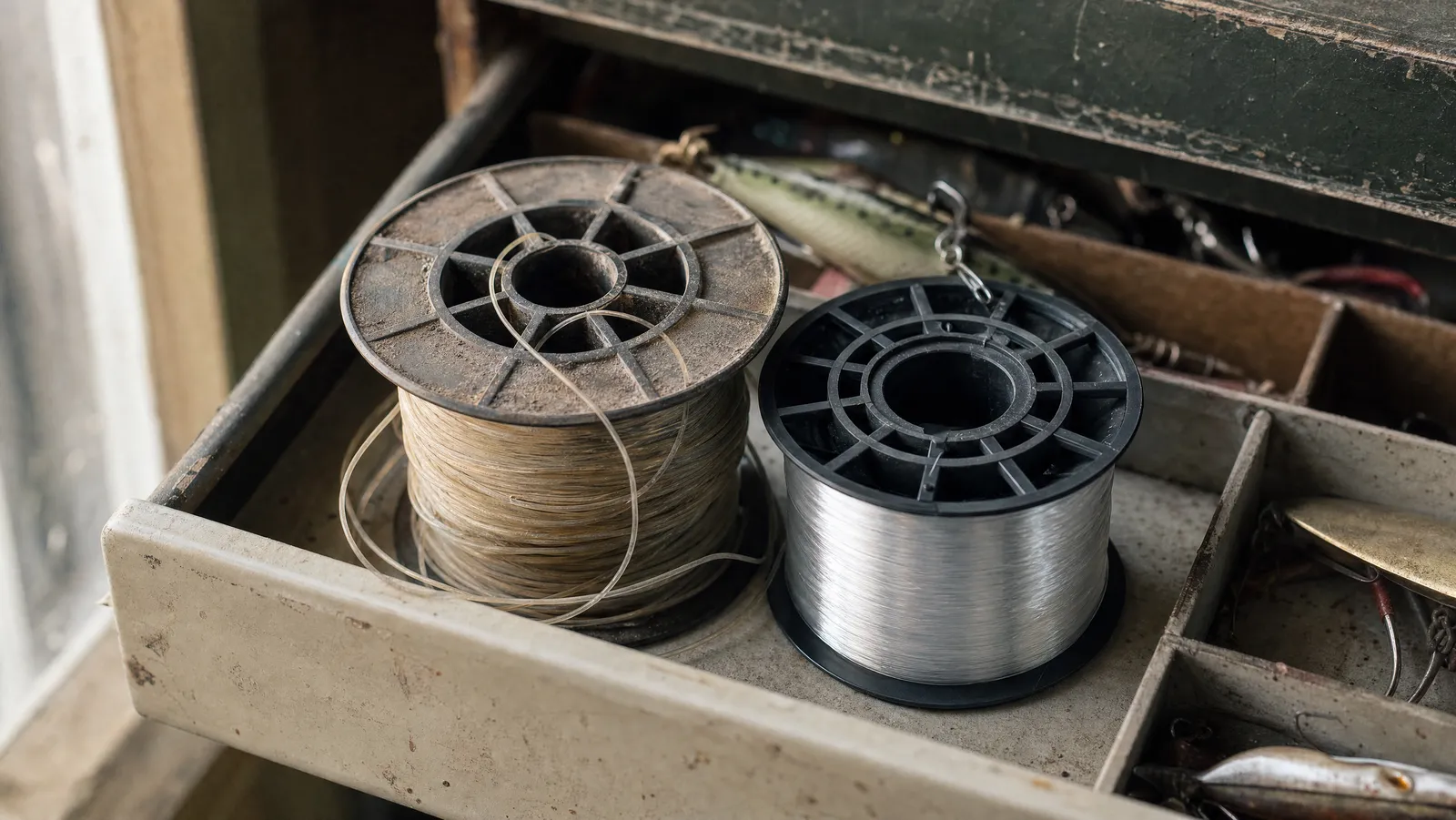
Yes, fishing line goes bad — but the three materials on your rods age on completely different clocks. Nylon monofilament degrades in storage and on the reel, fluorocarbon degrades far more slowly because it does not absorb water, and braid barely degrades chemically at all. Braid wears out mechanically instead, which is a different problem with a different fix.
Most bad advice about old line treats "worn out" as one thing when it is two: a chemical process that happens whether or not you fish, and a mechanical one that only happens when you do. If you are deciding what to buy rather than what to throw away, start with our guide to the best fishing line and come back once the spool is on the reel.
Two Clocks: Chemical Ageing and Mechanical Wear
Chemical ageing is the material itself changing. Ultima, the UK line maker, states in its monofilament advice centre that "Nylon is not U. V. stable" and that "the molecular structure within a line will breakdown during prolonged periods of exposure to natural sunlight." That damage is invisible, spread along the whole spool, and stripping off a few yards does nothing about it. It shows as stiffness, cloudiness and coil memory all at once.
Mechanical wear is the line being physically damaged — scuffed on rock, nicked on a gill plate, flattened under load against a guide. It concentrates at the business end, shows as roughness there and nowhere else, and is fixable in two minutes without a new spool.
Diagnose which one you have before you spend money. Four agents do nearly all the damage, and only one of them requires you to go fishing.
- Ultraviolet light. Sunline's storage guidance is the most specific we have found: it shows nylon and fluorocarbon after 500 hours of UV exposure and notes that "While 500 hours sounds like a lot, it would only be approximately six weeks of daylight." Berkley frames the same effect more conservatively, saying "prolonged exposure to UV light can weaken mono, although it may take hundreds of hours to incur appreciable damage."
- Heat. Sunline recommends room-temperature storage and says fluorocarbon "is more resilient than nylon to extreme temperatures. It can handle short-term exposure to heat and cold, but continuous exposure will also impact its performance." Nylon has less margin.
- Water absorption. Specific to nylon, and the least understood number in fishing. Next section.
- Abrasion. Rock, dock pilings, zebra mussels, grit in the guides. The mechanical half, and it kills line that is otherwise fine.
Monofilament: The Line That Genuinely Goes Off
Nylon absorbs water, and the cost is documented by line makers rather than guessed at. Ultima states "Mono will absorb up to around 4% of its weight in moisture from the atmosphere, and this increases to around 10% if stored in water." The consequence, per the same page: "Both linear and knot strength can be reduced by between 10 and 15 per cent after submersion in water for as little as two to four hours, depending on the diameter." Ultima puts the knot-strength effect alone at "between 5 and 10%."
Read that as a design fact, not a defect. Your 10-pound mono is a 10-pound line dry and, on Ultima's 10-to-15-per-cent figure, somewhere between eight and a half and nine pounds two hours into a trip. Berkley puts the same trade from the manufacturer's side: water absorption "makes mono lines more flexible, allowing for better handling and longer casts. However, it may compromise abrasion resistance and overall strength."
It is also reversible. Ultima notes that "After use, and back in the atmosphere, monofilament will return to its equilibrium point after a number of days or weeks." Wet mono is not ruined mono. Sun-cooked mono is.
How long does it last? The published guidance clusters tightly. Berkley recommends "changing nylon monofilament lines at least once a year." The Tackle Room's schedule is more aggressive, listing mono main line at every 3 to 6 months of regular use with a maximum of 6 months on the reel. Salt Strong recommends "changing it out at least once every 6 months to 1 year," and Salt Water Sportsman reports that "Most of the guides and tournament anglers I work with who are attentive to their lines say they replace mono on their reels twice a year."
Unopened mono in a drawer is a different question. Ultima says line kept away from natural light "will maintain optimum performance almost indefinitely"; The Tackle Room is more cautious, citing 3 to 5 years in original packaging stored cool and dark.
Light mono is the case to watch, because Ultima ties both effects to diameter: "the finer the diameter the more rapidly a state of equilibrium is reached," and the submersion strength loss also runs "depending on the diameter." If your 4-pound spool has been on a rod since last spring, our best fishing line for trout guide covers what to put back on.
Fluorocarbon: Slower, and Water Is the Reason
Fluorocarbon is a different animal on exactly the two variables that punish nylon hardest. Ultima is direct: "Pure fluorocarbon lines are not affected by light," and "Pure fluorocarbon does not absorb water and submersion for any length of time does not affect the lines performance." Sunline groups "braid and fluorocarbon" as the lines that "will maintain performance the longest in proper storage" while "Nylon can be the line most impacted if not stored properly."
In a drawer, fluorocarbon clearly lasts longer. On the reel, the published advice is less generous than the chemistry suggests. The Tackle Room lists fluorocarbon main line at every 6 to 12 months, maximum 12 months on the reel, and Salt Water Sportsman goes further the other way: "If you are one of the few who spool entire reels with fluoro, given its characteristics, it is probably the line that needs to be refreshed most often — at least every year, if not twice a year."
That reads as a contradiction until you remember the two clocks. Fluorocarbon is stiffer and denser than nylon, so it takes a set on a spinning spool and it is usually the line fished hardest against structure. It is not the chemistry giving out. It is memory and abrasion.
Our reading: treat fluorocarbon leader material as near-indefinite in a dark drawer, and fluorocarbon main line on a working reel as an annual job. The leader coil you bought two years ago is almost certainly fine. The reel you fish every weekend is not.
Braid: It Does Not Rot, It Frays
Braid is the outlier, and the reason a calendar fails. Sunline states that "Braided line is the least impacted by UV rays and would take many thousands of hours of light exposure to be impacted," and Salt Water Sportsman puts it simply: "Braided lines have the greatest longevity among the three popular line types."
Braid is woven polyethylene that does not absorb water and shrugs off sunlight — the full picture is in our braided line guide. What it does instead is wear. The weave abrades, fibers break, and the line goes from round and slick to flat and furry.
That gives you a retirement test based on feel rather than age. Salt Strong's version is clearest: replace braid "if the braid is frayed or fuzzy-looking," but "If it's just color faded, you don't need to change it." Faded braid is cosmetic. Fuzzy braid is structural.
The Tackle Room lists braid main line at every 1 to 3 seasons with a maximum of 2 to 3 years on the reel, and Salt Strong says flatly that "there's no reason to replace it within a year." Salt Water Sportsman describes the workaround most braid anglers adopt, citing Captain Chip Wingo's practice of back-spooling braid that shows wear and trimming off the worn parts, and a second guide who strips the line off and re-reels it so the line that was buried deepest on the spool becomes the line you cast.
Do not retire braid on a birthday. Retire it on a texture.
The Five Checks That Tell You a Spool Is Done
Run these on the next rod that has been sitting. None takes a minute.
- The hang test, for memory. Pull a few feet off and let it hang. The Tackle Room's threshold is the useful one: "Some coiling is normal, but if the line leaps off the reel in tight spirals, it has too much memory." Coils that will not fall out under the weight of a lure will not straighten on a cast either.
- The look, on mono. Again from The Tackle Room: "Fresh mono is clear and flexible. Old mono looks cloudy and feels stiff." Chalky white patches in otherwise clear line are UV damage seen from the outside.
- The finger test. "Run the first 30 feet of line slowly through your fingers. Pinch lightly between your thumb and forefinger." You are feeling for nicks, flat spots and rough patches. Good line feels round and smooth the whole way.
- The fuzz test, on braid. Same motion, different symptom. Furry or flattened braid is finished regardless of age.
- The break test, against a control. The diagnostic one, and the only one that gives a real answer. Pull a length of the suspect line to failure by hand, then do the same with fresh line of the same rating. You are not measuring pounds, you are comparing effort. If the old line gives up noticeably easier, careful knots will not get that strength back.
Fail the break test and you respool. Pass everything but the finger test and you have the cheap problem.
The First 20 Feet Rule
Here is the fix most anglers skip, because respooling feels more thorough. The Tackle Room's inspection routine starts with one specific stretch for a reason: "Look at the first 20-30 feet of line on each reel. This is the section that takes the most abuse from casting, retrieving, and fighting fish." That is where every knot has been tied and every fish landed. The rest of the spool has done nothing but sit there.
So strip and retie before you respool. The Tackle Room gives the same instruction for a narrower case — after fishing for toothy species, check the first 10 feet for invisible abrasion damage and "Replace that section by stripping it off and retying."
One thing not to do: splice fresh line on to make up the lost yardage. Salt Strong warns against it, noting that "some anglers will splice on more line but I do not recommend that because that's just another weak point in your line."
When to Change, Counted in Trips Rather Than Months
A calendar is a poor proxy because it does not know how much you fish. Read the numbers above as a usage scale instead.
- Every weekend, all season. Mono at the 3-to-6-month end of The Tackle Room's schedule, so twice a season. Fluorocarbon main line annually or better, per Salt Water Sportsman. Braid inspected monthly and retired on feel.
- A few trips a month. Mono once a year, per Berkley. Fluorocarbon at 12 months, The Tackle Room's on-reel maximum. Braid every second or third season.
- Four trips a year. Storage is the binding constraint, not use. A rod in a dark closet holds usable mono far longer than one on a sunlit garage wall.
- After a bad day, whatever your usage. A fish that ran you through structure, a snag pulled free hard, a day in rock or mussels. Strip and retie before the next trip, not during it.
Salt Water Sportsman is honest about the limits here: "There's no exact answer to any of this, so it truly comes down to personal preference and watching for when your line starts to wear out."
Storage That Actually Buys You Time
Storage attacks the chemical clock directly, and costs nothing.
- Dark beats bright, and fluorescent counts. Sunline advises you to "keep your line out of continuous exposure to light. This means sunlight, but it also includes fluorescent light." The shop lights over your bench are doing slow damage to bare spools.
- Cool and stable beats hot. Sunline recommends room temperature and names a "basement with stable temps and lower amounts of UV light" as the good case. The Tackle Room draws the practical line: "A garage that stays under 90F is fine. A rod rack on an unshaded deck or in a truck bed is not." A rod left on a truck dash in July stacks both of the agents The Tackle Room calls "the two biggest enemies of every line type" - UV and heat - onto one spool.
- Away from chemicals. The Tackle Room says to "Keep line away from DEET-based insect repellent, sunscreen with certain UV-blocking chemicals, and gasoline." A leaking bug spray bottle sharing a tackle bag with bare spools is worth sorting out before the next trip.
- Back the drag off. The Tackle Room's off-season instruction is to "back off the drag completely" when rods go away for the winter.
- Do not panic about damp line. Ultima's equilibrium note means mono that went away wet recovers over days or weeks in normal air. Dry the reel and move on.
The Money Question: Fill Half the Spool
Replacing 300 yards to refresh the 80 you actually cast is the most common waste in this hobby. The fix is backing. Salt Strong's version is specific: "You only need 100 to 150 yards of braided line for inshore fishing so put on a mono backing and top with braid." The logic holds for almost all freshwater fishing — you will rarely if ever see the bottom half of the spool, so fill it once with cheap mono and replace only the top layer from then on.
Two things make it work. Know your reel's real capacity first, which our line capacity calculator will tell you. And get the backing-to-main-line join right, because a bad connection there loses a fish at the worst moment — our walkthrough on spooling a spinning reel covers the arbor knot, the join and the fill level. For what to put back on, our roundup of the best fishing line for spinning reels is where we would start, because spinning gear punishes memory hardest.
The Decision Rule for the Reel in Your Garage
Go pick it up. Pull three feet off and let it hang, then run the first 30 feet through your fingers.
- Tight spirals that will not fall out, plus a cloudy look on mono. Chemical ageing. Respool it.
- Straight, clear line that feels rough in the first 20 to 30 feet. Mechanical wear only. Strip that section, retie, go fishing.
- Braid that is faded but smooth. Fish it. Colour loss is cosmetic, per Salt Strong.
- Braid that is fuzzy or flat. Flip it on the spool or retire it.
- Genuinely unsure. Break-test it against fresh line of the same rating.
The rule underneath fits in your head. Mono is a consumable, replaced roughly annually and sooner if it lives in the light. Fluorocarbon is slow-ageing material on a fast-wearing job, so judge it by memory and abrasion rather than by date. Braid outlives both and is retired by texture, never by the calendar.
And if this has you rethinking what is on the reel rather than how old it is, our full braid, fluorocarbon and mono comparison lays out which material earns its place on which rod.
About The Author
Rob Thomas
Rob Thomas is a fisherman who loves catching tales from his fellow fishermen. He always enjoys a good story, especially when it comes from the sea.