Best Fishing Line for Trout: Light, Limp, and Hard to See

This post may contain affiliate links. Read our policy.

Berkley Trilene XL, 6 lb, 110 yd, Low-Vis Green
The default trout spool.
- Berkley publishes the diameter, which most budget mono brands do not
- Nylon stretch forgives a hard hookset on a light-wire hook
- Cheap enough to respool every few trips, which is how light mono should be treated
- 110 yards is a single fill, not a season of fills
- Mono floats higher than fluorocarbon, so it is slower to get a bait down in current
Best Fishing Line for Trout: Light, Limp, and Hard to See
For most trout fishing, spool 4- to 6-pound line, and understand that the spec doing the work is diameter, not pound test. A trout in clear water gets a long, unhurried look at your offering. Thin, limp line disappears and lets a small bait move naturally. Heavy line does neither.
Angler Reviews is reader-supported. We may earn a commission on purchases made through links on this page, at no extra cost to you.
That is the whole article in one sentence: trout line has two jobs, and most anglers only buy for the first one. The line has to vanish, and it has to stay out of the way of the bait. If you have not picked a line type yet, our pillar on how braid, fluorocarbon and mono actually compare covers the full field. What follows is the trout-specific version of that argument, with the numbers.
Why Trout Are a Diameter Problem, Not a Strength Problem
A 3-pound rainbow does not break 6-pound line. With a drag set anywhere near sensibly, breaking strain is close to the least interesting number on the spool. Thickness and limpness are what you are actually buying.
Start with thickness. According to Tackle Village's fishing line diameter chart, which the site says was compiled using Berkley Trilene and Big Game for mono, Berkley Vanish for fluorocarbon and Spiderwire Stealth for braid, monofilament measures 0.005 inch at 2-pound test, 0.008 inch at 4, 0.009 inch at 6 and 0.010 inch at 8. Fluorocarbon tracks within a thousandth of an inch of that: 0.007 inch at 4-pound, 0.009 at 6, 0.010 at 8.
Now the contrast that makes the point land. The techniques in our guide to the best fishing line for bass routinely call for 12- to 20-pound line, and the same Tackle Village chart lists both 20-pound mono and 20-pound fluorocarbon at 0.016 inch. That is close to double the diameter of a 6-pound trout line. A bass crushing a jig in stained water never registers the difference. A trout watching a single egg drift past in a knee-deep pool absolutely does.
Agencies say it in plainer language than any tackle brand will. The Missouri Department of Conservation's trout fishing tips state that "trout will often see larger line and shy away under clear water conditions," and recommend a leader of clear nylon sewing machine thread or two-pound test on a clear sunny day. Washington Department of Fish and Wildlife's golden trout page is blunter still: "Light leaders (usually 4 pound test or less) and a stalking approach are needed as the fish can see out of the lakes extremely well."
The second half of the diameter problem is stiffness, and it is the half nobody talks about. Thicker line resists bending. In moving water that means the current grabs a bigger belly of line and drags your drift off its natural speed, which is the one thing a wary trout is measuring. On a 1/16 oz spinner we would expect it to be worse: a blade that small has very little mass to work against a stiff line, so heavy line can damp the wobble you paid for. We have not seen that one measured, so treat it as mechanism rather than data.
Buy the lightest, limpest line you can still land fish and break snags off with. For the full pound-test-to-diameter numbers across every line type, our fishing line weight chart has the rest of the figures.
Monofilament Is the Honest Default for Trout
Nylon mono is the line most trout anglers should be fishing, and the reason is the property everyone else apologises for: stretch.
The Tackle Room's line comparison puts monofilament at 25 to 30 percent stretch, fluorocarbon at 10 to 15 percent and braid at roughly zero. Sunline frames the same gap as distance rather than percentage, stating that "nylon will stretch nearly a yard more than a premium fluorocarbon on a 33-yard cast."
For trout that elasticity is a feature three times over. Trout have soft mouths. Trout baits hang on small light-wire hooks that straighten or tear out under steady load. And the reflexive hookset most of us make on an ultralight rod is far harder than the fish requires. Mono absorbs all of it.
Density helps too. Sunline puts nylon's specific gravity at around 1.14 against water at 1.0 — barely heavier than the water it sits in. Mono therefore sinks slowly, which is exactly right for a bait suspended under a float and exactly wrong when you need to get down fast in current.
The spool we would buy is Berkley Trilene XL in 6-pound, about $5 as of September 2026 for 110 yards of low-vis green. Berkley states a diameter of 0.009 in / 0.22 mm at 6 lb test, which matches Tackle Village's 6-pound mono figure exactly, and says the line resists twists and kinks for smooth casting. Berkley also rates it for optimal wet strength, and the XL range runs from 2 lb all the way to 30 lb if you want the same line on heavier rods.
Where mono loses: deep or fast water where the bait has to sink, and genuinely pressured gin-clear water. It is also the line that ages fastest on the reel, and light line has the least strength to spare when it does — which is why old line is worth throwing out sooner than you think on a trout rod specifically. At about $5 a spool, respooling is not a budget decision.
Fluorocarbon: The Clear-Water and Current Play
Fluorocarbon earns its price on two physical properties, and it is worth being precise about them because the marketing is not.
The first is refraction. Sunline states that "the light refraction index of fluorocarbon is closer to the refractive index of water than nylon," which is why it is harder to pick out underwater. Note what that sentence does not say: not invisible, less visible. Seaguar hedges the same way in its own copy — InvizX is described as "virtually invisible," not invisible.
The second is density, and it is the one that changes how you fish. AFTCO's fluorocarbon explainer puts fluorocarbon's specific gravity at 1.78 against nylon's 1.14, which is why fluoro sinks and mono does not. AFTCO also notes that "it takes a good bit more abrasion to damage fluoro than nylon" — relevant on any stream where the drift ends in rock.
Seaguar's own pitch for STS Trout/Steelhead follows that physics directly: the company describes it as sinking fast to get bait into the feeding zone, says it is good in current, and claims it comes through rocks, laydowns and brush more reliably than monofilament despite a smaller diameter. A 6-pound spool runs about $11 as of September 2026 for 100 yards.
If you want fluorocarbon as a full main line rather than a leader, softness is the spec to check. Sunline is candid that early fluorocarbons were "very stiff and difficult to use on baitcasting or spinning reels," with line "jump off" problems on spinning gear, and credits later production advances with fixing it. Seaguar describes InvizX as soft, castable and low-memory and rates it for both spinning and casting reels, which is the claim that makes a full ultralight spool plausible. Seaguar's published InvizX sizing, as listed by Tackle Warehouse, puts 4-pound at .007 inch and 6-pound at .008 inch — a thousandth thinner than 6-pound mono.
Do not fish fluorocarbon everywhere. Under a float with a very light bait, a sinking line drags the float off its drift. And Seaguar's own spec sheet lists "virtually no stretch" for InvizX, which is the wrong property on treble-hooked spinners and spoons.
Braid on Trout Water Is Mostly a Mistake
Braid as a trout main line is the most common tackle-shop upgrade that makes fishing worse. Roughly zero stretch, per The Tackle Room's comparison, meets a soft-mouthed fish on a size 10 light-wire hook. Something has to give, and on a locked-up ultralight nothing does. The hook tears, or straightens.
Braid is also opaque. Thin, certainly — Tackle Village lists 6-pound braid at 0.005 inch, about 45 percent slimmer than the mono of the same test — but thin and visible is not the trade trout water rewards. Braid floats, too, which puts a visible line on the surface directly above a fish that is looking up.
There is one setup where we would run it. Ultralight braid as a main line with a fluorocarbon leader is legitimate: you get long casts with 1/16 oz lures, no memory coils off a tiny spool, and bite detection that mono cannot match at distance. The leader is not optional in that build — it is the entire reason it works. Our guide to leaders covers the connection knots, and the tippet and leader selector will get you to a sensible test for the water you fish.
Braid straight to the lure in clear trout water is the version to avoid. If you will not tie a leader, spool mono.
What Pound Test for Trout? Three Bands, Three Reasons
Each band below is tied to a reason, not a preference.
- 2 to 4 pound: stocked put-and-take trout, small streams, ultra-clear water. This is where agency guidance lands. Missouri Department of Conservation describes a leader as "a 2-foot section of 2-pound test (or lighter) line," and WDFW's golden trout guidance calls for 4 pound test or less in high, clear lakes. At 0.008 inch for 4-pound mono, per Tackle Village, you are fishing a line that is genuinely hard to see, and you are accepting that you will break off some snags.
- 4 to 6 pound: general lake and river trout. Our default, and the band most anglers should live in. Six-pound mono at 0.009 inch is still thin enough to drift naturally, and it will pull a stuck spinner free from a soft snag instead of leaving it there.
- 6 to 8 pound: big browns, heavy current, and water with real snags. Eight-pound mono measures 0.010 inch per the same chart. You are giving up some stealth, and you are buying the ability to steer a heavy fish away from wood before it gets there. This is also the band where fluorocarbon's abrasion edge, as AFTCO describes it, pays for itself.
One practical note before you buy: check what your reel actually holds. The Trout Magnet S.O.S. spool is 350 yards of 4-pound, which is several fills of a typical ultralight, and our line capacity calculator will tell you whether you are buying a season's worth of line or five years of it.
Does Fishing Line Colour Matter for Trout?
Less than diameter, and we should be honest that the evidence here is thinner than the marketing.
The most useful published discussion we found is Trout Unlimited's piece on fly line colour, where Kirk Deeter lands on the cautious side: "The more I sight fish to trout in clear water, the firmer I land in the second school of thought," that school being the one that prefers natural colours — tan, cream, light green, light brown and gray, with "gray and light green best" for all-around use. He also concedes the limit of the argument: "does it really matter what your fly line looks like if you're throwing giant streamers downstream? Probably not."
The manufacturer claims are claims. Berkley says its Low-Vis Green colouring disguises the line when submerged. Leland's says the S.O.S. colour is hard to see in most water conditions. Neither is a measurement, and we are not going to dress them up as one.
What the agency guidance actually says is about size, not colour. MDC's warning is that trout "see larger line" and shy away. That is a diameter finding, and it is the one we would act on.
So: low-vis green or clear for a main line, and if you fish hi-vis, fish it for yourself. A bright line genuinely helps you track a drift and spot a subtle take, which is a real advantage — but it is an advantage for the angler, not a trick on the fish. Run a clear or fluorocarbon leader on the business end and you get both.
The Four Spools We Would Buy, by Job
Four spools cover nearly all of trout fishing, and they divide by job rather than by rank.
- The default spool. Berkley Trilene XL in 6-pound, about $5 as of September 2026, is the line we would put on a general-purpose trout rod. Published diameter, forgiving stretch, and cheap enough to change often.
- The stream and drift spool. Seaguar STS Trout/Steelhead in 6-pound, about $11 as of September 2026, is the one for current and clear water, because it sinks and Seaguar builds it for exactly this fish.
- The ultralight and stocked-trout spool. Trout Magnet S.O.S. in 4-pound, about $7 as of September 2026 for 350 yards, is a copolymer Leland's says is built specifically for light-line fishing and claims is stronger than other lines at the same diameter. Leland's does not publish a diameter, which is the one thing we would ask them to fix.
- The fluorocarbon main line. Seaguar InvizX in 4-pound, about $22 as of September 2026 for 200 yards and down from a $30 list price, is the finesse spool for pressured clear water. Soft and low-memory by Seaguar's own description, which is what makes fluoro survivable on a spinning reel.
If You Only Buy One Spool
Buy the 6-pound Trilene XL. At roughly 0.009 inch by Berkley's own figure, it is thin enough to fool most trout most days, it stretches enough to keep a light-wire hook in a soft mouth, and it costs less than a couple of spinners. Two-pound test is a specialist tool for clear, pressured water, not a starting point.
Spool it under firm tension, run it through a damp rag on the way to the reel, and fill to within an eighth of an inch of the spool lip so it casts without spilling. Then respool it long before it looks bad — light line has the least margin to give away.
If your water is clear, cold and moving, add the Seaguar STS and let the bait get down. If you fish a float for stocked rainbows, the S.O.S. in 4-pound and 350 yards is the cheapest good decision on this page.
When you are ready to compare the three line types head to head across every species, Angler Reviews' fishing line hub lays out the full field.
The Picks, Tested
Berkley Trilene XL, 6 lb, 110 yd, Low-Vis Green
The default trout spool. Berkley states a diameter of 0.
- Berkley publishes the diameter, which most budget mono brands do not
- Nylon stretch forgives a hard hookset on a light-wire hook
- Cheap enough to respool every few trips, which is how light mono should be treated
- 110 yards is a single fill, not a season of fills
- Mono floats higher than fluorocarbon, so it is slower to get a bait down in current

Seaguar STS Trout/Steelhead 100% Fluorocarbon, 6 lb, 100 yd
The clear-water and current answer. Seaguar describes STS as sinking fast to get bait into the feeding zone and as coming through rocks, laydowns and brush more reliably than monofilament despite a smaller diameter.
- Built and named for the trout and steelhead job rather than adapted from a bass line
- Sinks, which is what you want when a bait has to get down in moving water
- Cheapest way into 100% fluorocarbon on this list
- 100 yards is the shortest spool here
- Sinking line is a nuisance under a float with a very light bait

Trout Magnet S.O.S. Fishing Line, 4 lb, 350 yd
A copolymer built for light-line fishing, and 350 yards of it. Leland's claims it is stronger than other lines at the same diameter and extremely abrasion resistant, which is the pitch that matters when you are fishing 4-pound test around stream rock.
- 350 yards at this price is several fills of an ultralight reel
- 4 lb test is the band agencies point to for clear water and stocked fish
- Copolymer construction is aimed squarely at light-line work
- Leland's does not publish a diameter figure
- One test only, so bigger browns and heavy current need a second spool
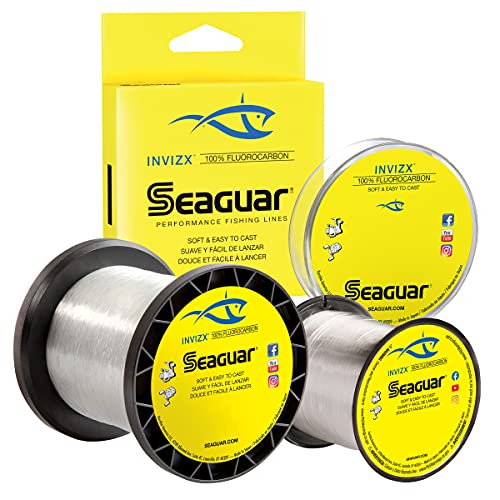
Seaguar InvizX 100% Fluorocarbon, 4 lb, 200 yd
The fluorocarbon we would actually spool as a main line rather than run as a leader. Seaguar describes InvizX as soft, castable and virtually invisible, with low memory and fast sinking, and rates it for both spinning and casting reels - the softness is what makes a full spool of fluoro workable on an ultralight.
- Seaguar builds its own fluorocarbon resins rather than buying them in
- Softness and low memory are the two specs that decide whether fluoro works on a spinning reel
- 200 yards of 4 lb is two fills of most ultralight spools
- Roughly four times the price of the mono pick
- Seaguar's own spec sheet says virtually no stretch, which is the wrong property on treble hooks
Compare The Field
| Compare | Best Overall Trout Line Berkley Trilene XL, 6 lb, 110 yd, Low-Vis Green | Best Fluorocarbon for Trout Seaguar STS Trout/Steelhead 100% Fluorocarbon, 6 lb, 100 yd | Best for Ultralight and Stocked Trout Trout Magnet S.O.S. Fishing Line, 4 lb, 350 yd |
|---|---|---|---|
| Overall | — | — | — |
| Price | $5.29 Check price → | $10.95 Check price → | $6.95 Check price → |
About The Author
Rob Thomas
Rob Thomas is a fisherman who loves catching tales from his fellow fishermen. He always enjoys a good story, especially when it comes from the sea.