Are Expensive Fishing Rods Worth It?

This post may contain affiliate links. Read our policy.
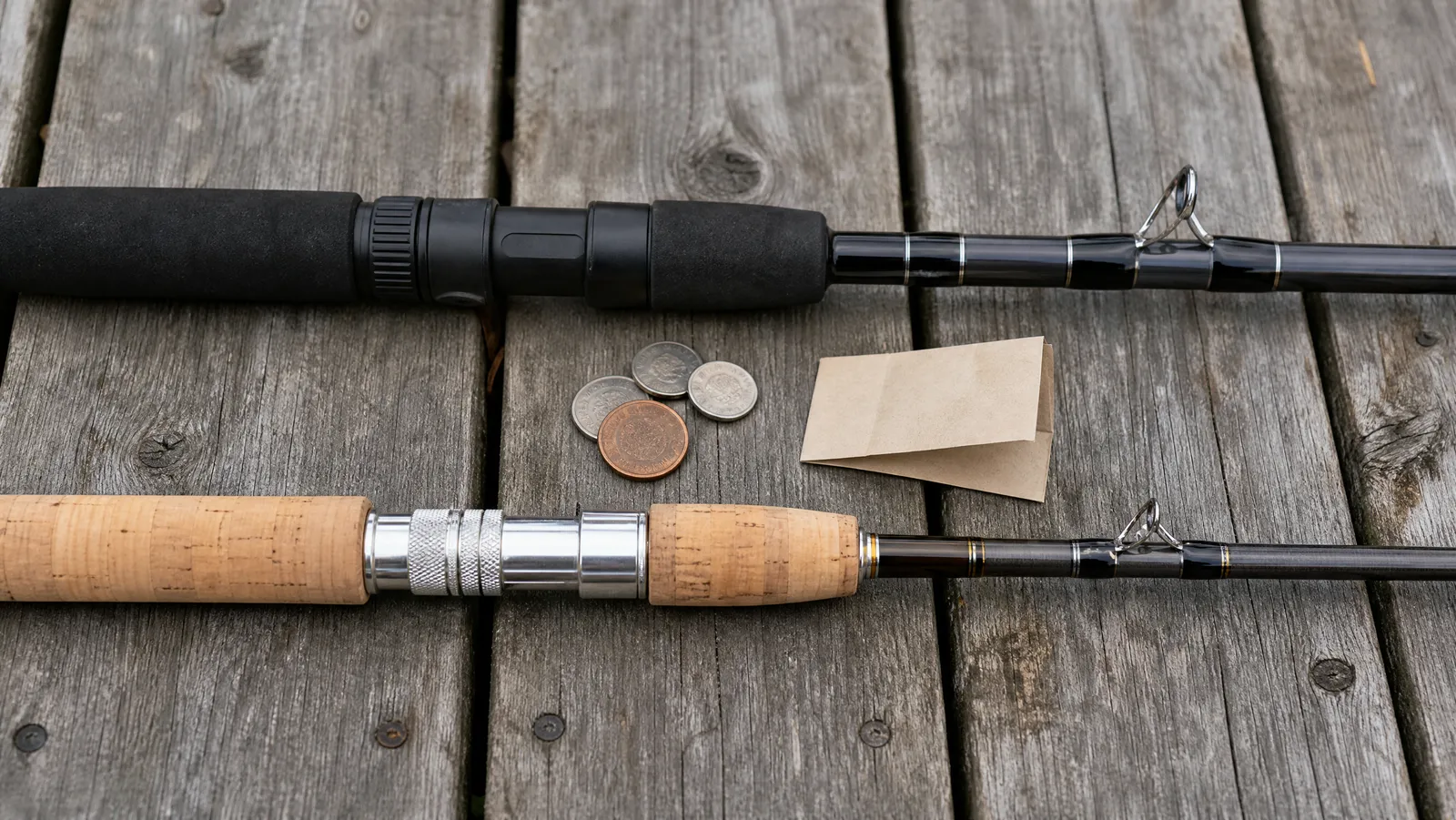
Are Expensive Fishing Rods Worth It?
Up to a point, and the point arrives earlier than the rack suggests. Rod spending goes from transformative to marginal somewhere around $100 to $150, and above roughly $250 you are buying grams of weight, cork grade, finish and warranty service rather than more fish. The first $60 changes what you can fish with. The next $600 changes how it feels while you do it.
That inflection is our read, not a measured fact - we have found no published controlled test of rod price against fish landed. What follows is the evidence behind it, tier by tier, using rods this site has priced and specs the manufacturers publish. If you want the shopping version instead of the argument, our guide to the best fishing rods does the picking.
The short answer: a curve, not a yes
The question "are expensive fishing rods worth it" has no single answer because the return on each extra dollar is steep, then gentle, then almost horizontal. Roughly how we see the fishing rod price tiers:
- $15 to $30. You are buying a rod that casts. Little more.
- $30 to $60. The biggest jump in the whole range. Published line and lure ratings, better guides, warranties with real terms.
- $60 to $150. Weight comes off, sensitivity goes up, and rods start specialising by technique.
- $150 to $250. Better components, complete spec disclosure, longer warranty terms.
- Above $250. Fractions of an ounce, cork grade, cosmetics and service.
We are not alone in putting the elbow in the low hundreds. In a long-running BassResource forum thread on the price point of diminishing returns for rods and reels, the figures anglers volunteer cluster between roughly $200 and $300. That is barroom consensus rather than data, but it is a lot of people independently drawing the same shape of curve.
What the first $30 buys
A rod that casts, with a spec sheet you cannot fish to.
The cheapest rod this site has covered is the Zebco Z-Cast at about $19.99 as of November 2026. Per the Amazon listing it is telescopic, collapsing to 17 inches and extending to 5 ft 6 in, built on a Z-Glass fiberglass blank in medium power, with a Twist-Lock reel seat, 3 plus tip shock-ring guides, an 8-12 lb line and 1/4-3/8 oz lure rating, and a 1-year warranty against defects in workmanship and materials.
Read that spec twice and it argues with itself. The same listing calls the rod medium power with an 8-12 lb line rating and then recommends it for panfish and trout, which are light species usually fished on 2-6 lb line. One of those descriptions is wrong and the buyer cannot tell which. That is the real cost of the bottom tier: not bad components, but published numbers you cannot plan around. It will put a bobber in front of a bluegill. It will not tell you anything about what is happening down there.
What $30 to $60 buys - the biggest jump in the whole range
If you spend one extra $30 in your fishing life, spend it here. This is where rods start publishing numbers specific enough to fish to, and where guides and warranties stop being an afterthought.
Four tier anchors this site has priced:
- Berkley Cherrywood HD, about $30.86 as of November 2026. 5 ft 6 in, light power, fast action, 2-6 lb line, 1/16-1/4 oz lures. The cheapest rod we have covered that publishes a 1/16 oz lure rating.
- Piscifun Torrent, about $39.99 as of October 2026. A full carbon blank in the 7 ft medium-heavy, fast-action layout that does most freshwater work.
- KastKing Royale Advantage, about $49.99 as of November 2026. Per the listing, a 6 ft 6 in medium-light two-piece on an IM6 graphite blank, with stainless guides carrying titanium oxide ceramic rings and a spare tip section in the box.
- Abu Garcia Vengeance, about $56.99 as of November 2026 against a $74.99 list price. Per the listing, 6 ft 6 in, medium power, fast action, 6-12 lb line, 1/4-5/8 oz lures, a 24-ton carbon blank and 8 stainless guides with aluminum oxide inserts.
The Ugly Stik GX2 sits at the top of the band at about $57.12 as of November 2026. Its listing publishes 6 ft, two-piece, medium power, 6-15 lb line, 1/8-5/8 oz lures, a graphite and fiberglass composite blank, six one-piece stainless Ugly Tuff guides that the listing says eliminate insert pop-outs, and a 7-year warranty. Seven years of coverage on a $57 rod is the best warranty-per-dollar figure on this page - hold that thought for the expensive end.
What the money actually buys in this band is information. A 6-12 lb line rating and a 1/4-5/8 oz lure window tell you which reel to hang on the rod and which lures will load it; a power and action rating tells you how it will bend and when, and our guide to fishing rod action and power covers how to read those labels. Almost every angler we know should buy in this band and stop.
Not every rod here discloses equally. The KastKing publishes a blank material, a guide material and a spare tip, but no line rating, no lure rating and no warranty term. Spending more does not automatically buy more facts.
What $60 to $150 buys
Weight, sensitivity, better reel seats, and rods built for one job instead of all of them.
It also, sometimes, buys less disclosure. The Shimano SELLUS B is about $64.99 as of November 2026, and per the listing it is a 7 ft heavy-power one-piece casting rod with DIAFLASH butt construction - carbon tape diagonally wrapped in opposing directions to form X shapes, which Shimano says minimises energy loss from butt-section flex. The same listing publishes no line rating, no lure rating and no warranty term. A $65 rod telling you less about itself than a $31 rod does is a real argument against reading price as quality, and the pattern repeats across the names in fishing rod brands compared.
Further up, the KastKing Kestrel lands at about $89.99 and the Fitzgerald Vursa at about $139.99, both as of November 2026. The Vursa is the clearest case: its listing publishes no line rating, no lure rating and no guide, reel-seat or warranty detail - less hard information than the $155 St. Croix a tier above it. We said so when we covered fishing rods for bass.
What is genuinely improving through this band is sensitivity, and the word deserves precision. Sensitivity is not "feeling the bite" - a 12-inch bass eating a jig is obvious on a broomstick. It is feeling what the bottom is made of: gravel from sand, shell from wood, the moment the jig drops off a rock. G.Loomis puts the mechanism plainly in its 2014 catalog, defining modulus as the rating used to describe the stiffness-to-weight ratio of a fiber, and stating that the higher the modulus, the stiffer the fiber, and that this translates to increased sensitivity for the angler.
Where the curve flattens
Our $155 anchor is the St. Croix Bass X casting rod, and its listing is the most complete on this page: 7 ft 11 in, heavy power, moderate-fast action, one-piece, 14-30 lb line, 1/2-2 oz lures, an SCII carbon blank the listing calls the strongest, lightest and most sensitive SCII to date, a premium cork handle, stainless guide frames with stainless primary and aluminum oxide secondary rings, made in the USA, and a 5-year warranty backed by St. Croix Superstar Service.
Now look at what the next tier costs. St. Croix's Legend Xtreme spinning rods are listed at Tackle Warehouse at $740.00, with the 7 ft 6 in medium model at $760.00, and the same page summarises the coverage as a Limited 15-Year Warranty with $60 Fee. That is nearly five times the Bass X price for ten extra years of warranty and a better-finished rod.
The clearest measurement of what the top delivers comes from TackleTour's 2010 review of the Legend Elite and Legend Xtreme. In the 70MHF models the reviewer recorded the Xtreme at 4.2 oz against the Elite's 4.5 oz, at prices the review gives as $340 and $380. So $40 bought three tenths of an ounce. TackleTour's own verdict was "Is it worth it? Only you can decide."
Modulus is where the marketing gets loudest at this end, and it deserves a warning. In that same catalog G.Loomis gives the numbers: regular graphite had a modulus of 33 million PSI and a tensile strength of around 450,000 PSI, while IM6 has a modulus of 38 million PSI and a tensile strength of 600,000 PSI. G.Loomis also describes what went wrong with the first high-modulus fibers - as the modulus increased, the tensile strength decreased, making them brittle and not useable in fishing rod applications - and adds that a stiffer fiber does not mean the blank is stiffer, because actions are designed around the material. Higher modulus means lighter and stiffer per unit weight. It does not mean stronger. We unpack the rest of that trade in graphite versus fiberglass.
The four things money genuinely buys
Weight in the hand. Over a day of casting a jig every forty seconds, ounces matter. The counter-argument is the size of the gain at the top: three tenths of an ounce between two premium St. Croix models, per TackleTour's measurements. The big savings happen between $20 and $100, not between $400 and $800.
Sensitivity. Real, and the main reason to go past $60 if you fish bottom contact. The counter-argument is that you cannot read it off a label: modulus describes the fiber, not the finished rod, and G.Loomis says outright that actions are designed around the material, so two rods quoting the same fiber can feel nothing alike.
Published, specific ratings. The $155 Bass X publishes line, lure, power, action, blank, guides, handle, warranty and country of manufacture; the $20 Z-Cast publishes a spec sheet that contradicts itself. The counter-argument is the Shimano at $65 and the Fitzgerald at $140, both of which publish less than the $31 Cherrywood does. Disclosure correlates with price. It does not track it.
Warranty and service. The most underrated reason to spend, and the most oversold. St. Croix's own service page states that a $60 warranty processing fee applies to in-warranty claims handled through its Excellerator Program, that unpaid warranty claims will not be processed, and that rods with guide, reel seat or cork damage are not processed at all. Real coverage, with a real excess attached, and it does not cover the cork you wore through.
The three things it does not buy
More fish for a beginner. No spec sheet addresses casting accuracy, knot strength or where you put the boat. A $500 rod in a first-season hand tends to catch what a $50 rod catches.
Durability. Often the reverse. The brittleness that G.Loomis describes in early high-modulus graphite is the same trade-off that tends to make thin-walled, high-modulus blanks less forgiving of a knock than a fiberglass stick. The $20 Zebco is Z-Glass fiberglass per its listing. The $155 St. Croix is carbon. Guess which one survives being trodden on.
Immunity from a car door. Rods die in transport, storage and closing hatches more than in fights. Which is why how to store fishing rods is a better investment than another $100 of blank, and why it pays to know how to fix a broken fishing rod before you need to.
Who should spend more
- The angler fishing 50-plus days a year. Spread over 50 days, the $100 step from a $55 rod to a $155 one costs $2 a day, and you feel it every cast.
- The angler fishing one technique. Specialisation is the clearest thing the $90 to $155 band sells. A rod built for one job - frogs, dropshot, cranks - has its power, action and length chosen for that job rather than for everything.
- The angler with hand, wrist or shoulder problems. If a day of casting hurts, ounces stop being a luxury. The one case where we would pay full price for weight alone.
- The angler buying a rod to keep. The 15-year term Tackle Warehouse lists on the Legend Xtreme is a different product from a 1-year warranty. Budget the $60 claim fee St. Croix's service page describes.
Who should not
- The first-season angler. You do not yet know what you will fish for, and the rod you buy now is the rod you will regret in April. Start in the $40 to $80 band - our best fishing rods for beginners page is built around that argument.
- The occasional angler. Six trips a year amortises nothing, and the 7-year warranty on a $57 Ugly Stik GX2 will outlast your interest in upgrading.
- The parent buying for a child. Buy the rod that survives sand, bikes and car doors, not the one that transmits shell hash.
- Anyone who has not fixed the rest of the outfit. The big one. A mismatched expensive rod is out-fished by a balanced cheap one, and fresh line is the cheapest performance upgrade in fishing. Before another $100 goes on a blank, spool fresh line - see our best fishing line guide - and check the reel is the right size for the rod, which is what how to match a rod and reel is for.
Our verdict
Is an expensive rod better? Yes, measurably, up to about $150 - and then the measurements get very small very quickly.
For most anglers, $40 to $80 is the right band. That buys published line and lure ratings you can fish to, stainless guides with real inserts, a carbon or composite blank, and in the Ugly Stik's case a 7-year warranty - the band where a dollar still buys capability rather than refinement.
For someone who fishes hard, $150ish is defensible. The Bass X at about $155 publishes a complete spec sheet and a 5-year warranty backed by Superstar Service, and that disclosure is part of what you are paying for.
Above that, be honest about what you are buying: three tenths of an ounce, nicer cork, and a longer warranty that still costs $60 a claim to use. Legitimate things to want. Not more fish. If you are still deciding which rod to buy rather than how much to spend, start with how to pick a fishing rod and let the fishing choose the price.
About The Author
Rob Thomas
Rob Thomas is a fisherman who loves catching tales from his fellow fishermen. He always enjoys a good story, especially when it comes from the sea.