Best Bass Lures: The Complete Guide to Every Lure Type and Season

This post may contain affiliate links. Read our policy.
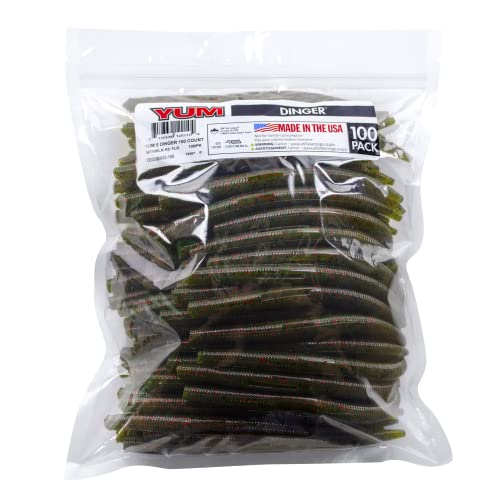
Yum Dinger 5" Stick Worm (100 pack)
The subtle, life-like action draws strikes from even highly pressured bass, whether the fish are actively feeding or not.
- Rigs Texas, Carolina or wacky, weighted or weightless
- Hook slot designed for better hook-up ratios
- 100 pack means plenty of spares for a full season
- One color and one length per pack (watermelon red flake, 5 inch)
- Sold unrigged, so hooks and weights are separate
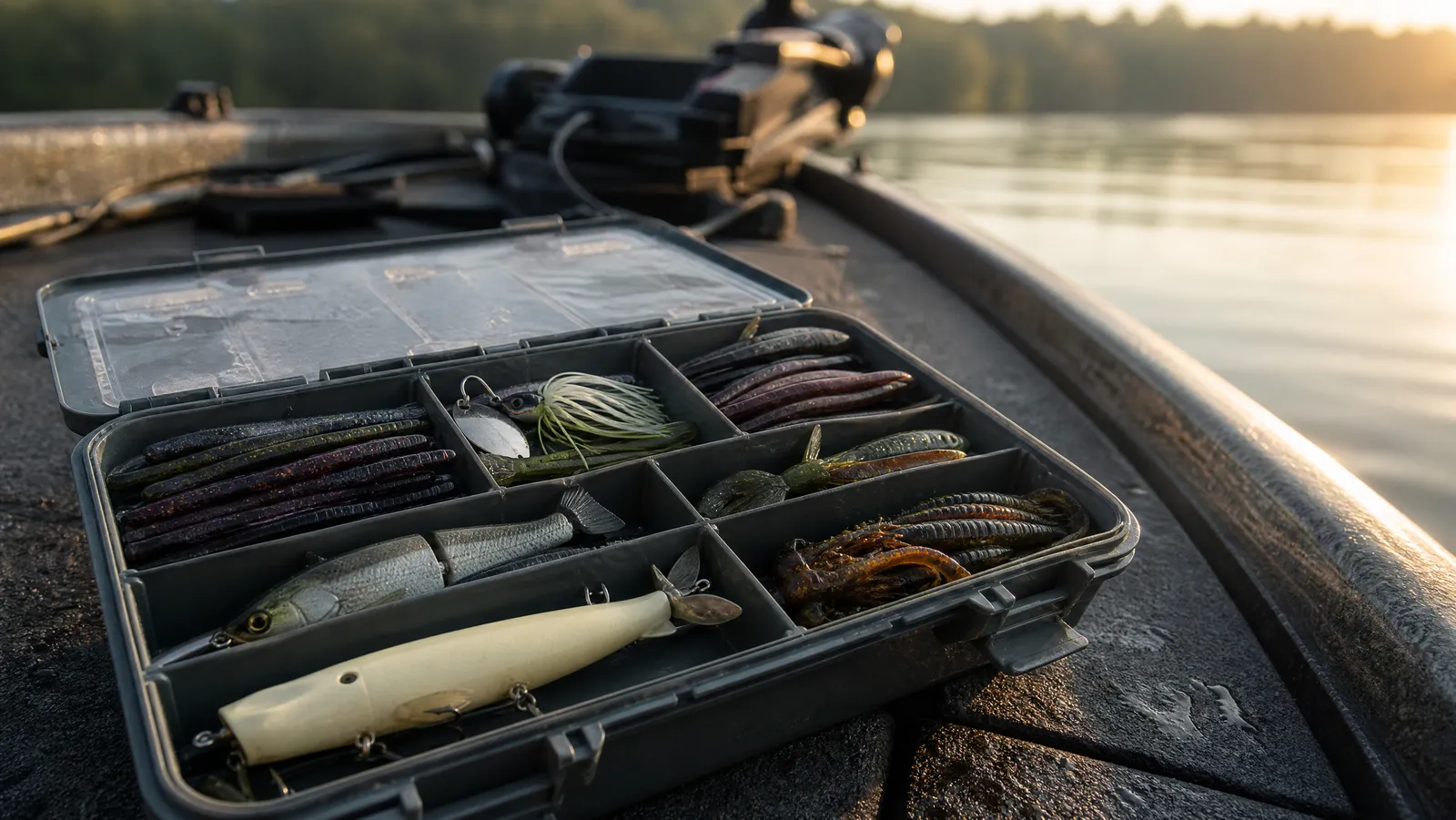
Ask ten serious bass anglers to strip their boat down to a handful of baits and you will hear the same short list. The best bass lures are a soft plastic stick worm, a walking topwater, a bladed jig, a crankbait or swimbait, and a weedless rig for heavy cover — five categories that catch largemouth and smallmouth anywhere in the US, twelve months a year.
Angler Reviews is reader-supported: as an Amazon Associate we may earn a commission from qualifying purchases, at no extra cost to you.
This guide is the hub for our entire bass lure series. We walk through every major lure family — topwater, soft plastics, crankbaits, and weedless setups — then map them to all four seasons and to both bass species. If you want the quick version first, our list of five proven largemouth lures is the short-form companion to this page. Everything below is built for one goal: helping you pick the right lure on the water, not just at the tackle shop.
How to Pick a Bass Lure: A Simple Framework
So what are the best bass lures for the water in front of you today? Run every decision through four questions before you tie on:
- Depth. Where are the fish holding — surface, mid-column, or bottom? Match the lure's running depth first. Nothing else matters if the bait never crosses a bass's face.
- Cover. Open water lets you throw treble-hook baits like crankbaits and walking topwaters. Grass, laydowns and docks demand weedless, single-hook rigs.
- Speed. Active fish chase moving baits. Cold, pressured, or post-frontal fish want something slow that soaks in the strike zone.
- Forage. Match the hatch loosely — shad-profile baits around schooling baitfish, craw and creature baits around rock and grass.
One more variable sits outside the tackle box: the rod in your hand. A softer tip protects treble hooks on crankbaits, while single-hook baits like jigs and Texas rigs need backbone to drive the point home. Our primer on matching rod power to your lure covers how to pair them.
With that framework in place, here is every lure family that matters, and when each one earns a spot on your deck.
Topwater Lures: Frogs, Poppers, and Walking Baits
Nothing in bass fishing beats a surface strike, and the best topwater bass lures split into three families: walking baits that zigzag side to side, poppers that chug and spit in place, and hollow-body frogs built for the thickest cover.
Walking baits are the oldest trick in the book — literally. According to Bass Pro Shops' 1Source, the style traces to 1922, when Heddon introduced the original wooden Zaragossa, and the redesigned plastic Zara Spook that followed in 1939 became the plug most associated with the "walk-the-dog" retrieve. The modern version of that lineage is the Heddon Super Spook, which comes as a 3-pack in bone, baby bass and foxy shad for about $18 as of July 2026 — three of the most useful surface colors you can own, with super sharp treble hooks straight out of the package.
The technique is simple to learn: point your rod tip down, twitch on a semi-slack line, and let the bait glide left-right-left. The cadence matters more than the speed — a steady rhythm draws fish up from surprising depths, and pausing the walk over a likely target is often what converts a follower into a strike. Poppers are the better call when fish are pinned to a specific target like a dock post or a laydown, because you can chug and spit almost in place, giving a reluctant fish three or four looks at the same bait. Frogs get their own treatment in the heavy-cover section below — their weedless design is a different game entirely.
In our experience, topwater shines in low light — early mornings, late evenings, and cloudy days — and any time bass are pushing baitfish to the surface. Keep one rigged from the first warm days of late spring through the last schooling activity of fall.
Soft Plastics: Worms, Craws, and Creature Baits
If we could fish only one category for the rest of our lives, this is it. The best soft plastic bass lures do what no hard bait can: they hover, shimmy and fall with almost no input from the angler, which makes them deadly on pressured fish.
The modern era of soft plastics runs through one bait. According to MeatEater, Gary Yamamoto molded the first Senko off the profile of a Bic pen in 1996, designing it to fall horizontally with a subtle shimmy instead of the nose-down drop of earlier worms. That stick-worm profile has been copied by nearly every soft plastic company since, and the copy we recommend is the Yum Dinger stick worm — a 5-inch bait in watermelon red flake that sells as a 100 pack for about $29 as of July 2026. It Texas rigs, Carolina rigs and wacky rigs, weighted or weightless, and a molded hook slot helps convert more bites into hooked fish.
Beyond stick worms, keep three other soft plastic shapes handy:
- Curly-tail and ribbon-tail worms for dragging along the bottom in summer.
- Craws as jig trailers or Texas rigs around rock.
- Creature baits with flapping appendages for flipping into heavy cover.
Rigging matters as much as the bait itself — an undersized or light-wire hook loses fish in cover, and an oversized one kills the action. Our guide to choosing the right hook walks through matching hook style and size to each soft plastic rig.
Crankbaits: Squarebills to Deep Divers
Crankbaits are the fastest way to cover water and find active fish, and they sort themselves by bill: the bigger the lip, the deeper the dive.
- Squarebills are the shallow-water workhorses. Their blunt bills deflect off stumps, riprap and dock posts, and that erratic deflection is exactly what triggers strikes. Throw them anywhere shallow cover meets baitfish.
- Mid-depth divers with rounded bills cover the middle of the water column — points, channel swings and the edges of flats.
- Deep divers reach offshore structure where summer bass school. They pull hard, so this is where a slower reel and a softer rod earn their keep.
- Lipless crankbaits sink on a count, run at any depth you choose, and rip cleanly through submerged grass.
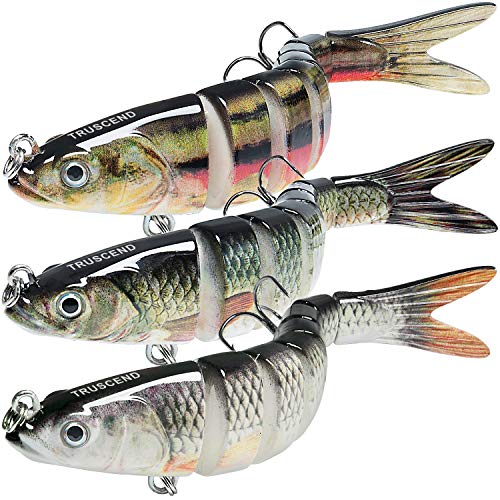
When bass want a bigger, slower meal than the best crankbaits for bass can offer, we hand them a swimbait instead. The TRUSCEND Swimmax jointed swimbait — about $21 as of July 2026 — swims with a wiggling, vibrating, segmented action, adds internal rattles for stained water, and solves the classic jointed-bait durability problem with heavy-duty Dyneema fiber joints instead of tear-prone soft plastic. Its sharp, corrosion-resistant BKK hooks are ready to fish out of the package.
One rule ties this whole category together: contact creates strikes. A crankbait swimming through empty water gets followed; a crankbait grinding bottom or bouncing off wood gets eaten. Pick a diver that runs slightly deeper than the cover you are fishing, and when a bait ticks a stump or a rock, resist the urge to slow down — that deflection is usually the moment the bite comes.
Fishing Heavy Cover: Weedless Setups
Big largemouth live where treble hooks cannot go — matted grass, flooded bushes, laydowns and dock cables. The best weedless bass lures are how you get them out, and the theme across all of them is a hook point that is buried, shielded or riding upward.
The core weedless presentations, from lightest cover to heaviest:
- Wacky and Neko rigs with a weedless hook, for sparse grass and dock edges.
- The Texas rig — hook point skin-hooked back into the bait — the single most snag-proof soft plastic setup ever devised.
- Hollow-body frogs, which slide over matted grass and pads on a collapsing body that exposes the hooks only when a fish eats.
- Punching rigs, a heavy weight and compact creature bait that crash through the canopy to fish nobody else reaches.
Our favorite starting point costs almost nothing to try: a Texas-rigged Yum Dinger fished weightless around grass edges and laydowns. Because the bait can be rigged weighted or weightless, the same 100 pack covers everything from skipping under docks to pitching into holes in the grass.
Two pieces of advice from hard experience. First, use stronger line in cover than you think you need — the fight happens at close range around wood and vegetation. Second, when a fish eats in the thick stuff, set hard and get its head up immediately. Hesitation is how good fish bury themselves in the salad.
Spring Bass Lures: Prespawn to Postspawn
Spring is three seasons in one, and water temperature — not the calendar — tells you which one you are in. According to BassResource, black bass begin their prespawn movements when water temperatures reach roughly 45 to 55 degrees, staging on points and channel edges near spawning flats. And according to Field & Stream, most black bass spawn once water temperatures sit between 55 and 70 degrees, with many bass starting to fan beds as temps climb into the high 50s.
That progression writes your lure schedule for you — these are the bass lures for spring we rely on:
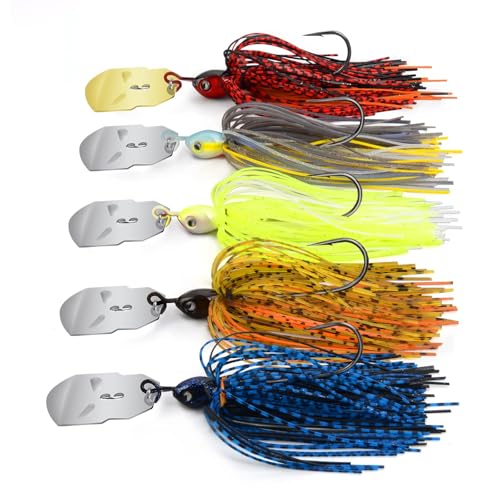
- Prespawn (roughly 45-55 degrees): slow-moving baits that hug the bottom — jigs, suspending jerkbaits, and lipless crankbaits ripped out of new grass. As the water climbs through the 50s, a bladed jig becomes our first pick. The MadBite bladed jig kit gives you five 3/8 oz jigs in bream, craw and shad skirt colors with a storage box for under $19 as of July 2026, and its heavy-wire needle point hooks stand up to fish pulled from cover.
- Spawn (roughly 55-70 degrees): slow soft plastics in shallow, protected pockets. A weightless stick worm or a creature bait worked through spawning flats draws strikes from fish guarding territory.
- Postspawn: fish recover in the first cover adjacent to spawning areas, and topwater starts producing as they slide toward summer haunts.
Spring is also when checking your local regulations matters most, since several states restrict bed fishing or impose seasonal rules — always confirm before you target shallow spring fish.
Summer Bass Lures: Early Mornings and Deep Structure
Summer bass fishing splits into two jobs with a dead zone in between. The bass lures for summer that earn their keep do one of these two things well.
Job one: the low-light shallow bite. From first light until the sun gets high, bass roam shallow to feed. This is prime time for walking topwaters, buzzbaits and frogs around grass lines, docks and bluff shade. In our experience the window is short but violent — be on the water at dawn, cover ground quickly, and lean on a walking bait like the Super Spook to call fish from a distance.
Job two: the deep structure bite. As the sun climbs, quality fish slide out to offshore structure — points, humps, ledges and channel swings — and to shade cover like thick grass mats and deep docks. Deep-diving crankbaits, big ribbon-tail worms on Carolina rigs, and football jigs dragged along the bottom are the classic tools. Many anglers find that summer schools fire in bursts: catch one on a fast-moving crankbait, and the school often lights up for a few minutes before shutting down again.
Between those windows, do not grind empty water. Fish shade, fish current if your lake has any, or slow down with a wacky-rigged stick worm on the deepest docks you can find. Summer rewards anglers who commit to either the dawn patrol or the offshore game rather than splitting the difference all day.
Fall Bass Lures: Follow the Baitfish
Fall has one rule: find the bait, and you find the bass. According to Bassmaster, the fall pattern is triggered when surface temperatures drop 10 degrees below their summer levels, and as the water cools shad migrate into the creeks with bass following close behind.
That migration dictates the bass lures for fall. This is moving-bait season, and shad imitations dominate:
- Bladed jigs and spinnerbaits to cover the shallow flats and creek arms where bait piles up. The MadBite bladed jig in its Sexy Shad skirt is our default search bait here, with or without a soft plastic trailer.
- Squarebill and lipless crankbaits for bouncing through scattered cover as you chase the schools.
- Walking topwaters any time you see surface activity — fall schooling bass will climb over each other for a Spook.
The practical challenge in fall is speed of decision-making. Bait schools move daily, so yesterday's creek can be empty water today. Idle or scan the backs of creeks, watch for flickering bait and diving birds, and do not fish memories. When you find the bait, slow down and pick the area apart; when you do not, keep moving.
Fall is also the easiest season to overthink color. Match the shad — white, silver, bone and natural shad patterns — and spend your mental energy on location instead.
Winter Bass Lures: Slow and Small
Winter strips bass fishing down to its patient core. According to Wired2Fish, once water temperatures fall below about 50 degrees a bass's metabolism slows to a crawl — the fish keep feeding, but only when a meal is easy and efficient to catch. You cannot make a winter bass chase. You can only put something easy in front of it.
The bass lures for winter that still produce share two traits: they are compact, and they can be fished at a crawl.
- Finesse jigs and hair jigs, dragged — not hopped — along deep rock and channel bends.
- Blade baits and jigging spoons, worked vertically on fish you graph on deep structure.
- Suspending jerkbaits, twitched and then left dead for pauses that feel absurdly long. Long pauses — sometimes 10, 20, even 30 seconds — are the proven cold-water cadence, per Wired2Fish's winter jerkbait guidance.
- Small soft plastics on light jigheads, fished on the bottom with as little movement as you can stand.
Location does most of the work in winter. Fish group tightly on steep structure near deep water — bluff walls, channel swings, deep points — so one productive spot often holds a school. In our experience, the retrieve rule is simple: slow down until you think you are fishing too slowly, then cut that speed in half. Bites are rare and subtle, but winter fish run big, and a single afternoon window when the sun warms a rock bank can save the whole day.
Smallmouth vs. Largemouth: Adjusting Your Lures
Everything above catches both species, but the two fish live differently, and your lure choices should follow. According to the New York State Department of Environmental Conservation, largemouth prefer shallow, weedy areas of lakes, ponds and rivers around cover like downed trees, while smallmouth prefer rocky areas across a wide range of depths, from 5 to 35 feet. Outdoor Life's species comparison adds that largemouth are more at home in murky lakes and slow-moving rivers, while smallmouth favor clear-water lakes and rivers with current.
Those habits change the playbook when you build a box of smallmouth bass lures:
- Downsize and go natural. Clear water and a diet heavy on small forage mean compact baits and subtle colors — green pumpkin, smoke, and shad patterns over bold largemouth colors.
- Fish rock, not grass. Trade the frog and punching rig for tubes, Ned rigs and finesse jigs crawled over gravel, boulders and current seams.
- Cover water up high. Smallmouth are aggressive roamers that will run down a moving bait. Jerkbaits, small swimbaits and topwater walkers all shine — a compact jointed bait like the TRUSCEND Swimmax is at home here, and its multi-species design (bass, trout, walleye, crappie and pike) fits the northern rivers and lakes where smallmouth share water with all of them.
For largemouth, run the opposite direction: bulkier profiles, louder presentations, heavier cover. The fish that lives in a grass mat wants a meal worth ambushing; the fish cruising a rock flat wants something it can chase down. Match the personality, not just the species name.
Building Your First Tackle Box
If you are starting from zero, resist the urge to buy one of everything. A functional first bass box needs to cover the framework from the top of this guide — surface, mid-column, bottom, and heavy cover — and nothing else.
Here is the starter loadout we recommend:
- Stick worms (our pick: the Yum Dinger 100 pack) with a bag of offset worm hooks and a few bullet weights — this alone covers Texas, wacky and weightless presentations.
- One walking topwater for the surface bite.
- One bladed jig or spinnerbait as your moving search bait.
- One squarebill or lipless crankbait for covering water around cover.
- A small selection of jigheads and finesse plastics for the tough days.
The fastest shortcut is a boxed kit, and among bass lure kits for beginners the PLUSINNO 137-piece lure kit is the one we point new anglers toward. For about $16.50 as of July 2026 you get a pencil bait, a VIB, a minnow, two spinners, three spoons, 23 soft baits, and the hooks, weights and accessories to fish them — covering seven rig types, including Texas, Carolina, split shot, jig head and wacky, in a segmented box that measures just 6.9 x 4.7 x 1.2 inches. It is aimed squarely at beginners, and that is its virtue: one purchase, every fundamental presentation, and a box small enough to live in a backpack.
Buy the kit to learn what you like, then upgrade the individual categories you actually fish. That order — kit first, specialization second — saves most new anglers a drawer full of regret purchases.
The Bottom Line
The best bass fishing lures have not changed much in decades, and that is the point: stick worms, walking topwaters, bladed jigs, crankbaits and weedless rigs keep winning because they cover every depth, season and cover type bass live in. Start with the five picks in this guide, fish them through the framework — depth, cover, speed, forage — and let the water in front of you make the final call. The angler who fishes five lures with confidence beats the one hauling fifty baits and second-guessing all of them.
Explore the full series
- Best Topwater Bass Lures: Frogs, Poppers, and Walking Baits — Walking baits, poppers, ploppers, and frogs, and when to throw each.
- Bass Lures for Fall: What to Throw During the Autumn Feed — A seasonal guide to the fall shad migration and the lures that match it.
- Best Soft Plastic Bass Lures: Worms, Craws, and Creature Baits — Stick worms, ribbon tails, craws, and creature baits — and how to rig each one.
- Bass Lures for Summer: Beating the Heat for July and August Bass — Dawn topwater, deep structure, and heavy shade — the three summer patterns.
- Best Crankbaits for Bass: Squarebills to Deep Divers — Squarebills, lipless baits, and deep divers matched to depth and cover.
- Weedless Bass Lures: How to Fish Heavy Cover Without Snagging — How to fish matted grass, wood, and docks without hanging up.
- Smallmouth Bass Lures: What Actually Works for Bronzebacks — Downsizing, natural colors, and rock — how the bronzeback playbook differs.
- Bass Lures for Spring: Prespawn, Spawn, and Postspawn — Prespawn, spawn, and postspawn — reading water temperature to pick the bait.
- Bass Lures for Winter: Slow Down and Catch Cold-Water Bass — Compact baits fished at a crawl, and where cold-water bass group up.
- Best Bass Lure Kits for Beginners: Complete Tackle Box Starters — What a starter box must cover, and which boxed kits actually get you there.
The Picks, Tested
Yum Dinger 5" Stick Worm (100 pack)
A 5-inch soft plastic stick worm in watermelon red flake, sold in a 100 pack. It can be Texas, Carolina or wacky rigged, weighted or weightless, and a unique hook slot provides better hook-ups.
- Rigs Texas, Carolina or wacky, weighted or weightless
- Hook slot designed for better hook-up ratios
- 100 pack means plenty of spares for a full season
- One color and one length per pack (watermelon red flake, 5 inch)
- Sold unrigged, so hooks and weights are separate

Heddon Super Spook (3-pack)
A three-pack of Heddon's walking-style topwater in bone, baby bass and foxy shad colors, rigged with super sharp treble hooks. It targets everything from largemouth bass to stripers to speckled trout.
- Three proven colors in one pack (bone, baby bass, foxy shad)
- Super sharp treble hooks out of the package
- Works in both freshwater and saltwater
- Exposed treble hooks are not suited to heavy cover
- One lure style across all three baits
MadBite Bladed Jig 5-pc Kit (3/8 oz)
A five-piece bladed-jig kit in 3/8 oz with multi-color silicone skirts and sticky-sharp heavy-wire needle point hooks in black nickel. The jigs fish with or without a soft plastic trailer and store in an included plastic box.
- Five skirt colors, including Alabama Bream, Bama Bug, Summer Craw and Sexy Shad
- Heavy-wire needle point hooks in black nickel
- Fishes with or without a soft plastic trailer
- Only one weight offered (3/8 oz)
- No soft plastic trailers included in the kit
TRUSCEND Swimmax Jointed Swimbait
A segmented, jointed swimbait that wiggles, vibrates and rattles on the retrieve, built with heavy-duty Dyneema fiber joints instead of tear-prone soft plastic. Sharp, corrosion-resistant BKK hooks finish the package.
- Durable Dyneema fiber joints instead of tear-prone soft plastic
- Sharp, corrosion-resistant BKK hooks
- Internal rattles add sound to the segmented swimming action
- Built as a multi-species bait rather than a bass-only profile
- Rattling, vibrating design is a loud presentation

PLUSINNO 137-Piece Lure Kit
A 137-piece freshwater kit with a pencil bait, a VIB, a minnow, two spinners, three spoons, 23 soft baits, plus hooks, weights and accessories in a compact 6.9 x 4.
- Covers seven rig types, including Texas, Carolina and wacky
- Hard baits, soft baits, hooks and weights in one box
- Compact 6.9 x 4.7 x 1.2 inch segmented case
- Aimed at beginners rather than tournament-grade components
- Only one each of most hard-bait styles (pencil, VIB, minnow)
Compare The Field
| Compare | Our Pick Yum Dinger 5" Stick Worm (100 pack) | Topwater Pick Heddon Super Spook (3-pack) | Moving-Bait Pick MadBite Bladed Jig 5-pc Kit (3/8 oz) |
|---|---|---|---|
| Overall | — | — | — |
| Price | $28.99 Check price → | $18.49 Check price → | $18.69 Check price → |
About The Author
Rob Thomas
Rob Thomas is a fisherman who loves catching tales from his fellow fishermen. He always enjoys a good story, especially when it comes from the sea.