Bass Lures for Summer: Beating the Heat for July and August Bass

This post may contain affiliate links. Read our policy.
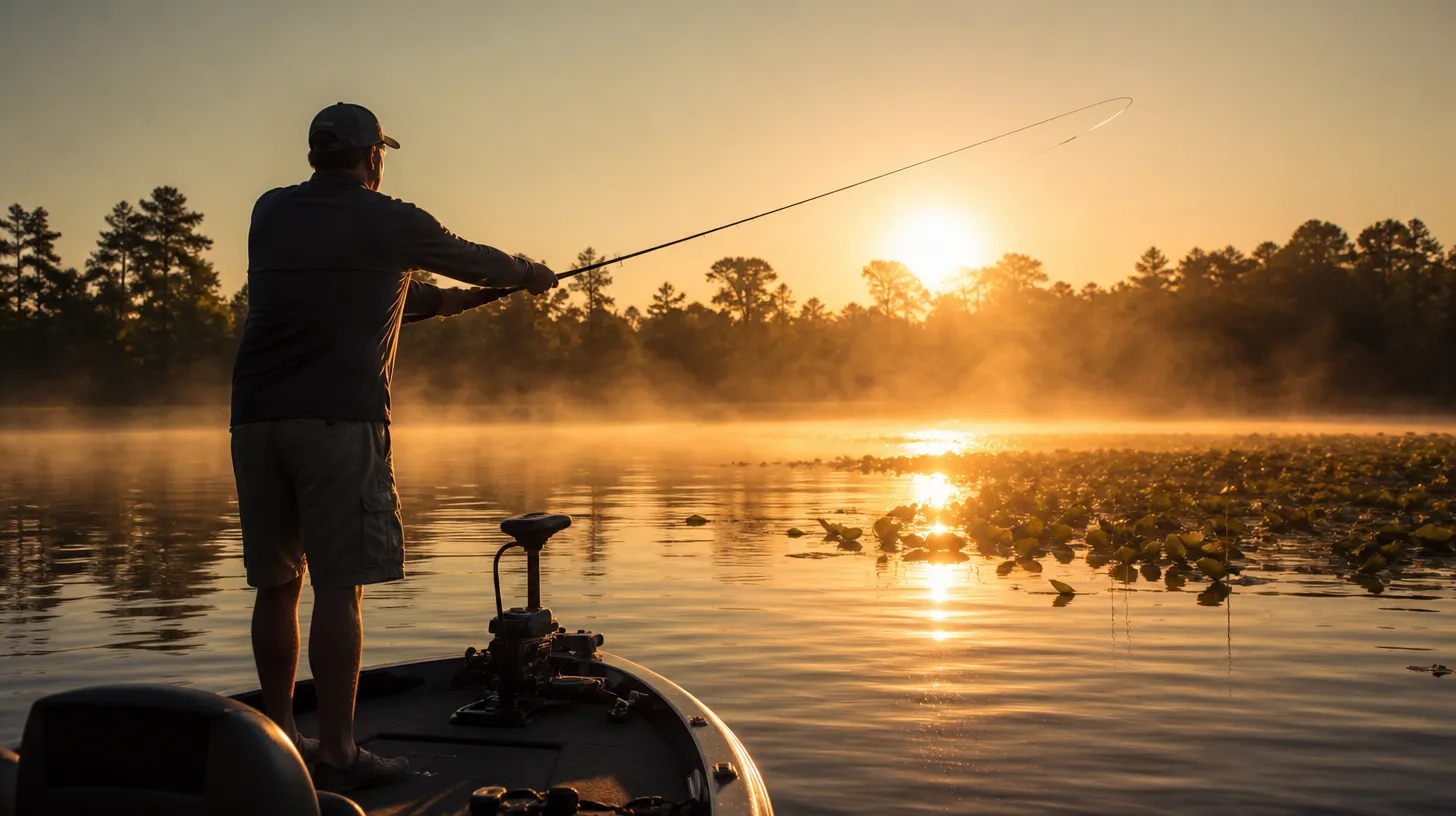
Bass lures for summer come down to three jobs: topwater baits for the low-light feeding windows at dawn and dusk, deep presentations — crankbaits, Carolina rigs, drop shots — for midday fish stacked on offshore structure, and heavy flipping and punching gear for bass buried in shade. Pick the right job for the right hour and July and August can out-fish June.
That last part is the catch. Summer bass are still eating; they just stop eating everywhere, all day. The anglers who struggle in the heat are usually fishing a 7 a.m. pattern at 1 p.m. The anglers who thrive treat the day as three separate trips — an early trip, a midday trip, and an evening trip — each with its own water and its own lures. This guide walks through all three, plus the night bite that a lot of us lean on when the ramps get crowded. If you are still building out your tackle box, our complete bass lure guide covers every category below in more depth; here we focus on when and where each one earns its spot once real summer heat sets in.
Why Summer Bass Fishing Splits the Day
Two things drive everything about summer bass fishing: temperature and oxygen.
Warm water speeds a bass's metabolism up to a point, then starts working against the angler. Wired2Fish's summer bass guide notes that once water temperatures pass the 70-degree mark, a bass's urge to feed goes way down. BassResource's seasonal-habits guide goes further: as water climbs into the 80s and 90s, largemouth conserve metabolic energy, move around less, and associate strongly with cover in roughly 1 to 20 feet of water where they can ambush prey instead of chasing it. That is why the same fish that ran down a burned squarebill in May wants a bait dragged past its nose in August.
The second driver is stratification. By midsummer, most reservoirs separate into layers, and the boundary between them — the thermocline — controls where bass can live. Wired2Fish describes the thermocline as the fine line separating the oxygen-rich warmer water from the cooler, anaerobic water below, and notes that because the layer above the thermocline holds the most oxygen, it holds the baitfish — and therefore the bass. Kentucky Afield Outdoors is blunt about the other side of that line: there is no dissolved oxygen below the thermocline for fish to breathe. The same article pegs typical late-summer thermocline depths at around 10 feet on shallow, fertile lakes, roughly 15 feet on mid-depth reservoirs, and about 20 feet on clearer lakes — the clearer the water, the deeper it sets up.
Put those two facts together and the summer playbook writes itself:
- Low light (dawn, dusk, night): bass slide shallow to feed. Fish fast and up top.
- High sun: bass either drop to structure just above the thermocline or tuck under the thickest shade they can find. Fish deep, or fish thick — nothing in between.
First Light and Dusk: The Best Bass Lures for Summer Start on Top
The dawn topwater window is the summer pattern, and it is worth setting an alarm for. In his Bassmaster column, pro Bill Lowen recommends fishing from daylight until around 10 or 11 in the morning and again from about 6 in the evening until dark, because the lower light and somewhat lower temperatures activate fish more than the middle of the day. He adds that baitfish activity is much heavier under low light — and it stands to reason the bass feed heavier at the same times.
Our low-light rotation runs almost entirely through topwater bass lures:
- Walking baits for covering flats, long points, and bait schools in open water. When bass are on shad, a walked spook-style bait draws the biggest fish of the window.
- Poppers for slower, targeted work — dock corners, laydowns, shade pockets. When fish swirl at a walking bait but miss it, we slow down with a popper.
- Buzzbaits for grass edges and shallow cover you want to cover quickly. A buzzbait is one of our five deadly largemouth bass lures for a reason: it draws strikes from fish a subtle bait never wakes up.
- Prop baits and wakebaits when the surface is dead calm and a full walking cadence feels like too much.
- Hollow-body frogs anywhere grass has already topped out — the frog bite only gets better as the mats thicken through summer.
Work the edges first. At first light, feeding bass roam ahead of the cover before they settle into it, so we make our first passes down weedlines and dock rows rather than casting straight into the thick stuff. And do not quit on top the second the sun clears the trees — cloud cover, wind, or a shaded bank can stretch the window well past mid-morning.
Midday Option One: Go Deep on Ledges, Points, and the Thermocline
When the sun gets high, one group of bass slides out to offshore structure — and on many reservoirs, that is the biggest group. Wired2Fish notes that in summer, especially on southern Tennessee Valley Authority reservoirs and northern lakes, deep rock and ledges will hold a ton of fish. Kentucky Afield Outdoors points anglers to points, humps, and channel ledges in roughly the 10-to-15-foot range on mid-depth reservoirs, and notes that shad like to follow channels — so structure that touches a creek or river channel is worth graphing first.
The depth rule from the thermocline section applies here in reverse: find the thermocline on your electronics (it often shows as a faint horizontal band), then fish structure at or just above that depth. Dragging a bait below it is fishing dead water.
Our midday deep rotation:
- Deep-diving crankbaits to fire up a school. A big-billed crankbait ground along a shell bar or ledge lip is the fastest way to find out whether anyone is home.
- Carolina-rigged worms and creature baits for slow, thorough coverage once the cranking bite fades. A three-quarter-ounce weight, a 3-foot leader, and a 7-to-10-inch worm stays in the strike zone all cast.
- Big Texas-rigged worms — the classic summer ledge bait. Deep worming and punching both run on soft plastic bass lures, which is why our summer soft-plastic bag is twice the size of our spring one.
- Football jigs dragged and hopped through rock.
- Drop shots for fish you can see on the graph but cannot make eat. When a school shuts down after a few catches, a drop shot picks off two or three more.
One habit worth stealing from ledge specialists: do not camp. Idle and graph until you actually mark a school, then fish. Ten minutes of graphing routinely saves two hours of casting at empty water.
Midday Option Two: Go Thick — Mats, Docks, and Shade
The other midday population never leaves the shallows; it just disappears into cover. Lowen makes an exception to his morning-and-evening rule for lakes and rivers with heavy weed growth, noting that the harsh midday sun concentrates bass under all of that cover and makes them vulnerable to flipping and pitching. Wired2Fish adds a biological reason to the shade: vegetation provides oxygen, and as the summer goes on, bass bury themselves deep in the grass where it is cooler and more oxygenated.
Three ways we attack it:
- Punching mats. We rig a compact creature bait behind a heavy tungsten weight — usually an ounce to an ounce and a half — snelled on straight braid, and drop it vertically through the canopy. The bites often come on the initial fall, so watch the line the moment the bait breaks through.
- Frogging the same mats. A hollow frog works the roof of the cover the punch rig fishes under. We rotate between them: frog first for the aggressive fish, punch behind it for the ones that would not commit to the surface.
- Skipping docks. On lakes without grass, docks are the shade. A skipped wacky-rigged stick worm or a compact jig sent to the darkest corner — under walkways, behind ladders, against float barrels — is our default when the sun is straight overhead.
The common thread is precision. Midday shallow fish are not chasing; the bait has to land in their living room. In our experience, the difference between a bite and nothing is often two feet of placement.
The Night Shift: Summer Bass Fishing Lures After Dark
If your local lake turns into a boat parade by 9 a.m., flip the schedule entirely. According to Outdoor Life's night-fishing roundup, the crowds generally clear out after sundown and bass that were previously inactive begin to feed heavily again — which is exactly the combination we want in August.
Night lures are about vibration and silhouette, not detail:
- Single-blade spinnerbaits, fished slow. Outdoor Life quotes veteran pro Charlie Ingram's night setup — a quarter-ounce spinnerbait with a single blade, crawled along the bottom with a patient lift-and-drop retrieve — and that slow, thumping cadence is the standard night presentation for good reason.
- Noisy topwaters. The same article notes that under the right conditions, nothing turns on the night bite better than surface lures like prop baits, Jitterbugs, and buzzbaits. The plodding, gurgling retrieve of a Jitterbug-style crawler is tailor-made for bass tracking sound in the dark.
- Jigs and big worms dragged on main-lake points and riprap for the bottom-oriented fish.
On color, Outdoor Life's guidance is simple: on dark, moonless nights, throw solid black, brown, or blue for the strongest silhouette; under a bright moon, louder combinations like green/orange or red/chartreuse get the nod.
Common Summer Bass Lure Mistakes
- Fishing the morning pattern all day. The topwater bite ending is not the fish quitting — it is the fish relocating. When the blowups stop, change zones, not just lures.
- Fishing under the thermocline. Remember the Kentucky Afield Outdoors warning: there is no dissolved oxygen below it. If your bait is dragging 25 feet on a lake with a 15-foot thermocline, you are fishing where bass cannot breathe.
- Burning the bank at noon. Midday shallow fish are shade fish. A spinnerbait run down a sunlit bank at 1 p.m. mostly proves nobody is there; a jig pitched under the dock proves somebody is.
- Going too small too soon. Summer bass eat big meals in short windows. We downsize as a last resort, not a first move — the big worm usually out-fishes the finesse worm on a ledge in July.
- Missing the late-August shift. When nights lengthen and bait pushes toward the creeks, the deep summer pattern erodes fast. That transition is its own game — our guide to bass lures for fall covers how we follow the bait backward into the pockets.
The Bottom Line on Summer Bass Lures
Summer does not shrink your lure selection — it schedules it. Topwater owns first light and dusk, when low light and heavier baitfish activity pull bass shallow to feed. High sun sends you deep to ledges, points, and humps just above the thermocline with crankbaits, Carolina rigs, big worms, and a drop shot — or into the thickest shade on the lake with a punch rig, a frog, and a skipping jig. And when the heat and the crowds both peak, the night shift with a slow-rolled spinnerbait or a noisy crawler might be the best bite of the week.
Match the lure to the hour, keep one eye on the thermocline, and July and August stop being the dog days. For a deeper look at every category in this rotation — and our favorite ways to fish each one — start with the Angler Reviews bass lure guide.
About The Author
Rob Thomas
Rob Thomas is a fisherman who loves catching tales from his fellow fishermen. He always enjoys a good story, especially when it comes from the sea.