Bass Lures for Fall: What to Throw During the Autumn Feed

This post may contain affiliate links. Read our policy.
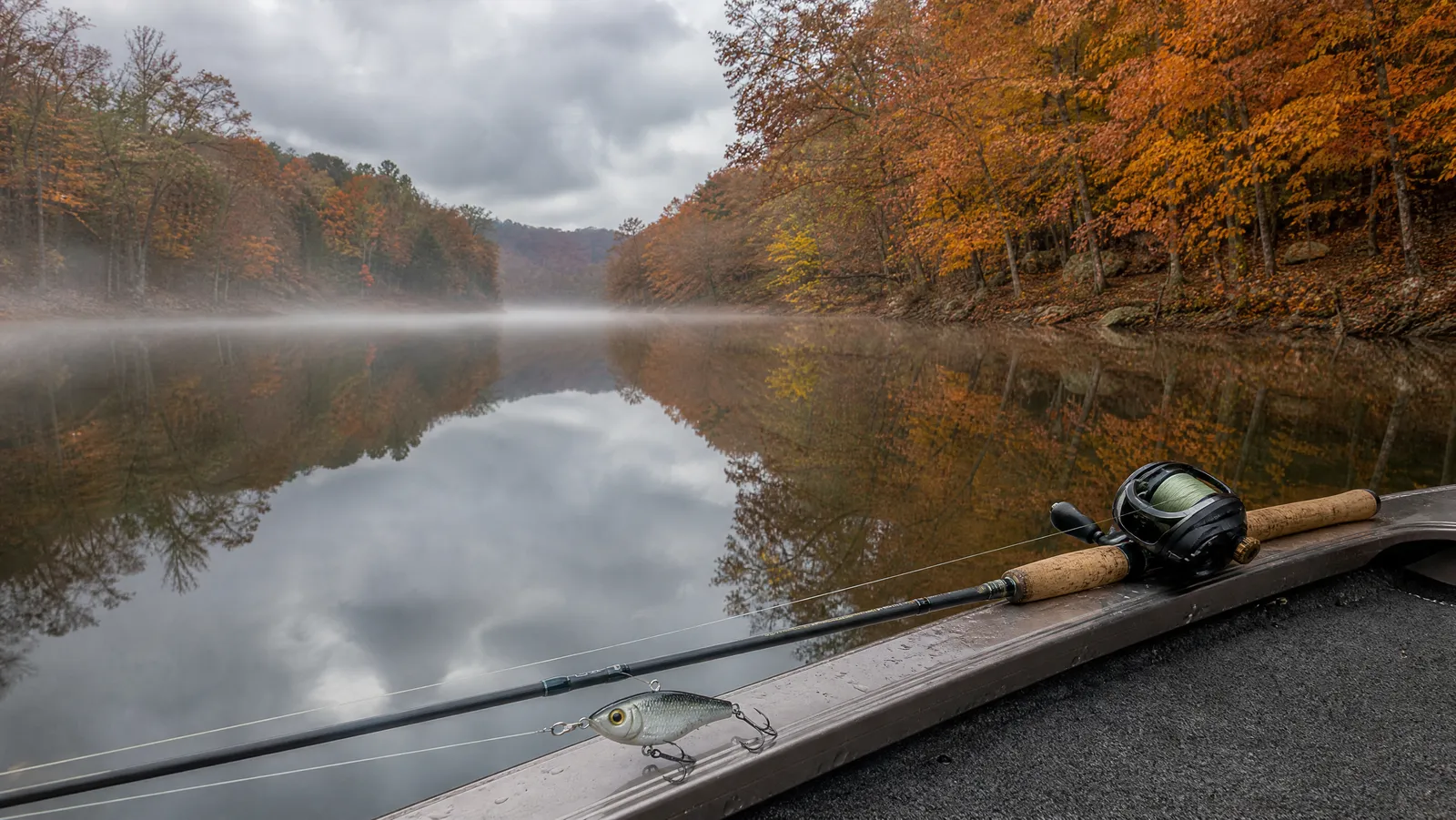
Fall bass fishing comes down to one word: shad. As the water cools, baitfish pour into creek arms and bass gorge ahead of winter, which is why moving, shad-imitating lures — lipless crankbaits, spinnerbaits, squarebills, and walking topwaters — dominate the season, with jigs and finesse worms closing it out late.
That is the short answer. The longer answer is that the right bass lures for fall change week to week, because fall is not one season — it is three. The lure that loads the boat in 68-degree water in late September can go completely dead in 52-degree water in November. We fish it as three distinct stages, and we swap baits as the thermometer drops.
This guide walks through why bass behave the way they do in autumn, what we throw in early, mid, and late fall, where the fish set up, and the mistakes that burn the most fishing days. It is a seasonal deep-dive from our full guide to bass lures for every season, so if you want the year-round picture, start there.
Why the Fall Transition Changes Bass Behavior
Three things happen at once in autumn, and together they reshuffle the whole lake.
First, the bait moves. According to Bassmaster, shad schools — larger fish from previous years plus juveniles spawned in late summer — migrate into the creeks in search of food as summer gives way to fall. That single migration drags much of the lake's food supply out of open water and funnels it into creek arms, pockets, and flats.
Second, the shallows get comfortable again. The Kentucky Department of Fish & Wildlife notes that cooler October nights mix the top layer of water in lakes and push more dissolved oxygen lower in the water column. Water that was a dead zone in August becomes livable, so bass roam banks and flats they abandoned all summer.
Third, winter is coming and bass know it. Bass are cold-blooded, so their metabolism runs on water temperature. In our experience, they feed with real urgency through the cooling trend, then taper hard once the water settles into the low 50s. That urgency is your window.
The net effect for fall transition bass: fish that were ganged up on deep summer structure scatter shallow, get aggressive, and start chasing. Your lures should do the same.
Early Fall Bass Fishing Lures: Cover Water Fast
Early fall — roughly the stretch when surface temps slide out of the high 70s and down through the 60s — is a pure reaction-bait game. Bass are shallow, moving, and keyed on shad, so we prioritize speed and shad profile over everything else.
Our early fall rotation:
- Lipless crankbaits (1/2 ounce, chrome or shad patterns). The most efficient search tool in the boat. We rip them across flats and over grass in 2 to 8 feet of water, burning long casts to find active schools. Nothing covers a 100-yard flat faster.
- Walking topwaters. When bass push shad to the surface — and in early fall they will, often in open water off points — a walking bait is the fastest way to convert a school before it sinks. Schooling fall bass absolutely crush topwater bass lures, and we keep one tied on from September until the surface bite dies.
- Buzzbaits and spinnerbaits (white, 3/8 to 1/2 ounce). For laydowns, dock edges, and grass lines where a treble-hooked bait fouls. The blades read as a small pod of fleeing shad.
- Soft-plastic jerkbaits (flukes). Our follow-up bait. When a fish blows up on a topwater and misses, a weightless fluke dead-falling into the hole gets bit more often than a repeat cast with the same lure.
The pattern here is simple: match the shad, keep it moving, and cover water until the fish tell you where they are. Ten casts and move is the right pace in early fall.
Mid Fall: The Best Bass Lures for the Peak Feed
Mid fall is the stage most anglers picture when they think of the autumn feed — bait balled up in the backs of creeks, bass herding it against banks, birds diving. When the pattern is on, this is some of the easiest bass fishing of the year. The best bass lures for fall's peak window are the ones you can put right in the middle of that chaos.
What we throw:
- Squarebill crankbaits. Our number one mid-fall bait. A shad-colored squarebill deflecting off stumps, riprap, and gravel in 2 to 6 feet triggers fish that ignore a straight retrieve. When people ask us about the best crankbaits for bass in the fall, a squarebill in a shad pattern is the first thing out of our mouths.
- Spinnerbaits, upsized. We bump to 1/2 and 3/4 ounce with double willow blades and slow-roll them along channel swings and through flooded cover. Bigger blades match the bigger year-class shad bass are eating by October.
- Swim jigs (white or shad-colored, 3/8 ounce). The quiet option. On calm, clear days when a spinnerbait feels like too much, a swim jig with a paddle-tail trailer slides through the same cover with a subtler footprint.
- Medium-diving crankbaits. For the fish staging on secondary points between feeding pushes, a crank running 6 to 10 feet keeps you in the game between the bank flurries.
One curveball to plan around: the turnover. Wired2Fish reports that most lakes don't actually turn over until surface temps drop below 50 degrees, and when it happens, the mixing stirs up bottom sediment and can wreck oxygen levels, throwing bass into a funk. The tells, per Wired2Fish, are tannic, coffee-colored water and a sulphuric, rotten-egg smell. If you find that, don't grind — run to the sections of the lake that haven't flipped yet, fish shallow where the mixing matters least, or find incoming current, which aerates and resets the water faster.
Late Fall Lures: Slowing Down for Transition Bass
Somewhere in late fall the party ends. Bassmaster notes that this last transition typically begins once the water temperature drops somewhere below 60 degrees — the cooling water prompts bass to start "downhilling" out of the shallows, leaving the pockets, creeks, and flats and moving deeper along breaklines and contours toward their winter holding areas.
Kentucky Fish & Wildlife's biologists see a similar rhythm on their lakes: in November, as water temperatures slide toward the mid-60s, largemouths move to the bank for one last week or two of feeding — and then the shallow bite fades. When that happens, we flip the whole program from speed to precision:
- Football jigs and casting jigs (3/8 to 1/2 ounce, crawfish colors). Kentucky DFW specifically recommends a 3/8-ounce crawfish-colored jig worked on points with a slow pull-and-drop retrieve, and that matches what we see everywhere in late fall. Crawfish become the reliable meal as shad schools thin out.
- Blade baits and tail spinners. The same agency points to tail spinners and blade baits allowed to shimmy down the sides of points — a deadly, mostly forgotten technique for bass sliding down the contour.
- Suspending jerkbaits. Once temps hit the mid-50s and falling, a jerkbait with long pauses — three seconds and up, longer the colder it gets — picks off the fish holding on the first drop outside the flats.
- Finesse worms and drop shots. The cleanup crew. When fish stack on channel swings and steep points but won't chase, a 4- to 6-inch finesse worm fished vertically gets the bites nothing else will.
This late-fall program is really the on-ramp to your cold-water approach — the same slow, deep, compact presentations carry straight into our thinking on bass lures for winter. If the jig-and-blade-bait bite is working in late November, do not abandon it in December; refine it.
Where to Find Fall Bass: Creek Arms, Flats, and Points
The best lure in the box is worthless in dead water, and fall punishes bad location more than any other season. Here is the map we run:
- Creek arms are the main stage. Start on the first third of a creek arm in early fall, then push farther back toward the very rear as the water keeps cooling. The bait leads, the bass follow, and you should too.
- Flats with cover hold the feeders. Shallow flats near the creek channel — especially ones with stumps, grass edges, or scattered rock — are where the actual eating happens, mostly early and late in the day.
- Secondary points are the rest stops. Between feeding windows, bass slide out to the first point or channel swing near the flat. When the bank goes quiet, back off and fish the nearest point before you leave.
- Ambush cover beats open bait. Here is the nuance most anglers miss: Bassmaster cautions that the old adage of "find the shad and you will find the bass" does not always hold true. Resident bass don't chase bait balls across the lake — they hold on ambush points in their home territory and take advantage of the prey that swims through. So don't just idle around staring at bait on your graph. Find the bait, then find the nearest piece of ambush cover — an isolated stump, a dock corner, a channel-swing bank — and fish that.
Common Fall Bass Fishing Mistakes
We have made every one of these. Save yourself the fuel:
- Fishing summer memories. The offshore school you caught in August is gone. Commit to the creeks and the bank, even when it feels wrong to drive past "your" ledge.
- Chasing bait instead of fishing ambush spots. Graphing bait all day is not a pattern. Bait plus cover plus a channel nearby — that is a pattern.
- Downsizing too early. Through early and mid fall, bass are eating the biggest shad of the year. Keep the full-size baits tied on until cold water forces the finesse gear on you.
- Ignoring turnover signs. Coffee-colored water and a rotten-egg smell mean move, not slow down. One long run to a fresh arm saves a wasted day.
- Quitting on the topwater too soon. The surface bite lingers deep into fall on many lakes, especially on warm afternoons. Keep a walking bait rigged until it genuinely stops producing.
- Fishing one speed all day. Fall bass flip between chasing and sulking as fronts roll through. Carry both halves of the program — a reaction bait and a jig — on the deck at all times.
The Bottom Line on Fall Bass Lures
Fall rewards anglers who move with the season instead of fishing one pattern into the ground. Run reaction baits — lipless cranks, walking topwaters, spinnerbaits — through the creek arms while the water is still in the 60s, lean on squarebills and swim jigs through the peak feed, and finish the year slow and low with jigs, blade baits, and finesse worms as the fish downhill toward winter. Follow the bait, but fish the ambush cover, and check the water color before you commit to a creek.
Five or six lure categories, three stages, one migration to track — that is the whole fall playbook. For a fuller breakdown of every bait mentioned here, including our five deadly largemouth lures and how each category fishes across the rest of the year, dig into Angler Reviews' complete bass lure guide. Then go burn a lipless crankbait across a flat while there is still a feed to catch.
About The Author
Rob Thomas
Rob Thomas is a fisherman who loves catching tales from his fellow fishermen. He always enjoys a good story, especially when it comes from the sea.