Best Spinning Reels: How to Choose One, and the Ones Worth Buying

This post may contain affiliate links. Read our policy.
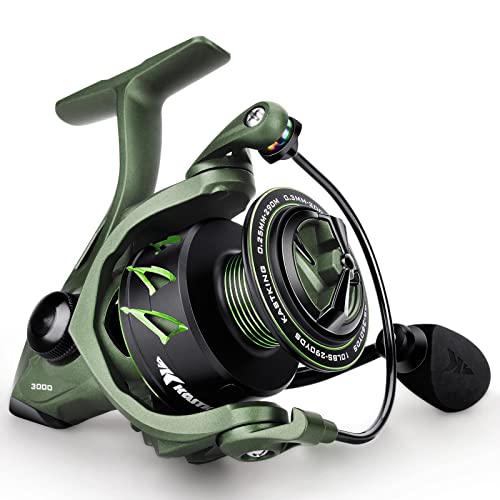
KastKing Spartacus II, 3000 Size
A graphite-bodied 3000 at about $39.
- About $39.09 as of September 2026, down from a $45.99 list price
- Brass pinion and ceramic line roller at a graphite-body price
- The 3000 size covers most freshwater work on 10 lb braid
- A graphite body flexes more under heavy load than an aluminium one
- Water-resistant by KastKing's description, not sealed - rinse it after salt
Most anglers need exactly one reel: a 2500 or 3000 in the eighty-to-one-hundred-thirty-dollar bracket, spooled with 10 lb braid. The Shimano Sahara FJ 2500, about $104.99 as of September 2026, is the one we hand over when someone asks without wanting a lecture. The best spinning reels are not the priciest ones - they are the ones sized correctly for the rod, the line, and the fish.
Angler Reviews is reader-supported: as an Amazon Associate we may earn a commission from qualifying purchases made through links on this page, at no extra cost to you.
This page is the hub of our spinning reel series. Below we walk the whole decision - size, drag, gear ratio, body material, brand tiers - then name six reels across price points, from a $39 budget workhorse to a $255 reel you buy once. If you already know what you want and just need line, start with our guide to the best fishing line for spinning reels instead.
How to Pick a Spinning Reel: Five Decisions
Everything in a tackle aisle collapses into five questions. Answer them in order and the shortlist writes itself.
- What do you fish for, and on what line? Line weight sets reel size, not the other way round.
- How big a spool do you need? Long casts and long runs want more line; ponds do not.
- Fresh, brackish, or salt? Salt means metal, seals, and rinsing discipline.
- How fast do you need to retrieve? Crankbaits and jigs want different speeds.
- How often do you fish? Thirty days a year justifies a metal body. Three does not.
Notice that none of those questions is "how many bearings does it have". Bearing count is the most-advertised and least-useful spec on the box. Seven cheap bearings in a flexing frame feel worse than five good ones in a rigid one.
The other thing worth saying early: the reel is half a system. A 4000 on a light rod feels like a hammer with a pencil handle. If you are buying both, read our breakdown of rod types and actions alongside this page and match them as a pair.
Reel Sizes: What 1000, 2500, and 4000 Actually Mean
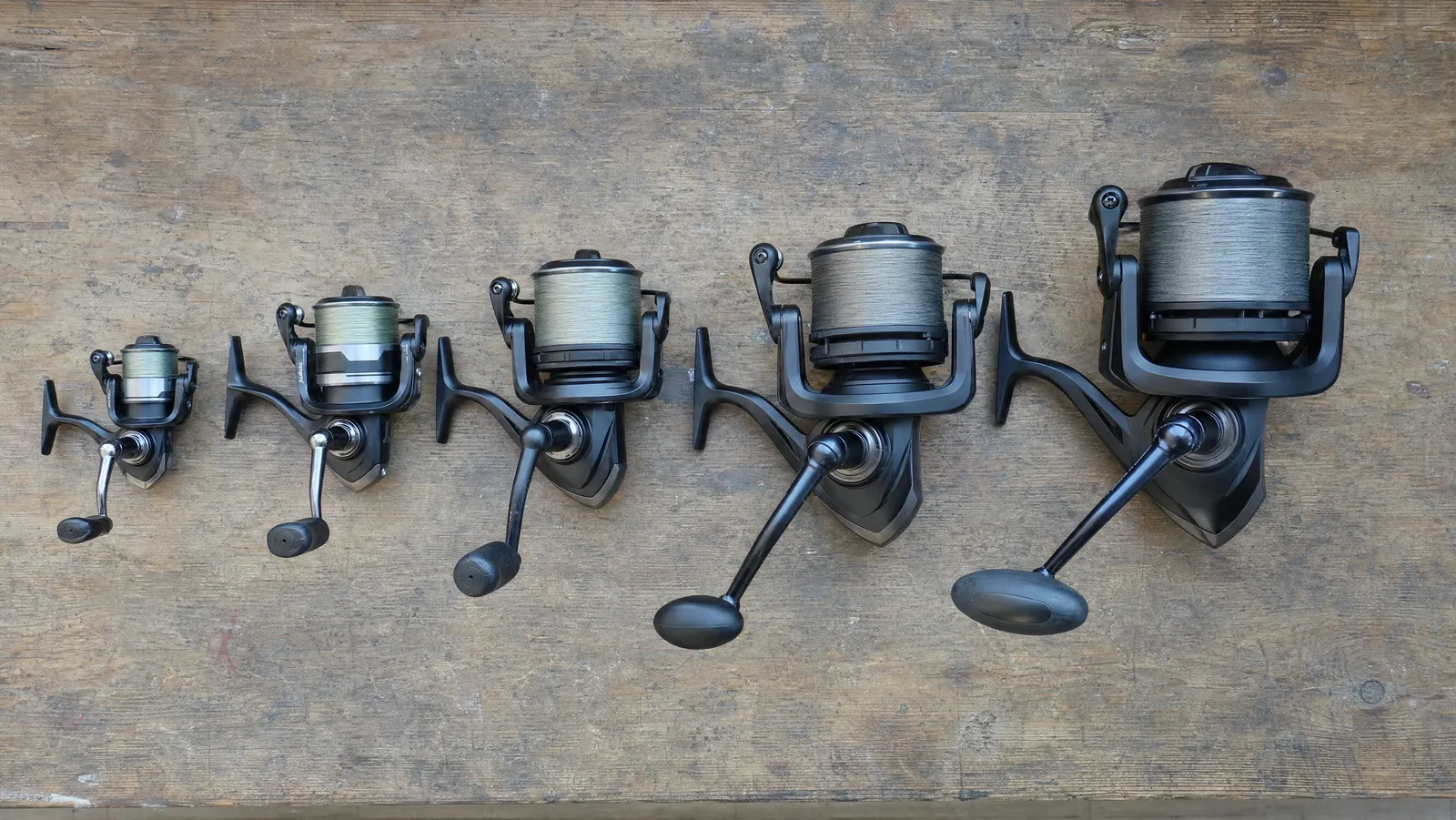
Anyone standing in front of a wall of boxes wants spinning reel sizes explained in one sentence, so here it is: the number is a rough capacity-and-weight class, and it climbs together with line capacity, drag power, and how much the reel weighs.
The practical ranges break down like this. Reel Coquina Fishing's size guide puts the 1000 to 2500 class on small trout, panfish and crappie. A 2500 suits light lure work such as drop-shotting and general spinning. A 4000 moves into pike, salmon and heavier trout territory, with more cranking power and more line on board - that is where the common published size charts put those species.
The awkward part is that there are two competing conventions. As Master Fishing Magazine points out, Shimano, Daiwa and PENN use four-digit labels such as 1000, 2500 and 4000, while Abu Garcia, Pflueger and Lew's use two-digit ones - 20, 25, 30, 40 - for roughly comparable sizes. A "30" and a "3000" are close cousins, not identical twins.
Our shorthand: 1000 for 4 to 6 lb line, 2500 for 8 to 10 lb, 3000 for 10 to 15 lb, 4000 for 15 to 30 lb braid and light inshore work. If you want the actual yardage for a given diameter, run the numbers through our line capacity calculator rather than trusting the sticker on the spool.
Depth matters as much as diameter. A shallow spool filled to within an eighth of an inch of the lip tends to cast a 1/8 oz lure further than a deep spool half full, because line peels off in smaller, freer coils with less friction against the lip.
The Best Spinning Reels Under $100
You can buy a genuinely good spinning reel for under a hundred dollars now, which was not true fifteen years ago. Two picks cover this bracket, and they are not competing for the same angler.
The KastKing Spartacus II in 3000 size is the budget answer at about $39.09 as of September 2026, down from a $45.99 list price. KastKing states a reinforced graphite body and rotor, a 22 lb triple-disc carbon fiber drag, 7+1 shielded stainless bearings on a brass pinion gear, and a 5.2:1 gear ratio across the 500 through 5000 sizes. For a first reel, a backup reel, or a rod that lives in a truck, it is hard to argue with.
Step up and the best spinning reel under $100 is the Piscifun NautiX in 3000 size, about $85.99 as of September 2026. The difference you feel is the frame: Piscifun states a full aluminium main body with a carbon rotor, CNC-machined aluminium main gears, a stainless main shaft, and a triple-disc carbon drag rated to 26 lb on the 3000 and 4000 sizes. Piscifun also claims an IPX5 water-resistance rating with an aluminium dust cover and four rubber rings.
Why the frame matters: when a fish loads a graphite body, the frame twists a fraction of a millimetre and the gear teeth stop meshing squarely. You hear it as a grinding note under pressure. A metal frame holds the gear train in line, which is why the same drag washers feel smoother in an aluminium reel.
What you give up under $100 is refinement, not function. Both of these reels will land good fish. Neither has the start-up smoothness of a $250 drag stack, and neither is fully sealed.
The All-Rounder Most Anglers Should Buy
If you told us you fish twenty days a year for bass, trout and whatever else is biting, we would not hesitate: the Shimano Sahara FJ 2500, about $104.99 as of September 2026.
Shimano builds it around HAGANE cold-forged gearing - gears pressed into shape rather than cut, which is the company's answer to gear wear - plus SilentDrive, the Propulsion Line Management System at the spool lip, and the G-Free Body, which Shimano says shifts the centre of gravity closer to the rod.
That last one sounds like marketing until you fish it. Mass sitting further from the rod blank makes the whole outfit feel tip-heavy over a long day of casting, and moving it back a centimetre is the cheapest comfort upgrade a reel maker can make.
Shimano publishes fewer headline numbers than KastKing or Piscifun do, and that is the trade. You are buying gearing quality and parts availability instead of a bigger drag figure on the box.
When You Need Saltwater Toughness
Salt does not care how nice your reel is. For inshore work, jetties, surf, and any freshwater fish that genuinely runs, the PENN Battle III at about $129 as of September 2026 is the sane choice.
PENN states an all-aluminium body and sideplates, a forged and machined aluminium spool with line capacity rings, an HT-100 front drag with carbon fibre washers rated to a 15 lb maximum, a 6.2:1 gear ratio that recovers 35 inches per crank, and five stainless bearings plus an instant anti-reverse. PENN lists braid capacity as 250 yards of 15 lb, 180 of 20, or 130 of 30.
It also has a trophy. Pure Fishing announced that the Battle III took top honours for Best Saltwater Reel in the ICAST 2020 New Product Showcase; the American Sportfishing Association's own summary of that show confirms it as a Best of Category win rather than the overall Best of Show.
Note the honest wrinkle: PENN's published 15 lb maximum drag is lower than the 22 lb and 26 lb figures the budget brands advertise. Maximum drag is the least important drag number. What matters is how smoothly the stack starts moving, and how much of that rating you can use without cooking the washers.
Ultralight and Finesse Reels
The best ultralight spinning reels share three traits: a 500 to 1000 body, a shallow spool, and a drag that breaks free cleanly at a pound or two rather than lurching.
Our pick is the KastKing Zephyr in 1000 size, about $39.09 as of September 2026. KastKing states the 1000 weighs about 7 ounces, offers up to 22 lb of carbon fibre drag, uses a corrosion-free graphite body and rotor with an oversized stainless main shaft and brass pinion, and comes with a braid-ready CNC machined aluminium spool that KastKing says needs no mono backing.
Seven ounces sounds trivial written down. Hold it for six hours of casting a 1/16 oz jig for stream trout and it is the difference between fishing and finishing early.
The catch with ultralights is capacity. A 1000 spool full of 6 lb line has maybe a hundred yards on it, so one bad backlash over a snag can cost you a third of your line. Check the pound test and diameter figures before you spool, and fill it properly rather than going heavy.
Matching a Spinning Reel to Bass Fishing
Ask around for the best spinning reel for bass and most serious anglers will name a 2500 or a 3000, because that is the size that throws finesse baits on 10 lb braid with a fluorocarbon leader.
The reason is technique. Wired2Fish's comparison has spinning gear excelling at light lures on light line - it describes humming a 1/8 oz jig or drop shot around on a medium to medium-light rod - while a baitcaster handles a 5/16 or 3/8 oz lure on 20 lb fluorocarbon without complaint. Finesse presentations such as the drop shot, Ned rig and shaky head sit on the spinning side of that divide, and bass fishing straddles it, which is why most bass anglers carry both.
For a bass-only spinning setup we would take the Sahara FJ 2500 or the NautiX 3000, spool 10 to 15 lb braid, and tie on a 8 to 12 lb fluorocarbon leader. Our guide to matching line to bass techniques covers the leader maths in detail.
One size note: go 3000 if you fish heavy cover or throw a lot of 1/2 oz baits. The larger spool takes the abrasion better and gives you a few more inches of retrieve per crank.
Spinning Reel or Baitcaster?
The honest way to frame a spinning reel versus a baitcaster is by lure weight and line diameter, not by skill level. The "baitcasters are for experts" line is thirty years out of date.
Wired2Fish lands on the split plainly. Spinning reels throw light lures on light line easily - a 1/8 oz jig is nothing to them, because line simply peels off a fixed spool with almost no inertia to overcome. Baitcasters, in that piece's words, struggle to throw light lures because the start-up inertia the spool demands is too high.
Above about 3/8 oz the advantage flips. A baitcaster's rotating spool gives direct control of line release, which is where its pinpoint accuracy for pitching and flipping comes from, and it handles heavy line and heavy cover better.
Our rule: under 3/8 oz and under 12 lb line, use spinning. Over 3/8 oz in cover, use a baitcaster. In the overlap, use whichever rod is already rigged - and read the rod pairing notes, because a spinning rod and a casting rod are not interchangeable even if the lure weight is.
Gear Ratio and Retrieve Speed
The gear ratio on a spinning reel tells you how many times the rotor turns per full turn of the handle. A 5.2:1 turns the rotor 5.2 times per crank; a 6.2:1 turns it 6.2 times.
What you actually care about is inches per turn. Wired2Fish makes the point that spool size, depth and width all feed into it, not the ratio alone. The cleanest worked example we found is in Surf Fishing SoCal's reel guide: a 4.4:1 reel with a 2-inch-diameter spool recovers 13.8 inches of line per turn of the handle, while a 6.2:1 reel with a 1.5-inch-diameter spool recovers less than 11 inches. The "faster" reel is slower.
So compare published inches-per-turn figures rather than ratios wherever a maker gives you one. PENN states the Battle III recovers 35 inches per crank at 6.2:1, which is a useful benchmark for a mid-size spinning reel; KastKing states the Spartacus II runs 5.2:1 across its freshwater sizes.
How to choose:
- Slower, around 5.2:1 - deep crankbaits, anything you want to keep in the strike zone, anything that pulls hard.
- Middle, around 6.0:1 - the honest all-rounder for jigs, soft plastics and general lure work.
- Faster, 6.4:1 and up - burning a bait back, picking up slack quickly on topwater, fishing a drop shot in current.
If you only own one, pick the middle. A slow reel can be cranked faster; a fast reel cannot be given more torque.
How a Spinning Reel Works
Understanding how a spinning reel works makes every other decision on this page make sense, and it takes one paragraph.
The spool does not rotate when you cast. It sits fixed on the main shaft while line jumps off the lip in coils. Turning the handle spins the pinion gear, which spins the rotor and its bail arm around the outside of the spool, laying line back on. Meanwhile an oscillation gear moves the whole spool slowly in and out so the line stacks evenly instead of piling in one band.
Three consequences follow directly from that design, and they explain most of what anglers complain about:
- Light lures cast well because nothing heavy has to spin up. There is no spool inertia to overcome.
- Line twist is built in. As Salt Water Sportsman explains, every revolution of the bail adds a small twist to the line, and those twists accumulate over hundreds of casts.
- Drag acts on the spool, usually through a stack of washers under the front knob, so drag pressure and spool diameter interact - a fuller spool gives up line more easily than a nearly empty one at the same setting.
That last point is why we treat a maximum drag rating as a ceiling rather than a working number. The pressure a fish actually feels shifts as the spool empties, even with the knob untouched.
Setting the Drag
Learning how to set your spinning reel drag takes two minutes, a luggage scale, and nothing else. It is the single highest-return thing a new angler can do.
The rule of thumb across the sport is to set drag at 20 to 30 per cent of the line's breaking strength. Salt Strong recommends that range, and its worked example is 10 lb line giving a 2 to 3 lb target. Mercury Marine's guide gives the same 20 to 30 per cent rule with a braid example - 20 lb test braid wants about 4 lb of drag pressure - and spells out the measuring method: tie the line to a spring scale coming straight out of the reel, set the drag, and pull until the spool starts to give.
A few practices worth keeping:
- Decide whether you are pulling straight off the reel or through the rod guides, then stay consistent. Mercury Marine's method measures straight off the reel; pulling through the guides adds guide friction and a loaded rod to the reading, so the two do not give the same number.
- Err loose rather than tight. Mercury Marine's guide is explicit that rod action and line type change the equation, and that you should err on the side of the drag being a little looser rather than tighter.
- Heavier line shifts the percentage upward. For mono, Salt Water Sportsman's drag guide gives 20 per cent for lines up to 20 lb test, 25 per cent for 30 to 50 lb, and 30 per cent for 80 to 130 lb. It pitches braid lower - 15 per cent up to 20 lb test, 20 per cent for 30 to 65 lb, 25 per cent above that - so on braid, start at the bottom of the range.
- Reset it when you change line. A drag knob does not know you switched from 8 lb mono to 20 lb braid.
Run your own numbers through our drag setting calculator, then check the result against the pound test chart for the line you are actually spooling. Treat all of this as practice rather than a guarantee: drag is a starting point that you adjust on the water as fish and structure demand.
Finally, back the drag off to nearly nothing when you put the reel away for the season. Carbon and felt washers take a set under constant compression, and a drag that has been clamped tight in a garage all winter starts jerky.
The Brands, Tier by Tier
Any honest attempt at spinning reel brands compared has to open by admitting the tiers overlap badly, and that a good reel from a budget brand beats a bad reel from a premium one.
Value tier - KastKing, Piscifun. Graphite or aluminium bodies, generous published specs, aggressive pricing. Both KastKing and Piscifun publish detailed claims about drag ratings and bearing counts; treat those as maker claims, not independent measurements. The weakness is long-term parts support.
Middle tier - Shimano Sahara and Daiwa's equivalents, PENN Battle. This is where gearing quality, tolerances and service networks appear. The Sahara FJ at about $104.99 and the Battle III at about $129 as of September 2026 both sit here, and it is the tier we push most anglers toward.
Premium tier - Shimano Stradic and above. At about $254.99 as of September 2026, the Stradic FL buys you a HAGANE metal body that Shimano says virtually eliminates body flexing, X-Ship pinion support at both ends, SA-RB shielded bearings aimed at salt and sand, and CrossCarbon Drag, which Shimano calls its smoothest drag performance.
The useful way to read those tiers: money buys consistency, not capability. A $40 reel will land the same fish on a good day. A $250 reel lands it on the four-hundredth day, in salt spray, with a drag that still starts without a lurch.
What to Spool It With
A good reel with the wrong line fishes badly, and this is the most common mistake we see. Braid in 10 to 15 lb has become the default main line for most anglers we fish alongside on 2500 and 3000 spinning reels, because thin diameter fills a shallow spool well and there is no memory to fight.
The trade-off is visibility and stretch, which is why most anglers run a fluorocarbon leader. Our fishing line pillar covers braid, fluorocarbon and mono side by side, and the spinning-reel-specific guide narrows it to what actually belongs on a fixed spool.
Two mechanical notes. Braid can slip on a bare aluminium spool, which is why makers either knurl the arbor or tell you to lay a few wraps of mono underneath - KastKing says the Zephyr's braid-ready spool needs no mono backing. And fill to roughly an eighth of an inch below the spool lip: underfilled costs distance, overfilled throws loops.
Get the spooling direction right too, or you will build twist in before the first cast. Our walkthrough on spooling without line twist is worth five minutes.
Cleaning and Greasing a Reel
Most of how to clean a spinning reel happens outside the reel, and the single most important habit costs thirty seconds.
Rinse after salt, every single time. Salt Water Sportsman's maintenance guide is explicit that you should hold the reel under a gentle flow of fresh water rather than a pressure hose, because pressurised water drives salt residue further inside past the seals.
Then, in order:
- Every trip in salt: gentle fresh rinse, dry with a cloth, store with the drag backed off.
- Every few trips: a drop of reel oil on the line roller, the bail pivots and the handle knob. Do not oil the drag stack blind - reel-repair specialists such as Mike's Reel Repair note that carbon washers usually want a thin film of drag grease while Teflon, cork and leather ones work best dry, so read your reel's schematic first.
- Periodically: a full strip-down, clean and re-grease. Alan Hawk's reel care guide sets his own interval at roughly every 60 to 70 hours of active fishing, which he puts at six to eight fishing days, and notes that a hard-used charter-boat reel can need it two or three times a year.
Grease goes on gears, oil goes on bearings. Reversing those is the classic home-service mistake: heavy grease in a bearing drags, and thin oil on a gear tooth is gone in an afternoon.
If you are not comfortable inside a gearbox, a paid annual service from an authorised centre costs less than a replacement reel and keeps the warranty intact.
Common Spinning Reel Problems
Almost all common spinning reel problems trace to three places: the line, the line roller, and the drag washers. Work through them in that order.
Wind knots. Sport Fishing Mag describes the mechanism precisely - a loop of slack line slips off the spool arbor, then gets trapped inside the reel when the bail closes over it. Braid's near-zero memory makes it worse, because slack coils do not sit down on the spool. The fixes are keeping tension on the retrieve and not overfilling.
Line twist. The bail adds a little twist on every revolution, so it accumulates. Salt Water Sportsman's advice is to check periodically that the bail rollers are clean, lubricated and working. A seized roller drags line across a fixed surface, which tends to force twist in without you noticing. A stuck roller is a two-minute fix and the most commonly ignored part on a spinning reel.
Uneven line stacking. Salt Strong's diagnosis is spool height: sitting too high, braid bunches toward the bottom of the spool; too low, it bunches toward the top. Either way the overlapping line causes knots. The remedy is adding, removing or swapping the washers under the spool - most reels ship with a small set for exactly this.
A grinding or lurching drag. Usually dried-out or compressed washers, or salt crystals in the stack. Sometimes it is a flexing body under load rather than the drag at all.
A handle that will not stay put. Usually a loose handle screw on the opposite side of the body. Check it before you assume the gearbox is failing.
If two of these show up at once, re-spool before you disassemble anything. A tired line explains more bad days than a tired reel does, and our spooling guide fixes the cause rather than the symptom.
So Which Spinning Reel Should You Buy?
Run it by how you actually fish. All prices below are as of September 2026.
- One reel, general freshwater, no fuss: Shimano Sahara FJ 2500, about $104.99 as of September 2026.
- Tightest budget, real capability: KastKing Spartacus II 3000, about $39.09.
- Best metal-body value: Piscifun NautiX 3000, about $85.99.
- Salt, surf, or fish that run: PENN Battle III, about $129.
- Trout streams and finesse: KastKing Zephyr 1000, about $39.09.
- Buy once, fish hard, for years: Shimano Stradic FL, about $254.99.
Whichever you choose, spend the first hour after it arrives doing two things: spool it properly and set the drag with a scale. Those two jobs change more about how a reel fishes than the two hundred dollars between the cheapest and dearest pick on this page.
Explore the full series
- Best Spinning Reels Under $100: Where the Money Actually Goes — What you give up under $100, and the three reels worth the money.
- Spinning Reel Sizes Explained: What 1000, 2500, and 4000 Really Mean — Why the numbers are not standardised, and how to read them anyway.
The Picks, Tested
KastKing Spartacus II, 3000 Size
A graphite-bodied 3000 at about $39.09 as of September 2026, which is where most anglers actually start.
- About $39.09 as of September 2026, down from a $45.99 list price
- Brass pinion and ceramic line roller at a graphite-body price
- The 3000 size covers most freshwater work on 10 lb braid
- A graphite body flexes more under heavy load than an aluminium one
- Water-resistant by KastKing's description, not sealed - rinse it after salt

Piscifun NautiX, 3000 Size
The NautiX is what you buy when you want a metal body without crossing the hundred-dollar line. Piscifun states a full aluminium main body with a carbon rotor, CNC-machined aluminium main gears, and a triple-disc carbon drag rated to 26 lb in the 3000 and 4000 sizes.
- Aluminium body and machined main gears under $100
- Highest claimed drag figure of the six picks here at 26 lb
- The IPX5 claim and four rubber seals suit brackish and inshore days
- Metal bodies tend to weigh more than graphite, so this is not the lightest 3000 around
- Parts and service support are thinner than Shimano's or PENN's
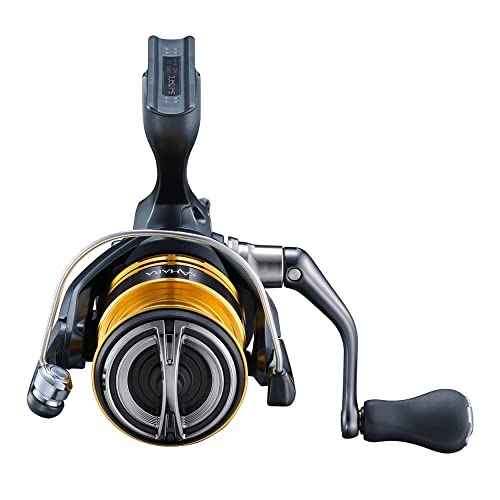
Shimano Sahara FJ 2500
Our default answer when someone wants one reel and no homework. Shimano builds the Sahara FJ on HAGANE cold-forged gearing and its G-Free Body, which Shimano says shifts the centre of gravity closer to the rod.
- Cold-forged gearing is the durability story at this price
- The 2500 is the single most versatile spinning size
- Shimano parts, schematics and service are easy to find
- About $104.99 as of September 2026, roughly twenty dollars over the NautiX
- Shimano publishes fewer headline numbers than the budget brands do

PENN Battle III
When fish pull hard and salt gets into everything, this is the pick. PENN states an all-aluminium body and sideplates, an HT-100 front drag with carbon fibre washers rated to a 15 lb maximum, and a 6.
- Metal body and sideplates resist flex when a fish loads the frame
- Line capacity rings machined into the spool show what you have left
- Named Best of Category for saltwater reels at ICAST 2020
- PENN's 15 lb maximum drag figure is lower than the budget picks claim
- An all-metal build carries more weight than a graphite freshwater reel

Shimano Stradic FL
The Stradic FL is the point at which you stop noticing the reel and just fish. Shimano builds it on a HAGANE metal body it says virtually eliminates body flexing, with X-Ship bearing support at both ends of the pinion gear and CrossCarbon Drag, which Shimano calls its smoothest drag performance.
- Supported pinion and metal frame keep gears aligned when a fish loads them
- Drag start-up is the whole reason to spend here, not a bigger drag number
- Shielded bearings are aimed at salt and sand exposure
- About $254.99 as of September 2026, well over twice the Sahara FJ
- Overkill if you fish a handful of weekends a year

KastKing Zephyr, 1000 Size
A dedicated ultralight for 4 to 8 lb line and lures down to a sixteenth of an ounce. KastKing states the 1000 size weighs about 7 ounces, carries up to 22 lb of carbon fibre drag, and uses a braid-ready CNC machined aluminium spool it says needs no mono backing.
- About 7 ounces by KastKing's figure, light enough for all-day trout water
- Braid-ready spool lip skips the mono backing step
- About $39.09 as of September 2026, down from a $45.99 list price
- A 1000 spool holds very little heavy line, so it is not a do-everything reel
- Graphite frame flexes more than a metal-framed ultralight
Compare The Field
| Compare | Best Budget Spinning Reel KastKing Spartacus II, 3000 Size | Best Spinning Reel Under $100 Piscifun NautiX, 3000 Size | Best All-Round Spinning Reel Shimano Sahara FJ 2500 |
|---|---|---|---|
| Overall | — | — | — |
| Price | $39.09 Check price → | $85.99 Check price → | $104.99 Check price → |
About The Author
Rob Thomas
Rob Thomas is a fisherman who loves catching tales from his fellow fishermen. He always enjoys a good story, especially when it comes from the sea.