How to Clean and Grease a Spinning Reel Without Wrecking It

This post may contain affiliate links. Read our policy.
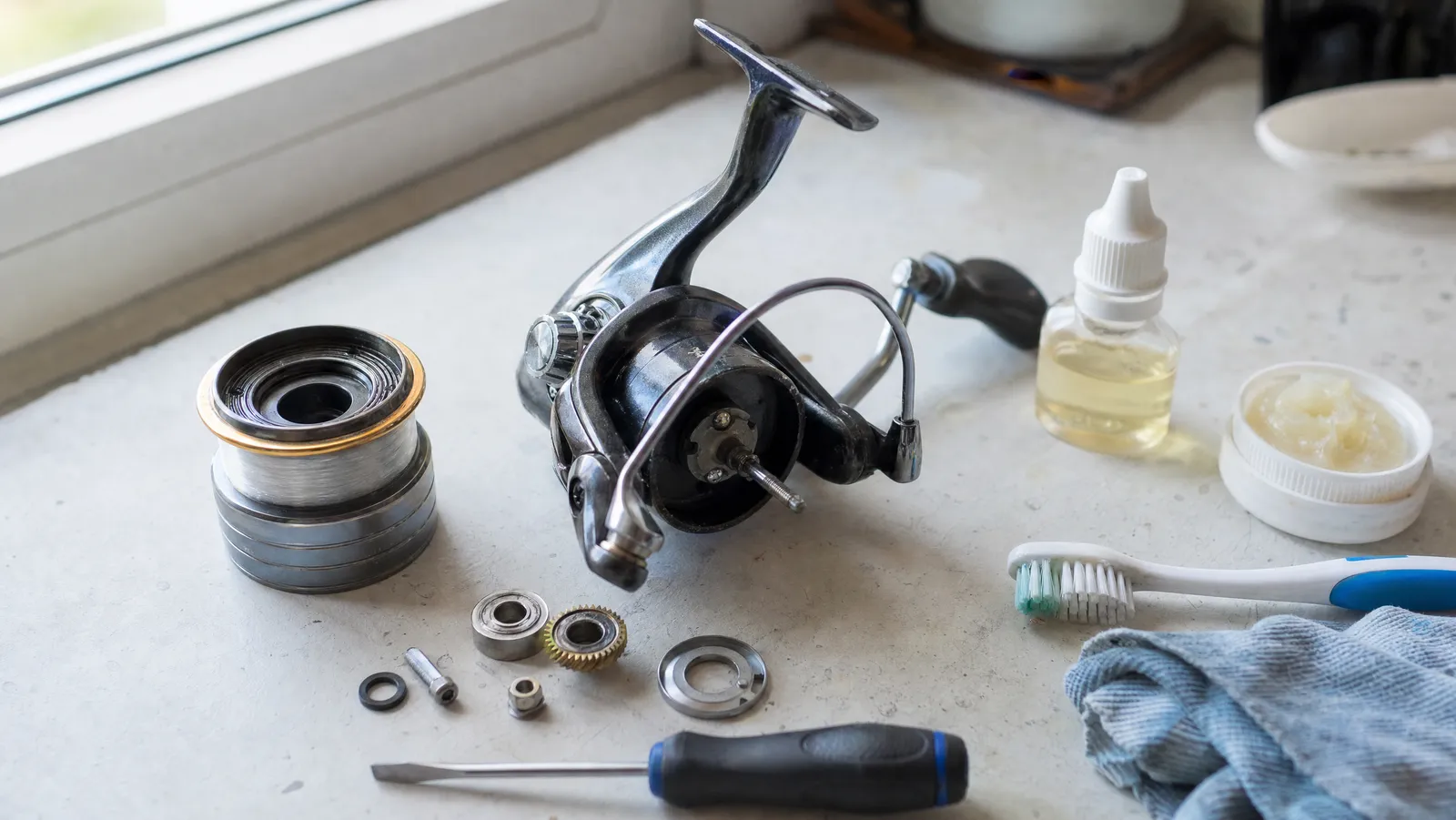
How to Clean and Grease a Spinning Reel Without Wrecking It
How to clean a spinning reel: back the drag off, rinse it with a light spray of fresh water, wipe it dry with a soft cloth, and leave it to air dry with the drag still loose. That is the whole after-trip job and it takes ten minutes. Oil and grease come afterwards, in single drops, in specific places.
The part most anglers get wrong is the rinse. Shimano's reel maintenance guidance says to rinse with cold fresh tap water but not to submerge the reel, and a repair technician quoted by Florida Sportsman puts it harder: hosing or dunking a reel forces water and salt inside, where it rusts the bearings. A hard jet of water is the most common way anglers push salt and grit past the seals instead of washing it off.
So this is not a deep clean. The goal is to move salt and sand off the outside without giving either a route in. If the words rotor, drag stack and oscillation gear are not familiar, how a spinning reel works is worth five minutes first. And if the reel in your hand is a candidate for replacement rather than rescue, our guide to choosing a spinning reel is the better read.
The ten-minute routine after every trip
Six steps, in order, with nothing in your hand more exotic than a cloth.
- Back the drag knob off until it turns with no resistance. Daiwa's maintenance FAQ says to loosen the drag right back so the washers are not left compressed, and to leave the reel out in the open for a final air dry in that state.
- Reel the line in and close the bail, wiping the line between finger and cloth as the last few metres come in.
- Rinse with a light spray or a damp cloth. A spray bottle, a misting nozzle, or a hose on a gentle flow, working top down. Do not aim anything at the drag knob, the handle shaft, or the seam where the rotor meets the body.
- Wipe it dry. A soft toothbrush reaches the bail arm hinge, the reel foot and the rotor seams where sand hides. Cotton buds do the line roller and the spool lip.
- Air dry upright, drag still loose, bail open, out of the sun and out of a sealed bag.
- Only when it is bone dry, add lubricant: one drop on the line roller, one on the handle knob, every few trips rather than every trip.
No stripping, no solvent, no screwdriver. Done after every saltwater session, that routine is most of what separates a reel still smooth at five years old from one that grinds at two.
Why you back the drag off before you rinse
A spinning reel's drag is a stack of washers squeezed together by spring pressure behind the knob. Tighten the knob and you clamp the stack. Leave it clamped while the reel sits wet in a garage and two things go wrong: water that did get in sits pressed against a compressed stack, and the washers take a set. The Tackle Room's maintenance guide warns that compressed drag washers can warp and lose smoothness over time, and Florida Sportsman recommends backing the drag off after each trip for the same reason.
There is a wrinkle worth knowing. Daiwa Australia's wash instructions actually have you snug the drag up during the wash, to keep water out of the stack, then back it right off for the dry and for storage. Both versions agree on what matters: the reel should not go into the cupboard with the drag tight.
Either way, reset the drag before you fish again. Our guide on how to set spinning reel drag covers the target figure and why most anglers run theirs too tight.
Oil or grease: how to tell which a part wants
You need two consumables and nothing else: a reel oil and a reel grease from any major maker. Which one goes where is a mechanical question, not a brand question.
Oil goes on parts that spin fast
Bearings, the line roller, the handle knob. These turn quickly under light load and need low friction, so they want a thin lubricant that does not resist rotation. Daiwa's maintenance FAQ lists those points, including the line roller bearing on a spinning reel, and warns that one drop is more than enough for each bearing and any more is waste. Shimano's guidance is the same shape: only a small amount of oil on metal-to-metal moving parts, and on reels with a maintenance port, a single drop every couple of trips.
Grease goes on parts that carry load slowly
Main gear teeth, the pinion, and the worm or oscillation gear that drives the spool up and down. These move slowly, carry real load, and need a film that stays put instead of running off. Daiwa recommends applying grease directly to individual parts with a small paintbrush rather than squeezing an unnecessary amount in from outside the reel body, and grease you cannot see is grease you cannot aim.
One drop, not a bath
Excess oil does not stay where you put it. It migrates, and the two places it reaches are the drag stack, where it destroys predictable friction, and the line, where it collects grit. Daiwa flags one route in particular: never put oil down the main shaft of a spinning reel, which it calls the most common cause of a slipping anti-reverse.
The three places grease must never go
Grease is a thick, sticky, grit-holding lubricant. That is the job. It is also why three parts of a spinning reel are the wrong home for it.
The drag washers, unless your maker says otherwise
A drag works by slipping at a predictable load, so predictable friction is the product. Pack the stack with a grit-catching paste and you change the number you set, unevenly. A Daiwa-focused service guide for the Saltiga warns against letting oil near the drag system with the spool off, on the grounds that it will effectively ruin the washers.
The caveat matters, because some makers do specify a greased stack. Penn's printed care instructions, as reproduced in reel manuals online, call for Penn's own reel grease in a thin even coat on main gears, drag washers and other moving parts. If your manual asks for that, use the product it names and nothing else. If it says nothing, leave the stack dry rather than improvise, and remember that going from a dry stack to a greased one changes the feel, so re-check the setting with a scale.
The bearings that should be oiled instead
A bearing packed with grease has been slowed down on purpose. Saltwater Sportsman's cleaning guidance notes that bearings and metal bushings deserve the attention precisely because they are where water and salt collect, and the answer to that is a thin lubricant that penetrates and displaces, not a plug of paste that traps whatever is already in there.
The inside of the line roller
Heavy grease in the line roller is a slow-motion failure: it attracts grit, stiffens in the cold, and eventually stops the roller turning. Mike's Reel Repair notes that line rollers are usually among the first parts to wear out because they are always in motion, and Outdoor Life's reel maintenance guidance attributes a seized roller to dirt and grit working inside it. One or two drops of oil is the whole treatment.
The line roller kills more reels than the gearbox
This is the part worth ninety seconds of your ten minutes. The line roller is meant to rotate as line passes over it. When it seizes, the line drags across one fixed point in the groove, which wears a flat spot into the roller and puts twist into the line on every retrieve. Field & Stream's line roller check describes the same mechanism: a roller that will not move easily chronically aggravates line twist, and Outdoor Life adds that a stuck roller lets braid cut a groove into the metal. Its fix is one most anglers can manage at the bank, which is to undo the single screw holding the roller, lift it off with its bushing or bearing, clean and dry it, then put it back with one drop of light oil.
The spin test takes two seconds. Flick the roller with a fingernail. It should turn freely and keep turning for a moment. If it is stiff or will not move, that is your next job. If you are already fighting twist, how to spool a spinning reel covers the other half of that problem, and common spinning reel problems works symptom by symptom through grinding, slipping and wind knots.
The field strip most anglers should stop at
Three or four times a season, go one level deeper. This needs a soft cloth, cotton buds, a soft toothbrush, a small flat-blade screwdriver if your drag knob takes one, and your two lubricants.
- Unscrew the drag knob and lift the spool off. Keep the washers from under the knob in order, laid out in a line on the bench.
- Wipe the spool shaft and the inside of the spool skirt. Sand collects here and grinds on the shaft every time the spool oscillates.
- Clean the line roller. Cotton bud and a dry brush in the groove. Spin test it before and after.
- Wipe the rotor, the bail wire and the bail arm hinge, working the bail through a few cycles to listen for grit.
- Lubricate. One drop of oil on the line roller, one on the handle knob. Nothing else unless your manual says where.
- Reassemble dry. Washers back in the order they came off, spool on, drag knob finger-tight, then backed off.
Stop there. The side plate and the gearbox are a different job: they need the schematic for your exact model and involve gear mesh you cannot eyeball. Shimano's own guidance recommends against opening the reel yourself and points you at a dealer for long-term maintenance. Daiwa is firmer about the worst case, advising that a reel fully dunked in saltwater be rinsed and then stripped and rebuilt by its service centre. A reel still under warranty is almost always better off going back to the maker than onto your kitchen table.
A full service also costs real money, and on some reels it approaches the price of a new one. Our roundup of the best spinning reels under 100 is a sanity check on what that money buys new, and spinning reel sizes explained will tell you whether the reel you are nursing was the right size for the job at all.
Saltwater versus freshwater cadence
Saltwater: rinse every trip, no exceptions. Salt crystallises as it dries, so it does not wait for you. Daiwa Australia advises washing gear after every outing with a light freshwater mist, and Shimano suggests stripping the line off now and again so salt cannot build up between line and spool, where it causes corrosion.
Freshwater: a wipe-down after each trip, a proper service a few times a season. Freshwater reels get a pass on salt, not on abrasives. Sand off a bank, dust off a boat carpet and grit off a gravel ramp are the freshwater equivalent of salt, and they do their damage mechanically rather than chemically.
Storing a reel between seasons
Dry, loose and indoors is the whole formula.
- Drag fully backed off. Boating Magazine's off-season routine has you strip the old line, pull the spool to clean the shaft, then replace the spool and back the drag completely off before the reel goes away.
- Dry before it goes away, and dry where it goes. Not a sealed hot car, not a damp bag, not a shed that sweats. Upright if you have the shelf space.
- Think hard about the line. On The Water's off-season guidance makes the case for stripping it: line left on the spool traps salt and moisture against the metal, which can corrode the spool and leave rough edges that then chew the next line you put on. Sunlight is the other argument for fresh line: UV exposure is widely reported to make nylon monofilament brittle, though braid spun from Dyneema fibres is generally held to tolerate it better.
If the reel is going away for a full season, plan on replacing the line rather than hoping. Does fishing line go bad covers how materials age in storage, and when you respool, the best fishing line for spinning reels narrows the choice. Our line capacity calculator tells you how much to buy.
Mistakes that turn a clean into a repair bill
- Pressure-washing or dunking. Both force water inside. The Tackle Room recommends a garden hose at moderate flow or a spray bottle for exactly this reason, and warns that high-pressure jets push salt in.
- Soaking the whole reel in solvent. Solvent does not know which lubricant you wanted to keep. It flushes the grease out of the gear train along with the dirt.
- Using WD-40 or another penetrant as reel oil. Penetrants are thin solvents built to creep and then flash off. On The Water's guidance warns against WD-40 specifically because it can strip grease out of a reel. It is not a lubricant for a gearbox.
- Packing every cavity with grease. More grease is not more protection. It is more grit, held in place.
- Oiling the drag stack by accident, which is what happens when you squirt oil down the main shaft and let it run.
- Over-tightening the handle or the drag knob. Finger-tight is all either needs.
- Reassembling a wet reel. Any water you close up inside is water that stays there. Patience is free.
What to do next
Tonight, pick the reel you fished most recently and run the six steps. Drag off, light spray, wipe, dry with the bail open and the drag loose. Then flick the line roller with a fingernail. Those two habits prevent most of the failures that send reels to a service shop.
Then put a seasonal service in the calendar: spool off, shaft wiped, roller cleaned and oiled, handle knob oiled, back together, drag reset with a scale. Leave the side plate to the people with the schematics.
A reel cleaned like this will outlast the rod it is bolted to. If you have decided yours is past saving, our complete spinning reel guide covers what to replace it with and which features are worth paying for in a reel that shrugs off salt in the first place.
About The Author
Rob Thomas
Rob Thomas is a fisherman who loves catching tales from his fellow fishermen. He always enjoys a good story, especially when it comes from the sea.