Common Spinning Reel Problems and How to Fix Them

This post may contain affiliate links. Read our policy.
Common Spinning Reel Problems and How to Fix Them
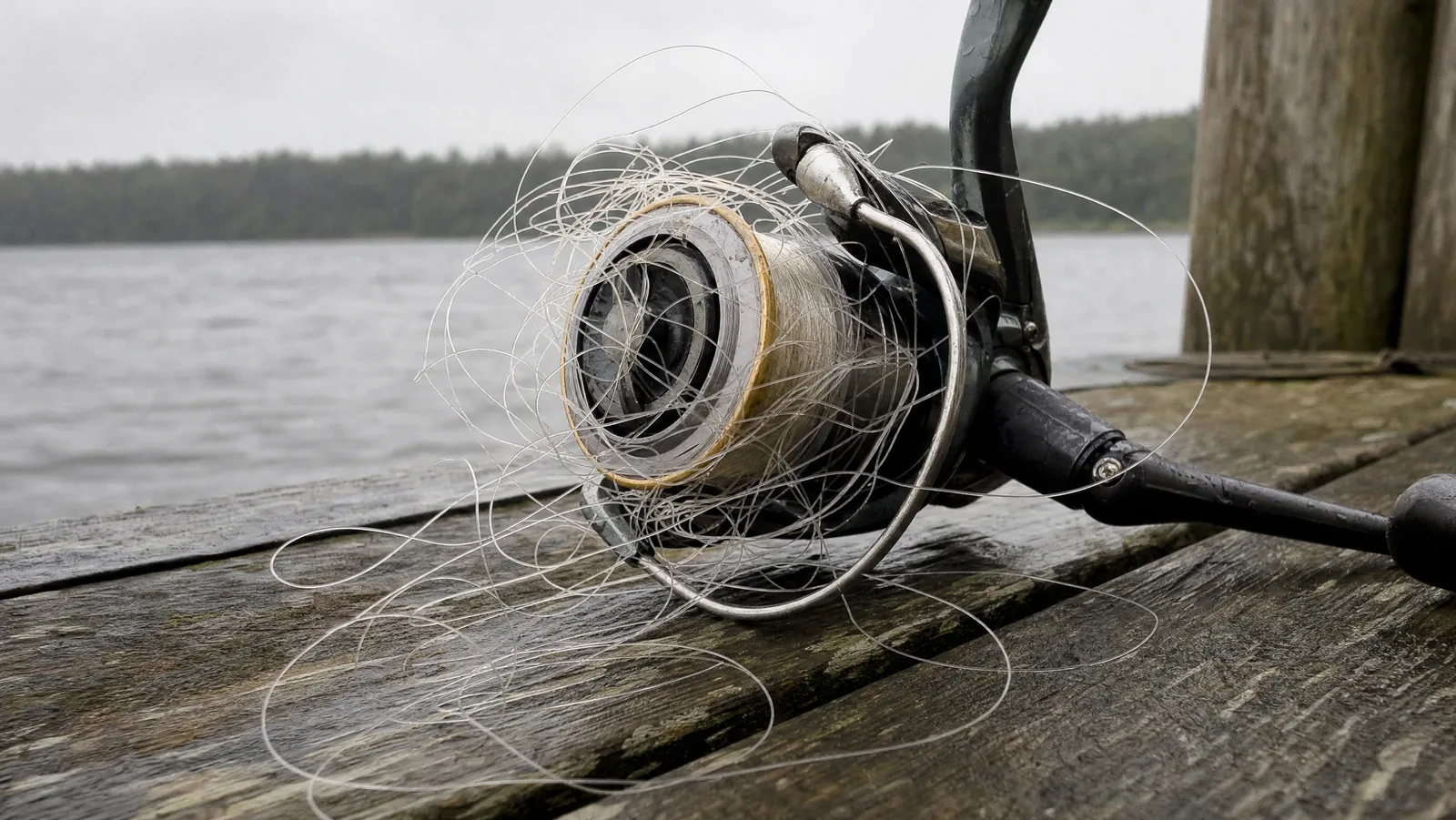
Most spinning reel problems are line problems, not reel problems. Line twist, an overfilled spool and a seized line roller account for the large majority of "my reel is broken" complaints, and all three are free or nearly free to fix at home. Only a minority of faults are actually in the gearbox.
The instinct is to assume the reel has worn out. Usually it has not.
Below is one section per symptom, each opening with the most likely cause, then the fix, then the point at which you should hand it to someone with a parts bin. If the words rotor, oscillation gear and drag stack are not familiar, our explainer on how a spinning reel works will help. And if the reel really is finished, our spinning reel buying guide covers what to replace it with.
Line twist, loops, and line coming off the spool in coils
The cause is almost always that line went onto the spool with twist in it, or is picking up twist every cast. The symptom is unmistakable: slack line that springs into corkscrews, loops that jump off the spool lip, a leader like old phone cord.
Four things put twist in:
- Reeling against a slipping drag. A fish takes line, you keep cranking, the rotor turns but the spool does not. Every one of those turns adds a full twist. Pump the rod and reel on the drop instead.
- A line roller that is not rolling. The roller lets line pivot onto the spool without dragging over a fixed surface. Field and Stream's spinning reel column suggests testing it with a toothpick to see whether it turns freely, and notes that a frozen roller chronically aggravates line twist.
- Spooling off the filler spool the wrong way. Zebco's spinning reel troubleshooting page says to make sure the supply spool feeds in the same direction the rotor turns. Get that backwards and you install twist, yard by yard, before you ever cast.
- A lure that spins without a swivel. Zebco recommends a ball-bearing swivel for in-line spinners specifically. Our fishing line leader guide covers rigging one so the twist dies at the swivel instead of travelling up the main line.
To get twist out of line already on the reel, let it out behind a moving boat or into current with no lure attached, then retrieve under tension. BassResource describes it as opening the bail, paying line out, then closing the bail and letting the water pull the twist out; Zebco gives the same advice for boat or river.
If the twist comes straight back, the line is the problem. Old monofilament holds the shape of the spool and fights you, and our piece on whether fishing line goes bad covers how to tell. Respool properly and the symptom usually disappears for the season; our walkthrough on how to spool a spinning reel has the tension-and-direction detail that prevents it.
Wind knots and tangles on the cast
More often than not, a wind knot means the spool is overfilled. Line sitting proud of the lip spills off in loose coils the instant tension drops, and the next coil traps it.
The commonly cited target is to stop filling about 1/8 inch short of the spool lip. Mercury Marine's spooling guide gives that figure and calls overfilling one of the easiest ways to cause problems on the cast; FishUSA's tutorial gives the same gap and ties overfilling directly to line slipping off and tangling. It is a rule of thumb, not a factory spec, so check your manual. To work out how much line a spool should hold in the first place, our line capacity calculator does the arithmetic.
Three other contributors:
- Line that is too stiff or has too much memory for a fixed spool. Heavy mono jumps off in coils. A limper line fixes it outright, and our roundup of the best fishing line for spinning reels is organised around that trade-off.
- Slack on the first crank after the cast. The first turn lays line on with whatever tension is in it, usually none. Pinch the line against the blank, take up the slack, then wind.
- Closing the bail by cranking the handle. It works, but the bail trips a fraction after the rotor starts turning, so the first wrap can land loose or outside the roller. Close it by hand.
Braid has no memory, which makes it excellent here, but it is thin and slick enough to dig into itself under load and to slip on a bare spool. Back it with mono or tape and keep the fill honest; our braided fishing line guide covers both.
The handle will not turn, or turns hard
Work through the cheap causes first; they are far more common.
The cheap causes
- Line jammed behind the spool or wrapped around the rotor shaft. Take the spool off and look. One wrap of braid behind the spool locks a reel solid and feels exactly like a seized gearbox.
- A drag knob wound down hard against a stack that has stuck together, which makes the handle feel heavy rather than the spool feel tight.
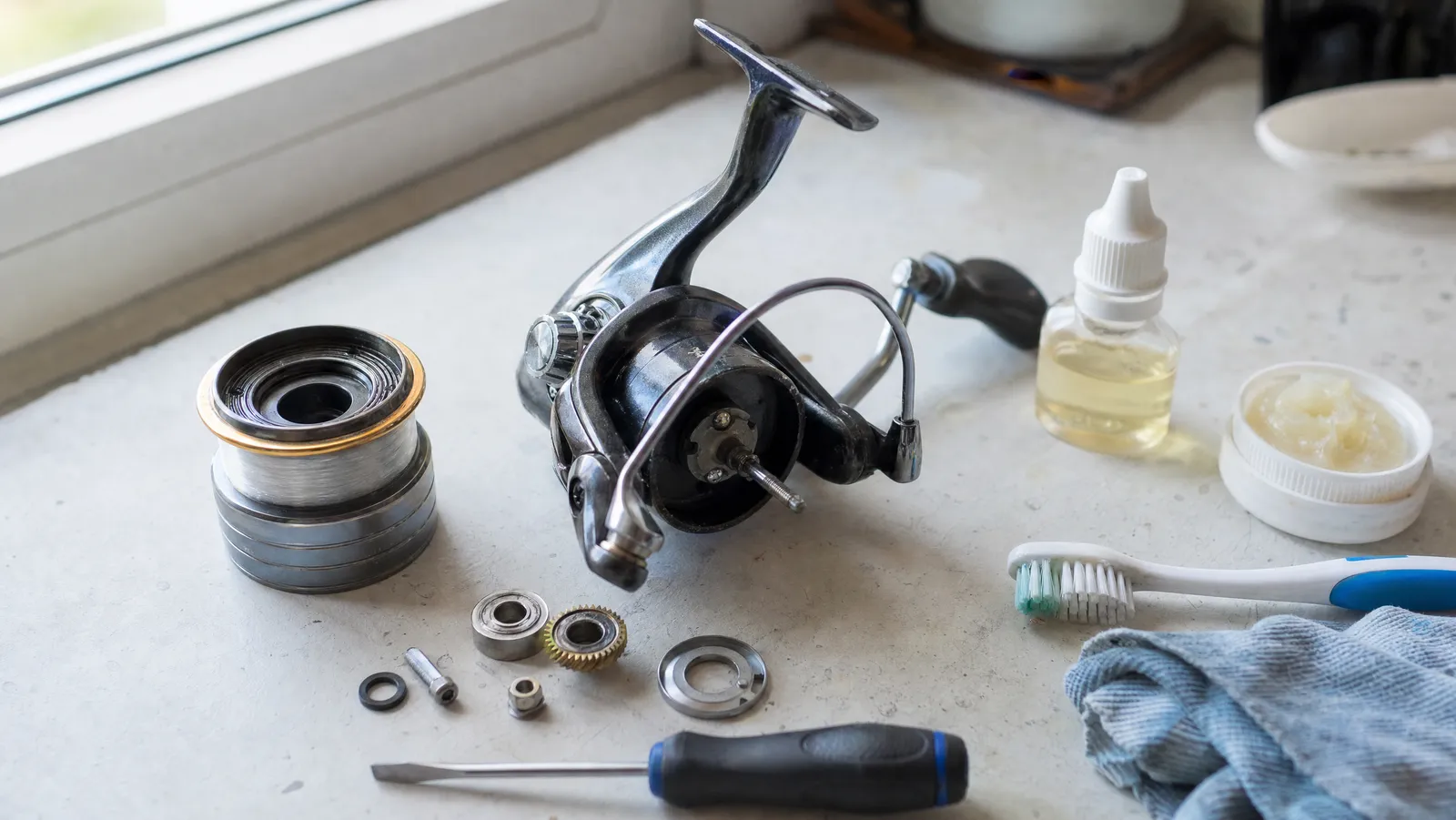
- Salt or sand in the rotor seam. Grit between rotor and body adds drag everywhere in the rotation. This is what the after-trip rinse prevents, and our routine for cleaning a spinning reel is a ten-minute job.
The real ones
If the reel is clean, the spool is off and the handle still fights you, you are looking at the gear train: a stripped or displaced main or pinion gear, a bent main shaft, or a failed bearing.
Here is the test that separates the two. Take the spool off, back the drag right off, and turn the handle slowly with no load. If it free-spins smoothly but goes gritty, tight or stepped the moment there is load on it, that is a gear-train symptom and a service-shop job. Do not force it. A displaced gear still mostly meshed can often be reseated by a technician; the same gear forced through another twenty turns loses teeth. Gear ratio has nothing to do with this, though our explainer on spinning reel gear ratio covers what the number does govern.
The bail will not close, closes on its own, or closes too early
The usual culprit is the bail spring, one of the cheapest parts in the reel. Repair guides list a spring that has broken or lost tension first among the usual causes of a bail that stops snapping shut, and the fix is a replacement ordered off the maker's parts diagram.
A quick check: lift the bail wire slightly out of the closed position and let go. If it snaps home, the spring is working and the problem is elsewhere. If it flops back and forth loosely, which reel forums describe as the giveaway for a broken spring, the spring is your answer.
The elsewhere, in order:
- Grit or line in the trip mechanism. Line wrapped around the bail arm post, or sand in the trip, physically blocks the arm. Clean it out and re-grease.
- Over-oiling the bail arm post. Reel-repair forums report that flooding the bail arm post with thin oil can let the bail close early, and that the fix is to clean it out and re-grease. Grease belongs there, not oil.
- A bent or misshapen bail wire. Zebco's troubleshooting page lists this as its own fault and recommends replacing the bail wire assembly rather than bending it back.
- A worn trip lever, also a replaceable part.
Worth saying plainly: a bail that snaps shut mid-cast is usually the trip mechanism, not your casting stroke. Shops do report healthy bails tripped by a snatchy cast, so try a smoother stroke first. If gentle casts do it too, the reel is at fault.
The drag slips in jerks, or will not loosen or tighten
A drag that grabs and releases in steps instead of sliding has a washer problem, and heat or storage usually caused it. The drag is a stack of washers clamped by spring pressure behind the knob, and it only works when every face slides evenly.
- Dry or glazed washers. Mike's Reel Repair, a long-running reel service shop, writes that neglected fibre washers dry out, run jerky and overheat. Once a face is glazed, cleaning rarely brings it back.
- The wrong lubricant, or lubricant where none belongs. Whether a stack should be greased depends on the design, and the maker's schematic is the authority. For carbon washers, repair forums are consistent that only a drag-specific, PTFE-based grease should be used, because general-purpose grease can leave carbon sticky.
- A knob bottomed out. If it will not tighten further, the stack is already fully compressed and you need a heavier drag, not a tighter knob.
- Washers that took a set in storage. Daiwa's maintenance advice is to back the drag right off so the washers are not left compressed between trips. A stack stored clamped all winter can come out with flat spots in it.
Fix the stack, then reset the number. Most anglers run their drags tighter than they need to; our guide on how to set spinning reel drag covers the target and how to measure it. Treat any drag figure as practice, not a guarantee: a stack that slipped smoothly in April may not in September.
A grinding, clicking or crunching noise
Rule out the noises that belong there. The drag clicker ticks when line pays out against the drag, and the anti-reverse clicks softly as it engages. Neither is a fault, though both can worry a new owner.
The noises that matter are grit in the gears, a dry bearing and a chipped tooth. To tell them apart with no tools: take the spool off, back the drag off, and turn the handle slowly through several full rotations, listening and feeling for a catch that repeats at the same point in the rotation. A repeating catch means a specific tooth or a specific bearing ball. A constant gritty hiss is more likely contamination throughout, which a clean and re-grease may cure. A dry bearing whines at speed rather than catches.
Contamination is worth attacking yourself. A repeating catch is not, and fishing on will take the rest of the tooth with it.
The handle turns backwards slightly before it bites
That back-play is the instant anti-reverse roller clutch, and it is a replaceable part. The clutch is a one-way bearing on the pinion that lets the rotor turn forward freely and locks the moment you stop the handle. Parts suppliers describe worn or contaminated clutches by exactly this symptom, intermittent backward slip or slop in the handle, and note it often shows up first in cold weather.
Two things before you order one. Suppliers warn that over-lubrication kills these bearings and that heavy grease does not belong in a roller clutch, so if yours started slipping right after an enthusiastic service, degreasing may be the whole fix. And note the old bearing's orientation before you pull it, check the inner spacing sleeve, and verify the part against your model's exploded diagram, since suppliers say part numbers are frequently superseded.
Line piles at one end of the spool
Uneven line lay is an oscillation problem, not a winding technique problem. The oscillation gear drives the spool up and down the shaft as the rotor turns. When it wears, or the spool sits at the wrong height, line stacks at one end and casting distance goes with it.
The adjustment most anglers do not know about is the shim stack. Many reels ship with a packet of thin washers that sit under the spool specifically so the line lay can be tuned, and the rule described consistently across tackle-shop guides and reel forums is simple: adding a washer raises the spool and pushes line toward the bottom; removing one lowers it and shifts line up. Change one washer at a time and test.
Two caveats. A reel that laid line evenly for years more likely has a seized roller, a bent bail or a badly tensioned respool than a shim problem. And braid and mono of the same rating fill a spool differently, so a stack tuned for one may be wrong for the other. If the lay stays bad across washers and lines, the oscillation gear is worn.
Corrosion: a reel that works fine and looks awful
Three things cause nearly all of it: salt left on after a trip, a reel locked in a hot car, and storage in a damp bag.
Surface corrosion on anodised and painted surfaces is mostly cosmetic. A white bloom around screw heads, the reel foot and the bail arm hinge is not, because that is the route inward. Shimano's reel care guidance is to use cold fresh water and not to submerge the reel, and the full after-trip routine is in our cleaning walkthrough. Store reels loose and dry, drag backed off, not in a zipped bag.
When to stop and send it in
Three questions.
Is it still under warranty? Shimano's warranty page describes a one-year warranty from the date of purchase to the original purchaser, requires a dated receipt from an authorised seller, and separates non-conformities in material or workmanship, which are covered, from normal wear, corrosion, misuse or accidental damage, which are repaired for a fee after an estimate. Shimano also notes that bearings are not covered. Terms differ by brand, so read your maker's current page rather than a forum post.
What will the service cost? Penn's repairs page lists a per-reel processing and handling fee of ten dollars plus the applicable labour, parts and shipping charges. Penn describes labour as a flat rate set by reel model, parts at its consumer price list, and shipping charged at UPS rates according to the weight, value and destination of the shipment. Get a written estimate before approving work.
Is the reel worth the quote? A bail spring, a line roller, a spool shim or an anti-reverse clutch is cheap on any reel and worth doing at almost any price point. A gearbox fault is different. Add the handling fee, parts and shipping and a twenty-five dollar reel with a stripped main gear is usually not worth a paid service — you will spend more than a working replacement costs. On a better reel the same repair is an easy yes, which is a decent argument for owning one reel you will service rather than three you will throw away.
If the quote comes back higher than the reel is worth, that is your answer, and our roundup of the best spinning reels covers what holds up over multiple seasons. Keep the old one for parts. A dead reel is a free bail spring and a free roller for the next one.
About The Author
Rob Thomas
Rob Thomas is a fisherman who loves catching tales from his fellow fishermen. He always enjoys a good story, especially when it comes from the sea.