Spinning Reel vs Baitcaster: Which One Belongs in Your Hand

This post may contain affiliate links. Read our policy.
Spinning Reel vs Baitcaster: Which One Belongs in Your Hand
Lure weight is the honest dividing line between a spinning reel and a baitcaster, not skill level. A baitcaster needs a lure heavy enough to spin a stationary spool up to speed. A spinning reel's spool never turns, so it throws light baits a baitcaster physically cannot. Pick by what you cast, not by how long you have fished.
The version you have read a hundred times — baitcasters for experts, spinning reels for beginners — is a habit, not a mechanical fact, and it falls apart on any tournament deck. Bassmaster credits Woo Daves with winning the 2000 Bassmaster Classic on spinning gear and reports he catches at least 90 percent of his tournament bass on spinning tackle. Nobody calls Woo Daves a beginner.
Here is the long version: what separates the two reels, which failure mode each hands you, and which we would buy first. Already decided and just want sizes and models? Go straight to our spinning reel guide.
The mechanical difference everything else follows from
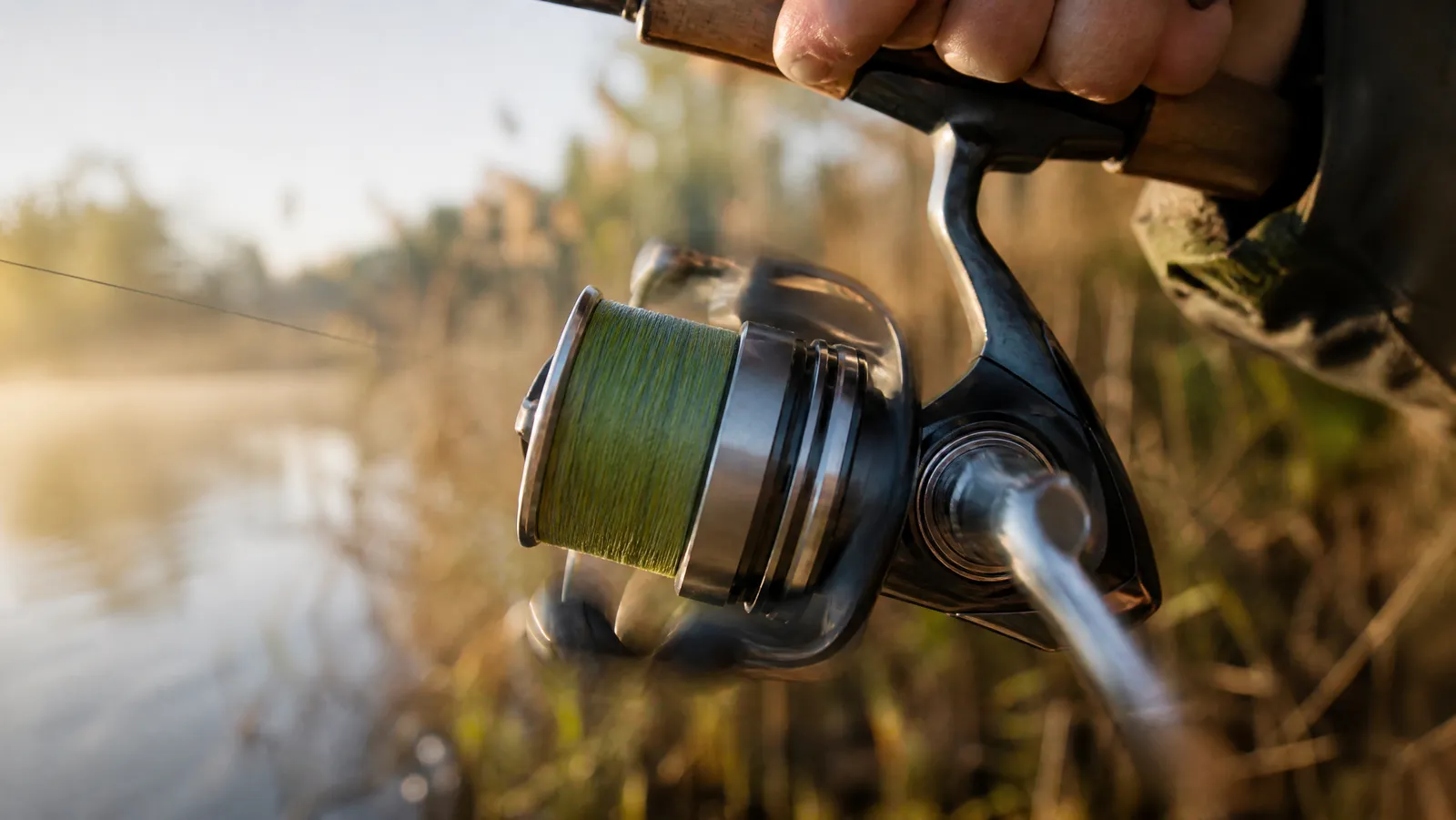
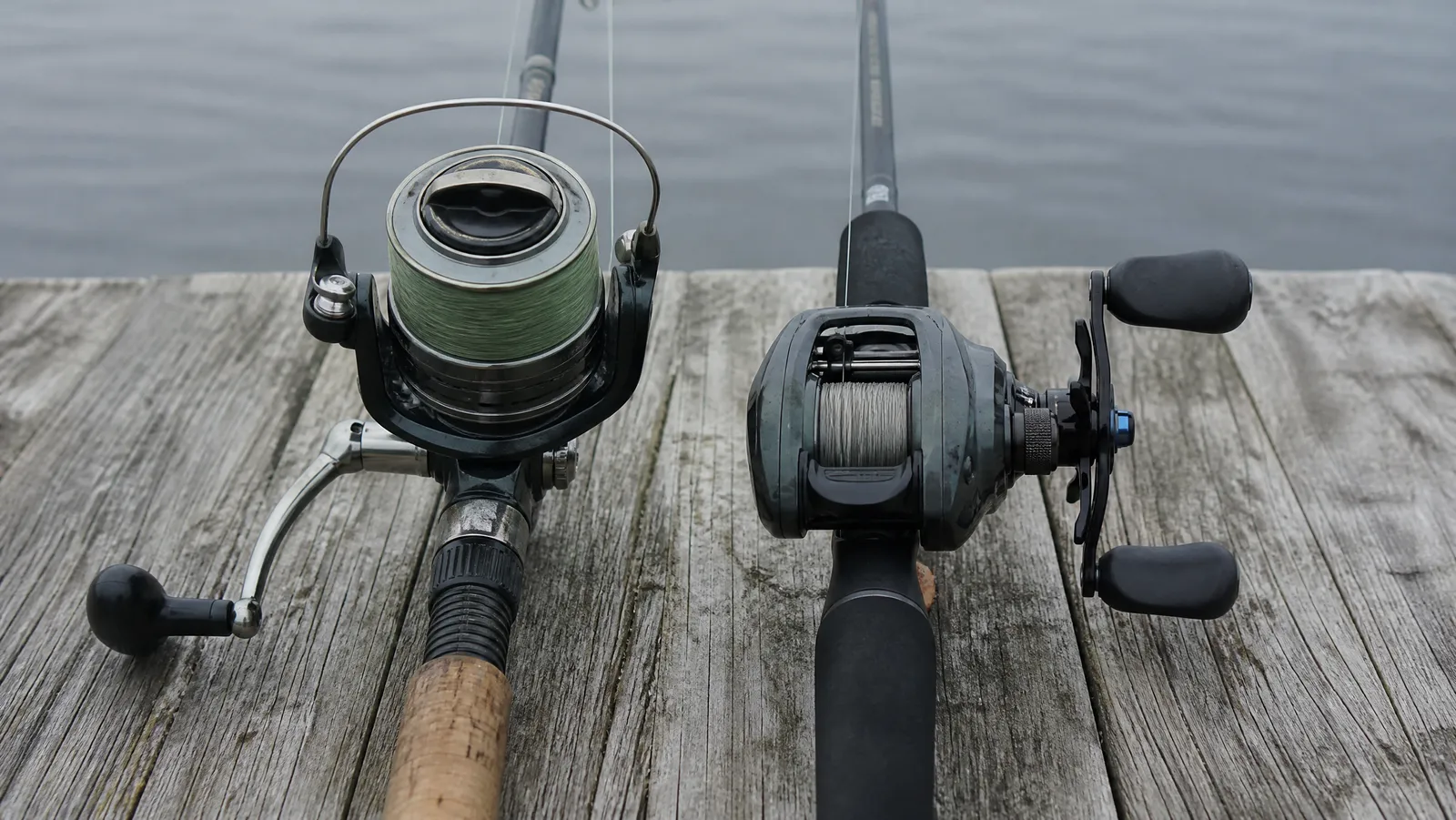
A spinning reel has a fixed spool that does not rotate when you cast. You open the bail, the lure flies, and line peels off the front lip in coils. On the retrieve, a rotor swings around the outside of that spool while a line roller lays line back on and the spool oscillates to spread it evenly.
A baitcaster has a revolving spool mounted crosswise, on top of the rod. During the cast that spool is connected to nothing but bearings. The lure's momentum pulls line off, and the tension in the line is what spins the spool up. Your thumb rides on it the whole time.
That one difference generates everything else on this page: backlash, the casting weight floor, line twist, cranking leverage, and where the reel sits on the blank. It is also why reel and rod get bought together — a casting rod puts guides and seat on top, a spinning rod hangs both underneath. See rod power and action for that pairing.
Why spool geometry sets the casting weight floor
To cast a baitcaster, the lure has to do work. It must accelerate a spool, a shaft and a set of bearings from a dead stop up to speed, and do it in the first few feet of the cast. That resistance is start-up inertia. A heavy lure carries enough momentum to overcome it and keep accelerating. A light lure does not: the spool never comes up to speed, the cast dies ten feet off the rod tip, and swinging harder just overruns the spool instead.
A spinning reel asks almost none of that. The spool is bolted in place, so the only resistance is friction — line slipping over the spool lip and through the guides. A 1/16 oz hair jig can supply that. It cannot supply the other.
Where is the floor? Outdoor Life's explainer on the two reel types notes that baitcasters historically "weren't capable of casting super-light lures" and calls spinning reels the "smart options for casting lightweight lures (especially on light lines)." Working anglers put numbers on it: in BassResource's long-running thread on baitcast lure weight limits, the consensus is that any modern baitcaster handles 3/8 oz without complaint, while 1/4 oz is roughly where a standard reel starts to fight you.
Check the weight printed on the baits you actually tie on before you buy a reel; our roundup of proven bass lures lists it for most of the usual suspects.
Backlash: what it is, and how long it takes to beat
Backlash is not clumsiness, it is a speed mismatch. The patent literature on anti-backlash braking puts it plainly: the trouble starts when the spool rotates faster at some point in the cast than the rate at which the lure is pulling line away from it. The spool pays out line nothing is taking, and the slack piles in as a bird's nest.
Two controls fight it. Mechanical spool tension, the knob on the handle side, sets baseline drag on the spool shaft. The brake — centrifugal weights or magnets — bleeds speed off during flight. Both are blunt: that same patent background notes conventional centrifugal and magnetic brakes are "applied without regard to the relative speed of the line being played out relative to the spool's rotation," which is why a setting tight enough to feel safe usually costs you distance.
Modern designs narrow the gap by attacking inertia instead of adding friction. Shimano's Finesse Tune Brake moves the braking unit off the spool into the side plate; TackleTour's review of the 22 Aldebaran BFS lists a 6-gram spool on that reel and reports the FTB system was tuned to cast baits down to 2 grams, roughly 1/16 oz.
The curve is real and measured in hours, not seasons: plan on an afternoon in a field with a 1/2 oz practice weight, brakes high and tension snug, before you cast without picking line out. Monofilament tends to be kinder than braid while you learn, which is why our baitcaster line guide puts mono first for a thumb still in training.
Line twist: the spinning reel's own failure mode
Each design has one annoying structural flaw. The baitcaster's is backlash. The spinning reel's is line twist.
Because the spool never rotates, line leaves it in coils, and every coil is a twist added to the line. The retrieve does not undo it — the rotor winds line back on the same way regardless. Add a bait that spins, an inline spinner, or a rig with no swivel and you compound it. Crank against a locked drag or a snagged hook and you add more, because the rotor keeps turning while the spool gives nothing back.
You feel it later as wind knots: loops that lift off the spool and jump through the guides on the next cast. Mystery Tackle Box names the biggest single trigger — "the number one cause of spinning tackle loops is when an angler reels to close the bail" — because cranking the bail shut does not guarantee the line seated in the roller. Close it by hand and tug the line tight instead.
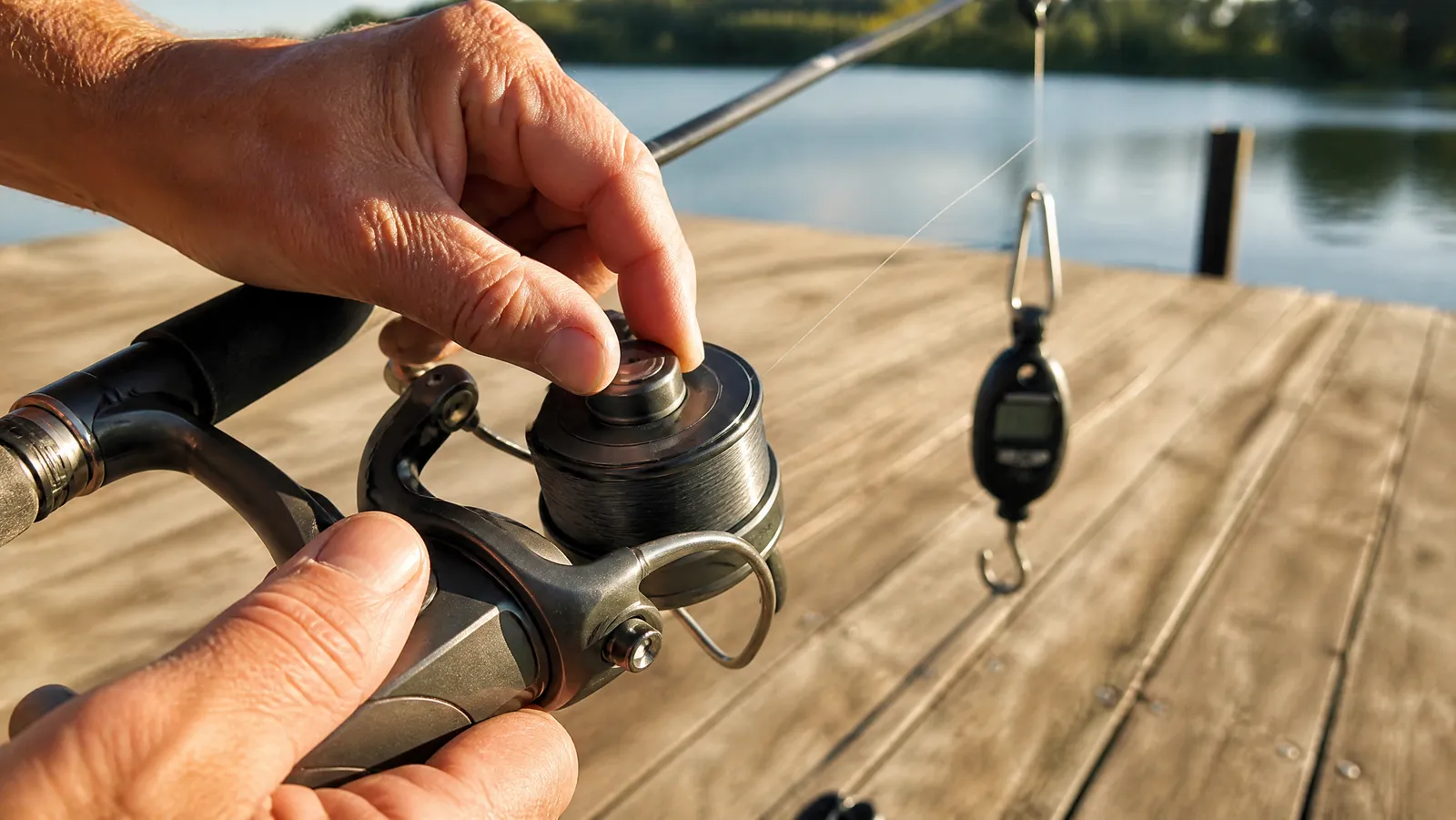
The rest is spooling. Load line so it comes off the filler spool the same way it goes onto the reel, keep firm tension through the fill, and stop short of the lip; our step-by-step on spooling a spinning reel runs the sequence. Line choice matters too, since limp braid and stiff fluorocarbon behave nothing alike on a fixed spool — see our spinning reel line guide.
Where the baitcaster wins
Cranking power and heavy line
On a baitcaster the handle sits close to the spool axis and drives it almost directly. On a spinning reel the handle turns a rotor that swings around the outside of a much larger-diameter spool, through a right-angle gear set. Less mechanical disadvantage means less strain in your hand when you are winching a fish out of a brush pile rather than playing it in open water. A narrow, deep casting spool also holds plenty of thick line in a reel that still sits in your palm, which matters at 17 to 25 lb fluorocarbon or 50 lb braid.
Outdoor Life notes that baitcasting reels "tend to be more widely-available in super-fast retrieves like 8:1 and 9:1." Spinning covers useful ground, but the extremes live on the casting side. If retrieve speed is the number you are trying to get right, our breakdown of spinning reel gear ratios explains what the figures buy you.
Accuracy, pitching and skipping
A thumb on a revolving spool is a brake you can modulate in mid-flight. Feather it and the lure stops dead where you aimed. Nothing on a spinning reel gives you that — you can cup the spool lip or close the bail, but both are on-off switches. That is why pitching a jig under an overhanging limb and skipping a bait down a dock walkway are casting-gear skills first.
Where the spinning reel wins
Light lures, and distance on light line
Below the baitcaster's floor there is no contest: spinning is the only one of the two that casts the bait at all. Above it, on light line, spinning still throws a long way, because thin line slips off a fixed spool with very little drag — exactly the condition finesse presentations fish in.
A spinning cast also has one variable — when you let go of the line — while a baitcast adds spool tension, brake setting and thumb pressure on top of it. Pros exploit all of that for jobs the catalogue files under casting tackle. Bassmaster reports John Crews flipping light worms on spinning gear, Tim Horton skipping floating worms with it, and Ken Cook pulling crankbaits on spinning rods with 8 to 10 lb line. Aaron Martens won a Major League Fishing event at Table Rock Lake on a drop shot fished on a spinning rod, according to Mystery Tackle Box, and collected a 100,000 dollar check for it.
What each one costs to own
Purchase price should not decide this. Both types have usable reels under 100 dollars and flagships several hundred above that. The ongoing cost differs.
- A baitcaster is pickier about line. Heavier mono and fluorocarbon behave best on a revolving spool, and braid tends to slip on a bare spool unless you back it with mono — two spools, not one.
- A spinning reel is pickier about replacement. Line twist means re-spooling sooner than you would like, and braid plus a fluorocarbon leader is the standard answer. Again two spools.
- Both want the same care. Rinse, dry, oil where the handle turns, and a drag you have measured rather than guessed. Our walkthrough on setting a spinning reel drag is worth ten minutes.
The decision guide, by what you actually fish
Put the reels down and name the five baits you tie on most. That list answers the question.
Reach for spinning when the day looks like this
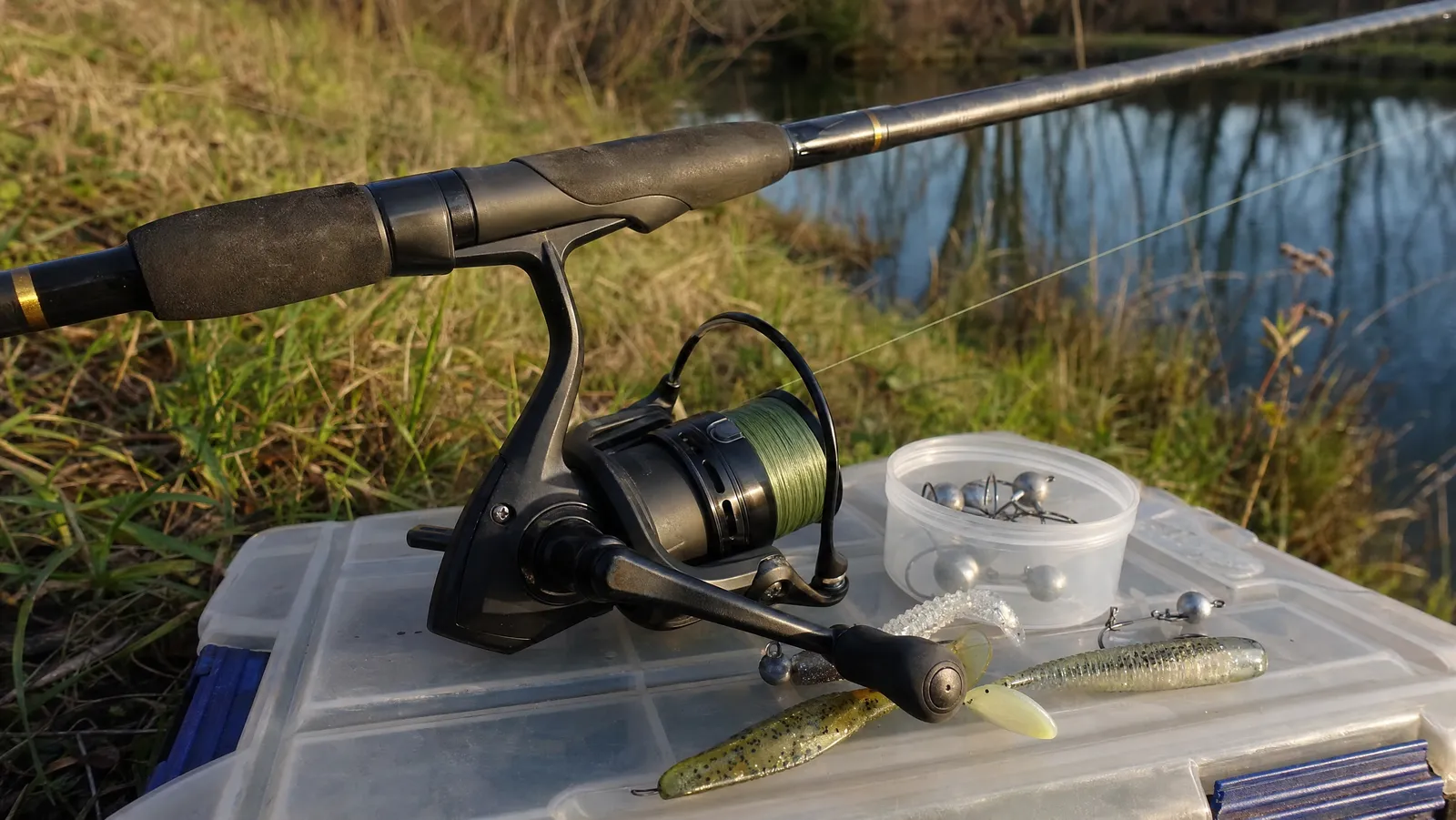
- Finesse plastics: shaky heads, Neko rigs, wacky-rigged stickbaits.
- Drop shot, where the weight is often 1/4 oz or less on 6 to 10 lb line.
- Light jigs and hair jigs under 1/4 oz.
- Trout and panfish on 2 to 6 lb line, including small spinners and spoons.
- Live bait and float rigs, where the bait weighs almost nothing by itself.
- Surf and inshore light tackle: long casts with light jigs and soft plastics.
- Any day you hand the rod to someone who has never cast before.
Reach for a baitcaster when the day looks like this
- Jigs from 3/8 oz up, especially pitched or flipped into cover.
- Big crankbaits and deep divers that load the rod hard on the cast.
- Frogs and heavy topwater worked over mats and pads.
- Swimbaits, bladed jigs and anything else with real mass.
- Flipping and pitching on heavy line, where accuracy is the presentation.
- Any situation where you have to turn a fish's head the instant it bites.
If you land on spinning and bass is your fish, our roundup of the best spinning reels for bass narrows it to sizes and models. If the size numbers are the confusing part, reel sizes explained decodes 1000 through 6000.
If you can only own one, buy the spinning reel first
Buy spinning — not because it is the beginner's reel, but because it is the one with no floor. A spinning reel will cast a 1/16 oz jig, and it will also cast a 3/4 oz swimbait: not beautifully, but well enough to fish. A baitcaster covers the top of that range brilliantly and cannot do the bottom at all.
The techniques spinning owns are also the ones that save bad days: drop shot, shaky head, small jerkbaits. Add a baitcaster second, as soon as your tray tips toward 3/8 oz and up.
The hybrid cases: BFS baitcasters and oversized spinning reels
The weight floor is a design constraint, not a law of nature, and both camps have pushed on it.
Bait finesse system reels — BFS — are baitcasters built specifically to lower it. The recipe is a very light, shallow spool, low-inertia bearings and a brake tuned for tiny baits. TackleTour's review of Shimano's 22 Aldebaran BFS describes a 4.7 oz reel with a 6-gram spool and 6 lb / 50 yd capacity, running the magnet-based FTB system Shimano tuned for baits down to 2 grams; the reviewer's lightest real-world casts were micro jigs and Ned rigs around 3 grams, just under 1/8 oz. Real engineering, and also a specialist purchase — small capacity, modest drag, and pricing that assumes you already own normal tackle.
Spinning scales the other way just as well: inshore and surf reels in 4000 to 8000 sizes run heavy braid and serious drag stacks, and plenty of saltwater anglers never pick up a casting reel. What a big spinning reel will not do is match a baitcaster's leverage when you have to haul a fish straight up through wood.
What does not decide this
- Your experience level. This is a weight class, not a skill ladder. Plenty of twenty-year anglers fish spinning most of the day because that is what their baits weigh.
- The species name on its own. "Bass" covers a 1/8 oz drop shot and a 2 oz glide bait. The technique decides, not the fish.
- Brand. Every major manufacturer builds competent versions of both. Choose the reel type by lure weight, then the brand you can get serviced.
The short version
Look at what you cast. If most of your baits are under 1/4 oz on line under 12 lb, a spinning reel is not a compromise, it is the correct tool. If most of your baits are 3/8 oz and up and your day is spent pulling fish out of wood and grass, the baitcaster earns its learning curve back in a weekend.
Most anglers end up owning both, and they are right to. Start with spinning, then add a casting reel for the heavy end when your tackle tray tells you to. Our full breakdown on choosing a spinning reel takes it from there — sizes, drag, gear ratios, and what we would actually spend.
About The Author
Rob Thomas
Rob Thomas is a fisherman who loves catching tales from his fellow fishermen. He always enjoys a good story, especially when it comes from the sea.