Best Fish Finders for Kayaks: Compact Units That Actually Fit

This post may contain affiliate links. Read our policy.
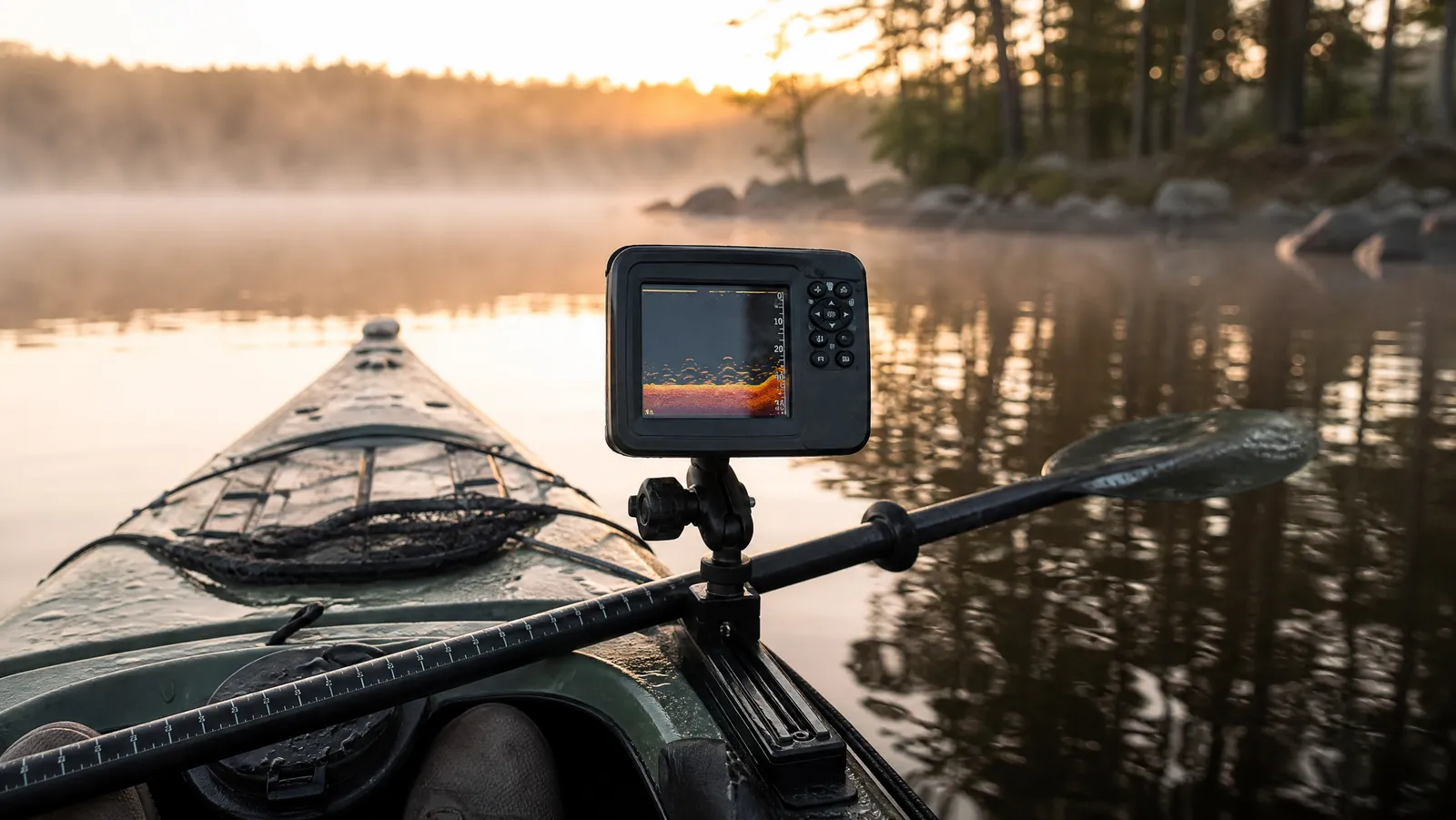

Garmin Striker 4
A 3.
- Lowest current draw in this group, which matters on a small battery
- Keyed buttons work with wet hands and gloves
- Built-in GPS waypointing at this price
- 3.5-inch screen is genuinely small
- No down-imaging view
- No sun cover included, and no kayak track mount — only transom and trolling-motor hardware
Best Fish Finders for Kayaks: Compact Units That Actually Fit
The best fish finder for kayak use is the Garmin Striker 4 at about $131 as of August 2026. It is a 3.5-inch CHIRP unit with GPS waypointing, and Garmin rates its current draw at 0.23 amps at 12 volts — low enough that a battery small enough to sit in a dry bag will outlast your shoulders.
Angler Reviews is reader-supported. We may earn a commission on purchases made through links on this page, at no extra cost to you.
Kayaks do not make sonar hard because they are small. They make it hard because there is no transom, no console, no 12-volt system, and no way to stand up and look straight down at a screen. Below are four head units and two mounts that solve those specific problems, plus the power and transducer arithmetic nobody prints on the box. If you want the wider framework first — frequencies, imaging, mapping, screen sizing — read our full guide to choosing a fish finder.
What Makes a Fish Finder Right for a Kayak
Four constraints, roughly in the order they will bite you.
- Deck space. You are not fitting a 7-inch screen between your knees and the front hatch on most sit-on-tops. Anything past 5 inches diagonal starts competing with rod tubes, a paddle, and your own legs.
- Current draw. There is no alternator. Everything the unit uses comes out of a battery you personally carried down the bank, so amps matter more than they do on a bass boat.
- Viewing angle. You sit low, and the screen usually ends up below your sternum and off to one side. A display that washes out off-axis or through polarized lenses is worse than a smaller display that does not.
- Mounting. No transom means the transducer needs a home — an arm, a scupper, or the inside of the hull — and the head unit needs a base that does not require drilling a hole in a boat you paddle.
Screen size is the constraint people fixate on, and it matters least as long as you can read what is on it. A 4-inch display shows the same sonar returns a 9-inch display does, just smaller — workable if you already know what an arch, a hard bottom, and a thermocline look like, frustrating if you do not. If sonar is new to you, spend an hour with how to read a fish finder before you spend $200 on a display. Interpretation is the skill that pays, not pixels.
How We Picked a Kayak Fish Finder
We weighted five things: published current draw, physical footprint, off-axis screen legibility, whether a transducer came in the box, and whether the unit could be rigged without drilling the hull. Price mattered, but only as a tiebreaker — a kayak unit that eats a battery by noon is not a bargain.
One note on method. We do not run a sonar lab, and we did not paddle each of these for a season. These picks come from manufacturer specifications, current pricing, and what kayak anglers consistently report about rigging and power. Where something is a trade-off, we say so.
It is also worth knowing what is happening above this tier. Bassmaster reported that B.A.S.S. will allow forward-facing live sonar in only up to five of the nine regular-season 2026 Elite Series events, chosen at random. Major League Fishing, announcing its own 2026 forward-facing sonar rules, limited anglers across its circuits to one continuous three-hour window of forward-facing or 360-degree sonar per competition day. Kayak anglers were rarely running live sonar anyway — but traditional 2D sonar reading, exactly what a $130 unit teaches, is the skill the top of the sport is being pushed back toward.
Kayak sonar is also not a separate, pricier category. The same $120-to-$200 band that wins our best fish finder for the money comparison wins here too; what changes is the hardware you bolt around it.
Garmin Striker 4: Best Overall for Kayaks
The Garmin Striker 4 is about $131 as of August 2026, down from a $159.99 list price, and it is our pick because it is the least demanding unit here on the two resources a kayak actually lacks: power and space.
Garmin rates the Striker 4 to 1,600 feet in fresh water and 750 feet in salt water, with a current draw of 0.23 amps at 12 volts, an IPX7 water rating, and a display measuring 1.9 by 2.9 inches. It runs traditional CHIRP sonar through a dual-beam 77/200 kHz transducer — this model has no ClearVu down imaging, which is what the 4cv adds — and has high-sensitivity GPS for marking waypoints.
That current-draw number is the whole argument. At 0.23 amps, an eight-hour day costs you roughly 1.8 amp-hours, which means even a very small 12-volt pack finishes the day with most of its capacity untouched. Nothing else on this list is that forgiving.
Two more kayak-specific wins. The interface is keyed buttons, not a touchscreen, which is what you want with wet hands or gloves — capacitive screens and spray do not get along. And GPS waypointing means the brush pile you found in July is still findable in November, which matters more on a kayak, where you cover less water and revisit the same spots.
The compromises are real: a 3.5-inch screen is genuinely small once you split it, there is no down-imaging view, and while Garmin lists a tilt/swivel mount in the box, there is no sun cover and nothing that bolts to a kayak accessory track, so budget for rigging hardware.
Who we point here: almost every kayak angler buying their first sonar, and anyone running a small battery who does not want to think about it.
Lowrance Eagle 4X: Best Screen for a Narrow Deck
The Lowrance Eagle 4X is $121.37 as of August 2026 — the cheapest head unit here — and it solves a problem the others do not even acknowledge: screen orientation.
It runs a 4-inch IPS panel in portrait orientation with true-scroll sonar. Lowrance describes the display as sunlight-readable and viewable through polarized sunglasses, and lists the Eagle 4x as a sonar-only unit with no GPS, no charts, and no networking, rated to a maximum depth of 500 feet. Lowrance says the included Bullet Skimmer transducer delivers wide-angle sonar that doubles the coverage of most standalone fish finders.
Turning a 4-inch panel on its end gives back an inch or more of lateral deck width, which on a kayak is the difference between a mount that clears your paddle stroke and one that does not. The IPS part matters just as much. You almost never look at a kayak-mounted screen straight on — it sits low and to one side — and IPS panels hold contrast off-axis where cheaper TN panels wash out.
The twist-lock connector is a quiet advantage too: the unit comes off the mount in seconds, which is how you avoid leaving $120 of electronics on a car roof rack overnight.
What you give up is waypointing. No GPS means no marking, no returning, no track. For an angler who fishes one small lake and already knows it, that is a fine trade. For anyone exploring new water, it is not.
Who we point here: narrow-hulled kayaks, budget rigs, and anglers who fish familiar water and just want depth, bottom, and fish marks they can actually see.
Garmin Striker Vivid 4cv: Best Step-Up
The Garmin Striker Vivid 4cv is $199.99 as of August 2026, roughly $70 more than the Striker 4, and it buys two things a kayak angler will actually use.
The first is ClearVu down imaging alongside CHIRP traditional sonar, delivered through the included GT20 transducer, on a 4-inch color display with vivid scanning sonar color palettes. The second is built-in Quickdraw Contours mapping, which records your own depth contours as you move. The head unit weighs 11.2 ounces and, according to Garmin, ships with a tilt/swivel mount plus transom and trolling-motor hardware — none of which, on any unit here, is a kayak track mount.
Quickdraw is the underrated half. Kayaks get onto the small, unmapped, no-ramp water that never made it onto a commercial chart — the mill pond, the strip pit, the river stretch below a low bridge. Paddle one methodically twice and you own a chart nobody else has.
The costs: the GT20 is a bulkier transducer to hang on a kayak arm than the Striker 4's, the screen is still only 4 inches, and $70 is $70.
Who we point here: anglers who fish unmapped water, or who want down imaging to tell a stump from a school without stopping.
Humminbird PiranhaMAX 4: Simplest Setup
The Humminbird PiranhaMAX 4 is $135.76 as of August 2026, and it is the unit to buy if you want depth and fish marks without learning a menu system.
Humminbird's product page lists DualBeam sonar at 200 kHz with a 28-degree beam and 455 kHz with a 16-degree beam, 2,400 watts peak-to-peak power, and a depth capability of 600 feet. The wide beam is for searching, the narrow beam is for looking hard at one thing, and switching between them is one button rather than a submenu.
It ships with a tilt-and-swivel mount and the XNT 9 28 T transom-mount transducer, so the box contains a working system. That is the appeal and also the catch: a transom-mount transducer needs an adapter arm on most kayaks, because your kayak does not have a transom. Plan on pairing it with the Scotty arm below.
There is no GPS and no imaging view. This is a depth-and-fish unit, and it is honest about that.
Who we point here: anglers who want the shortest possible path from box to water, and who fish somewhere they do not need to mark waypoints.
Fish Finder Mount for Kayak: Display Mount vs Transducer Arm
These are two different jobs, and conflating them is the most common rigging mistake we see. A display mount holds the head unit where you can see it and reach it. A transducer arm puts the transducer in the water at the right depth and angle, and gets it out of the way when you launch. Most kayaks need both, and most kits sell them separately.
The HITORHIKE Track Mount Base Set is $24.98 as of August 2026 and handles the display side without touching a drill. It T-bolts into a standard kayak accessory track, holds fish finders up to 9 inches, and is listed as compatible with Garmin, Lowrance, Humminbird, Raymarine, Furuno, and Simrad units. It is built from DuPont nylon for marine use, with a reinforced arm and a locking 360-degree ball head.
That ball head earns its keep. Glare on a low screen is constant in a kayak, and rolling the display a few degrees to kill a reflection is worth more than another half-inch of diagonal. The whole assembly comes off at the ramp in seconds.
Two caveats. You need an existing accessory track — no track, no T-bolt — and nylon flexes more than aluminum when you are punching into chop. Arm configuration also varies by kit, so read the listing for the set you order.
The Scotty 141 Transducer Mounting Arm is $31.03 as of August 2026, down from $33.99, and covers the other half. Scotty says the 141 telescopes from 11.5 inches to 18 inches, swivels 360 degrees, is built from high-strength composite that will not corrode, and includes the 438 gear-head track adapter. Scotty also notes you can drop a post-mount fishfinder mount on top of it, which means the display and the transducer can share a single post — the tidiest small-deck solution there is.
The swing-up ability is the part that keeps the arm alive. You launch with it folded, drop it once you are in a foot of water, and swing it back up before you slide onto gravel. Left down, an over-the-side transducer is the first thing to find a rock. Note that the Scotty slide track and the universal sounder mount are sold separately, and that composite is not as rigid as aluminum.
A fish finder for a canoe is the same problem with less hardware to work with, since canoes rarely have factory accessory tracks. The HITORHIKE base is listed as working on kayaks, canoes, and larger boats, but confirm you have a track or a flat gunwale surface to bolt to before you order.
If none of this appeals — if you paddle rentals, a packraft, or a borrowed canoe and refuse to rig anything permanent — look at portable fish finders instead. You give up GPS and screen quality and get back a system that lives in one dry bag.
Powering a Kayak Fish Finder Without Guessing
Do the arithmetic once and you never worry about it again. Garmin rates the Striker 4 at 0.23 amps at 12 volts. Over an eight-hour day that is about 1.8 amp-hours. Add margin for cold weather, an aging pack, and the fact that you should not routinely drain a battery flat, and call it 3 to 4 amp-hours of real capacity per day.
Every unit on this list is in the same neighborhood, but not every manufacturer publishes a draw figure. When one does not, assume it is worse than the Striker 4 and size up.
Weight is the variable that actually changes your day. Dakota Lithium says its 12-volt 10Ah LiFePO4 pack weighs 2.77 pounds, about 60 percent lighter than a comparable sealed lead-acid battery, and rates it for up to 2,000 cycles while still holding 80 percent of capacity. At the Striker 4's 0.23 amps, 10 amp-hours is roughly 40 hours of runtime on paper — which, against 1.8 amp-hours a day, is a season of Saturdays between charges.
Three rigging habits worth adopting:
- Fuse the positive lead close to the battery, not at the unit.
- Keep the battery low and centered, ideally behind the seat in a sealed box. Weight up high on a kayak is stability you gave away for nothing.
- Assume water gets in. Dielectric grease on the connector and a dry box around the pack cost almost nothing and prevent the most common failure.
We will cover fish finder batteries on their own — lithium versus sealed lead-acid, box options, and how to build a fused pigtail — in a separate guide.
Through-Hull, Scupper, or Over the Side?
Where the transducer goes decides what your screen shows. There are three practical answers on a kayak.
Shoot-through-hull means bonding the transducer inside the hull so it fires through the plastic. Nothing hangs in the water, nothing snags, nothing drags on a gravel bar. The costs are a permanent installation, some signal loss through the hull, and unreliable water-temperature readings, since the sensor never touches water. Trapped air under the puck will also ruin the signal, which is why people bed these in epoxy or gel rather than tape.
Scupper mounting drops the transducer through an existing scupper hole so it sits just below the hull, with no drilling required. It is the cleanest no-commitment option on a sit-on-top. The trade-off is placement: kayak rigging guides generally call for the transducer to project at least an inch below the bottom of the hull, so in very shallow water it may be the first thing to find rock or sand. Some scupper mounts recess the transducer inside the tube to protect it, so check how far the one you buy actually hangs down.
Over-the-side on an arm — the Scotty approach — is the most flexible and the most exposed. You get full water contact, accurate temperature, easy access for cleaning weed off the face, and the ability to swing the whole thing up in two seconds. You also accept a little drag and an arm that lives in the path of one paddle stroke.
Our default: if you launch off rock, fish skinny water, or move between boats, use the arm. If you mostly fish open water and want a deck with nothing on it, shoot through the hull. Scupper mounts are the middle path and a good first attempt for anyone who is not ready to epoxy anything.
We will go deeper on fish finder transducers — cone angles, frequency choice, and cable routing — separately, because the transducer, not the head unit, is where most disappointing sonar images come from.
The Bottom Line
For most kayak anglers the answer is the Garmin Striker 4 at about $131, a HITORHIKE track base at $24.98, and a Scotty 141 arm at $31.03 — call it a little under $190 as of August 2026 for a complete, no-drill rig, plus a battery. That combination gives you CHIRP sonar, waypoints, a screen you can angle out of the glare, and a transducer you can swing clear of the launch.
From there the choices are simple. Take the Lowrance Eagle 4X at $121.37 if deck width is your binding constraint and you do not need GPS. Take the Garmin Striker Vivid 4cv at $199.99 if you fish unmapped water and want Quickdraw Contours and down imaging. Take the Humminbird PiranhaMAX 4 at $135.76 if you want the fewest possible decisions between the box and the water. All prices are as of August 2026.
Buy the mount and the arm at the same time as the unit. The single most common kayak sonar story we hear is a good head unit sitting in a garage for a month because the rigging hardware was an afterthought.
Still weighing sonar types, screen sizes, and mapping before you commit to anything? Start with the Angler Reviews fish finder guide, then come back and pick the mount.
The Picks, Tested
Garmin Striker 4
A 3.5-inch CHIRP fishfinder with GPS waypointing and a built-in flasher, small and light enough to live on a kayak track mount.
- Lowest current draw in this group, which matters on a small battery
- Keyed buttons work with wet hands and gloves
- Built-in GPS waypointing at this price
- 3.5-inch screen is genuinely small
- No down-imaging view
- No sun cover included, and no kayak track mount — only transom and trolling-motor hardware

Lowrance Eagle 4X
A 4-inch IPS unit that runs in portrait orientation, so it takes up less lateral deck space than a landscape screen of the same size.
- IPS panel stays readable off-axis, which is how you actually view a kayak-mounted screen
- Portrait layout fits a narrow deck better than landscape
- Twist-lock connector is easy to break down between trips
- Sun cover sold separately
- No GPS or waypointing
- Traditional sonar only

Garmin Striker Vivid 4cv
A 4-inch color unit that adds ClearVu down imaging and Quickdraw Contours mapping to the Striker formula, at 11.2 ounces.
- Down imaging plus traditional sonar in one small head unit
- Quickdraw Contours lets you map an unmapped pond as you paddle
- Bail mount is included, unlike most units here
- Roughly $70 more than the Striker 4
- GT20 transducer is bulkier to mount on a kayak arm
- Still a 4-inch screen

Humminbird PiranhaMAX 4
A dual-beam sonar unit that ships with a tilt-and-swivel mount and a transom-mount transducer, aimed at anglers who want depth and fish marks without menus.
- Narrow beam for detail, wide beam for coverage, switchable on the fly
- Mount is in the box
- Very short learning curve
- No GPS
- Transom-mount transducer needs an adapter arm on most kayaks
- No imaging views

HITORHIKE Track Mount Base Set
A T-bolt track mount with a locking ball head and transducer arm options, sized for displays up to 9 inches.
- No holes in the hull
- Ball head lets you angle the screen away from glare
- Comes off at the ramp in seconds
- Requires an existing accessory track
- Nylon flexes more than an aluminum arm in chop
- Transducer arm configuration varies by kit
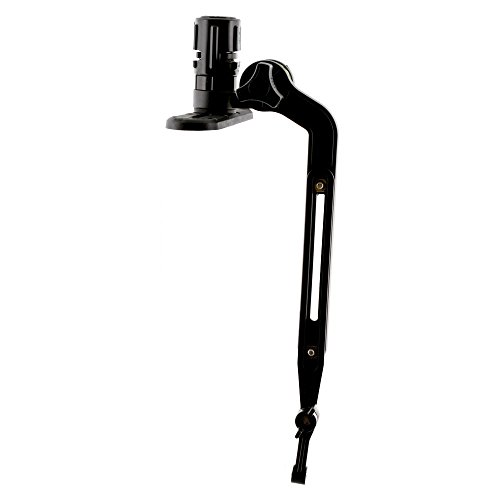
Scotty 141 Transducer Mounting Arm
A telescoping composite arm that puts a transducer over the side of a kayak or SUP and swivels out of the way for transport.
- Swings up out of the water for launching and landing
- Telescoping length suits both narrow and wide hulls
- Stacks a display mount on the same post
- Scotty slide track and universal sounder mount are sold separately
- Over-the-side transducers are exposed to strikes in shallow water
- Composite arm is not as rigid as aluminum
Compare The Field
| Compare | Best Overall for Kayaks Garmin Striker 4 | Best Screen for a Narrow Deck Lowrance Eagle 4X | Best Step-Up Garmin Striker Vivid 4cv |
|---|---|---|---|
| Overall | — | — | — |
| Price | $130.99 Check price → | $121.37 Check price → | $199.99 Check price → |
About The Author
Rob Thomas
Rob Thomas is a fisherman who loves catching tales from his fellow fishermen. He always enjoys a good story, especially when it comes from the sea.