Portable and Castable Fish Finders: Sonar From the Bank

This post may contain affiliate links. Read our policy.
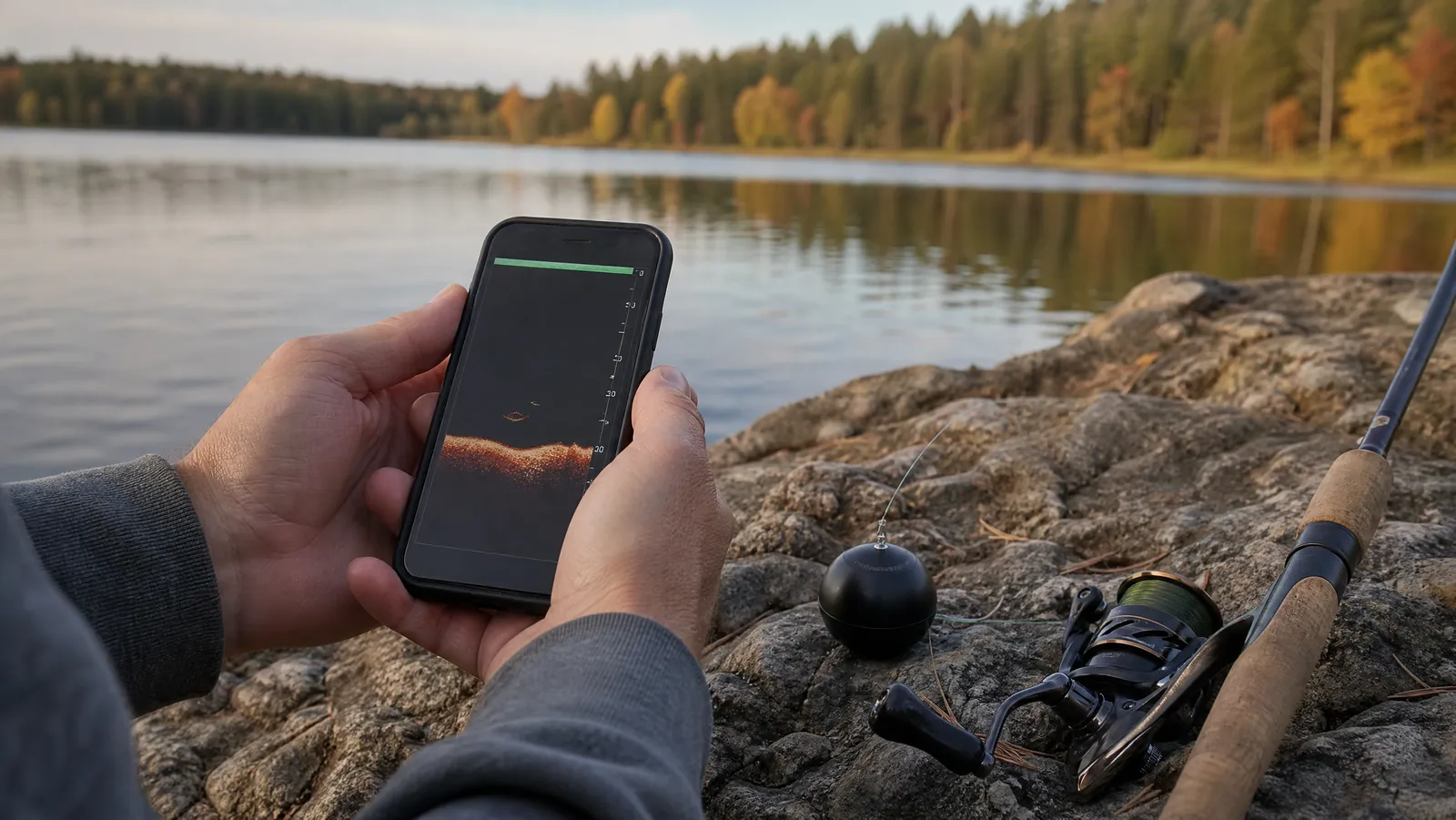

Garmin Striker Cast
A castable sonar ball that streams traditional 2-D and flasher sonar to a phone from up to 200 feet away.
- Flasher mode makes it usable through the ice as well as from the bank
- Water-activated power switch means you rarely kill the battery by accident
- Garmin app support is more actively maintained than most in this category
- No built-in GPS on this version
- Your phone is now the screen, in the rain
- 200-foot range is shorter than the surf-casting crowd wants
Portable and Castable Fish Finders: Sonar From the Bank
A portable fish finder is sonar you can carry: either a castable float you tie to your line and reel back, or a wireless sensor paired to a small handheld screen. It exists so bank, dock, and ice anglers can see depth, temperature, and structure without a boat, a battery box, or a transducer mount.
Angler Reviews is reader-supported. We may earn a commission on purchases made through links on this page, at no extra cost to you.
The six units below run from $72.99 to $159.99 as of August 2026. That is a narrow price band hiding two very different tools, and picking the wrong one is the most common mistake we see. If you want the full framework — frequencies, screen sizing, mounting, mapping — the Angler Reviews guide to fish finders covers it. This article is about the case where there is nothing to mount a transducer to.
Two Kinds of Portable Fish Finder
Every unit in this category is one of two things. Get this split right and the rest of the decision is easy.
- App-based castables. A floating sonar pod with a Wi-Fi or Bluetooth radio inside. You tie it to 20-pound braid on a spare rod, cast it, and it streams sonar to your phone. Your phone is the screen, the settings menu, and the map. Examples here: the Garmin Striker Cast, Deeper PRO+ 2, and ReelSonar iBobber.
- Two-piece handhelds. A wireless sonar float plus a dedicated color LCD you hold in your hand or hang on a lanyard. No app, no pairing, no software updates, and no phone sitting on a wet rock. Examples here: the Venterior Portable Fish Finder, LUCKY FF718 Portable Fish Finder, and DANOPLUS Portable Fish Finder.
Castables are also the no-rigging answer for paddlers, which is why they overlap heavily with our best fish finder for kayak picks: nothing gets drilled, nothing gets glued into the hull, and the whole kit fits in a dry bag with room left over.
The trade is straightforward. App-based units give you a big, bright, high-resolution display you already own, plus real mapping. Two-piece handhelds give you a screen that does not care about rain, cold, or a dead battery at 2 p.m.
How We Picked
We do not run a sonar lab, and we are not going to pretend otherwise. These picks come from manufacturer specifications, current pricing, and the failure patterns anglers consistently report in this category. Four things drove the ranking.
- Honest range, both kinds. Wireless range (how far from you the pod can float) and depth range (how far down it reads) are different numbers, and cheap listings blur them. We list both.
- Cone width. A wide cone covers more water per cast but muddies detail. A narrow cone does the reverse. This matters more on a castable than on a boat unit, because you only get one look per retrieve.
- What happens when it rains. A phone-only system has a single point of failure, and it is the device you also need for maps, photos, and the drive home.
- Price against the alternative. Portable does not automatically mean cheaper — the Garmin Striker 4 with GPS and CHIRP is listed on Amazon at $130.99 as of August 2026, which lands in the middle of this same band and actually undercuts our two top castables. That is why we keep a separate list of the best fish finder for the money. If you have a hull, buy the hull unit. If you do not, keep reading.
App-Based Castables: The Phone Is the Screen
These three are the reason the category exists. They stream real sonar returns — not a cartoon fish icon — to a screen with enough resolution to show you the difference between a hard bottom and a soft one.
They also share one weakness worth naming up front. Apple states that iPhone and iPad are designed to be used where the ambient temperature is between 32 and 95 degrees F, and that using the device in very cold conditions outside that range may temporarily shorten battery life and can cause the device to shut off. That is a real constraint in February, and it is the single best argument for the handheld units further down this page.
Garmin Striker Cast: Best Overall Castable
The Garmin Striker Cast is $149.99 as of August 2026 and it is the castable we recommend first, mostly because the software behind it is maintained by a company that sells marine electronics for a living.
Garmin lists a wireless range of up to 200 feet, 10-plus hours on the internal USB-rechargeable battery, and both traditional 2-D and ice fishing flasher sonar modes in the free STRIKER Cast app on Apple or Android. It powers on when it is floating in water and off when you take it out, which is a small feature that quietly solves the most common castable complaint: arriving at the lake with a dead pod.
It will also download Quickdraw Community maps with contours as fine as 1 foot, so you can see a lake's shape even though this version has no GPS receiver of its own.
What you give up: no built-in GPS on this model, a 200-foot range that surf casters will find short, and the phone-as-screen problem in bad weather. Who it is for: the pond, dock, and river-bank angler who wants one pod that also works through the ice.
Deeper PRO+ 2: Best for Mapping From Shore
The Deeper PRO+ 2 is $159.99 as of August 2026 — the most expensive unit here — and the extra money buys one specific capability: it maps.
According to Deeper, the PRO+ 2 holds a stable connection up to 100 meters (about 330 feet), scans down to 100 meters with a minimum range of 15 centimeters, and offers three beams: a 7-degree narrow beam at 675 kHz, a 20-degree mid beam at 240 kHz, and a 47-degree wide beam at 100 kHz. Deeper rates the battery at up to 9 hours and says it reaches an 80 percent charge in 45 minutes. Target separation is 0.4 inches on the narrow beam and 1 inch on the wide and mid beams.
The important spec is the built-in GNSS receiver, which Deeper says supports GPS, GLONASS, Galileo, BeiDou, and QZSS. Because the pod knows where it is, fan-casting a stretch of bank builds a real bathymetric map in the Fish Deeper app. That is how you find the one 12-foot hole in a shoreline that reads flat from the parking lot.
It also runs its own Wi-Fi rather than Bluetooth, which holds up better at distance.
What you give up: the highest price in this group, faster phone-battery drain over Wi-Fi, and mapping accuracy that depends entirely on how consistently you cast. Who it is for: the shore angler who fishes the same three banks all season and wants to learn them properly.
ReelSonar iBobber: Lightest Castable
The ReelSonar iBobber is $89.99 as of August 2026, down from $99.99, and it is the one you can throw on the rod you already have rigged.
It reads to 135 feet, runs 10-plus hours on a charge, and connects over Bluetooth to an iOS or Android app that tags fish icons with depth and color-codes them by size. There is a fish alarm and a strike alert, and it works in fresh or salt water, from shore or on ice.
Weight is the argument. A heavy pod needs a heavy rod, and a heavy rod is not what you brought to the dock. This one casts on light tackle without turning the trip into a chore.
What you give up: a 135-foot depth range that is the shallowest here, shorter Bluetooth range than the Wi-Fi units, and no GPS or mapping at all. Who it is for: dock and pier anglers, and anyone who wants sonar as a second thought rather than a second rod.
Two-Piece Handhelds: A Screen That Is Not Your Phone
The next three units pair a sonar float with their own small color LCD. They show fish as size icons rather than raw sonar returns, which is less informative, and their screens are a fraction of a phone's resolution.
They also do not care that it is 20 degrees F, that it is raining sideways, or that you forgot to charge your phone. For a lot of bank fishing, that is the better deal.
Venterior Portable Fish Finder: Best Standalone Screen
The Venterior Portable Fish Finder is $87.99 as of August 2026 and it is the most complete of the two-piece systems.
The wireless sensor reaches the handheld from up to 262 feet, which beats every Bluetooth castable here, and it reads from 2.6 to 164 feet deep through a 105-degree sonar beam. The display shows depth, water temperature, fish size, fish depth, and bottom contour, and you can flip the background between black and white for night or bright sun. Two small holes in the sensor let you tether it to your line and cast it like any other float. It carries a 2-year warranty.
The white-background mode deserves a mention. Small LCDs wash out at noon, and having a high-contrast option is the difference between reading the screen and guessing at it.
What you give up: resolution far below a phone display, two devices to keep charged, and fish rendered as icons instead of arches. Who it is for: the angler who fishes in weather and does not want a $900 phone balanced on a rock.
LUCKY FF718 Portable Fish Finder: Longest Wireless Range
The LUCKY FF718 Portable Fish Finder is $82.89 as of August 2026 and it claims the longest reach in this group by a wide margin: 492 feet of wireless operating range with the handheld's antenna extended.
It pairs a 2.4-inch TFT color LCD with a sonar float that detects to 147 feet, and it offers both a wireless mode and a simulation mode so you can learn the menus on the couch. For the price, the settings list is deep: adjustable sensitivity, brightness, depth range, zoom, depth alarm, and fish alarm. The float also carries a fish attractive lamp under a transparent cover.
Battery life is the asterisk. The handheld runs about 4 hours per charge while the sonar sensor lasts 10, so the screen dies first on a long day.
What you give up: that 4-hour handheld runtime, an antenna you have to remember to extend, and a fish-attracting lamp we would treat as marketing rather than a proven feature. Who it is for: anglers working long jetties, wide flats, and anywhere a 200-foot cast is not enough.
DANOPLUS Portable Fish Finder: Budget Pick
The DANOPLUS Portable Fish Finder is $72.99 as of August 2026, the cheapest complete sensor-plus-screen package here, and it does not feel like a toy.
You get a 2.4-inch color LCD with 21 operating languages, 147-foot depth detection, and a 90-degree sonar coverage angle. The rechargeable sensor and its lamp power on when they touch water, and the screen shows a fish-size icon with depth, water temperature, depth reading, and bottom contour, plus a fish alarm.
That 90-degree cone is worth a second of math. Humminbird's transducer guide puts approximate coverage at depth multiplied by 2.00 for a 90-degree cone, depth multiplied by 1.00 for a 60-degree cone, and depth multiplied by 0.35 for a 20-degree cone. In 10 feet of water, a 90-degree cone is looking at a circle roughly 20 feet across — plenty for finding a drop-off, too coarse for telling two crappie apart.
What you give up: the smallest screen here, less water covered per cast than the 105-degree units, and unbranded support if it fails. Who it is for: the angler testing whether portable sonar is worth it at all.
The Honest Limits of Castable Sonar
Castable sonar answers one question extremely well — what is under this spot right now — and several other questions badly.
You only see where the pod is. There is no forward view, no live arrow tracking your jig, none of the real-time picture that has reshaped tournament fishing. That technology is also getting reined in at the top level: Bassmaster reported that B.A.S.S. announced forward-facing sonar will be permitted in only up to five of the nine regular-season 2026 Elite Series events, chosen at random, with the 2025 restrictions of one live sonar transducer and a maximum of 55 total screen inches remaining in place. Nothing in this price range does what those rules are restricting.
Cast range is your search radius. A 200-foot pod means a 200-foot circle around wherever you can stand. Steep banks, brushy shorelines, and heavy current all shrink that number in practice.
The returns still need reading. A castable does not interpret anything for you. Arches, bottom hardness, thermoclines, and bait balls look the same on a phone as they do on a console unit, so how to read a fish finder is the skill that makes any of these purchases pay off.
Power is a two-device problem. The pods here run 9 to 10-plus hours, but your phone will not, especially over Wi-Fi with the screen at full brightness in the sun. Carry a power bank. If you are shopping for a boat setup instead, fish finder batteries are a separate decision entirely, and a much bigger one.
A mounted unit still wins on a boat. Continuous scanning while you idle, a screen you can split, GPS waypoints, and a transducer at a fixed depth beat a pod you have to reel in every 90 seconds. Portable sonar is not a downgrade — it is a different job.
Ice Fishing and Dock Use: Where Portables Are the Right Answer
Two situations make a portable the correct buy rather than the compromise buy.
Through the ice. Drop a pod in a hole and you have a flasher. The Garmin Striker Cast includes an ice fishing flasher mode outright, and the iBobber is rated for ice use. Deeper's own support guidance is worth following whatever brand you buy: drill the hole vertically, because angled holes cause bad readings and blind spots; drill a larger hole when the ice is thick so the sonar cone does not reflect off the sides; keep the hole free of slush, ice, and snow, since even small debris creates false returns; and let the pod sit upright, centered, and free-floating.
Docks, piers, and jetties. This is the most underrated use. Tie the pod off, let it sit, and watch depth and temperature all afternoon while you fish. A fish alarm — the iBobber, LUCKY, and DANOPLUS all have one — turns a static rod into a monitored one.
The same logic covers rented jon boats, farm ponds you walk into, and any water where a launch is a mile of gravel road away.
Which Portable Fish Finder Should You Buy?
If you want one recommendation, take the Garmin Striker Cast at $149.99 as of August 2026. Real 2-D sonar, a flasher mode for winter, 10-plus hours of battery, and an app from a company that will still be updating it in three years.
Spend the extra $10 on the Deeper PRO+ 2 only if you plan to map — the built-in GNSS is the whole reason it costs more. Go to the ReelSonar iBobber at $89.99 if light tackle and pocket size matter most.
If your fishing happens in weather, skip the phone entirely. The Venterior Portable Fish Finder at $87.99 is the best-rounded handheld, the LUCKY FF718 at $82.89 buys the longest reach, and the DANOPLUS at $72.99 is the cheapest honest entry into the category.
None of these replaces a console unit, and none of them needs to. They answer the question a bank angler actually has, which is where the bottom drops and how warm the water is. If that turns out to be a habit rather than an experiment, the next step up is the same one every boat owner faces, and our full guide to picking a fish finder is where that decision starts.
The Picks, Tested
Garmin Striker Cast
A castable sonar ball that streams traditional 2-D and flasher sonar to a phone from up to 200 feet away.
- Flasher mode makes it usable through the ice as well as from the bank
- Water-activated power switch means you rarely kill the battery by accident
- Garmin app support is more actively maintained than most in this category
- No built-in GPS on this version
- Your phone is now the screen, in the rain
- 200-foot range is shorter than the surf-casting crowd wants
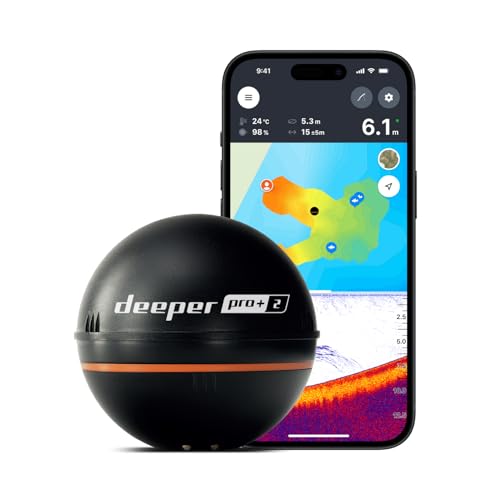
Deeper PRO+ 2
A three-beam castable with its own Wi-Fi and built-in GPS, which lets it build bathymetric maps of a bank you can only reach on foot.
- Onboard GPS is the reason to pay the premium: you can map from the bank
- Three beam widths cover both scanning and vertical detail
- Wi-Fi link is more stable than Bluetooth at distance
- Most expensive castable here
- Wi-Fi mode drains a phone battery quickly
- Mapping accuracy from shore depends on your casting consistency

ReelSonar iBobber
A small Bluetooth sonar bobber with depth-tagged fish icons, a fish alarm, and a strike alert, aimed at dock and bank anglers.
- Small and light enough to cast on light tackle
- Fish alarm is genuinely useful for dock fishing
- Lowest price of the app-based units here
- 135-foot depth range is the shallowest in this group
- Bluetooth range is shorter than Wi-Fi units
- No GPS or mapping

Venterior Portable Fish Finder
A wireless sonar sensor paired with its own color handheld display, so your phone stays dry in your pocket.
- Dedicated screen means no phone in the rain and no app to update
- 262-foot range beats most Bluetooth castables
- White background mode is genuinely readable in bright sun
- Screen resolution is far below a phone display
- Two devices to keep charged instead of one
- Fish are shown as size icons, not raw sonar returns

LUCKY FF718 Portable Fish Finder
A handheld with a 2.4-inch color LCD and a wireless sonar float rated to 492 feet of operating range, with an antenna you pull out on the handheld.
- Longest claimed wireless range in this group by a wide margin
- Deep menu of sensitivity and alarm settings for the price
- Simulation mode lets you learn the interface on the couch
- Handheld battery only lasts about 4 hours
- Antenna must be extended manually to get the rated range
- Fish attractive lamp is a marketing feature, not a proven one

DANOPLUS Portable Fish Finder
The cheapest complete sensor-plus-screen package here, with a 2.4-inch color LCD and a 90-degree sonar cone.
- Lowest price for a complete two-piece setup
- Sensor powers itself on when it touches water
- Narrower 90-degree cone gives a slightly tighter read than the 105-degree units
- Narrower cone also means less water covered per cast
- Unbranded support if something fails
- Screen is the smallest here
Compare The Field
| Compare | Best Overall Castable Garmin Striker Cast | Best for Mapping From Shore Deeper PRO+ 2 | Lightest Castable ReelSonar iBobber |
|---|---|---|---|
| Overall | — | — | — |
| Price | $149.99 Check price → | $159.99 Check price → | $89.99 Check price → |
About The Author
Rob Thomas
Rob Thomas is a fisherman who loves catching tales from his fellow fishermen. He always enjoys a good story, especially when it comes from the sea.