Ice Fishing Fish Finders and Flashers: Reading the Hole

This post may contain affiliate links. Read our policy.
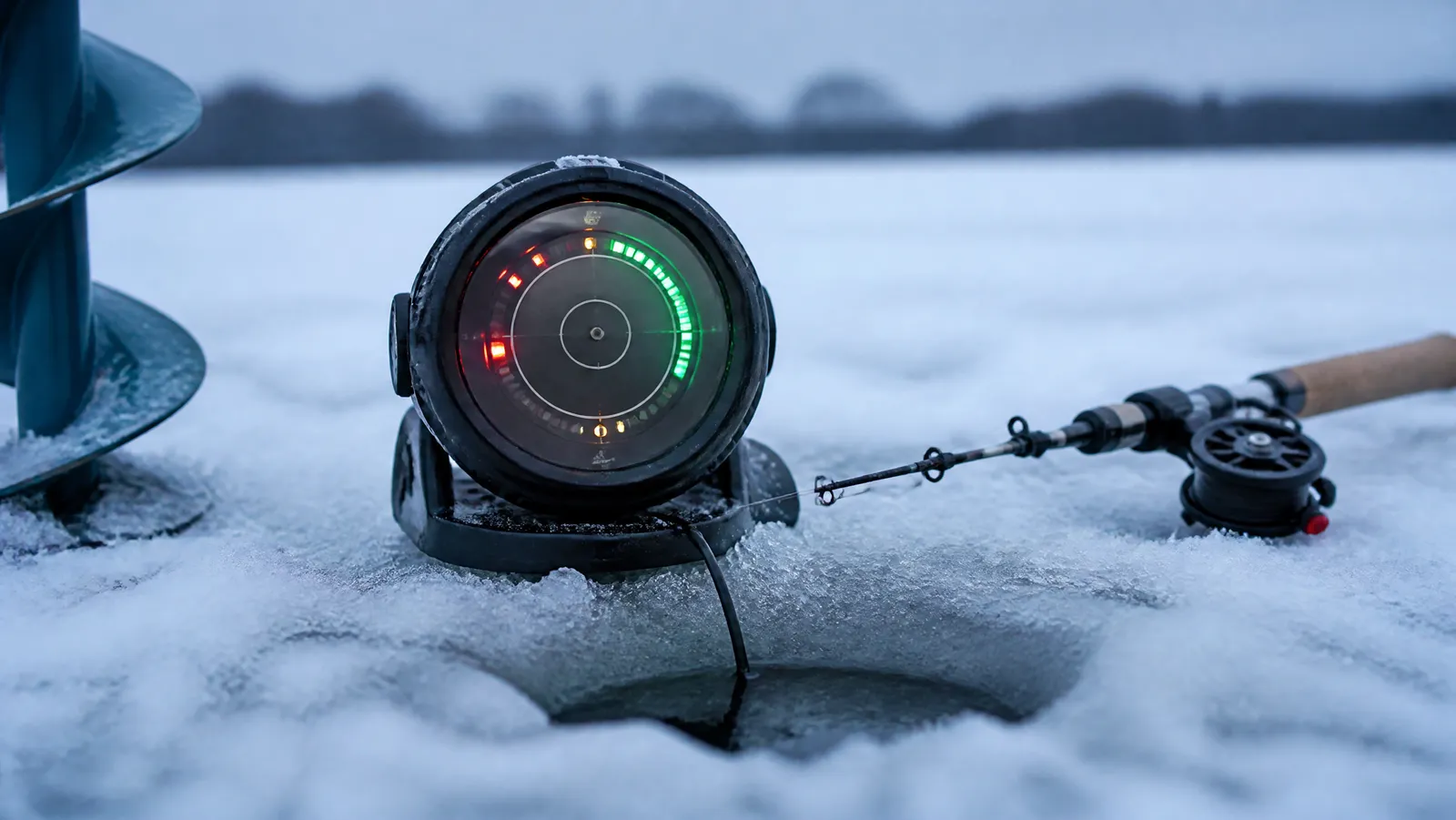

Vexilar FLX-18 ProPack II
The flasher most serious ice anglers end up on: high and low power modes, twenty interference-rejection settings, and a sunlight-readable three-color display in a carry pack.
- 20 interference rejection settings is the deepest cross-talk defense in this group
- Low power mode keeps shallow and weedy water readable
- Three-color LED readout stays legible in direct sun, with a night mode for after dark
- Most expensive unit here by a wide margin
- Vexilar packs ship with a 12-volt lead-acid battery, which is the part that suffers most in cold
- Flasher only, so no GPS, no mapping, and no sonar history
Ice Fishing Fish Finders and Flashers: Reading the Hole
A fish finder for ice fishing comes in one of two shapes. A flasher shows a live circular dial of everything under your hole at this instant. A graph scrolls that same sonar across a screen as a picture of the last minute. Neither one is newer or better — the choice is about how you fish.
Angler Reviews is reader-supported. We may earn a commission on purchases made through links on this page, at no extra cost to you.
The five units below run from $130.99 to $498.85 as of August 2026, and that spread hides two philosophies rather than two levels of quality. If you want the wider framework — frequencies, screen sizing, transducer choice, mapping — our fish finder buyer's guide covers it. This page is about one narrow problem: an 8-inch hole, a vertical presentation, and a wind chill that makes menus annoying.
Why a Flasher Still Exists in 2026
Flashers look like a relic next to a color touchscreen, and they keep selling anyway. The reason is refresh, not nostalgia.
A flasher paints returns onto a spinning dial as fast as the transducer hears them. According to Outdoor Canada's comparison of graphs and flashers, flashers display fish and lure movement in near real time, while digital sonar can present a barely perceptible lag. Barely perceptible does not matter when you are idling over a hump in July. It matters a great deal when a crappie is following your jig up eight feet and deciding.
That is the whole argument. On the ice you are fishing one spot, straight down, and reacting — so a display that shows "now" beats a display that shows "the last 45 seconds."
The gap has narrowed. Outdoor Canada also notes that many newer LCD units include a real-time sonar window, essentially a vertical rather than circular flasher, showing what is happening directly under the transducer beam. Garmin builds that idea into the Striker line as a flasher view. It is genuinely good. Whether it fully replaces a dedicated flasher depends on how fast you fish.
Our short version: if you jig aggressively for panfish and walleye, buy the dial. If you spend as much time drilling and searching as jigging, or you already own a summer unit, the graph route makes more sense.
How to Read the Dial
A flasher dial is a depth scale wrapped into a circle. Zero is at the top, the bottom of the water column is wherever the fat band sits, and every mark in between is something suspended.
Four things you learn to read in about twenty minutes on the ice:
- The bottom. A wide, hard band. Soft mud reads thinner and dimmer than gravel or rock.
- Your jig. A thin mark that moves exactly when your wrist moves. This is your calibration check — if you cannot see your own lure, nothing else on the dial is trustworthy.
- A fish. A mark that appears below your jig and rises toward it. Watching that gap close is the entire reason people pay for these things.
- Slush and ice chips. Scattered junk near the top of the scale, which is a hole problem rather than a sonar problem.
Color is signal strength, not fish size. Vexilar's FLX-18 page describes a standard palette where strong signals show red, medium signals show yellow, and weak signals show green, with alternate palettes that drop green or show red only for a cleaner display. A big fish sitting at the edge of the cone can read weak, and a small fish dead center can read strong.
Gain is the other half of reading a dial. AnglingBuzz's ice sonar guide frames the goal as setting gain as low as you can while still seeing your jig as a clearly defined mark. Turn it up past that and you start marking dust.
Graphs, All-Season Units, and the Crossover Case
A graph gives you something a flasher never will: history. When a mark drifts through, you can see the shape of its path — whether it came off bottom, cruised flat, or spooked — because the screen holds the last minute of returns. If you are new to arches, thermoclines, and what a bait ball looks like, the same reading skills apply on the ice as in open water, and our guide to how to read a fish finder walks through it.
The crossover case is the strongest financial argument in this whole category. If you already own a small Garmin, Humminbird, or Lowrance unit for summer, you may not need a second machine at all — you may only need an ice transducer and a way to carry the head unit. Garmin's Striker 4, for example, lists a built-in flasher view for ice fishing and vertical jigging in its own feature set.
Two cautions before you go that route. First, a summer transducer is designed to be shot through a hull or dragged through water, not hung plumb in a hole, so an ice ducer is a real purchase and not an accessory. Second, small screens get small fast in winter gloves.
Vexilar FLX-18 ProPack II: Best Flasher Overall
The Vexilar FLX-18 ProPack II is $498.85 as of August 2026, and it is where a lot of serious ice anglers eventually land.
Vexilar's specifications for the FLX-18 list six depth range settings topping out at 100 feet plus a deep-water setting that reaches 300 feet, two zoom options of 6 or 12 feet, high and low power modes, 20 interference rejection settings, three selectable color palettes with a night mode, and a 525-segment display. Vexilar states the pack includes a 12-volt, 9-amp-hour lead-acid battery and a 1-amp charger.
The ProPack II part is the case. Vexilar describes it as having an enlarged handle that supports the gimbal bracket so the head rotates upward for vertical viewing, a rod holder, a tackle box, an Ice-Ducer support eye-bolt, and a 10-inch round base sized to drop into a standard five-gallon pail.
What you give up: the highest price here, a lead-acid battery in a category where cold punishes lead-acid hardest, and no GPS or mapping of any kind. Who it is for: the angler who fishes hard water twenty-plus days a season and wants the fastest, cleanest dial available.
Vexilar FL-8se Genz Pack: Best Classic Flasher
The Vexilar FL-8se Genz Pack is $357.06 as of August 2026 and it has been the on-ramp into flashers for a very long time.
Vexilar lists six depth ranges of 20, 30, 40, 60, 80, and 120 feet, 525 segments of resolution, 10 interference rejection settings, and the same three-color logic where weak targets read green, medium targets read orange, and strong bottom returns read red. The Genz Pack ships with a 19-degree Ice-Ducer, a 12-volt 9-amp-hour battery and charger, and a base designed to sit on top of a five-gallon bucket.
That 19-degree cone is worth understanding rather than dismissing. A wider cone shows you more water around the hole, which helps when you are trying to see fish approach from the side. A narrower cone shows less water in more detail. Neither is objectively correct; the wide one is friendlier when you are learning.
What you give up: half the interference rejection settings of the FLX-18, a shallower maximum range, and no zoom sophistication. Who it is for: the angler who wants a real flasher, fishes under 100 feet, and would rather spend the difference on a shelter.
Garmin Striker Plus 4 Ice Fishing Bundle: Best Graph-Style Ice Unit
The Garmin Striker Plus 4 Ice Fishing Bundle is $379.99 as of August 2026 and it is the complete graph answer: head unit, dual-beam ice transducer with Garmin CHIRP traditional sonar, and a portable carrying case in one box.
Garmin lists the Striker Plus 4 with a 4.3-inch diagonal color display and a maximum depth of 1,600 feet in freshwater and 750 feet in saltwater. Built-in high-sensitivity GPS handles waypoints, and Quickdraw Contours lets the unit build its own 1-foot contour maps as you fish.
The mapping is the sleeper feature for ice anglers. Punching holes along a break and letting Quickdraw record depth as you go builds a map of a spot you can return to in July, from a boat, using the same unit.
What you give up: the immediacy of a dial, plus a screen that gets crowded if you run sonar and map side by side. Who it is for: the angler who wants one purchase that covers ice and open water and values a record of where they have been.
Garmin Striker 4: Best Budget Crossover
The Garmin Striker 4 is $130.99 as of August 2026, down from $159.99, and it is the value pick in this guide by a good margin.
Its feature set includes a built-in flasher view for ice fishing and vertical jigging, CHIRP sonar for better target separation, a 3.5-inch keyed display measuring 1.9 by 2.9 inches, a maximum depth of 1,600 feet in freshwater and 750 feet in saltwater, an IPX7 water rating, and a current draw of 0.23 amps at 12 volts.
That current draw deserves a second look. A unit sipping a quarter of an amp will run a very long time on a small battery, which matters more in February than any other spec on the sheet.
What you give up: the ice transducer, which is not included and has to be bought separately, plus the smallest screen here and waypoints instead of contour mapping. Who it is for: the angler who wants sonar in both seasons for the lowest total spend and does not mind sourcing a ducer.
Garmin Striker Cast: Cheapest Way onto the Ice
The Garmin Striker Cast is $149.99 as of August 2026 and it is the least expensive way to see anything at all under the ice.
Garmin lists traditional 2-D and ice fishing flasher sonar modes, wireless streaming to the free STRIKER Cast app on Apple or Android from up to 200 feet, 10-plus hours on the internal USB-rechargeable battery, a water-activated power switch that turns the unit on when it floats and off when you pull it out, and Quickdraw Community map downloads with contours as fine as 1 foot.
A castable with a genuine flasher mode is the cheapest door into ice electronics, and it is the same pod that works from the bank in June — which is why it also headlines our roundup of portable fish finders. One unit, two seasons, no mount.
The catch is the screen. Apple states that iPhone and iPad are designed for ambient temperatures between 32 and 95 degrees F, and that using a device in very cold conditions outside that range may temporarily shorten battery life and can cause the device to shut off. Plan on keeping the phone inside a jacket between looks, or fish it inside a heated shelter.
What you give up: no built-in GPS on this version, phone dependence in the cold, and a runtime figure that is a manufacturer rating rather than a February measurement. Who it is for: the occasional ice angler, or anyone testing whether they want to spend flasher money next winter.
Interference: Why Twenty Rejection Settings Matter
On a quiet lake, interference rejection is a spec you ignore. On a Saturday in January with four shacks inside casting distance, it is the difference between a readable dial and a wall of noise.
Sonar units do not know whose ping they are hearing. When your neighbor's transducer fires, your unit paints that return too, usually as marks that flicker at a rhythm slightly out of sync with your own. Vexilar describes its interference rejection as a feature that rejects sonar interference generated by other nearby depth sounders, engaging automatically when you turn the flasher on and adjustable from there.
That is why the FLX-18's 20 interference rejection settings versus the FL-8se's 10 is a real difference and not a marketing number. More settings means more chances to find a timing offset that nobody around you is using.
Two practical habits help regardless of your unit. Fish the outside of a crowd when you can, and if the dial suddenly fills with junk, cycle rejection settings before you touch gain. Noise from a neighbor and noise from too much gain look similar and have opposite fixes.
Cold-Weather Practicalities
Three things break ice electronics, and none of them is the sonar.
Battery capacity falls with temperature. According to RELiON, a lithium iron phosphate battery loses roughly 10 percent of its capacity at 0 degrees C, while a lead-acid battery can lose up to 50 percent at the same temperature. That is the single strongest argument for swapping the sealed lead-acid brick in a flasher pack for a lithium replacement — and it also explains why an amp-hour rating on a box is a summer number. Our fish finder batteries guide covers sizing and chemistry in detail.
One caution that goes with lithium: RELiON also states that charging lithium iron phosphate below 0 degrees C requires reducing the charge current, and that below -10 degrees C it must be reduced further. Charge indoors, not in the truck bed.
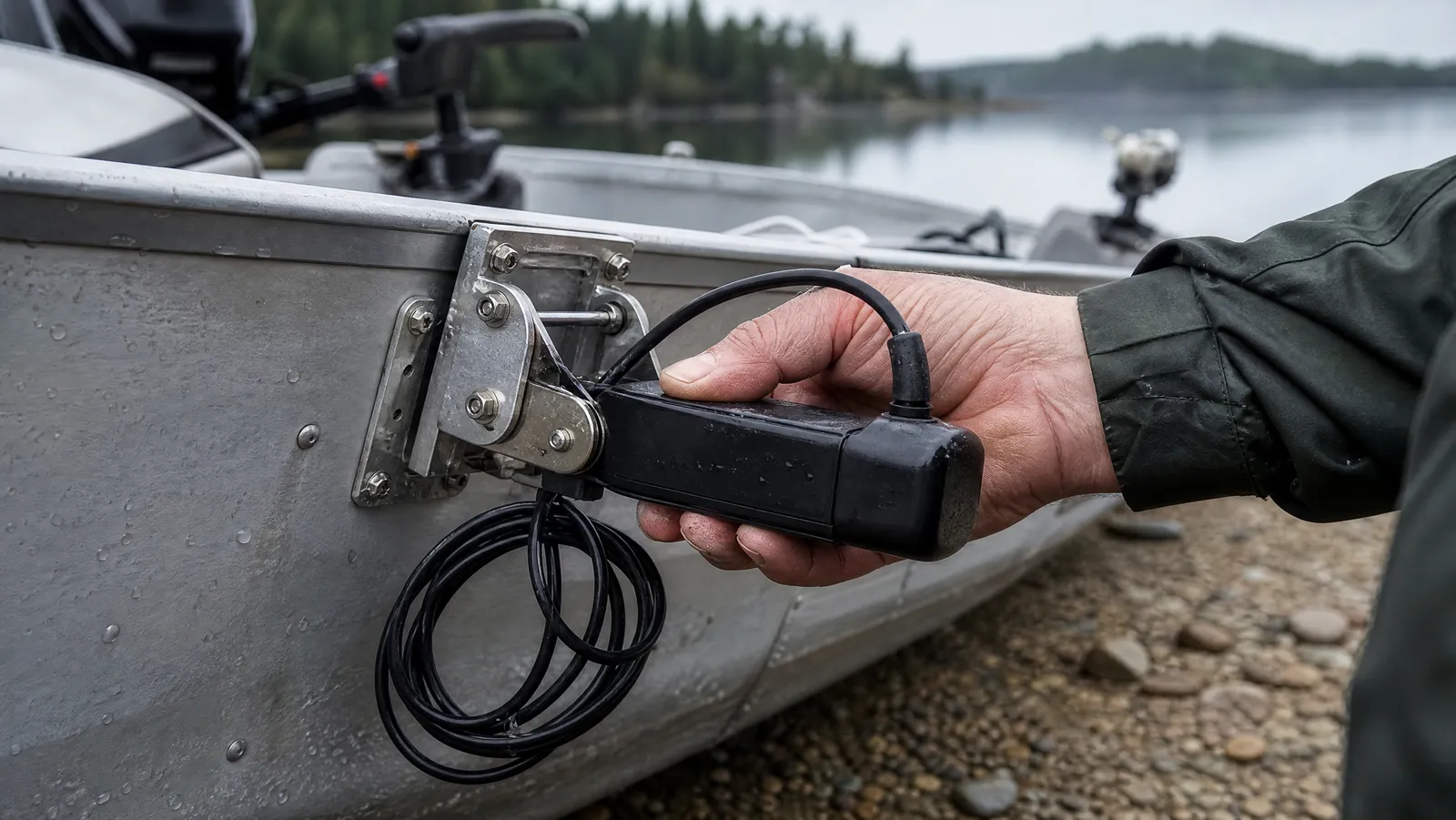
Transducer placement decides your picture. MarCum's beginner guide to ice sonar describes the conventional approach as hanging the transducer just below the ice in the center of the hole, so your jig falls into the conic beam that forms at the transducer — though the same guide suggests easing it toward the edge of the hole, without touching the ice, for the clearest signal. Either way, a ducer that hangs at an angle points its cone off to the side, and then your jig and your fish are in different places.
Slush is a sonar problem, not a cosmetic one. Ice chips floating in a fresh hole scatter returns and clutter the top of the scale. Skim the hole, keep the transducer cable free of the rim, and re-skim when the hole starts to skin over.
A Word on Ice Thickness
We do not publish our own ice numbers, and we would be careful about anyone who does. Defer to your state agency.
For reference, the Minnesota DNR's general guidelines recommend at least 4 inches of new, clear ice for ice fishing on foot, 5 to 7 inches for a snowmobile or small ATV, 7 to 8 inches for a side-by-side, 9 to 12 inches for a car, and 13 to 17 inches for a truck — and they say to double those numbers for white or snow-covered ice. The DNR is blunt that there is no such thing as 100 percent safe ice, that four inches of clear, newly formed ice may support one person on foot while a foot or more of old, partially thawed ice may not, and that because thickness varies you should check as you go.
Their recommended kit is short and worth carrying: ice picks, a foam life jacket or flotation suit, a drill and tape measure, ice cleats, and a rope. No sonar screen tells you what the ice is doing.
The Short Version
Buy a flasher if you jig. The Vexilar FLX-18 ProPack II at $498.85 is the ceiling and the Vexilar FL-8se Genz Pack at $357.06 is the sensible floor, and both do the one thing a graph cannot quite do, which is show you the exact instant a fish commits.
Buy a graph if you want a record and a map. The Garmin Striker Plus 4 Ice Fishing Bundle at $379.99 arrives ready to fish, and the Garmin Striker 4 at $130.99 is the crossover play if you are willing to buy an ice ducer separately. And if you are still deciding whether ice fishing is your thing at all, the Garmin Striker Cast at $149.99 puts a flasher view on your phone for less than a new auger blade. All prices are as of August 2026.
Whichever way you go, the electronics are the easy part. Clean the hole, hang the ducer plumb, keep the battery warm, and check the ice. If you are still weighing screens, frequencies, and transducers more broadly, Angler Reviews' full fish finder guide is the place to start.
The Picks, Tested
Vexilar FLX-18 ProPack II
The flasher most serious ice anglers end up on: high and low power modes, twenty interference-rejection settings, and a sunlight-readable three-color display in a carry pack.
- 20 interference rejection settings is the deepest cross-talk defense in this group
- Low power mode keeps shallow and weedy water readable
- Three-color LED readout stays legible in direct sun, with a night mode for after dark
- Most expensive unit here by a wide margin
- Vexilar packs ship with a 12-volt lead-acid battery, which is the part that suffers most in cold
- Flasher only, so no GPS, no mapping, and no sonar history

Vexilar FL-8se Genz Pack
The long-running entry point into Vexilar flashers, sold as a Genz Pack with a 19-degree ice transducer.
- Same three-color reading logic as the pricier Vexilars for less money
- The wider 19-degree cone covers more water per hole than a 12-degree ducer
- Genz Pack base is built to sit on a five-gallon bucket
- Vexilar lists 10 interference rejection settings versus 20 on the FLX-18
- Depth ranges top out well short of the FLX-18 deep-water setting
- No GPS, mapping, or scrolling sonar history
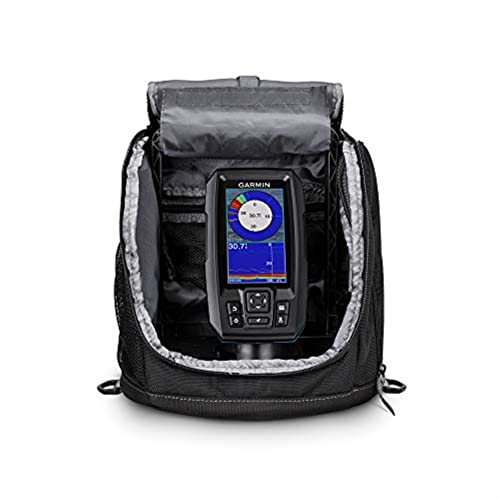
Garmin Striker Plus 4 Ice Fishing Bundle
A 4-inch color graph bundled with an ice transducer and a carry case, for anglers who want a screen history rather than a dial.
- Ice transducer and carry case are in the box, so nothing else to buy
- GPS waypoints and Quickdraw Contours carry straight over to open water
- Screen history shows how a fish moved over the last minute, not just where it is now
- A scrolling graph reads with slight lag next to a flasher dial
- Small screen fills up fast if you split sonar and map
- Costs more than the FL-8se without matching a flasher's real-time feel

Garmin Striker 4
The cheapest way to get a CHIRP graph with a built-in flasher view that works open-water in summer and through the ice in winter, if you add an ice ducer.
- Built-in flasher view means one unit covers summer and winter
- A 0.23-amp draw at 12 volts is gentle on a small portable battery
- Cheapest entry to real CHIRP sonar in this guide
- The ice transducer is a separate purchase
- 3.5-inch screen is the smallest here
- Waypoints only, with no contour mapping

Garmin Striker Cast
A castable sonar ball with a dedicated ice-flasher mode, which turns a phone into an ice electronics setup for well under the price of a flasher.
- A dedicated ice flasher mode for a fraction of flasher money
- Water-activated power switch means it rarely dies in the sled
- Nothing to mount or clamp, and the whole thing fits in a coat pocket
- Your phone becomes the screen, and Apple rates iPhone operation only down to 32 degrees F
- No built-in GPS on this version
- The 10-plus-hour battery figure is Garmin's rating, not a cold-weather number
Compare The Field
| Compare | Best Flasher Overall Vexilar FLX-18 ProPack II | Best Classic Flasher Vexilar FL-8se Genz Pack | Best Graph-Style Ice Unit Garmin Striker Plus 4 Ice Fishing Bundle |
|---|---|---|---|
| Overall | — | — | — |
| Price | $498.85 Check price → | $357.06 Check price → | $379.99 Check price → |
About The Author
Rob Thomas
Rob Thomas is a fisherman who loves catching tales from his fellow fishermen. He always enjoys a good story, especially when it comes from the sea.