Fish Finder Batteries: Sizing, Lithium vs Lead, and Real Runtime

This post may contain affiliate links. Read our policy.
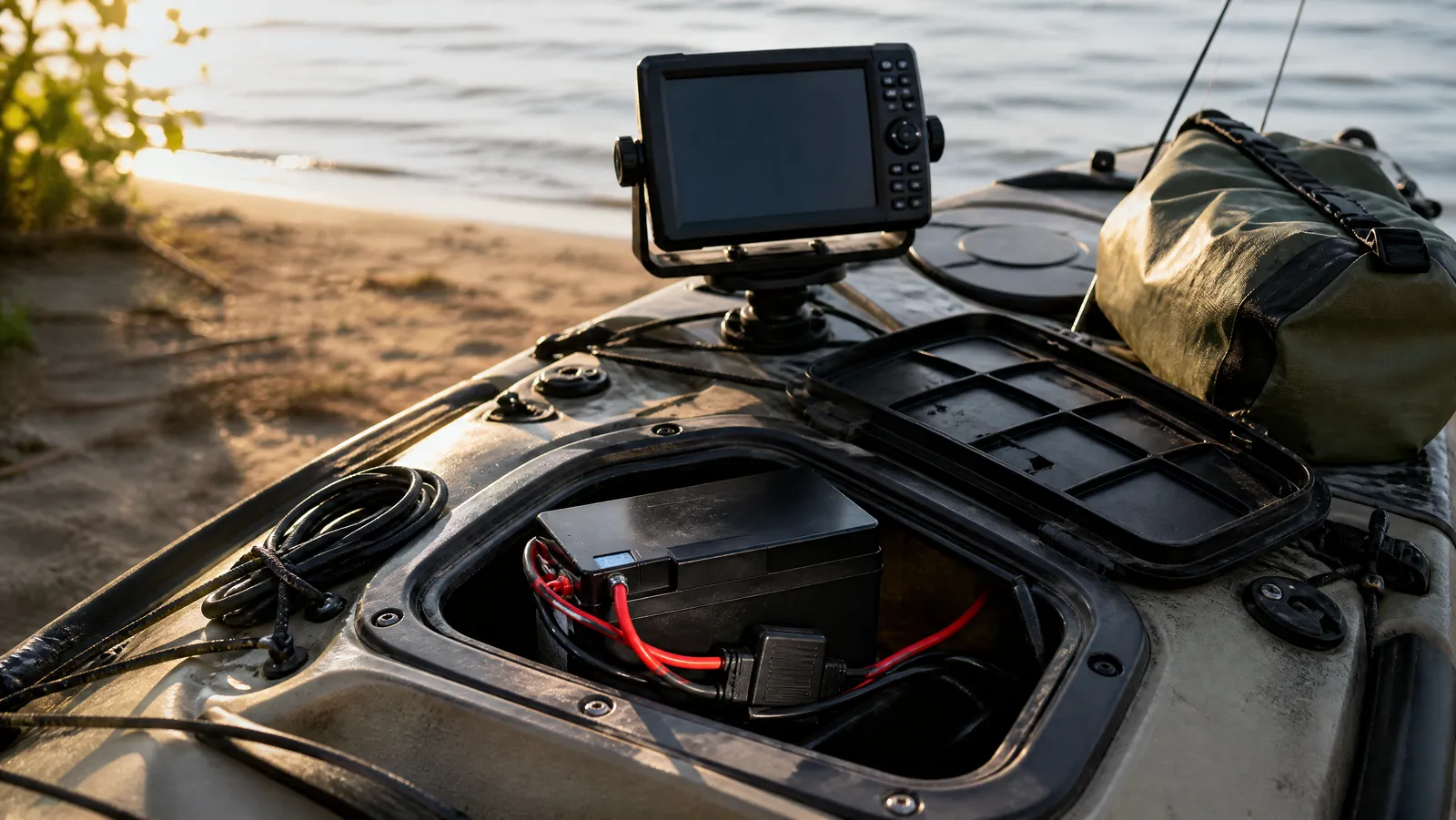

Enegitech 12V 10Ah LiFePO4
The default size for a small graph: a 10Ah lithium iron phosphate pack under two pounds, at roughly the price of a lead-acid brick.
- At 1.87 pounds it weighs roughly a third of a comparable 7Ah sealed lead-acid brick
- Ten amp-hours covers a full day for almost any 4-inch to 7-inch graph
- Battery management system cuts off on over-charge and over-discharge
- Cannot be wired in series or parallel, so the pack cannot grow with your rig
- No charger listed with the pack, unlike the kits here
- The 128W ceiling rules out adding a trolling motor or a large accessory load
Fish Finder Batteries: Sizing, Lithium vs Lead, and Real Runtime
A fish finder battery is almost always a 12-volt source, and sizing one comes down to a single piece of arithmetic: the unit's current draw in amps, times the hours you fish, plus headroom. For a small graph that lands on a 7Ah to 10Ah lithium pack. Bigger screens and imaging transducers push the number up fast.
Angler Reviews is reader-supported. We may earn a commission on purchases made through links on this page, at no extra cost to you.
Two mistakes account for most of the trouble: buying four times more battery than a 3.5-inch screen will ever use, and buying a cheap lead-acid brick that cannot hold voltage long enough to keep that screen bright at 2 p.m. If you have not settled on a head unit yet, start with our complete guide to fish finders — the number you need is in its manual.
The Only Fish Finder Battery Math You Need
An amp-hour is amps multiplied by hours. A device pulling 1 amp for 1 hour has used 1 amp-hour. The sizing formula is three terms:
- Current draw in amps at 12 volts, from the maker's specification page for your exact model.
- Hours on the water, counted honestly. Dawn to lunch is five hours, not ten.
- Headroom of roughly 30 to 50 percent, so you never run the pack to the floor.
Work it with a real unit. Garmin publishes a current draw of 0.23 amps at 12 volts for the Striker 4. An eight-hour day is 0.23 times 8, or 1.84 amp-hours. Add 40 percent headroom and you need about 2.6 amp-hours of usable capacity — a 4.4Ah lithium pack covers that easily, and a 10Ah pack runs that unit for three days between charges.
One spec-sheet number confuses people. Garmin's STRIKER series page lists a power source range of 10 to 20 volts and a rated current of 1 A. That is the circuit rating, not the running draw. Size the fuse off rated current, the battery off current draw.
Why Bigger Screens and Imaging Transducers Raise the Number
Move up a class and the arithmetic changes completely. Garmin's specifications for the ECHOMAP UHD2 sv series list a typical current draw of 1.52 amps at 12 volts for the 7-inch sv model and 1.72 amps for the 9-inch, with a maximum power draw of 18.3 watts on the 7-inch. Those units accept 9 to 18 volts DC and ship with a 3-amp fast-acting fuse.
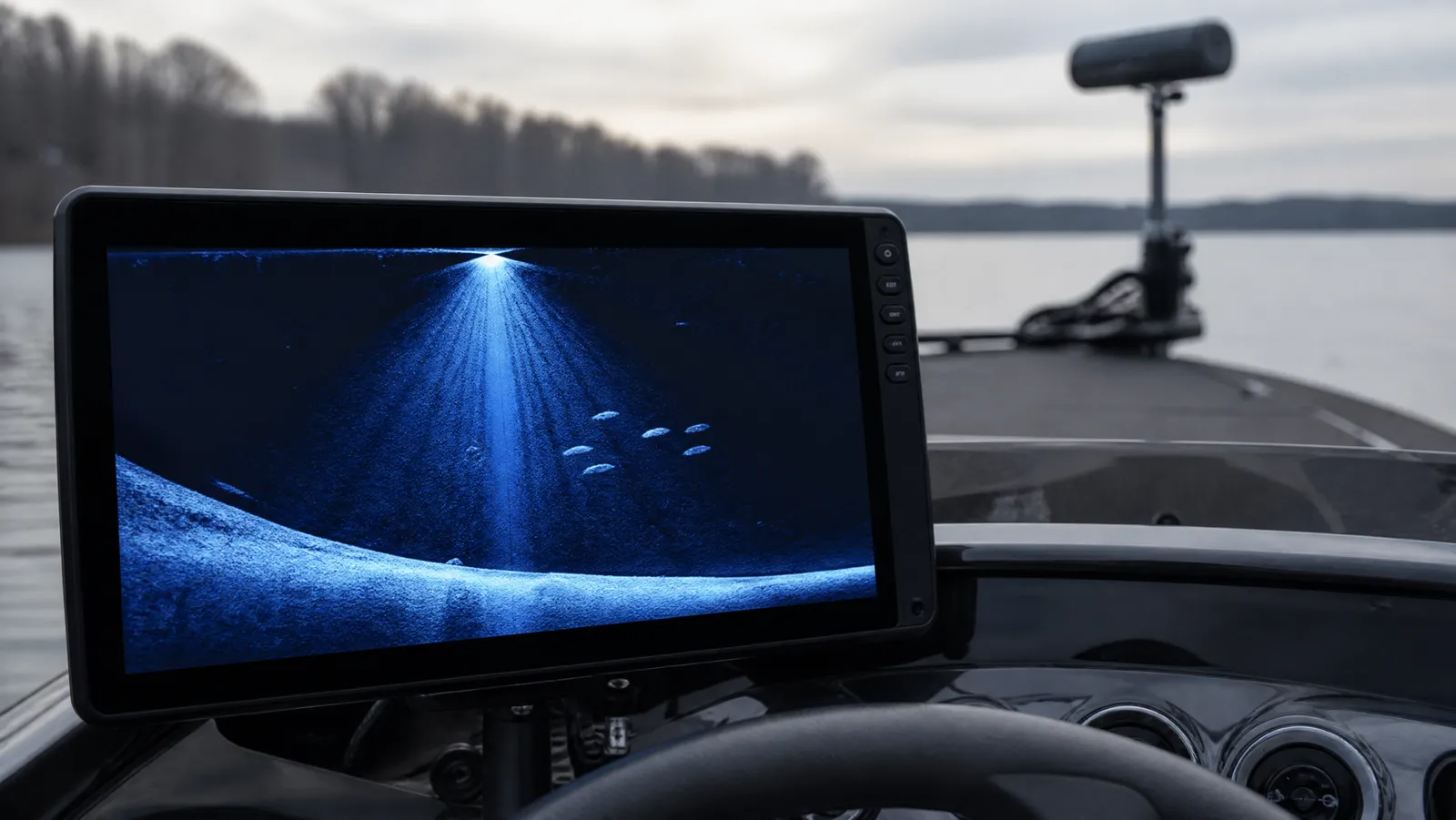
Run that 1.52-amp figure through the same eight-hour day and you get 12.2 amp-hours before headroom. A 4.4Ah pack is suddenly under three hours of raw runtime, and you are shopping in the 15Ah to 20Ah range. The bigger backlight is part of it, and imaging adds to it — down and side imaging run at higher frequencies than traditional 2-D sonar, typically 455 or 800 kHz. Garmin does not publish a per-mode breakdown, so size from your model's published draw. Our guide to fish finder transducers covers which transducer feeds which imaging mode.
Live sonar is another step again. Garmin lists power usage for the LiveScope Plus system with the GLS 10 sonar module at 21 watts typical and 58 watts maximum — roughly 1.75 amps typical and about 4.8 amps at peak at 12 volts, on top of whatever the head unit draws. Running live sonar off a portable pack means 30Ah or more, or a short day.
Castable sonar sidesteps all of this, because the sensor carries its own battery — Garmin rates the STRIKER Cast at 10 hours of typical use on a built-in rechargeable lithium-ion cell. If you mostly fish from the bank, our roundup of portable fish finders is the cheaper answer to the power problem.
Lithium vs Sealed Lead-Acid: Weight, Usable Capacity, and Sag
For years the default fish finder battery was a 12V 7Ah sealed lead-acid alarm-panel brick, because it was cheap. Lithium iron phosphate has closed that price gap, and on every other measure it is not close.
Weight. A common 12V 7Ah sealed lead-acid battery, the UB1270 pattern, is listed at roughly 5 pounds. The Enegitech 10Ah pack here weighs 1.87 pounds at 5.87 by 2.52 by 3.7 inches. More capacity, roughly a third of the weight, about the same footprint.
Usable capacity versus rated capacity. Renogy's comparison of sealed lead-acid and lithium iron phosphate notes that most lead-acid batteries lose capacity or cycle life if discharged more than 50 percent, while a LiFePO4 pack can be taken to 20 percent state of charge without long-term damage. Other lithium makers, RELiON among them, put the usable window at 80 to 90 percent depth of discharge. So a 7Ah lead-acid battery is honestly a 3.5Ah battery, and a 10Ah lithium pack is honestly an 8Ah to 9Ah battery. On paper that gap is 3Ah. In practice it is more than double.
Voltage sag and what it does to your screen. Lead-acid voltage slopes down through the discharge, and as a battery ages its rising internal resistance makes it sag further under load even when it reads full at rest. Fish finders do not like it: anglers commonly report dim screens, degraded sonar returns, and units that reboot mid-drift as supply voltage sags. LiFePO4 holds a much flatter curve — Akiisolo states its 15Ah pack keeps voltage across roughly 95 percent of capacity — so the screen looks the same at hour seven as at hour one, and then the pack simply stops. That cliff arrives without warning, which some anglers dislike. We prefer it: a sonar unit that is quietly wrong for two hours is worse than one that is off.
Cycle life and price. Enegitech rates its 10Ah pack for over 2,000 deep cycles, and Akiisolo rates its 15Ah pack for over 2,000 cycles at 100 percent depth of discharge and up to 8,000 at 50 percent. Those are manufacturer figures, not measured results, but even discounted heavily they leave lead-acid behind — and the Enegitech pack is $33.99 as of August 2026.
Fish Finder Battery Sizing, Tier by Tier
Five packs, 4.4Ah to 20Ah. Price does not track capacity here — you are largely paying for the enclosure, the connectors, and whether a charger is in the box.
- 4.4Ah — one small screen, half-day trips, minimum weight. Nocqua kit.
- 5Ah — one small screen, in a sealed case you can throw in a wet hatch. NUOVEPE kit.
- 10Ah — the default. Any 4-inch to 7-inch graph, all day, with margin. Enegitech.
- 15Ah — a 7-inch unit running imaging all day. Akiisolo.
- 20Ah — a big screen plus accessories, dark to dark. FixOasis kit.
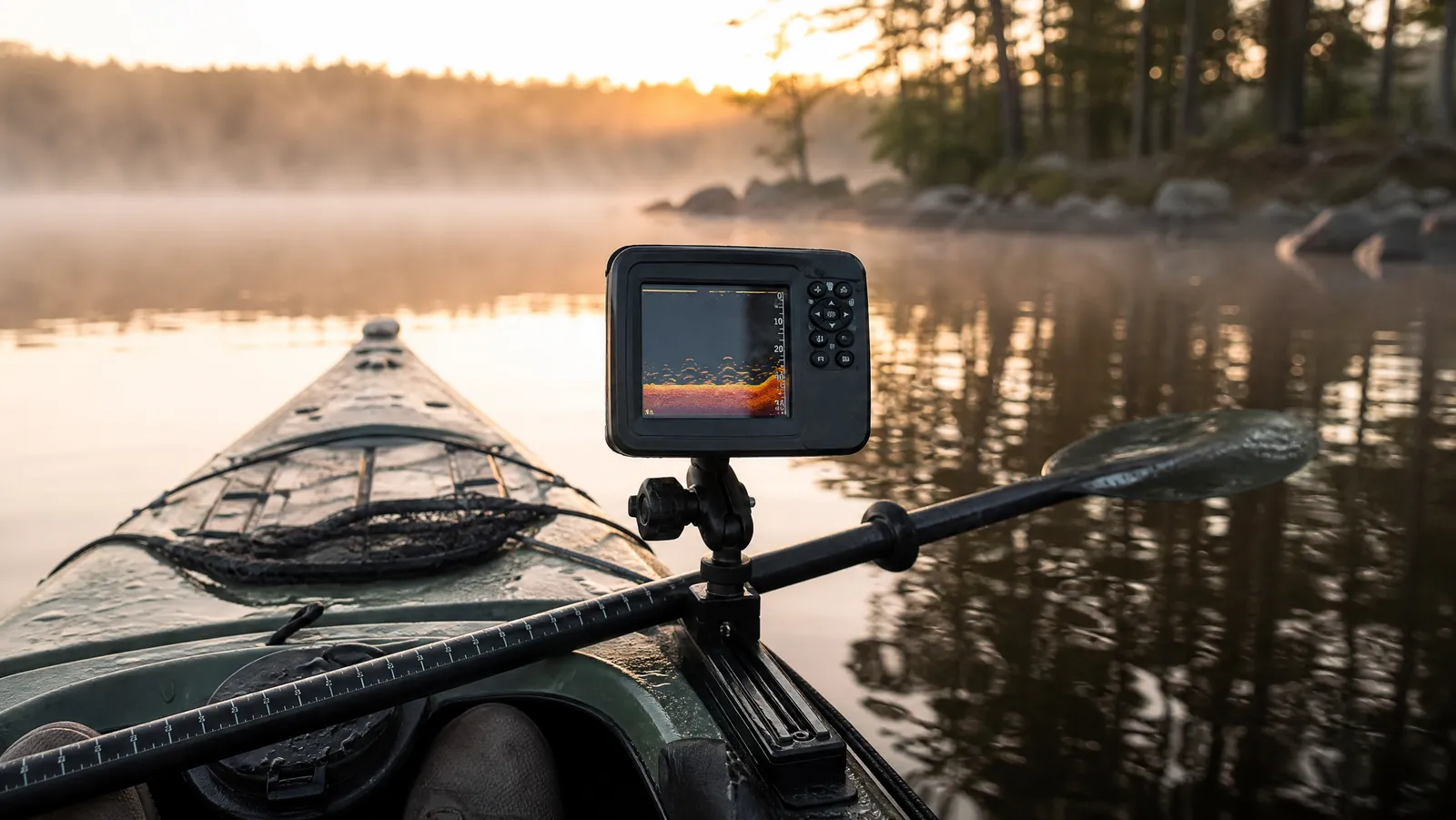
On a paddle craft there is no charging system: whatever you carry down the bank is the whole energy budget. That is why the low-draw units in our best fish finder for kayak roundup pair so well with the two smallest packs here.
Nocqua Pro Power Kit 4.4Ah: Best Purpose-Built Kayak Kit
The Nocqua Pro Power Kit 4.4Ah is $99.98 as of August 2026 — the most expensive amp-hour on this page by a wide margin, and the only pack here from a company built around power and lighting for paddle craft.
You get a water-resistant, silicone-sealed enclosure, universal pigtail leads for a fish finder or GPS, a wall charger, and short-circuit protection with automatic shutoff on high voltage, overcharge, or deep discharge.
At 4.4Ah it runs a Striker 4 for about 19 hours of raw arithmetic, or one long day with a comfortable reserve. It will not carry a 7-inch imaging unit through a full day.
Who we point here: kayak and canoe anglers with a small screen who want a sealed, purpose-built kit.
NUOVEPE 12V 5Ah Battery Kit: Best Compact Kit
The NUOVEPE 12V 5Ah Battery Kit is $59.99 as of August 2026 and solves one specific problem: a battery you can drop in a hatch that gets wet.
The pack lives in an aluminum alloy case the maker describes as waterproof without a separate protective bag, which beats cutting a cable gland into a dry bag. It ships with a 4-in-1 charging cable carrying USB-C, Micro USB, and Lightning connectors, and protection cuts off on short circuit, overheating, overvoltage, or deep discharge.
The catch is the price tag: 5Ah for $59.99 is more money and half the capacity of the Enegitech pack below. You are buying the case.
Who we point here: anglers who fish wet, and want the pack itself to be the waterproofing.
Enegitech 12V 10Ah LiFePO4: Best Value 10Ah
The Enegitech 12V 10Ah LiFePO4 is $33.99 as of August 2026 and it is the pack we recommend to most people asking this question.
Ten amp-hours of lithium iron phosphate, 1.87 pounds, 5.87 by 2.52 by 3.7 inches, with a battery management system handling over-charge and over-discharge protection. Enegitech rates the cells for over 2,000 deep cycles, specifies a charging range of 0 to 55 C and a discharge range of -20 to 60 C with automatic cut-off outside those windows, and rates the pack for devices drawing up to 128 watts.
Against the earlier numbers: a Striker 4 at 0.23 amps runs about 43 hours on this pack in raw arithmetic, and a 7-inch ECHOMAP UHD2 sv at 1.52 amps runs about six and a half hours — a full day for most anglers, a little short for the committed.
Two limits. The pack cannot be wired in series or parallel, so it will never become half of a bigger bank, and no charger is listed with it.
Who we point here: almost everyone. It is the least money that buys a battery you never think about again.
Akiisolo 12V 15Ah LiFePO4: Best Capacity per Dollar
The Akiisolo 12V 15Ah LiFePO4 is $37.99 as of August 2026, down from a $39.99 list price — the cheapest amp-hour here, four dollars more than the 10Ah pack for 50 percent more capacity, with a charger included.
It is a 12.8V 15Ah LiFePO4 pack rated by the maker for over 2,000 cycles at 100 percent depth of discharge and up to 8,000 at 50 percent, with an operating range of -20 to 60 C. Akiisolo states the flat discharge curve holds voltage across roughly 95 percent of capacity, and unlike the Enegitech pack it supports series and parallel connections — so two of them become a 30Ah bank if your rig grows.
At 15Ah, a 7-inch ECHOMAP UHD2 sv drawing 1.52 amps gets about ten hours of raw runtime — a real dark-to-dark day with imaging running. The warranty is 12 months, and the cycle-life claims are Akiisolo's own.
Who we point here: anglers running a mid-size imaging unit all day, and anyone who may want a two-pack bank later.
FixOasis 12V 20Ah Battery Kit: Best All-Day Capacity
The FixOasis 12V 20Ah Battery Kit is $129.99 as of August 2026, and what that price buys is a complete installation rather than a bare battery.
The kit includes a wall charger plus waterproof connectors, marine-grade heat-shrink butt connectors, and heat-shrink tubing — the parts most anglers order separately after the first splice corrodes. Protection covers short circuit, overheating, high voltage, and deep discharge, FixOasis rates the kit for over 24 hours of continuous use, and it carries a 5-year replacement warranty.
Twenty amp-hours is where you stop rationing — a 7-inch imaging unit plus deck lights, or a big screen feeding a live-sonar module for part of the day. It is also overkill for a 3.5-inch graph, and the heaviest thing here. Buy it because you have accessories, not because bigger sounds safer.
Who we point here: anglers running a portable pack for a second screen, and kayak anglers with lights, a pump, and a big display.
Wiring and Protection: Fuse It, Seal It, Strap It Down
A lithium pack can dump enormous current into a dead short. The wiring is not optional.
Put an inline fuse at the battery, not at the unit. Humminbird's in-line fuse guidance tells installers to cut the positive wire as near the battery as possible, and states that Humminbird does not recommend connecting to a battery without a fuse and a switch. Marine practice is stricter still: ABYC E-11 requires overcurrent protection within 7 inches of the battery positive terminal, with longer runs allowed only when the conductor is sheathed. The point is to minimize unprotected positive cable.
Size the fuse from the manual, not the battery. Garmin's STRIKER series lists a rated current of 1 A; the ECHOMAP UHD2 sv units ship with a 3-amp fast-acting fuse. Use what the maker specifies for your head unit.
Make the connections marine-grade. Use adhesive-lined heat-shrink butt connectors over crimped terminals. The FixOasis kit includes those parts; if your pack does not, buy them. Corroded splices are a frequently reported cause of a fish finder that reboots in chop.
Seal and secure the battery. Unless the pack is sealed like the NUOVEPE aluminum case, it belongs in a dry bag or small sealed case inside the hatch — and then strapped down. A loose 2-pound pack eventually finds your transducer cable, and in a boat that takes a wave it is a projectile with exposed terminals.
Cold Weather and Charging: The Two Things That Kill Lithium Packs
LiFePO4 is tough about almost everything except being charged cold. REDARC and other lithium makers warn against charging below 0 C, or 32 F: the cell deposits metallic lithium on the anode instead of letting it intercalate into the graphite, which permanently reduces capacity, and the damage is cumulative. Good packs block this in firmware: Enegitech specifies a charging range of 0 to 55 C with automatic cut-off outside it, which is exactly the behavior you want. Cheap no-name packs may accept a charge at any temperature and quietly destroy themselves.
Discharging cold is fine. Enegitech publishes a discharge range down to -20 C, and Akiisolo lists an operating range of -20 to 60 C, with capacity simply dropping as it gets colder. So an ice pack works — bring it inside and let it reach room temperature before plugging in the charger. That one habit is most of lithium cold-weather care.
For the offseason, store the pack partly charged, not full or empty. LiFePO4 self-discharges at roughly 1 to 3 percent per month, and most lithium makers recommend storing at a partial charge — Renogy suggests around 50 percent, others a 50 to 70 percent window. Check the voltage every three to six months, and follow the sheet that came with your pack, because makers do not all agree. Do not leave it on a charger all winter, and do not put it away flat in November expecting it in April.
Finally, use a LiFePO4 charger — ideally the one that came with the kit. A lead-acid charger's absorption and equalization stages apply voltages lithium chemistry does not want, and pushing an equalize cycle into a LiFePO4 pack is asking the battery management system to save you.
What Not to Do
Do not run your electronics off the battery that starts your motor. Cranking batteries use many thin plates for a short, huge burst of current; deep-cycle batteries use fewer, thicker plates for steady current over hours. Battery makers are clear that repeatedly drawing down a starting battery with electronics wears it out quickly, because it was never built for cyclic use. The failure mode is specific and bad: you fish until dark, then the motor will not turn over.
Do not run an unfused pack. A power lead that chafes on a stainless fitting and shorts is a fire, not an inconvenience — and lithium delivers more current into a short than the lead-acid brick you replaced.
Do not wire packs together unless the maker says you can. The Enegitech 10Ah explicitly cannot be used in series or parallel; the Akiisolo 15Ah explicitly can. Packs paralleled against the maker's guidance can pass large currents between them when their states of charge differ, and that branch-current imbalance is what makers cite when they disallow parallel wiring.
One more: do not size a battery from a forum post about a different model. Open your manual.
The Bottom Line
Look up your unit's current draw, multiply by the hours you actually fish, add 40 percent, and buy lithium. For most anglers that ends at the Enegitech 12V 10Ah LiFePO4, $33.99 as of August 2026 — under two pounds, thousands of cycles by the maker's rating, and enough capacity that a small graph never reaches the bottom of it.
Go up to 15Ah if you run a 7-inch screen with imaging all day, or 20Ah if accessories hang off the same pack. Drop to 4.4Ah or 5Ah only if weight or a sealed case matters more than runtime.
Then buy an inline fuse holder and adhesive-lined butt connectors, and mount the fuse at the battery. That is the part nobody photographs and everybody regrets skipping.
Still choosing the screen this battery will feed? Our roundup of the best fish finders is the place to start, and the current-draw number you need is on the spec page of whichever unit you land on.
The Picks, Tested
Enegitech 12V 10Ah LiFePO4
The default size for a small graph: a 10Ah lithium iron phosphate pack under two pounds, at roughly the price of a lead-acid brick.
- At 1.87 pounds it weighs roughly a third of a comparable 7Ah sealed lead-acid brick
- Ten amp-hours covers a full day for almost any 4-inch to 7-inch graph
- Battery management system cuts off on over-charge and over-discharge
- Cannot be wired in series or parallel, so the pack cannot grow with your rig
- No charger listed with the pack, unlike the kits here
- The 128W ceiling rules out adding a trolling motor or a large accessory load

Akiisolo 12V 15Ah LiFePO4
Fifteen amp-hours with a charger in the box, which is more runtime than most kayak anglers will use in a season of day trips.
- Charger is in the box and the pack accepts series and parallel wiring, so it can grow with the rig
- The most amp-hours per dollar in this group at $37.99 as of August 2026
- Maker states the flat discharge curve holds voltage across roughly 95% of capacity
- 12-month warranty against five years on the FixOasis kit
- Fifteen amp-hours is more hatch space than a single small screen needs
- The 2,000 and 8,000 cycle figures are maker ratings, not measured results

NUOVEPE 12V 5Ah Battery Kit
A 5Ah aluminum-cased pack sold as a kit, sized for a small screen on a short trip where every ounce in the hatch counts.
- Aluminum housing is sealed on its own, so the pack does not need a dry bag
- The 4-in-1 cable covers USB-C, Micro USB, and Lightning charging
- Protection circuit covers short circuit, overheating, overvoltage, and deep discharge
- At $59.99 as of August 2026 it costs more than the 10Ah pack here for half the capacity
- Five amp-hours is thin for a 7-inch screen or a dark-to-dark day
- No cycle-life rating stated in the listing

Nocqua Pro Power Kit 4.4Ah
The kayak-specific option: a silicone-sealed 4.4Ah pack with pigtail leads and a wall charger, from a brand built around power and lighting for paddle craft.
- Silicone-sealed enclosure and pigtail leads are designed for paddle craft rather than adapted to them
- Wall charger is included
- Automatic shutoff on high voltage, overcharge, and deep discharge
- At $99.98 as of August 2026 it is by far the highest price per amp-hour in this group
- 4.4Ah leaves little margin for a large screen or a day that runs long
- Listed as water-resistant, not submersible

FixOasis 12V 20Ah Battery Kit
Twenty amp-hours with marine connectors and a charger, aimed at anglers running a screen plus accessories from dark to dark.
- Waterproof connectors and marine-grade heat-shrink butt connectors are in the box, so the wiring is not an afterthought
- 5-year replacement warranty is the longest stated here
- Enough capacity to run a large screen plus lights or a live-sonar module
- At $129.99 as of August 2026 it costs nearly four times the 10Ah pack for twice the capacity
- Twenty amp-hours is more weight and bulk than a small graph will ever use in a day
- The 24-hour runtime figure is a maker claim, not a measured result
Compare The Field
| Compare | Best Value 10Ah Enegitech 12V 10Ah LiFePO4 | Best Capacity per Dollar Akiisolo 12V 15Ah LiFePO4 | Best Compact Kit NUOVEPE 12V 5Ah Battery Kit |
|---|---|---|---|
| Overall | — | — | — |
| Price | $33.99 Check price → | $37.99 Check price → | $59.99 Check price → |
About The Author
Rob Thomas
Rob Thomas is a fisherman who loves catching tales from his fellow fishermen. He always enjoys a good story, especially when it comes from the sea.