Forward-Facing Sonar Explained: What It Does, What It Costs, and the 2026 Rule Changes

This post may contain affiliate links. Read our policy.
Forward-Facing Sonar Explained: What It Does, What It Costs, and the 2026 Rule Changes
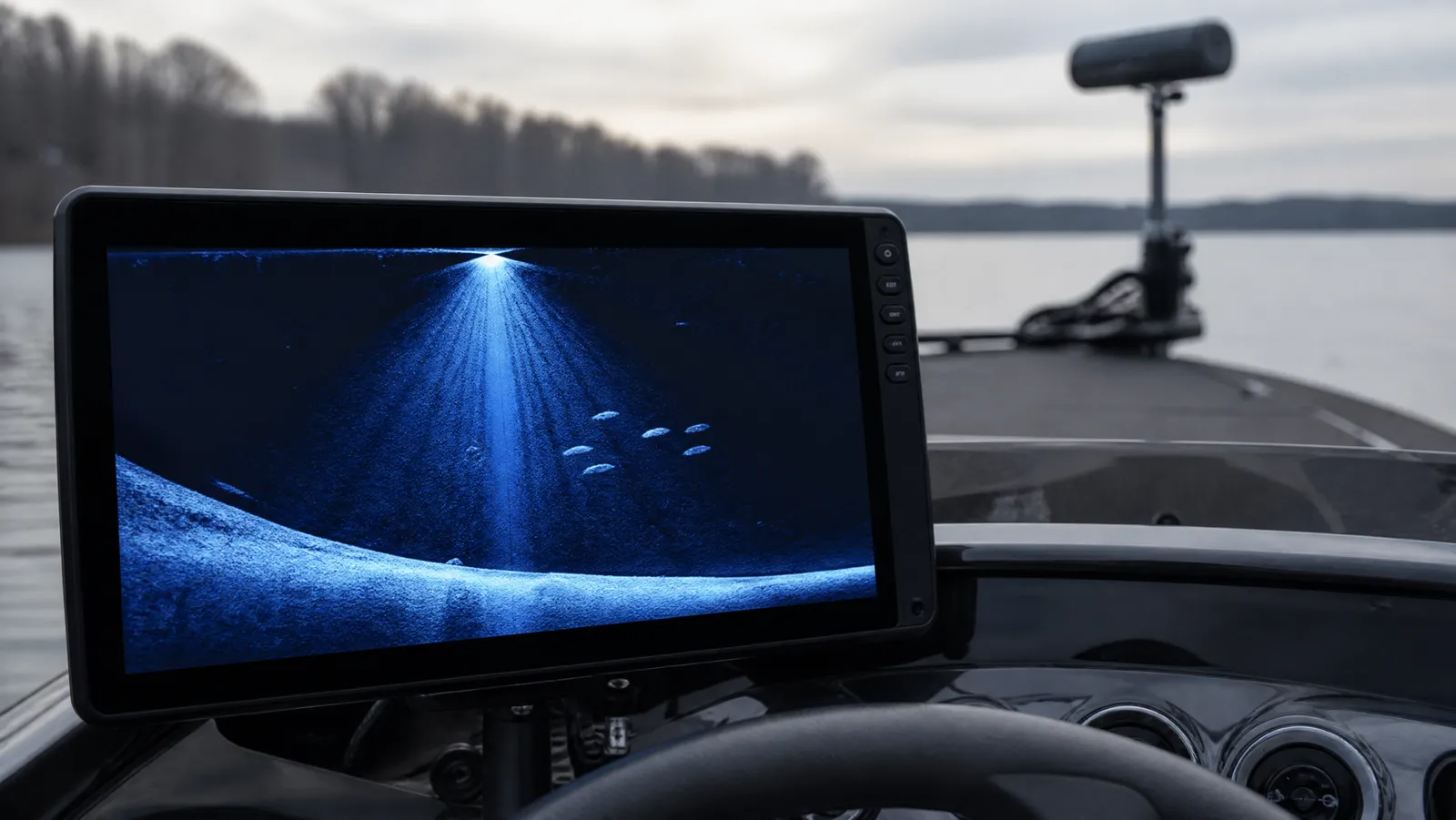
Forward-facing sonar is a transducer that scans out in front of the boat in real time. Instead of reading a scrolling history of what already passed beneath the hull, you watch fish, cover, and your own lure move across the screen as it happens. A full system costs four figures, and in 2026 both B.A.S.S. and Major League Fishing wrote rules to limit it.
That second part is why the technology is a ramp conversation now instead of a tournament-only argument. Organizations do not spend an offseason drafting restrictions on an ordinary depth finder.
This page is the long version. How the beam works, what genuinely separates Garmin LiveScope from Lowrance ActiveTarget and Humminbird MEGA Live, what the whole rig costs once you add a black box and a display big enough to use, what the 2026 rulebooks actually say, and whether a weekend angler should buy one. If you are still deciding what kind of unit to own at all, start with our guide to fish finders and sonar and come back here.
How Forward-Facing Sonar Actually Works
Traditional 2D sonar fires a cone straight down and draws the echoes as a timeline that scrolls right to left. The right edge is happening now. Everything to the left already happened.
Live sonar points the beam somewhere else. The transducer mounts on the trolling motor shaft, aims where the motor aims, and throws a thin, wide fan of sound out ahead of the boat. The returns are painted into a fixed picture rather than a scrolling one, and the picture redraws fast enough that movement looks continuous. A fish swimming toward your jig moves toward your jig on the screen.
Three specs decide what any live sonar system can and cannot show you:
- Beam shape. The fan is narrow in one axis and wide in the other. Garmin's published specifications for the LVS62 transducer list a 20-by-135-degree beam, which is why the image is a wedge and not a circle.
- Range. According to Garmin, the LiveScope XR system reaches up to 500 feet in fresh water and 350 feet in salt water. Humminbird says the Forward Mode on MEGA Live 2 identifies structure and locates fish up to 120 feet out. Those are two very different tools wearing the same category label.
- Orientation. Because the transducer follows the trolling motor, the picture swings when you steer. Nearly the entire learning curve lives in that one sentence.
The practical effect is that live sonar answers a question no other view answers: is the fish reacting to my bait right now? Not "was something here thirty seconds ago," but "did that mark just turn."
Live Sonar Does Not Replace Imaging
A common assumption is that forward-facing sonar makes every other view obsolete. It does not, and the reason is coverage.
Live sonar looks at a narrow wedge, in one direction, at one moment. It is a magnifying glass. Scanning sonar is the opposite: a wide, photographic strip of everything you idled past, saved as a picture you can study. The question of side imaging vs down imaging is really a question about searching versus confirming, and forward-facing sonar sits in a third role entirely, which is engaging.
Most anglers who run all three settle into a rhythm. Side imaging finds the isolated brush pile at 60 feet off the bow during a shoreline idle. Down imaging confirms what it is. Live sonar tells you whether anything is home and how it responds to a cast. Skip the first two steps and you spend the day pointing an expensive magnifying glass at empty water.
LiveScope vs. ActiveTarget vs. MEGA Live: What Genuinely Differs
Three systems own the market. The marketing makes them sound identical. They are not.
Garmin LiveScope. The range leader. Garmin rates the LiveScope XR system at up to 500 feet in fresh water and 350 feet in salt, with Forward, Down, and Perspective modes from one transducer. It requires the GLS 10 sonar black box and a compatible Garmin chartplotter. If you fish deep reservoirs, offshore structure, or open-water suspended fish, the extra range is the reason to look here first.
Lowrance ActiveTarget 2. The coverage play. Lowrance says ActiveTarget 2 gives Forward, Down, and Scout views, and that the ActiveTarget 2 XL transducer shows a full 180 degrees front to back in a single image, which is Lowrance's answer to anglers who were tired of swapping transducer orientation. It runs through its own sonar module and works with HDS PRO, HDS LIVE, HDS Carbon, and Elite FS displays.
Humminbird MEGA Live 2. The shortest published forward range of the three and the best integration story. Humminbird lists three viewing modes — forward, down, and landscape — with Forward Mode rated to 120 feet, and MEGA Live 2 is compatible with XPLORE, APEX, and SOLIX G3 units. The differentiator is TargetLock, which holds the sonar's aim on a chosen direction while the boat moves, so the picture stops swinging every time the trolling motor corrects. On an Ultrex it requires the MEGA Live 2 TargetLock adapter.
In our view the honest summary is this: pick the brand that matches the display and trolling motor you already own. Cross-brand live sonar builds are possible but they add adapters, cabling, and a second head unit. The performance gap between these three is smaller than the gap between an angler with 100 hours on any of them and an angler with ten.
What a Full System Actually Costs
The transducer is not the purchase. The system is.
- Transducer and module. Retail listings in August 2026 put the complete Garmin LiveScope XR bundle, meaning the GLS 10 black box plus the LVS62 transducer, at about $3,000, with the transducer-only upgrade around $2,500 for owners who already have a black box. As of August 2026, Lowrance lists the ActiveTarget 2 sonar module at $1,399 and the ActiveTarget 2 XL transducer at $1,799, though retailers routinely discount the module to around $830.
- A display you can actually use. Live sonar on a 5-inch screen is a bad experience. Every one of these systems requires a compatible unit from the same brand, and that unit is a separate purchase.
- The mount. A shaft mount, a pole mount, or a directional system like TargetLock, plus the hardware to keep it from rotating in current.
- Power. A black box, a large display, and a trolling motor running all day is a real load. Most serious live sonar boats end up on lithium.
Add it up and a first-time live sonar build lands in the same territory as a good used bass boat's worth of electronics. That is the number worth sitting with before you start comparing beam widths.
The Learning Curve Nobody Puts on the Box
Live sonar is a different reading skill from 2D, not an easier one. The habits that let you interpret how to read a fish finder — arch length as time in the beam, bottom hardness from the second return, sensitivity discipline — mostly do not transfer.
What replaces them:
- Finding your own lure. Until you can reliably see your bait on screen, everything else is decoration. Many anglers report starting with a heavy tungsten jig in open water and a short range setting on the screen, and practicing nothing else for an hour.
- Reading distance instead of depth. The horizontal axis is now range from the boat, and casting to a target 45 feet out is a skill your arm has never had to calibrate.
- Separating fish from cover. A branch and a bass return similar-looking marks until you learn how each behaves when the boat drifts.
- Not chasing. The most common failure is spending eight hours following individual marks that were never going to bite.
Anglers consistently report that the first several trips with live sonar produce fewer fish, not more. That is normal, and it is a real cost on top of the hardware.
The 2026 Rule Changes: What B.A.S.S. Did
On September 2, 2025, B.A.S.S. announced a live sonar rule change for the 2026 Progressive Bassmaster Elite Series. Forward-facing sonar is permitted in only five of the nine regular-season events. In the other four it is prohibited outright, including during official practice.
Which events fell on which side was decided by coin flip. B.A.S.S. paired the nine venues and ran the flips during a live show on Bassmaster.com hosted by Tommy Sanders, Mark Zona, and Davy Hite, with the hosts learning the results at the same time as the audience. B.A.S.S. reported more than 50,000 fans watched live. The results, announced September 5, 2025:
- Forward-facing sonar allowed: Lake Martin, the Arkansas River, Lake Murray, the Pasquotank River and Albemarle Sound, and the St. Lawrence River.
- Forward-facing sonar prohibited: Lake Guntersville, the Tennessee-Tombigbee Waterway, the Santee Cooper lakes, and Lake Champlain.
Two 2025 restrictions carry into 2026 at the events where the technology is legal: a maximum of one live sonar transducer per boat, and a maximum of 55 total screen inches. The 2026 Bassmaster Classic remains an all-technology event, because its qualifiers earned their berths under the previous rules.
B.A.S.S. CEO Chase Anderson framed the change around the idea that no single technology should define competitive bass fishing. Davy Hite, a former Classic champion, said the format ensures the 2026 Angler of the Year will be "the most versatile angler on the planet."
The 2026 Rule Changes: What Major League Fishing Did
Major League Fishing went broader. On November 30, 2025, MLF published its 2026 forward-facing sonar rules covering every circuit it operates, and the restrictions differ by level.
- Bass Pro Tour. Unchanged from 2025. Anglers may use forward-facing or 360-degree sonar during only one of the three competition periods each day, and must declare in advance which period they intend to use.
- Tackle Warehouse Pro Circuit. One continuous three-hour segment per competition day.
- Toyota Series and Phoenix Bass Fishing League. Boaters get one continuous three-hour segment per day. Co-anglers act as accountability stewards and sign off nightly on the boater's compliance. A co-angler may bring a portable transducer, but may only run it during the boater's declared window — or during the final three hours if the boater declines to use the technology at all.
- Abu Garcia College Fishing. No restrictions.
- Abu Garcia High School Fishing. Forward-facing and 360-degree sonar are prohibited during the regular season, but unrestricted at the High School Fishing National Championship, which MLF operates jointly with The Bass Federation. State athletic association events follow whatever rules those associations adopt.
- Heavy Hitters and Fishing Clash Team Series. Unrestricted, because anglers compete in identical, league-issued boats.
The enforcement mechanics are the genuinely new part. MLF says the time limits are enforced with electronic lock boxes that log how long a unit is unlocked, backed by live-streaming security cameras onboard each pro's boat. MLF introduced the lock box, designed and manufactured by Precision Sonar, to support rules limiting anglers to two forward-facing or 360-degree transducers during competition. At the Toyota Series and BFL level, the co-angler signature is the accountability mechanism instead.
MLF cited positive feedback from fans and anglers on the 2025 Bass Pro Tour restrictions, and said the goal is to promote multi-dimensional angling while keeping traditional techniques competitive.
Does Any of This Apply to Your Home Lake?
Legally, no. These are tournament rules written by private organizations, not fishing regulations. Your state agency sets what is legal on the water, and as of August 2026 we are not aware of a broad state-level ban on forward-facing sonar for general angling.
State agencies are studying it rather than restricting it. The Minnesota Department of Natural Resources formed a working group to examine forward-facing sonar's impact, and is surveying anglers to learn how many use the technology and how their catch rates compare with everyone else's. DNR official Marc Bacigalupi framed the open question as "how much is too much," and the department's stated position is to look for evidence of population-level harm before writing rules. Muskies come up repeatedly in that discussion because, per the DNR, the population is less robust than other species.
If you fish tournaments at any level, though, read your specific circuit's rules before the season. The per-circuit differences above are large enough that "MLF allows it" is not a useful sentence anymore.
Is Forward-Facing Sonar Worth It for a Weekend Angler?
For most readers, our honest answer is not yet.
Live sonar earns its price under a specific set of conditions: clear or moderately clear water, fish that suspend or roam rather than bury in cover, and enough time on the water to build the reading skill. Offshore reservoir fishing, open-water crappie, and winter suspended fish are where it shines. Shallow, stained, heavy-cover lakes are where it disappoints.
It also assumes you have solved the boring problems first: a properly installed transducer, a mapping-capable display, and a battery that holds up all day.
Here is what that money buys instead. A best fish finder for the money build — a mid-tier head unit with real cartography, a good CHIRP and imaging transducer, and a lithium battery — comes in at a fraction of a live sonar system and covers the entire lake, not a wedge in front of the bow. The same budget also stretches to a quality trolling motor, a season of guide trips on unfamiliar water, or the rod-and-reel upgrades that actually change your landing percentage.
Buy live sonar when you can name the specific situation it solves for you. "Everyone at the ramp has one" is not that situation.
The Bottom Line
Forward-facing sonar is the most consequential fishing electronics development in a decade, and 2026 is the year the sport put boundaries around it. B.A.S.S. removed it from four of nine Elite events by coin flip. Major League Fishing capped it at a declared window and started enforcing that window with locked boxes and cameras. Neither organization banned the technology, and neither pretended it does not work.
For the rest of us, the signal matters more than the rules. When the two largest organizations in the sport decide that structure reading, mapping, and traditional sonar deserve to decide events again, the mid-priced unit already on your console is closer to competitive than it has been in years. Learn that screen first. If you still want the wedge in front of the bow after 100 more hours, buy it knowing exactly what it does.
Start with the fundamentals, and when you are ready to upgrade the whole platform, our roundup of the best fish finders covers the displays, transducers, and mapping that any live sonar system eventually plugs into.
About The Author
Rob Thomas
Rob Thomas is a fisherman who loves catching tales from his fellow fishermen. He always enjoys a good story, especially when it comes from the sea.